Tallinn Town Hall: The Gothic Heart of the Old City
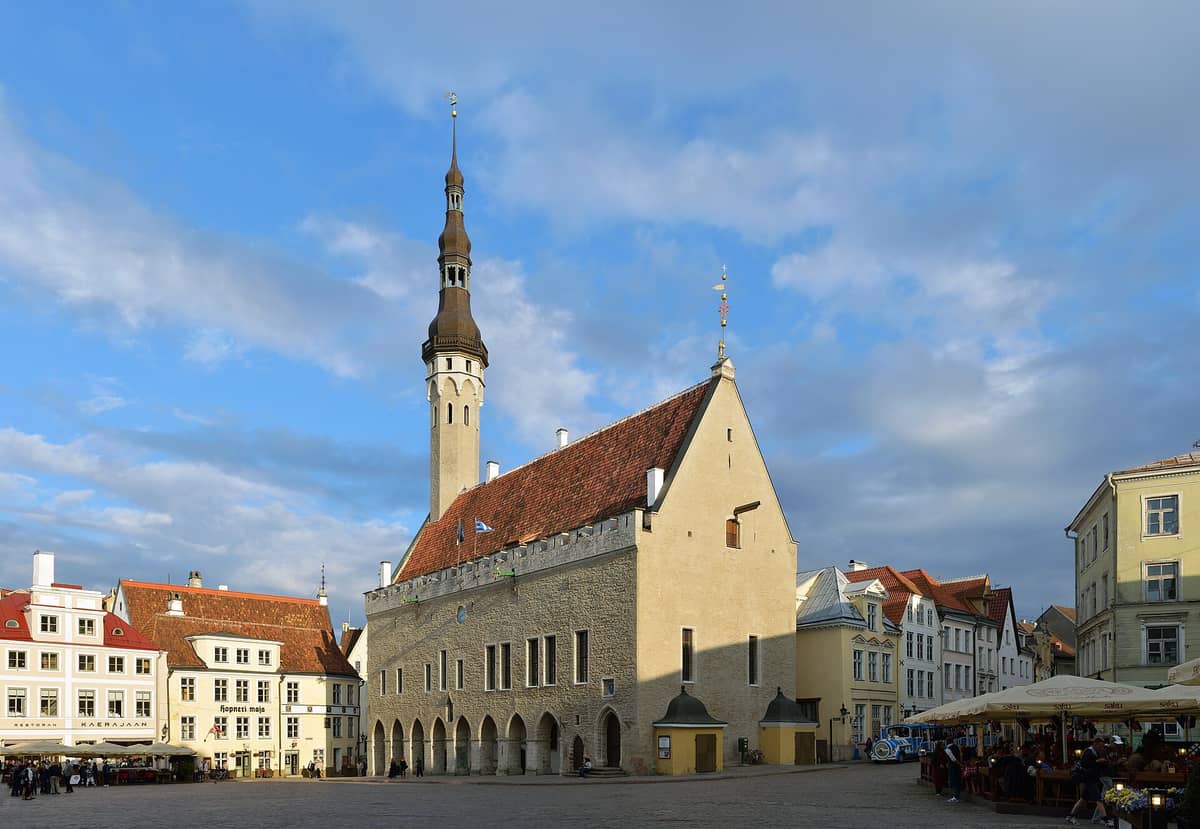
Completed in 1404, Tallinn Town Hall is the oldest and only surviving Gothic town hall in northern Europe. Sitting on the cobblestoned Town Hall Square, it serves today as a museum and event venue, and its spire — crowned by the legendary weather vane Vana Toomas — remains one of Estonia's most recognizable silhouettes.
Quick Facts
- Location
- Raekoja plats 1, Tallinn Old Town (Town Hall Square)
- Getting There
- 10–15 min walk from Balti jaam (Baltic Station) or the port; easily reached on foot from Viru Gate
- Time Needed
- 45–90 minutes for the interior; longer if you linger on the square
- Cost
- Admission fees vary by season and exhibition; verify current prices at raekoda.tallinn.ee before visiting
- Best for
- History enthusiasts, architecture lovers, first-time visitors to Tallinn
- Official website
- raekoda.tallinn.ee/en
Why Tallinn Town Hall Still Commands Attention
There are plenty of medieval buildings scattered across Tallinn's Old Town, but Tallinn Town Hall occupies a different category entirely. Completed in 1404 and recognized as the oldest and only surviving Gothic town hall in northern Europe, this is not a reconstruction or a romantic approximation of history. The stone is original, the proportions are medieval, and the institution that once governed the city from these halls shaped the commercial and civic life of a trading port that punched well above its weight for centuries.
Standing on Raekoja plats, the Estonian name for Town Hall Square, the building defines the square rather than simply occupying it. Its long, arcaded ground-floor loggia, pointed Gothic windows, and the octagonal spire rising above the roofline give the structure a visual clarity that photographs cannot fully convey at ground level. The weather vane at the very top — Vana Toomas, or Old Thomas, a figure of a medieval warrior — has been a symbol of Tallinn since the 16th century. Residents and visitors alike orient themselves by his silhouette.
ℹ️ Good to know
Opening hours are strictly seasonal. The interior is typically open to visitors from 1 June through 31 August (Monday to Thursday 11:00–18:00, Friday to Sunday 11:00–16:00), with additional openings from 28 to 30 December (11:00–16:00 daily). Tower access and exhibition schedules may vary independently. Always check raekoda.tallinn.ee or contact the venue before visiting, especially outside peak summer months.
The Architecture Up Close
The exterior rewards slow looking. The ground floor arcade — a row of pointed arches running along the square-facing facade — was originally used by merchants and as a site for public announcements. Walk the length of it and look up at the limestone tracery above each arch. The stone has weathered to a pale grey-cream, mottled in places by centuries of Baltic rain and frost. The texture is rougher than it appears in photographs, with individual tooling marks still legible on some surfaces.
The building follows Late Gothic conventions that were common in the Hanseatic trading towns of the southern Baltic coast, yet it has a restraint that distinguishes it from the more ornate Gothic civic buildings of Flanders or the Rhine. Tallinn was a wealthy trading city, but its merchant class expressed status through proportion and permanence rather than excessive decoration. The result is a building that reads as authoritative rather than showy, which suited a city council that genuinely ran things.
The spire, which rises to 64 metres, was added in the 15th century and rebuilt after storm damage in the 17th. Vana Toomas himself — the current figure is a replica, with the original preserved inside the building — has watched over the square since 1530, making him one of the oldest continuous civic symbols in northern Europe.
Tickets & tours
Hand-picked options from our booking partner. Prices are indicative; availability and final rates are confirmed when you complete your booking.
Self-guided Discovery Walk in Tallinn legends of the Old Town
From 28 €Instant confirmationFree cancellationSelf-guided Discovery Walk of Tallinn city contrasts beyond the medieval walls
From 26 €Instant confirmationFree cancellationTallinn's art and culture tour with a local
From 62 €Instant confirmationFree cancellationHistorical walking tour of Tallinn with a local
From 599 €Instant confirmationFree cancellation
What the Interior Actually Looks Like
The interior is compact by the standards of later civic buildings. The Citizens' Hall, the main public space at ground level, has a vaulted ceiling and whitewashed walls that keep the atmosphere cool even in summer. The scale is human, almost intimate, which makes it easier to picture the original function: merchants presenting disputes, councils issuing ordinances, the city's elite transacting the business of a Hanseatic port. There is nothing theatrical about the space; the architecture is purely functional Gothic.
The Council Chamber above is more refined, with carved wooden details and better light from the tall windows facing the square. This is where the town council met, and the room retains enough of its original features to give a genuine sense of the decision-making environment of a prosperous medieval city. The original Vana Toomas figure is displayed inside the building, which is worth tracking down specifically — seeing the weathered original next to the polished replica on the spire clarifies how much time has actually passed.
Tower access, when available, involves a narrow spiral staircase. The ascent is not difficult but it is steep, and the passage is tight enough that two people passing each other requires some patience. At the top, the view across the Old Town rooflines toward Toompea hill is excellent, and you can see the relationship between Lower Town and the Upper Town — the traditional division between the merchant class below and the bishop and nobility above — that structured Tallinn's medieval social geography.
Town Hall Square by Hour
The square surrounding the building is as much a part of the experience as the building itself. In the early morning, before 9am, the cobblestones are nearly empty and the light is low and flat, hitting the facade at an angle that brings out the texture of the limestone. Café chairs are being set out, a delivery van is unloading near the pharmacy on the corner — the same Town Hall Pharmacy that has operated on this square since 1422. The square smells of damp stone in the morning, with occasional wafts of coffee from the cafés opening up.
By late morning in summer, the square fills quickly. Tour groups arrive, outdoor tables fill, and the acoustic character changes from echoing and quiet to a layered murmur of a dozen languages. This is when photography becomes genuinely difficult: the square is not large, and human traffic is constant. Midday light is also harsh and flat, flattening the facade in photographs.
Late afternoon, from around 4pm onward, is arguably the best time to be on the square. The tour groups thin out, the light goes golden from the west, and the Town Hall's facade picks up a warmth that makes every photograph look more considered than it is. Locals begin appearing, sitting on the old stone steps, and the square feels less like a set piece and more like a real urban space.
In winter, particularly in December, the square is transformed into one of Tallinn's most beloved Christmas markets. The Town Hall building becomes a backdrop for the market stalls, mulled wine smells drift across the square, and the spire is lit against the dark sky. If this is your reason for visiting, the Tallinn Christmas market guide covers the logistics in detail.
Historical Context Worth Knowing
Tallinn's medieval Old Town, of which the Town Hall is the civic centerpiece, is a UNESCO World Heritage Site recognized for being one of the best-preserved medieval urban landscapes in northern Europe. The Town Hall did not exist in isolation — it was the administrative core of a city that was a full member of the Hanseatic League, the trading network that dominated Baltic commerce from the 13th to the 17th century. Understanding this context changes how you read the building. This was not a decorative civic gesture; it was a working institution in a city that competed directly with Riga, Lübeck, and Danzig for commercial dominance. The Tallinn medieval history guide gives the broader picture if you want to properly contextualize what you're seeing.
The building has survived wars, fires, occupations, and the full sweep of modern political history relatively intact, which is itself remarkable for a structure this old in a city that has changed hands many times. It functioned as a town hall in the conventional sense until the early 20th century, and the transition to a museum and event venue has been managed without gutting the interior spaces that give it its character.
Practical Walkthrough and Getting There
The Town Hall is at Raekoja plats 1, in the dead center of the Old Town. From Viru Gate, the main pedestrian entry point into the Old Town from the east, it is roughly a five-minute walk along Viru Street. From Balti jaam (the Baltic Station), the walk is 10 to 15 minutes through the Old Town on foot. There is no metro in Tallinn; trams and buses stop near the Old Town perimeter, but the center itself is pedestrianized.
The cobblestones on the square and surrounding streets are uneven, with some sections quite rough. This matters if you are using a wheelchair, a pram, or have mobility concerns. The Town Hall interior has stairs and level changes, and not all areas are accessible to visitors with mobility impairments. If accessibility is a concern, contact the Town Hall directly in advance at raekoda.tallinn.ee to understand what is reachable and what is not.
If you hold a Tallinn Card, check current inclusions before visiting, as benefits and partner venues do change. The Tallinn Card guide explains what the card currently covers and whether it represents value for your itinerary.
💡 Local tip
Photography tip: For clean exterior shots without crowds, arrive before 9am in summer. The facade faces roughly south‑southeast, which means morning light hits it directly and the square is almost empty. By 10am, both the crowd and the light quality will have changed significantly.
Is It Worth Your Time?
The interior is genuinely historic rather than reconstructed, and for anyone interested in medieval civic architecture or Hanseatic history, a visit is worthwhile even if the exhibition content inside is modest. The building itself is the main event.
That said, if your primary interest is contemporary art, Soviet-era history, or outdoor experiences, the Town Hall will feel like a polite obligation rather than a revelation. Visitors who want depth on Tallinn's medieval past will get more analytical content from the Town Hall's neighbor,
the Tallinn City Museum, which covers the city's full historical arc with more interpretive material. The Town Hall itself is stronger as an architectural and atmospheric experience than as a formal museum visit.
⚠️ What to skip
The Town Hall interior is only open in summer (June to August) and briefly in late December. Visiting outside these windows means you can see the exterior and the square but cannot enter the building. Always verify current opening hours at raekoda.tallinn.ee before making it the centerpiece of your day.
Insider Tips
- The original Vana Toomas figure is displayed inside the building — most visitors photograph the replica on the spire and never realize the weathered original is within arm's reach indoors.
- The arcade along the building's ground floor offers shade on hot summer days and a dry vantage point during rain. It is one of the few sheltered spots on the square where you can stand and observe without buying something.
- The square's medieval pharmacy, operating since 1422, is a legitimate historical curiosity and not a tourist gimmick — the interior is worth a few minutes even if you buy nothing.
- If you want to photograph the Town Hall spire against a clear sky, position yourself at the far southern end of the square and shoot upward in the early morning. At ground level looking straight on, other buildings and market infrastructure crowd the frame.
- For the tower climb, visit on a weekday morning in June or July when visitor numbers are lower. Weekend afternoons in peak summer can mean a wait at the narrow staircase entrance.
Who Is Tallinn Town Hall For?
- First-time visitors to Tallinn wanting to understand the city's medieval core
- Architecture enthusiasts interested in Late Gothic and Hanseatic civic buildings
- Travelers on the Tallinn Old Town walking route who want more than a surface-level look at the square
- Winter visitors attending the Christmas market who want to understand what they are standing next to
- History readers who have done background reading on the Hanseatic League and want to see a surviving example of the merchant city it created
Nearby Attractions
Other things to see while in Tallinn Old Town:
- Alexander Nevsky Cathedral
Rising above Toompea Hill with five gilded onion domes and a facade that dominates every Old Town panorama, Alexander Nevsky Cathedral is Tallinn's most visually assertive building. Built between 1895 and 1900, it remains an active Orthodox place of worship and a window into the city's layered Russian and Estonian history.
- Danish King's Garden
Tucked into the western slope of Toompea hill, the Danish King's Garden is a small, free public park woven into Tallinn's medieval fortifications. Open around the clock and steps from the Old Town's main streets, it offers a rare moment of calm alongside ancient towers and stone walls with an 800-year-old backstory.
- Fat Margaret
Fat Margaret (Paks Margareeta) is a squat, round cannon tower that has guarded the northern gate of Tallinn's Old Town since the early 16th century. Today it houses the Estonian Maritime Museum, with exhibits on seafaring history and a rooftop terrace overlooking the harbour. It is one of the few surviving medieval structures in Tallinn where you can explore both the architecture and a well-curated permanent collection under the same roof.
- Freedom Square
Freedom Square sits at the southern edge of Tallinn Old Town, anchoring the city's civic identity with the striking War of Independence Victory Column. Open around the clock and free to enter, it serves as a gathering point for national celebrations, winter markets, and everyday Tallinn life.