Tallinn Cathedral (Toomkirik): Inside Estonia's Oldest Church
St. Mary's Cathedral, known locally as Toomkirik, has stood on Toompea Hill since at least 1240, making it the oldest church in Estonia. With its 15th-century Gothic nave, Baroque tower, and walls lined with noble coat-of-arms epitaphs, it rewards visitors who take time to look closely. Here is what to expect before you make the uphill walk.
Quick Facts
- Location
- Toom-Kooli 6, Toompea Hill, Tallinn Old Town
- Getting There
- Walk uphill from Old Town centre via the Long Leg or Short Leg gates; trams stop near the base of Toompea
- Time Needed
- 30–60 minutes inside; combine with Toompea Hill sights for a half-day
- Cost
- Small entrance fee applies; verify current prices at the cathedral directly as they change seasonally
- Best for
- History lovers, architecture enthusiasts, photography, quiet reflection
- Official website
- www.toomkirik.ee
What Is Tallinn Cathedral, Exactly?
Tallinn Cathedral, officially the Episcopal Cathedral of the Holy Virgin Mary (Estonian: Tallinna Püha Neitsi Maarja Piiskoplik Toomkirik), is the principal Lutheran cathedral of Estonia and the oldest continuously used church in the country. It sits at the top of Toompea Hill in Tallinn's medieval Old Town, in a pocket of calm just a few steps from the Russian-Orthodox Alexander Nevsky Cathedral and the medieval walls of Toompea Castle.
The building is commonly called the Dome Church in English, which confuses most first-time visitors because there is no dome anywhere in sight. The name derives from the Estonian word toom, itself borrowed from the German Dom, meaning cathedral. It is a linguistic echo of the Baltic German aristocracy that dominated this hill for centuries, not a reference to any architectural feature.
ℹ️ Good to know
A church on this site is first recorded in 1240, making Toomkirik the oldest church in both Tallinn and mainland Estonia. The current structure is largely 15th-century Gothic, with Baroque spire additions added later.
A Building That Accumulated History Rather Than Being Designed All at Once
The cathedral's exterior is deliberately understated from the outside. Its whitewashed limestone walls give it a severe, almost fortified look typical of northern Gothic ecclesiastical architecture, where ornament was secondary to endurance in a cold climate. The Baroque tower, which rises above the western facade, was added in later centuries and creates a gentle stylistic tension with the older nave behind it.
What the exterior withholds, the interior provides in unexpected quantity. The walls and pillars of Toomkirik are covered from floor to ceiling with coats of arms, epitaphs, and memorial plaques belonging to the Baltic German noble families who dominated Estonia's political and cultural life from the medieval period through to the late 19th century. There are more than a hundred of these epitaphs, some of them large carved wooden panels painted in rich reds, blacks, and golds. Walking through the nave feels less like visiting a church and more like reading a layered archive written in heraldry.
Among the tombs here are those of Swedish commander Pontus de la Gardie and the Baltic German explorer Adam Johann von Krusenstern, who led the first Russian circumnavigation of the globe between 1803 and 1806. The cathedral has functioned as the burial place and commemorative space for Tallinn's ruling class for the better part of eight centuries, and that accumulation of memory is palpable when you stand inside.
Tickets & tours
Hand-picked options from our booking partner. Prices are indicative; availability and final rates are confirmed when you complete your booking.
Self-guided Discovery Walk of Tallinn city contrasts beyond the medieval walls
From 26 €Instant confirmationFree cancellationTallinn's art and culture tour with a local
From 62 €Instant confirmationFree cancellationHistorical walking tour of Tallinn with a local
From 599 €Instant confirmationFree cancellationIntroductory walking tour of Tallinn with a local guide
From 109 €Instant confirmationFree cancellation
The Experience on the Ground: What a Visit Actually Feels Like
From the outside, the approach matters. You will almost certainly arrive after a short uphill walk along cobblestone lanes from the lower Old Town. By the time you reach the cathedral square, you have already passed the Alexander Nevsky Cathedral's onion domes, a marked contrast in both faith and architectural sensibility. The square in front of Toomkirik is small and often quiet, especially on weekday mornings, when the tourist traffic that packs the lower town has not yet climbed the hill.
Step inside and the temperature drops noticeably, even in summer. The stone walls retain coolness in warm months and chill in winter, so bring an extra layer regardless of season. The nave is neither enormous nor particularly ornate by Western European cathedral standards, which is part of its appeal. The scale is human-sized, and because it is not overwhelmingly large, you can actually spend time with individual epitaphs rather than rushing to absorb a grand space.
The quality of light shifts dramatically depending on the time of day and the season. Morning visits in summer produce soft, directional light through the windows that picks out the textures of carved stone and painted wood. On overcast days, the interior feels more solemn, the gilt on the epitaphs dimmer, the mood closer to how it must have felt during winter services centuries ago. Neither is objectively better, but the contrast is worth knowing before you choose when to come.
💡 Local tip
Visit on a weekday morning, ideally before 10:00, to have the interior largely to yourself. Tour groups from cruise ships typically arrive mid-morning and leave by early afternoon. The cathedral is also a working church, so check in advance whether services or concerts are scheduled during your visit — both are worth attending if timing allows.
The Tower and the Views
The cathedral tower is open to visitors seasonally, and climbing it gives you a vantage point over the Toompea Hill rooftops and, on clear days, across the lower Old Town toward Tallinn Bay. The staircase is narrow and steep, as is standard in medieval and early-modern towers, so it is not suitable for visitors with limited mobility or those uncomfortable in confined spaces. The view from the top is rewarding but not dramatically different from the nearby Kohtuotsa or Patkuli viewing platforms, which are free and require no climbing.
If panoramic views are your primary goal, the dedicated Kohtuotsa viewing platform is just a few minutes' walk from the cathedral and offers one of the best unobstructed views of Tallinn's Lower Town rooftops without the tower climb. That said, ascending the cathedral tower adds a sense of architectural intimacy that a purpose-built viewpoint cannot replicate.
Practical Walkthrough: Getting There and Getting In
The cathedral sits at Toom-Kooli 6, on Toompea Hill. From the lower Old Town, the most atmospheric approach is through the Long Leg Gate (Pikk jalg) tower, a covered gate passage that opens onto Lossi plats, the square shared by Toompea Castle and the Alexander Nevsky Cathedral. From there, the cathedral is a two-minute walk. The Short Leg Gate (Lühike jalg) is an alternative, lined with craft shops and galleries if you want to browse on the way up.
A small entrance fee is charged for visitors to the interior. Tower access, where available, may carry a separate charge. Opening hours vary seasonally and around services, so it is worth checking the official cathedral website at toomkirik.ee before you arrive, particularly if you are visiting outside summer months or on a public holiday.
Accessibility is limited by geography and architecture. Toompea Hill is reached via cobblestone streets with a notable gradient, and the cathedral interior involves steps at the entrance. Visitors with mobility requirements should contact the cathedral in advance to discuss options. There is no dedicated parking adjacent to the cathedral; the entire Toompea area is best approached on foot.
⚠️ What to skip
The cobblestone streets leading up to Toomkirik are uneven and become slippery when wet or icy. In winter or after rain, wear shoes with grip. This applies to the surrounding Toompea area generally, not just the cathedral approach.
Photography Inside and Out
Photography is generally permitted inside the cathedral, though you should confirm this on arrival and avoid using flash near the older painted epitaphs, which are sensitive to repeated light exposure. The interior is relatively dim, so a camera or phone that handles low light well will produce significantly better results than one that struggles in mixed artificial and natural lighting.
For exterior shots, the small square in front of the cathedral gives you a clean frontal view of the tower and facade. Early morning light comes from the east and illuminates the front of the building well in summer. The surrounding lanes offer tighter architectural frames if you prefer detail over full facade.
Placing Toomkirik in the Broader Toompea Context
Toomkirik does not stand alone on Toompea Hill. The square it shares with the Alexander Nevsky Cathedral creates an immediate visual essay in religious and imperial history: the Lutheran cathedral representing the Baltic German Protestant establishment, the Orthodox cathedral built by the Russian imperial administration in 1900 as a deliberate architectural statement of power. The Alexander Nevsky Cathedral is larger, more visually striking from the outside, and draws more casual visitors. Toomkirik rewards those who go looking for depth rather than spectacle.
A short walk from the cathedral brings you to Toompea Castle, now home to the Estonian Parliament (Riigikogu), and to the viewing platforms that look out over the lower city. The entire Toompea Hill area can be covered in two to three hours at a relaxed pace, making it a natural anchor for a morning or afternoon exploring the Tallinn Old Town walking tour route.
Who Might Want to Skip This One
Travelers who prioritize dramatic interiors, such as grand basilicas with soaring vaulted ceilings and elaborate altarpieces, may find Toomkirik underwhelming. The space is relatively modest in scale, and the epitaph-covered walls require patience and a degree of interest in heraldic and genealogical detail to fully appreciate. If you are visiting Tallinn primarily for design, nightlife, or nature, the cathedral will not be the highlight of your trip, and that is fine.
Those with very limited time in the city may also find that the climb to Toompea is better used visiting the free viewing platforms and exterior sights rather than paying to enter the cathedral. But for anyone with even a passing interest in Baltic history, the Lutheran Reformation in northern Europe, or the social history of the Baltic German nobility, Toomkirik is worth every minute.
Insider Tips
- The organ in Toomkirik is one of the finest in Estonia and the cathedral hosts occasional concerts, particularly in summer. Check the official website for the current program before your visit. Attending a concert here, even briefly, changes the way you understand the acoustics and scale of the space entirely.
- Most visitors spend time looking at the altar end of the nave and miss the epitaphs near the entrance and along the side walls. Slow down at the back of the church where some of the oldest and most intricately carved memorial panels are mounted, easily overlooked in the rush toward the front.
- If you want to photograph the cathedral's exterior from an angle that avoids tour groups, come before 9:00 in summer. The square in front of the building is genuinely empty at that hour, and the morning light on the whitewashed limestone is clean and soft.
- The cathedral square is also directly adjacent to one of the quieter access points to the Patkuli viewing platform. Combining the two in a single walk, ending at the platform with a view over the lower Old Town, makes for a satisfying one-hour circuit.
- Dress in layers regardless of season. Even on a hot July day, the interior of the cathedral is cold enough that standing still for twenty minutes will make you reach for something warm. The difference between outside and inside temperatures can be startling in summer.
Who Is Tallinn Cathedral For?
- History and heritage travelers with interest in Baltic German and Lutheran history
- Architecture enthusiasts who appreciate Gothic stonework and ecclesiastical interiors
- Photographers looking for low-light interior subjects and classic Old Town exteriors
- Visitors combining Toompea Hill sights into a single morning walk
- Travelers seeking a moment of genuine quiet away from the busier lower Old Town
Nearby Attractions
Other things to see while in Tallinn Old Town:
- Alexander Nevsky Cathedral
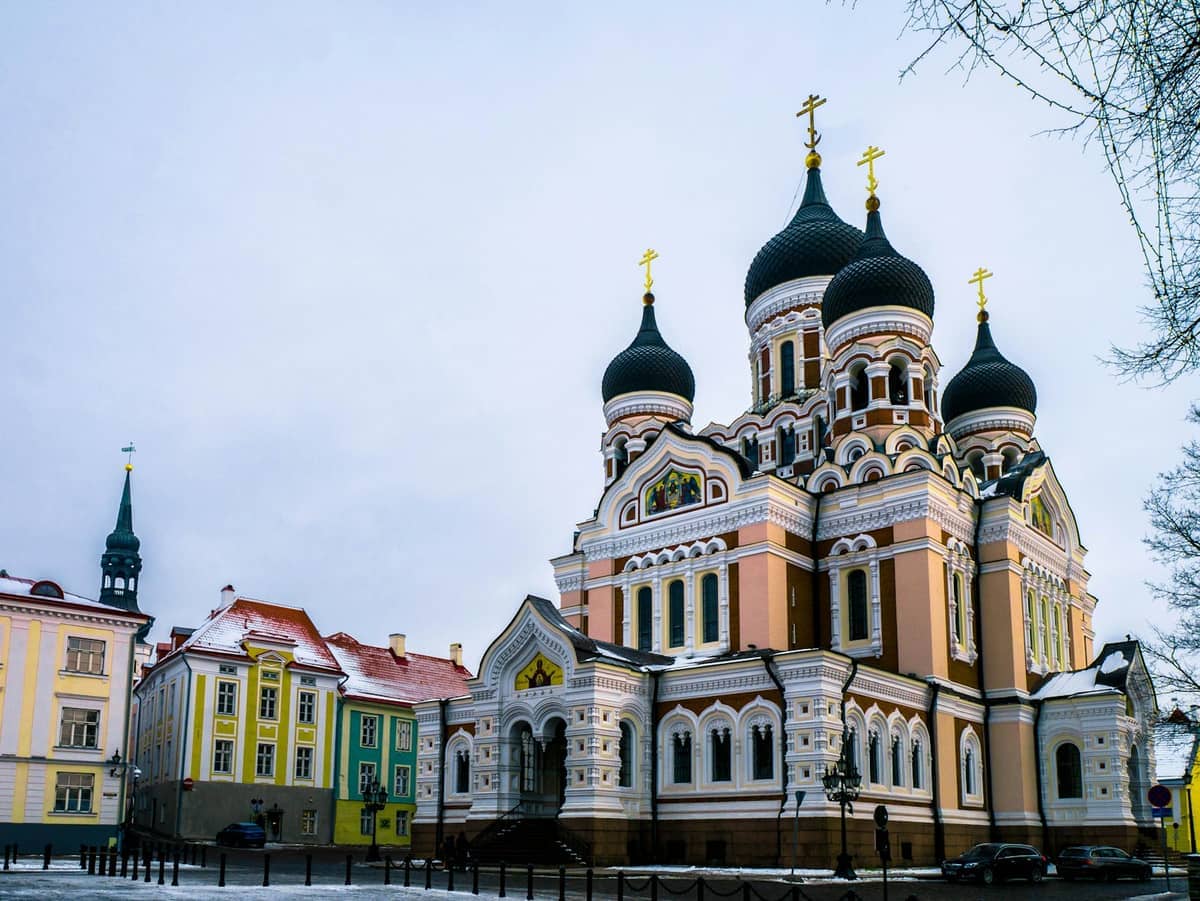
Rising above Toompea Hill with five gilded onion domes and a facade that dominates every Old Town panorama, Alexander Nevsky Cathedral is Tallinn's most visually assertive building. Built between 1895 and 1900, it remains an active Orthodox place of worship and a window into the city's layered Russian and Estonian history.
- Danish King's Garden
Tucked into the western slope of Toompea hill, the Danish King's Garden is a small, free public park woven into Tallinn's medieval fortifications. Open around the clock and steps from the Old Town's main streets, it offers a rare moment of calm alongside ancient towers and stone walls with an 800-year-old backstory.
- Fat Margaret
Fat Margaret (Paks Margareeta) is a squat, round cannon tower that has guarded the northern gate of Tallinn's Old Town since the early 16th century. Today it houses the Estonian Maritime Museum, with exhibits on seafaring history and a rooftop terrace overlooking the harbour. It is one of the few surviving medieval structures in Tallinn where you can explore both the architecture and a well-curated permanent collection under the same roof.
- Freedom Square
Freedom Square sits at the southern edge of Tallinn Old Town, anchoring the city's civic identity with the striking War of Independence Victory Column. Open around the clock and free to enter, it serves as a gathering point for national celebrations, winter markets, and everyday Tallinn life.