Kadriorg Park: Tallinn's Royal Green Escape
Kadriorg Park is Tallinn's largest and most historically significant urban park, spanning around 70 hectares just east of the city centre. Founded by Russian Tsar Peter I in 1718, it combines formal baroque gardens, swan ponds, mature forest paths, and a cluster of world-class museums. Entry to the park itself is free, and it rewards visitors across all seasons.
Quick Facts
- Location
- A. Weizenbergi 26, Kesklinna, Kadriorg, Tallinn
- Getting There
- Tram lines 1 or 3 to Kadriorg stop, then a short walk along Weizenbergi St
- Time Needed
- 1.5 to 3 hours for the park; add time for museums
- Cost
- Free to enter the park; museums within have separate paid admission
- Best for
- Leisurely walks, history lovers, families, photography
- Official website
- www.kadriorupark.ee
What Kadriorg Park Actually Is
Kadriorg Park is Tallinn's main park and, by most measures, its most beautiful one. Laid out on the orders of Russian Tsar Peter the Great starting in 1718, the park was designed as a formal baroque ensemble to accompany Kadriorg Palace, which Peter built as a summer residence for his wife Catherine I. The name Kadriorg literally means 'Catherine's Valley' in Estonian, a direct reference to the Tsarina. Today it covers around 70 hectares and functions simultaneously as a royal heritage site, a neighbourhood park, and a cultural campus housing several major museums.
What makes Kadriorg unusual among European palatial parks is the way it transitions from tight formal geometry near the palace into something looser and more forested as you move north and east. The baroque flower garden directly behind the palace is a formal, symmetrical affair with clipped hedges, seasonal plantings, and a central fountain. But walk five minutes deeper into the park and the mood shifts entirely: shaded gravel paths wind between mature oaks and lindens, local families cycle past, and the city largely disappears.
💡 Local tip
Tram lines 1 and 3 both stop at Kadriorg, at the end of the line by the park’s edge near Weizenbergi Street. The ride from Tallinn Old Town takes around 10 minutes and a single ticket is inexpensive. There is no reason to take a taxi.
The Park Through the Day
Kadriorg Park is open 24 hours a day, every day of the year, with no admission charge. That said, the experience changes significantly depending on when you arrive. Early mornings on weekdays are genuinely quiet: joggers trace the main avenue, dog walkers cluster near the lower pond, and the light through the lime tree canopy is soft and directional. If you want photographs of the baroque garden without strangers in frame, arrive before 9am.
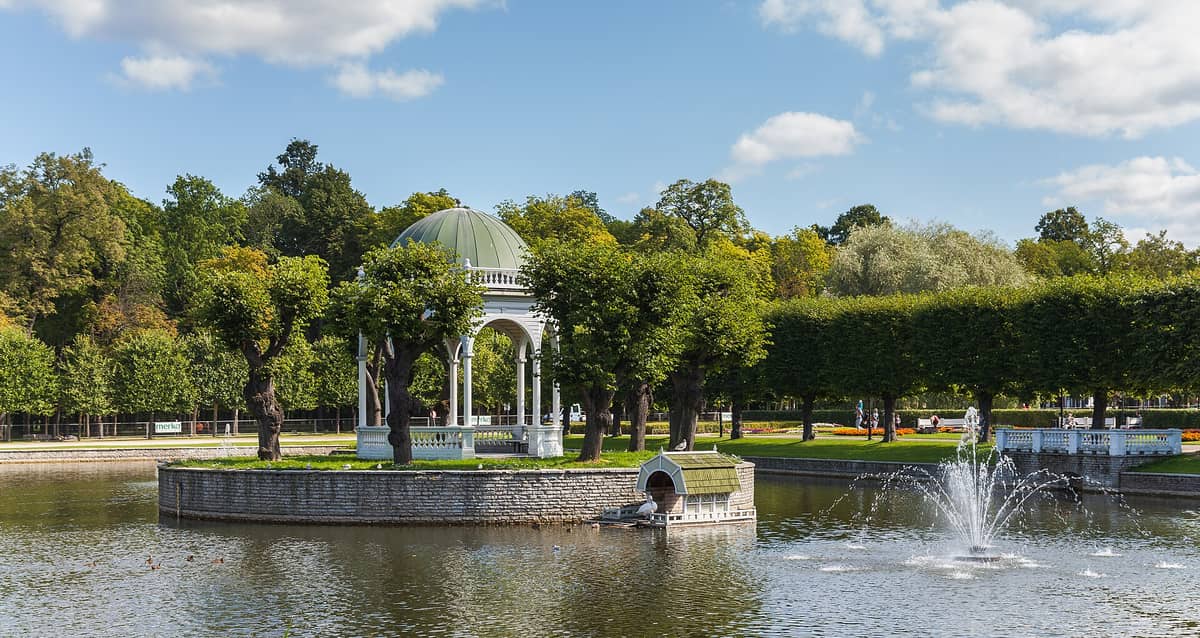
By mid-morning the park fills steadily, particularly at weekends when Tallinn families descend with pushchairs and picnic bags. The area around the swan pond becomes a natural gathering point: there are benches, a low stone wall to sit on, and usually bread-throwing at the ducks. It is pleasant but not peaceful. Midday in summer can feel genuinely crowded around the palace forecourt and the main avenue. If you want the park to feel like a retreat rather than a stroll down a promenade, plan accordingly.
Late afternoon is a reliable sweet spot. By 4pm the tour groups have mostly dispersed, the light is warmer, and the northern forested sections of the park are practically empty. In June and July, Tallinn stays light until nearly 11pm, so an evening walk through Kadriorg is a reasonable option rather than a peculiar one. The park takes on a noticeably different atmosphere: quieter, cooler, with the smell of cut grass and pine mixing in the air near the forest edge.
Tickets & tours
Hand-picked options from our booking partner. Prices are indicative; availability and final rates are confirmed when you complete your booking.
Architectural walking tour of Tallinn with a Local
From 177 €Instant confirmationFree cancellationCity Sightseeing hop-on hop-off bus tour of Tallinn
From 60 €Instant confirmationFree cancellationSelf-guided Discovery Walk of Tallinn city contrasts beyond the medieval walls
From 26 €Instant confirmationFree cancellationTallinn's art and culture tour with a local
From 62 €Instant confirmationFree cancellation
The Formal Garden and the Palace
The baroque flower garden directly behind Kadriorg Palace is the compositional heart of the park. It is a small but precisely executed space: symmetrical beds of seasonal flowers, clipped yew hedges, a central oval fountain, and sight lines that frame the palace facade at one end and a belvedere at the other. In summer the beds are planted with dahlias, begonias, and salvias in dense colour blocks. In winter the bare geometric structure of the hedges becomes the main visual interest, particularly after a light snowfall.
Kadriorg Palace itself is now home to the foreign art collection of the Art Museum of Estonia. The building is a compact Italian baroque structure designed by architect Nicola Michetti, and it is one of the few surviving examples of baroque palace architecture in the Baltic states. Entry to the palace requires a separate ticket. If you are visiting multiple museums in Tallinn, the Tallinn Card covers admission to Kadriorg Palace and several other major attractions.
ℹ️ Good to know
The baroque garden is at its visual peak from June through August. Spring tulip planting can be striking in May. The garden is maintained by the Kadriorg Park Authority; exact seasonal planting schedules are not always published in advance.
The KUMU Connection and the Museum Cluster
One of the strongest reasons to spend a full afternoon in Kadriorg rather than just an hour is the concentration of cultural institutions within or adjacent to the park. The KUMU Art Museum, Estonia's national art museum and one of the largest in the Baltic states, sits at the park's northern edge. The building itself, designed by Finnish architect Pekka Vapaavuori and opened in 2006, is worth seeing for its integration into the landscape: it is partly embedded into a limestone escarpment, and the terraced approach from the park is one of the better architectural promenades in the city.
Also within easy walking distance is the Maarjamäe Palace, which houses a branch of the Estonian History Museum focused on the 20th century. It sits just northeast of the main park boundary, and combining it with a Kadriorg visit makes for a coherent half-day on Tallinn's east side. For visitors specifically interested in how Estonia lived through Soviet occupation and the push for independence, this pairing is particularly worthwhile.
Seasons and Weather
Kadriorg Park is genuinely worth visiting in every season, though each requires a different approach. Summer is the obvious choice for the garden, the pond, and the general greenery, but it is also when the park is at its most crowded. Spring brings blossom on the cherry and apple trees near the palace and a quieter atmosphere than July. Autumn is arguably the most photogenic season: the old hardwood trees turn amber and gold from mid-September, and fallen leaves collect on the gravel paths in a way that feels almost staged.
Winter visits require preparation but offer something genuinely different. When snow settles on the baroque garden's geometric hedges and the pond ices over, the park looks more like a stage set than a public space. Dress for temperatures that can drop well below freezing, and wear boots with grip. The paths are not always cleared quickly after snowfall. That said, a snowy Kadriorg on a clear January morning, with almost no other visitors present, is one of the quieter pleasures Tallinn offers.
For a broader look at how Tallinn performs across different times of year, the best time to visit Tallinn guide breaks down weather, crowds, and seasonal events in detail.
Who Should Skip This, and Why
Kadriorg Park is not for visitors who want compressed, high-density sightseeing. If your time in Tallinn is limited to a single day and you are prioritising medieval architecture and Old Town history, the park is probably lower priority than the Town Hall Square, the city wall, or Toompea Hill. The park is a slow, ambient experience. It rewards wandering and sitting still more than it rewards checking things off a list.
Visitors who are primarily interested in nightlife, contemporary food culture, or the creative scene around Kalamaja will find Kadriorg a pleasant detour but not a central draw. The neighbourhood is residential and quiet, and the park closes the day down rather than opening it up. It is also worth knowing that the park's paths, while mostly level, are a mix of gravel and paved surfaces: visitors with significant mobility limitations should contact the Kadriorg Park Authority in advance to understand which routes are most accessible.
Insider Tips
- The secondary pond in the northern section of the park, away from the main palace axis, attracts far fewer visitors than the central swan pond. It is a better place to sit quietly, and the reflection of surrounding trees on the water makes for stronger photographs.
- Weizenbergi Street, which runs through the heart of the Kadriorg neighbourhood, is lined with well-preserved wooden villas from the late 19th and early 20th century. Walking the full length of the street to and from the tram stop adds almost nothing to your journey time but shows a side of Tallinn that most visitors miss entirely.
- If you are visiting KUMU, approach it through the park from the palace side rather than from the road. The walk takes about 15 minutes and the arrival at the building's limestone terrace is considerably more satisfying than the car park entrance.
- The baroque flower garden is enclosed and can feel small in photographs. For the best wide view of the palace and garden together, use the elevated belvedere at the far end of the garden axis rather than shooting from ground level.
- Kadriorg is one of the few large parks in Tallinn where cycling is comfortable. If you have access to a bike, riding from the Old Town along the coastal path to Kadriorg takes around 20 to 25 minutes and is flat most of the way.
Who Is Kadriorg Park For?
- Visitors who want a genuine break from Old Town crowds without leaving the city
- Families with children who need open space, ponds, and room to run
- Architecture and art enthusiasts combining the palace, KUMU, and Maarjamäe in one afternoon
- Photographers, especially in autumn or after winter snowfall
- Travellers on a longer Tallinn itinerary looking to understand the city beyond its medieval core
Nearby Attractions
Other things to see while in Kadriorg:
- Kadriorg Palace
Built by Russian Tsar Peter I in 1718 as a gift for his wife Catherine, Kadriorg Palace is one of the finest Petrine Baroque buildings in Northern Europe. Today it houses the Kadriorg Art Museum and sits within a beautifully maintained park just east of Tallinn's city centre.
- Kumu Art Museum
Kumu Art Museum is the largest and most architecturally striking art museum in Estonia, built into a limestone cliff at the edge of Kadriorg Park. Spanning Estonian art from the 18th century to the present day, it offers a serious, rewarding museum experience that stands well beyond the Old Town tourist circuit.
- Russalka Memorial
Standing at the edge of Kadriorg Park where the city meets the Gulf of Finland, the Russalka Memorial is a bronze angel atop a granite column, erected in 1902 to honour the sailors lost when the Russian warship Russalka sank in 1893. It is free, open year-round, and takes about 20 to 30 minutes to visit properly.