Russalka Memorial: Tallinn's Seaside Monument to a Lost Ship
Standing at the edge of Kadriorg Park where the city meets the Gulf of Finland, the Russalka Memorial is a bronze angel atop a granite column, erected in 1902 to honour the sailors lost when the Russian warship Russalka sank in 1893. It is free, open year-round, and takes about 20 to 30 minutes to visit properly.
Quick Facts
- Location
- Pirita tee 1, Tallinn (Kadriorg / Kesklinna district)
- Getting There
- Tram stop Kadriorg (lines 1 & 3) or bus to the Rusalka stop on Pirita tee
- Time Needed
- 20–40 minutes (longer if combining with Kadriorg Park)
- Cost
- Free, open 24 hours year-round
- Best for
- History, photography, seafront walks, quiet contemplation
- Official website
- www.kadriorupark.ee/park-eng/sights/russalka
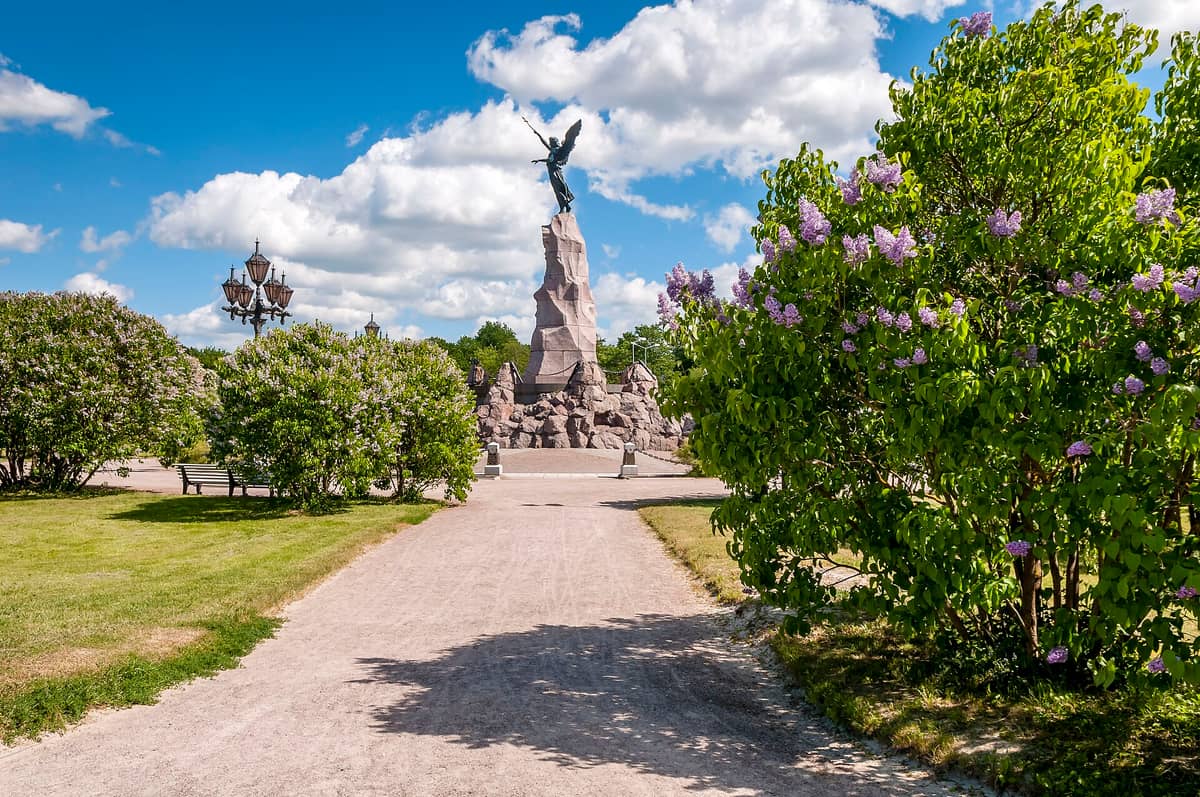
What the Russalka Memorial Actually Is
The Russalka Memorial, known in Estonian as Russalka mälestussammas, stands at the northern edge of Kadriorg Park on the Pirita tee seafront. It marks the spot closest to the point where the Russian armoured gunboat Russalka sank in the Gulf of Finland on 7 September 1893, during a routine crossing to Helsinki, taking all 177 crew members with her. The wreck was only located by divers in 2003, 110 years after the disaster.
The monument was unveiled on 7 September 1902, exactly nine years after the sinking. Designed by Estonian sculptor Amandus Adamson, it takes the form of a bronze angel standing atop a tapered granite column, her wings half-spread, holding an Orthodox cross aloft while facing out to sea. The pose is deliberately symbolic: the angel faces the direction of the wreck, as if still watching over the sailors below the surface. The column itself rises from a stepped granite base that catches the light differently depending on the time of day and season.
ℹ️ Good to know
The Russalka Memorial is one of the few surviving works in Tallinn by Amandus Adamson, the most significant Estonian sculptor of the 19th century. His other major works include sculptures in St. Petersburg. The craftsmanship of the bronze angel repays close inspection.
The Historical Weight of the Site
The sinking of the Russalka was one of the most catastrophic naval disasters in the Baltic Sea during the Imperial Russian period, and it shocked both Russian and Estonian society. The ship had been built in 1867 and was considered seaworthy. Investigations pointed to structural weaknesses and bad weather, but no single definitive cause was ever established. The loss of 177 men in a short crossing that should have taken only hours made the tragedy feel preventable, which only deepened the public grief.
Fundraising for the memorial came largely from public donations, which gives it a character quite different from state-commissioned monuments. It was not built to project imperial power but to express genuine mourning. That distinction still comes through when you stand in front of it. The names of the dead are inscribed on the base, and there is usually a small accumulation of flowers or candles at the foot of the column, left by visitors who have read what happened.
The memorial sits within the broader landscape of Kadriorg, the neighbourhood built around the early 18th-century palace complex of Peter the Great. Understanding that context matters: this is a district with deep Russian imperial associations, and the Russalka Memorial fits within that layer of history rather than standing apart from it. For visitors interested in how different eras have shaped Tallinn's identity, the memorial is a useful anchor point.
Tickets & tours
Hand-picked options from our booking partner. Prices are indicative; availability and final rates are confirmed when you complete your booking.
Self-guided Discovery Walk of Tallinn city contrasts beyond the medieval walls
From 26 €Instant confirmationFree cancellationTallinn's art and culture tour with a local
From 62 €Instant confirmationFree cancellationHistorical walking tour of Tallinn with a local
From 599 €Instant confirmationFree cancellationIntroductory walking tour of Tallinn with a local guide
From 109 €Instant confirmationFree cancellation
What It Looks and Feels Like on the Ground
The memorial sits on a low promontory where Pirita tee meets the seafront path, with a clear view across Tallinn Bay toward Naissaar Island on clear days. The site is not enclosed or fenced; you approach it from the pavement along the water. Locals cycle and jog past on the adjacent path throughout the day, which gives the place an interesting dual quality: it functions simultaneously as a solemn monument and as a landmark on a popular recreational route.
Up close, the granite base is solid and textured, the kind of stone that absorbs both sunlight and cold in equal measure. In winter, ice can form on the lower steps after rain, and the angel above takes on a harder, more austere look against a pale Baltic sky. In summer, the same figure looks lighter, and the surrounding greenery of Kadriorg softens the mood. Early morning is the most atmospheric time to visit: the light from the northeast is direct, the seafront path is nearly empty, and the sound of the Gulf of Finland is clearly audible.
💡 Local tip
For photography, arrive in the first two hours after sunrise. The angel faces east-northeast, which means early morning light falls directly on the front of the figure. By midday the face and wings are in partial shadow.
The location also functions as a low-key viewpoint. Looking back from the base of the monument toward the city, you get a clear sight line along the seafront promenade toward the Old Town skyline on the horizon. It is not a dramatic panorama, but it is a clean, unobstructed view that rewards a moment's attention.
Combining the Russalka Memorial with Kadriorg Park
Most visitors arrive at the Russalka Memorial as part of a walk through Kadriorg Park, and that is easily the best way to approach it. The memorial sits at the park's eastern edge nearest the sea, so a natural route is to enter the park from the Kadriorg tram stop, walk through the formal gardens, then continue east and north along the seafront path to the monument. The walk from the tram stop to the memorial takes around 20 minutes at a comfortable pace.
If you want a longer excursion, the seafront path continues north from the memorial toward Pirita beach and the Pirita Convent ruins. The Russalka Memorial makes a natural midpoint stop on that route, roughly 2 kilometres from Pirita. The path is flat and paved, suitable for cyclists, joggers, and those with pushchairs.
For a tighter itinerary focused on Kadriorg's cultural highlights, you might pair the memorial with the Kadriorg Palace and KUMU Art Museum, both a short walk inland. None of these require more than half a day in total.
Getting There and Practical Details
The memorial is at Pirita tee 1 in the Kesklinna district. Tram lines 1 and 3 stop at Kadriorg, from which the memorial is roughly a 10 to 15 minute walk north along the seafront. Several bus lines also serve the Narva maantee corridor; check transport.tallinn.ee for current routes and schedules before your visit.
The site is entirely outdoors and free, with no barriers, ticket booths, or facilities. There are no toilets on site; the nearest public facilities are in Kadriorg Park itself. The surrounding ground is paved and level, though the stepped granite base of the monument is not ramped, which limits close-up access for wheelchair users. The broader seafront path and park are generally accessible.
⚠️ What to skip
In winter, the granite steps around the monument base can be icy and slippery after rain or overnight frost. Wear footwear with grip if visiting between November and March.
Parking is available along Pirita tee, but the street can be busy on weekend afternoons in summer when the seafront path draws large numbers of people. Arriving by tram or on foot from Kadriorg Park is more practical.
Is It Worth Your Time?
The Russalka Memorial is a compact, low-key attraction. It does not require a large time investment and it has no entry cost, so the question of whether it is worth visiting is mainly about whether it sits naturally on your route. If you are already spending time in Kadriorg, it absolutely merits the detour: the combination of Adamson's craftsmanship, the historical backstory, and the seafront setting makes it more interesting than a typical decorative monument.
Visitors who are primarily interested in medieval history or the Old Town may find it too far out of the way to justify a standalone trip, particularly on a short visit. But for anyone with an afternoon in Kadriorg, or anyone walking or cycling the coastal path, the Russalka Memorial is a genuinely affecting stop that adds historical texture to what is otherwise a pleasant seaside stroll.
If you are putting together a fuller picture of Tallinn's history across different periods, the Tallinn medieval history guide and the broader context of things to do in Tallinn are useful starting points for planning your time.
Insider Tips
- The angel faces east-northeast toward the site of the wreck. On a clear day, especially in autumn when the air is dry, you can see Naissaar Island from the monument's base — the island the Russalka was sailing toward when she sank.
- The stepped granite base is wide enough to sit on, and many locals use it as a resting point during the seafront walk. It is a good place to pause and read about the disaster before moving on.
- If you are visiting in September, the anniversary of the sinking falls on the 7th. Small commemorations occasionally take place at the site on that date, with candles and flowers at the base.
- The seafront path between Kadriorg and the memorial is a favourite spot for Tallinn residents at dusk in summer. The light on the water between 9 and 10 pm in June and July is exceptional, and the monument is well-positioned to photograph with the sea behind it.
- Amandus Adamson's studio and biography are not widely covered in English-language Tallinn guides, but the visitor information at Kadriorg Palace sometimes references his work. If you are interested in Baltic sculpture of the late 19th century, he is worth looking up before your visit.
Who Is Russalka Memorial For?
- History and culture travellers interested in pre-WWI Baltic and Russian imperial history
- Photographers working the Tallinn seafront, especially at golden hour or in winter light
- Walkers and cyclists following the coastal path between Kadriorg and Pirita
- Visitors who want a free, unhurried stop that combines open air, water views, and genuine historical weight
- Travellers combining a full afternoon in Kadriorg with the palace, park, and KUMU
Nearby Attractions
Other things to see while in Kadriorg:
- Kadriorg Palace
Built by Russian Tsar Peter I in 1718 as a gift for his wife Catherine, Kadriorg Palace is one of the finest Petrine Baroque buildings in Northern Europe. Today it houses the Kadriorg Art Museum and sits within a beautifully maintained park just east of Tallinn's city centre.
- Kadriorg Park
Kadriorg Park is Tallinn's largest and most historically significant urban park, spanning around 70 hectares just east of the city centre. Founded by Russian Tsar Peter I in 1718, it combines formal baroque gardens, swan ponds, mature forest paths, and a cluster of world-class museums. Entry to the park itself is free, and it rewards visitors across all seasons.
- Kumu Art Museum
Kumu Art Museum is the largest and most architecturally striking art museum in Estonia, built into a limestone cliff at the edge of Kadriorg Park. Spanning Estonian art from the 18th century to the present day, it offers a serious, rewarding museum experience that stands well beyond the Old Town tourist circuit.