Pirita Convent: Tallinn's Haunting Medieval Ruins by the Sea
The roofless Gothic shell of Pirita Convent has stood on the banks of the Pirita River since the early 15th century, outlasting war, occupation, and centuries of Baltic winters. Open year-round and steps from the sea, it is one of the most atmospheric historical sites in the Tallinn region.
Quick Facts
- Location
- Merivälja tee 18, Pirita district, Tallinn
- Getting There
- City bus from central Tallinn to Pirita klooster stop; check transport.tallinn.ee for current route numbers
- Time Needed
- 45–90 minutes
- Cost
- Small entry fee (approx. €3 reported by visitors; verify on-site); pay machine accepts card
- Best for
- History, photography, quiet reflection, combining with a walk along Pirita beach
- Official website
- http://www.piritaklooster.ee/?lang=en
What You Are Looking At
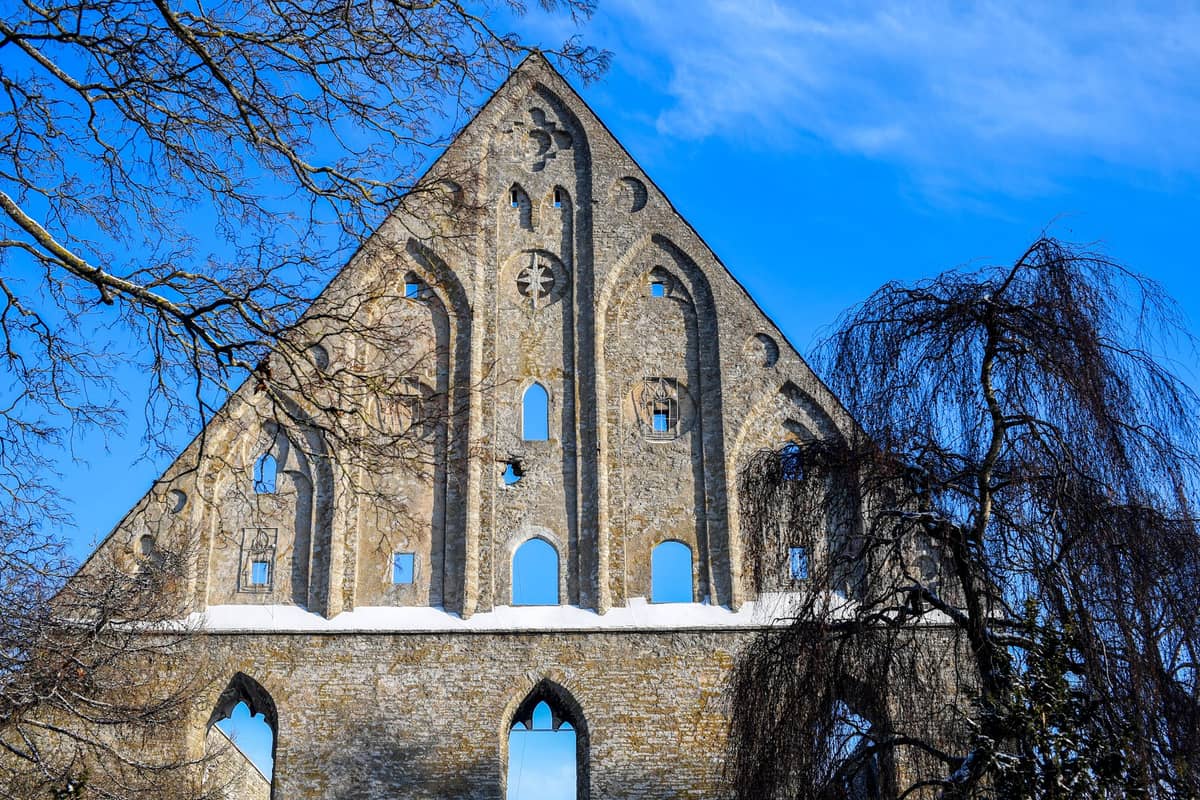
Pirita Convent is the preserved ruin of a Bridgettine double monastery, founded in the early 15th century and destroyed during the Livonian War in 1577. What remains is the towering west gable of the convent church, a section of the nave walls, and enough surrounding stonework to understand the scale of what once stood here. With a church floor area of approximately 1,360 square metres, this was one of the largest medieval church buildings in Estonia. Standing inside the roofless nave on a clear afternoon, with the open sky framed by Gothic arches above and the smell of river air drifting in from the Pirita River nearby, it is easy to understand why this site still draws visitors six centuries after its founding.
The convent church was consecrated on 15 August 1436, and the Order of Saint Bridget (Bridgettines) established a double community here: a house for nuns and one for monks, following the rule of Saint Birgitta of Sweden. The Order of Saint Bridget (Bridgettines) established a double community here: a house for nuns and one for monks, following the rule of Saint Birgitta of Sweden. The site functioned as a significant religious and cultural centre for well over a century before Livonian War raids reduced it to the shell visible today.
ℹ️ Good to know
The ruins are open daily 08:00–20:00 year-round. A small pay machine at the entrance accepts card and contactless payment. Carry a card to be safe, as cash use is not prominent.
The Experience by Time of Day
Early mornings, especially on weekdays, are close to silent. The gravel path crunches underfoot, jackdaws call from the upper walls, and the light hits the west gable at an angle that makes the old stonework look almost amber. This is the best window for photography: soft light, no tour groups, and the ruins entirely to yourself or nearly so.
By mid-morning on summer weekends, small groups begin arriving, often as part of a combined walk along the Pirita promenade or a visit to Pirita beach just down the road. The site never becomes truly crowded in the way that Tallinn's Old Town squares do, but solitude becomes harder to find between roughly 11:00 and 15:00 on warm days. Afternoon light in summer floods the nave from the west, creating long shadows across the grass floor of the former church interior.
In winter, the ruins take on a different quality entirely. Snow collects in the Gothic window openings, the surrounding trees are bare, and the wind off the Gulf of Finland cuts through the open nave. Dress warmly. The site is still worth visiting in winter for its stark, uncluttered atmosphere, and the low Baltic sun in January and February produces dramatic photography conditions.
Tickets & tours
Hand-picked options from our booking partner. Prices are indicative; availability and final rates are confirmed when you complete your booking.
Self-guided Discovery Walk of Tallinn city contrasts beyond the medieval walls
From 26 €Instant confirmationFree cancellationTallinn's art and culture tour with a local
From 62 €Instant confirmationFree cancellationHistorical walking tour of Tallinn with a local
From 599 €Instant confirmationFree cancellationIntroductory walking tour of Tallinn with a local guide
From 109 €Instant confirmationFree cancellation
Walking Through the Site
The entrance path leads you toward the west facade first, and the scale of the remaining gable wall is the initial surprise. It rises to a height that seems disproportionate to the surrounding landscape of low trees and coastal vegetation. Walk through the main arch into the nave and you are standing on the original church footprint, now open to the sky and carpeted in grass. The perimeter walls, though partly collapsed, trace the full outline of the building clearly enough to read the architecture.
Stone details reward close attention. Look for the corbels and pilaster remnants along the interior walls where the vault ribs once met the stonework. The window openings, particularly on the south side, retain their Gothic tracery profiles even where the infill has long gone. The surfaces are rough limestone, pocked by weather and centuries of exposure, with lichen patches of grey-green and orange spreading across the upper courses.
Adjacent to the ruins, a functioning convent community of Bridgettine sisters has been present since the mid-1990s, operating from a modern building on the same grounds. The community is active and the site remains spiritually significant, not merely a tourist attraction. Visitors are expected to behave respectfully, particularly near the functioning convent buildings. The ruins themselves are secular in access but the wider grounds carry a quiet, contemplative character that most visitors pick up instinctively.
💡 Local tip
The terrain inside the ruins is uneven grass and compacted earth. Flat-soled shoes or light hiking footwear are more practical than sandals or heeled shoes, especially after rain.
Historical Context: Why This Place Matters
Pirita Convent was founded at a moment when the city now known as Tallinn was a prosperous Hanseatic trading port under the Teutonic Order, and the wider region of Livonia was a complex patchwork of ecclesiastical and secular power. The Bridgettine order, originating in Sweden, spread rapidly through the Baltic during the early 15th century, and the Pirita foundation was one of the most ambitious in the region. Understanding this site properly means understanding the medieval religious landscape of the Baltic, which the Tallinn medieval history guide covers in useful depth.
The destruction of 1577 was not random. The Livonian War, which drew in Muscovite Russia, Poland-Lithuania, Sweden, and Denmark over the course of decades, systematically dismantled much of what the medieval church had built across the region. Pirita was among the casualties. Unlike many ruined churches that were rebuilt or repurposed after conflict, the Pirita convent church was never restored to functional use, which is partly why the ruins retain such integrity: no later additions overlay the original structure.
Combining Pirita Convent with the Surrounding Area
The convent sits within Tallinn's Pirita district, a low-density coastal neighbourhood that rewards an unhurried afternoon. The Pirita beach is a short walk away and is one of the longest sand beaches within easy reach of central Tallinn, making a combined visit practical from late spring through early autumn. The Pirita River mouth and the small boat harbour are also close by.
If you are making a day of it in the area, the Tallinn Botanic Garden is reachable by bus or on foot, and Maarjamae Palace with its history museum and Soviet-era memorial complex sits on the route between the city centre and Pirita. Pairing the convent with one or both of these sites makes for a coherent half-day in eastern Tallinn without retracing your steps.
For those exploring the wider Pirita neighbourhood on foot, the area offers a distinct contrast to the density of Tallinn's Old Town. The streets here are quieter, the architecture is mostly 20th-century residential, and the atmosphere is closer to a seaside suburb than a tourist centre. That said, public transport connections back to the centre are reliable and frequent.
Photography Tips and Practical Notes
The west gable is the defining image of Pirita Convent and the view most commonly seen in photographs. For a less predictable angle, move along the south exterior wall to frame the window openings against sky, or position yourself inside the nave looking east toward the apse remnants. The roofless interior creates a natural frame for any overhead shot.
Drone photography is subject to Estonian aviation regulations and the presence of an active convent community. Do not fly without checking current rules, and avoid hovering near the residential convent buildings.
The site is primarily outdoors with no permanent cover. In heavy rain the experience is significantly diminished, as the grass floor of the nave becomes muddy and the stonework loses the light-play that makes it photogenic. Check the forecast. The ruins are not going anywhere; there is no obligation to visit in poor conditions.
⚠️ What to skip
Accessibility is limited. The terrain includes uneven ground, gravel paths, and grass. There are no ramps or step-free routes through the ruins interior. Visitors with mobility difficulties should assess this before visiting.
Insider Tips
- Visit on a weekday morning between May and August for the best combination of good light and minimal other visitors. Weekend afternoons in summer bring tour groups from the cruise terminals.
- The automatic pay machine at the entrance accepts contactless payment including Apple Pay and bank cards. No need to hunt for coins.
- Look up at the west gable from directly below: the original Gothic window tracery profile is best appreciated from this angle, where the openings frame the sky like cut-stone lacework.
- The functioning Bridgettine convent community holds services in the adjacent chapel. If timing aligns, hearing the community at prayer adds a layer to the experience that no amount of historical reading can replicate.
- Combine the visit with the Pirita promenade walk along the river to the sea. The 10-minute walk from the convent to the beach passes through old pine trees and is quiet even on summer days.
Who Is Pirita Convent For?
- Architecture and medieval history enthusiasts who want context beyond the Old Town
- Photographers looking for dramatic stonework with natural light and no crowd management required
- Couples or solo travellers wanting a contemplative half-day away from the tourist core
- Visitors combining a history stop with a beach walk in Pirita
- Those interested in the Bridgettine Order or Baltic ecclesiastical history
Nearby Attractions
Other things to see while in Pirita:
- Maarjamäe Palace
Maarjamäe Palace is a 19th-century Gothic Revival manor on Tallinn's northeastern coast that now houses the Estonian History Museum's flagship permanent exhibition. The building's ornate silhouette, the surrounding Soviet-era memorial complex, and the Gulf of Finland backdrop make it one of the most layered cultural sites in the country.
- Pirita Beach
Pirita Beach is Tallinn's largest and most popular beach, stretching 2.4 kilometres along the Gulf of Finland just 15 minutes from the city centre. Free to access year-round, it draws swimmers in summer, joggers in spring and autumn, and winter walkers who come for the frozen sea views. This guide covers what the experience is actually like, when to go, and how to get there.
- Tallinn Botanic Garden
Set in the forested Kloostrimetsa area of Pirita, Tallinn Botanic Garden is a working botanical institution founded in 1961 (opened to the public in 1970) with a large outdoor landscape and greenhouse collections. It rewards slow exploration and is especially worthwhile in late spring and early summer when the flowering plants peak.
- Tallinn Song Festival Grounds
The Tallinn Song Festival Grounds, known in Estonian as Lauluväljak, is one of the most symbolically charged open-air venues in Europe. With a sweeping arched stage, a park open 24 hours a day, and a direct connection to Estonia's peaceful path to independence, it rewards visitors who look beyond the Old Town.