Tallinn Song Festival Grounds (Lauluväljak): Where Estonia Found Its Voice
The Tallinn Song Festival Grounds, known in Estonian as Lauluväljak, is one of the most symbolically charged open-air venues in Europe. With a sweeping arched stage, a park open 24 hours a day, and a direct connection to Estonia's peaceful path to independence, it rewards visitors who look beyond the Old Town.
Quick Facts
- Location
- Narva mnt 95, Tallinn — between Narva Road and Pirita Road, near Kadriorg
- Getting There
- Tram line 1 or 3 to Kadriorg stop; several bus routes also serve Narva mnt
- Time Needed
- 45–90 minutes for a casual visit; longer if attending an event
- Cost
- Free to enter the grounds; event tickets priced by organiser
- Best for
- History lovers, architecture fans, walkers, and anyone attending a summer concert
- Official website
- www.lauluvaljak.ee/en
What Is the Tallinn Song Festival Grounds?
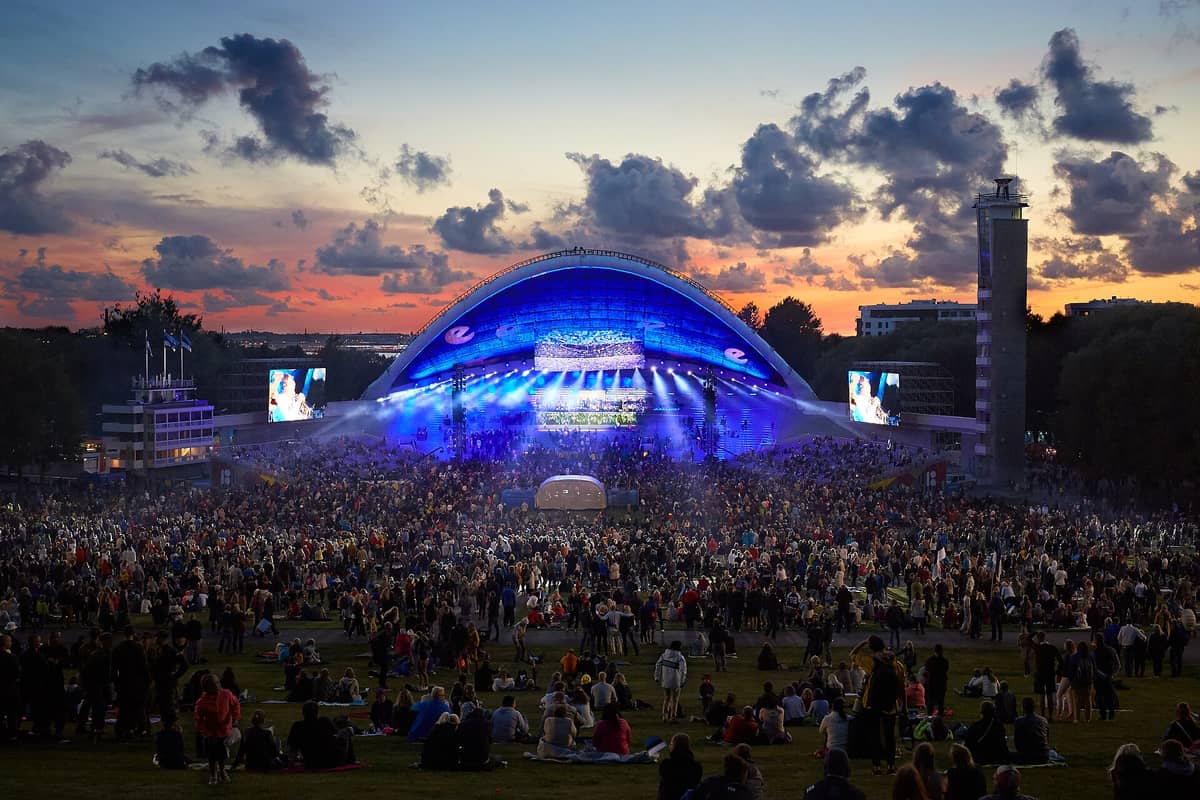
The Tallinn Song Festival Grounds, or Lauluväljak, is a vast open-air amphitheatre on the eastern edge of the city, a short tram ride from the Old Town. Its most recognisable feature is a monumental curved shell stage, built in 1959, which frames a sloping grass field large enough to hold tens of thousands of people. Outside of major events, the space functions as a public park: cyclists cut through, dog walkers loop the perimeter, and the occasional jogger passes the stage in near-silence.
The grounds sit at Narva mnt 95, positioned between Narva Road and Pirita Road and closely associated with the Kadriorg neighbourhood, though technically bordering the Pirita district. Visitors approaching from the tram stop on Narva Road encounter the venue gradually: a long tree-lined approach, then the first glimpse of the arch rising above the treeline. On a clear day, the pale concrete shell catches the northern light in a way that makes it look simultaneously grand and unexpectedly delicate.
💡 Local tip
The grounds are open 24 hours a day, year-round, and entry is free outside of ticketed events. You can walk in any time. The Visitor Centre usually keeps daily opening hours (10:00–17:00), but visits to specific facilities are best arranged in advance by phone or email.
History: From Song Festival Tradition to Singing Revolution
The Estonian Song Festival, Laulupidu, is one of the oldest continuously running amateur choral events in the world. The first stage at this specific location was built in 1928 for the 9th Estonian Song Festival, establishing a permanent home for a tradition that dates back to 1869. The current arched concrete shell was completed in 1960, constructed to mark the 20th anniversary of the Estonian Soviet Socialist Republic — one of the great ironies of the venue's story, given what happened there three decades later.
In 1988, during the twilight of the Soviet era, this site became the physical centre of the Singing Revolution. Mass gatherings here, drawing hundreds of thousands of Estonians, used song as direct political expression. Estonian national songs, many of them banned or suppressed under Soviet rule, were performed openly. The emotional and political force of those events contributed directly to Estonia's eventual declaration of restored independence in 1991. The grounds are therefore not simply a concert venue — they are a site where culture functioned as resistance.
For deeper context on this period, the Vabamu Museum of Occupations and Freedom in the city centre covers the Soviet occupation and independence movement in detail, and pairs well with a visit to the Lauluväljak.
Tickets & tours
Hand-picked options from our booking partner. Prices are indicative; availability and final rates are confirmed when you complete your booking.
Self-guided Discovery Walk of Tallinn city contrasts beyond the medieval walls
From 26 €Instant confirmationFree cancellationTallinn's art and culture tour with a local
From 62 €Instant confirmationFree cancellationHistorical walking tour of Tallinn with a local
From 599 €Instant confirmationFree cancellationIntroductory walking tour of Tallinn with a local guide
From 109 €Instant confirmationFree cancellation
The Stage and Architecture: A Closer Look
The shell stage is the dominant architectural element and the main reason photographers come here even on ordinary days. The arched structure is made from reinforced concrete and opens outward toward the slope in a broad elliptical sweep. Standing directly beneath it, the scale becomes clearer: the interior of the arch is designed for acoustics at massive scale, and even without amplification, sounds carry across the open field in a noticeably focused way.
The 1959 stage has been supplemented over the decades with various infrastructure additions, and the venue has been subject to ongoing modernisation discussions. Plans to expand and update the grounds have been reported in recent years, reflecting both the venue's continued active use and Estonia's desire to maintain it as a viable large-scale event space. Despite institutional changes, the main arch remains unchanged and is the structure most visitors want to see.
Photography works best in the morning hours when the light comes from the east and illuminates the front face of the stage directly. By midday the arch sits in flatter light, and in the late afternoon it falls into partial shadow. The wide grass slope in front of the stage provides good foreground interest if you photograph from the back of the field looking toward the arch.
Visiting on an Ordinary Day: What the Experience Is Actually Like
On a weekday morning outside of event season, the Lauluväljak is almost contemplative. The grass slope is empty, the stage silent. You can walk right up to the front of the arch, stand on the performance platform, and look back at the full extent of the field. The sense of scale is startling when you realise it filled with 100,000 people. There are no barriers, no entry desks, no queuing. It is simply a large open space that happens to carry an enormous amount of cultural weight.
Weekends bring more foot traffic, particularly families with children and local residents using the park paths. The surrounding green areas connect loosely with the broader Kadriorg park network, making it natural to combine a visit here with a walk toward Kadriorg Palace or along the coast toward Pirita. The smell of pine from the adjacent tree lines and the occasional distant traffic noise from Narva Road are the main sensory constants on a quiet visit.
The grounds sit within easy walking and cycling distance of Kadriorg Park and the KUMU Art Museum, making this area of Tallinn well worth a half-day.
ℹ️ Good to know
The Estonian Song Festival (Laulupidu) takes place roughly every five years and draws choirs from across Estonia. When the event is on, the atmosphere is unlike anything in ordinary tourism — tens of thousands of singers on stage simultaneously, and a crowd that stretches to the horizon. Check laulupidu.ee for the next scheduled festival date.
Visiting During an Event: Concerts and Large Gatherings
The venue hosts major concerts and public events beyond the Song Festival itself — large pop and rock performances, national celebrations, and the Dance Festival that accompanies Laulupidu. During these events the grounds transform entirely: vendor stalls appear along the approach paths, the tree-lined entry route fills with slow-moving crowds, and the acoustic atmosphere around the arch changes completely with amplification.
Ticket prices vary entirely by event and are set by individual organisers. For any specific concert, check the official Lauluväljak site at lauluvaljak.ee/en or the event organiser directly. Accessibility for events, including accessible entrances and seating, also varies by event; contact the venue in advance if you have specific requirements.
⚠️ What to skip
On major event days, public transport on the Narva mnt corridor gets congested. Trams and buses fill quickly. If you are attending a large concert, consider arriving early or using a taxi or ride-hailing app for departure rather than waiting for a packed tram.
Getting There and Practical Notes
The most convenient public transport option from central Tallinn is tram line 1 or 3 along Narva mnt, alighting at the Kadriorg stop. The walk from the stop to the main entrance is a few minutes. Several bus routes also run along Narva Road and stop nearby. Taxis and ride-hailing apps such as Bolt are readily available for the return journey, particularly useful after evening events when trams are crowded.
If you are planning a full day in the eastern part of Tallinn, the Tallinn walking tour can be combined with a tram ride out to the grounds afterward. Allow at least 45 minutes for the Lauluväljak itself, more if the weather is good and you want to explore the surrounding paths.
Wear comfortable shoes: the grounds have a mix of paved paths and grass slopes, and the approach from Narva Road involves some uneven surfaces. In wet weather the grass field becomes soft underfoot, so footwear matters. In winter, the open field can be cold and windswept, but the grounds remain accessible and have a stark, photogenic quality under snow.
If you are travelling on a budget, the Lauluväljak is one of the most significant free attractions in the city. For more ideas, see our guide to free things to do in Tallinn.
Insider Tips
- Visit on a weekday morning to have the stage almost entirely to yourself. The contrast between the silence and the scale of the venue is genuinely affecting, and you will have the best photographic conditions without other visitors in frame.
- The back of the field, at the highest point of the slope, gives the best overview of the full venue layout. From here you can see how the arch frames the horizon behind it and appreciate why the space works acoustically for such large crowds.
- The Visitor Centre requires booking by appointment, but if you want to understand the history in depth rather than just walk the grounds, it is worth arranging in advance. Contact the venue by email or call during weekday office hours (09:00–17:00).
- The approach path from the Kadriorg tram stop is tree-lined and pleasant. On the way back, take the slight detour toward Kadriorg Park rather than retracing along Narva Road — the park and palace are a ten-minute walk and worth including.
- If you are in Tallinn when the Song Festival is not running, look for the smaller choral and music events that the grounds host throughout the year. They offer a quieter version of the same atmosphere, without the logistical complexity of the major festival.
Who Is Tallinn Song Festival Grounds For?
- History and politics travellers interested in Soviet-era Baltic history and the Singing Revolution
- Architecture enthusiasts drawn to mid-20th century concrete structures and large-scale public design
- Photographers looking for a dramatic, low-crowd subject outside the Old Town
- Visitors attending summer concerts or the Estonian Song and Dance Festival
- Walkers using the Kadriorg and Pirita corridor for a longer eastern Tallinn day
Nearby Attractions
Other things to see while in Pirita:
- Maarjamäe Palace
Maarjamäe Palace is a 19th-century Gothic Revival manor on Tallinn's northeastern coast that now houses the Estonian History Museum's flagship permanent exhibition. The building's ornate silhouette, the surrounding Soviet-era memorial complex, and the Gulf of Finland backdrop make it one of the most layered cultural sites in the country.
- Pirita Beach
Pirita Beach is Tallinn's largest and most popular beach, stretching 2.4 kilometres along the Gulf of Finland just 15 minutes from the city centre. Free to access year-round, it draws swimmers in summer, joggers in spring and autumn, and winter walkers who come for the frozen sea views. This guide covers what the experience is actually like, when to go, and how to get there.
- Pirita Convent
The roofless Gothic shell of Pirita Convent has stood on the banks of the Pirita River since the early 15th century, outlasting war, occupation, and centuries of Baltic winters. Open year-round and steps from the sea, it is one of the most atmospheric historical sites in the Tallinn region.
- Tallinn Botanic Garden
Set in the forested Kloostrimetsa area of Pirita, Tallinn Botanic Garden is a working botanical institution founded in 1961 (opened to the public in 1970) with a large outdoor landscape and greenhouse collections. It rewards slow exploration and is especially worthwhile in late spring and early summer when the flowering plants peak.