Vajdahunyad Castle: Budapest's Architectural Fantasy in City Park
Vajdahunyad Castle in Budapest's City Park is a single complex that condenses a thousand years of Hungarian architectural history into one walkable site. Entry to the courtyards is free and open around the clock, making it genuinely worth an hour or two at any time of day. The Hungarian Agricultural Museum inside adds depth for those who want more than a photo stop.
Quick Facts
- Location
- Vajdahunyad sétány, 1146 Budapest, City Park (Városliget), District XIV
- Getting There
- Metro M1 to Széchenyi fürdő or Hősök tere, then a 10-minute walk through City Park
- Time Needed
- 1 hour for courtyards only; 2.5–3 hours if including the Agricultural Museum
- Cost
- Courtyards free (except during festivals). Agricultural Museum: 2,500 HUF adults, 1,200 HUF students/seniors (verify current prices before visiting).
- Best for
- Architecture lovers, history buffs, families, photographers, and anyone on a budget
- Official website
- www.mezogazdasagimuzeum.hu
What Vajdahunyad Castle Actually Is
Vajdahunyad Castle is not a medieval fortress. That distinction matters, because travelers who arrive expecting the grim stone weight of a real defensive castle will find something stranger and, arguably, more interesting: a purpose-built architectural collage designed in 1896 to showcase the full spectrum of Hungarian building styles across a thousand years of history, all on one walkable site in City Park.
Architect Ignác Alpár designed the complex for the Millennial Exhibition of 1896, which commemorated the 1,000th anniversary of the Hungarian conquest of the Carpathian Basin. The brief was ambitious: represent Romanesque, Gothic, Renaissance, and Baroque architecture in a single cohesive structure. Alpár drew on more than 20 actual Hungarian buildings for reference, including the real Hunyad Castle (now Corvin Castle in Hunedoara, Romania), which gives this Budapest replica its name.
The original construction used wood and cardboard, intended as a temporary exhibition pavilion. But the public response was strong enough that a permanent stone version was commissioned. It was rebuilt in brick and stone between 1904 and 1908, and that is the version standing today.
ℹ️ Good to know
The castle courtyards are open 24 hours a day, free of charge (except during ticketed festivals). There is no need to plan around operating hours for a courtyard visit — though daylight is obviously better for photography.
The Architecture Up Close: What You Are Actually Looking At
Walking through the main gate from the lakeside path, the first thing that registers is the sheer variety of surfaces. Within a few dozen meters, rough Romanesque stonework gives way to a soaring Gothic chapel facade, which abuts a Renaissance loggia modeled on Transylvanian manor houses. The effect is initially disorienting, then genuinely impressive once you understand the logic behind it.
The Romanesque section, on the approach from the bridge, features thick columns, rounded arches, and a deliberate heaviness that evokes the earliest period of Hungarian Christianity. The Gothic wing, with its pointed spires and tracery windows, anchors the northern part of the complex and gives the skyline its most recognizable silhouette. The Baroque elements are more restrained here than in, say, the interior of St. Stephen's Basilica, but they provide a visual softness that prevents the whole ensemble from feeling like an architectural lecture.
Visitors who enjoy architectural detail are well served here, particularly if they have already walked Matthias Church on Castle Hill, which shares some Gothic vocabulary. Seeing both in the same trip gives a useful sense of how the style was interpreted across different periods and purposes.
The Gate Tower and the Apostles' Tower are the two vertical elements worth noting. The Gate Tower can sometimes be climbed on guided visits (check current options and pricing), offering a direct view down over the lake and across the park. The climb involves narrow stairs with no elevator access, so it is not suitable for visitors with mobility limitations.
Tickets & tours
Hand-picked options from our booking partner. Prices are indicative; availability and final rates are confirmed when you complete your booking.
Private Buda Castle walking tour
From 195 €Instant confirmationFree cancellationBuda Castle District Tour on MonsteRoller
From 50 €Instant confirmationFree cancellationPrivate Buda Castle walking tour and Danube river cruise with Margaret Island
From 292 €Instant confirmationFree cancellationBuda Castle 3-hour tour with a friendly historian
From 68 €Instant confirmationFree cancellation
How the Experience Changes by Time of Day
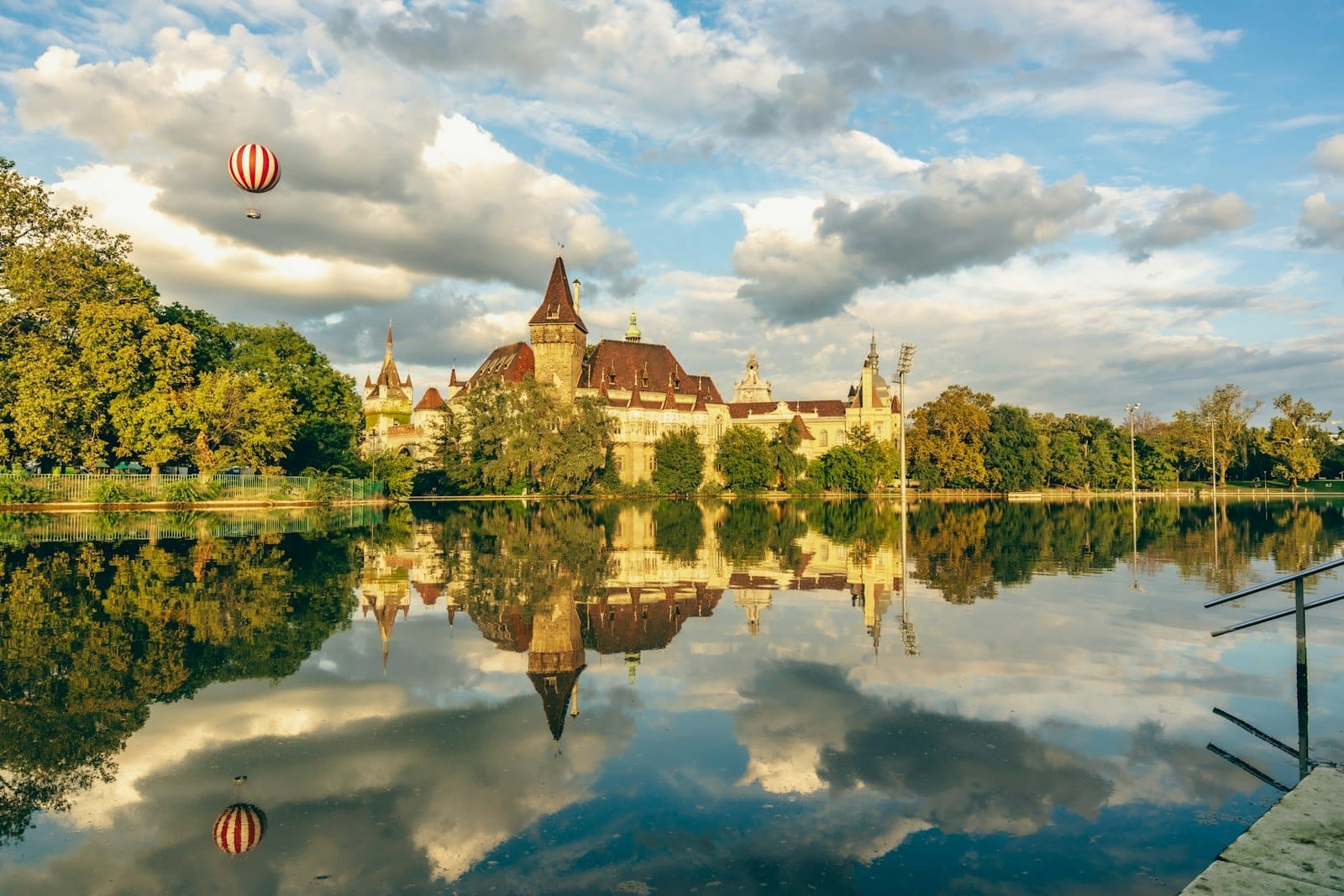
Early morning, before 9 a.m., the castle grounds are nearly empty. The lake surface in front of the main facade is still, and the reflection of the towers carries clearly in calm weather. This is the window for photographers. The light comes from the east at this hour, hitting the Romanesque and Gothic sections directly and picking out the texture of the stonework in a way that midday flat light does not.
By late morning and through the afternoon, particularly on weekends between May and September, the main courtyard fills steadily. School groups arrive from around 10 a.m. onward. The atmosphere is pleasant but not quiet. Families with children use the open areas, and the lawns around the outer walls see picnics and informal gatherings. If you are visiting purely for architecture and want space to look without crowds, a weekday morning in spring or autumn is the practical choice.
In winter, from December into February, the boating lake in front of the castle is converted into one of Budapest's most popular ice-skating rinks. The castle facade lit against a grey winter sky, with skaters moving across the foreground, is one of the more genuinely atmospheric scenes in the city. Crowds gather in the afternoon and evening around the rink. If ice skating is the draw, check current season dates and rental information before you visit, as conditions and opening schedules vary by year.
💡 Local tip
For the cleanest photos of the main facade from across the lake, arrive before 9 a.m. on a calm morning. By 10 a.m. on any weekend, the bridge and lakeside path will have significant foot traffic crossing your frame.
The Hungarian Agricultural Museum: Worth Going Inside?
The main building of the castle complex houses the Hungarian Agricultural Museum, one of the oldest agricultural museums in Europe. It covers Hungarian farming, viticulture, fishing, forestry, and hunting across multiple gallery floors. The collection is substantial: tools, equipment, taxidermy, scale models of rural estates, and documents tracing the transformation of Hungarian agriculture from medieval strip farming through the collective farm era.
This is a niche interest, and it is worth naming that directly. For most visitors on a general Budapest itinerary, the museum is not essential. The courtyard and exterior architecture are the primary draw, and they are free. But if you are traveling with children who are curious rather than restless, or if you have a specific interest in Central European rural history, the museum provides context that the castle's exterior does not.
The museum is open Tuesday through Sunday, generally 10:00 to 17:00, with weekday closing at 16:00 in the winter season (November 1–March 31). It is closed on Mondays. Hours vary seasonally, so check the official website before planning a specific visit around it. Adults pay 2,500 HUF; students and seniors pay 1,200 HUF (verify current pricing before visiting). Photography inside the museum requires a separate photo ticket.
If museums are a priority on your trip, Budapest's wider museum landscape includes options more likely to appeal to general travelers, including the Museum of Fine Arts directly across Heroes' Square, which is harder to justify skipping.
The Statue of Anonymous: A Small Detail Worth Finding
In the courtyard, under a stone arch near the Romanesque section, sits a hooded bronze figure on a bench. This is the Statue of Anonymous, a tribute to the unknown medieval chronicler known only as 'P. Master' or Anonymus, who wrote the Gesta Hungarorum, the earliest chronicle of Hungarian history. The figure's face is hidden beneath the hood, a deliberate choice by sculptor Miklós Ligeti in 1903 to represent the mystery of the unknown author.
The statue has become a small ritual stop for visitors, who rub the pen in the figure's hand for good luck, particularly writers and students. The bronze pen is noticeably worn and brighter than the rest of the sculpture. It is easy to walk past if you are not looking for it, but it is one of those details that rewards slowing down.
Getting There and Practical Logistics
The most direct route from central Budapest is the M1 metro line, also called the Millennium Underground, which is itself a historical artifact: opened in 1896, it was the first metro line on the European continent. Take it to either Széchenyi fürdő or Hősök tere. From Hősök tere, you walk directly through Heroes' Square and into City Park, reaching the castle in about ten minutes on foot.
City Park itself is worth treating as a destination rather than just a passage. The Széchenyi Thermal Bath is a few minutes' walk from the castle and makes a logical afternoon pairing. The Budapest Zoo is also within the park. A morning at Vajdahunyad followed by a thermal bath session is a format that works well and covers a reasonable amount of ground without excessive travel.
The ground surface through the park paths is paved and generally manageable for pushchairs, though the castle courtyards include cobblestone sections and some steps. Tower climbs are stairs-only with no accessibility provisions. Sensible footwear is enough for the main courtyard visit; hiking shoes are unnecessary.
⚠️ What to skip
During major ticketed events, such as summer festivals held in and around the castle grounds, the normally free courtyards may require an event ticket for entry. Check the official website or local event listings if you are visiting during summer weekends.
Honest Assessment: Is It Worth Your Time?
Vajdahunyad Castle earns its place on a Budapest itinerary primarily because of the combination of things it offers for free: a photogenic facade with reflected water in front, an architectural range that genuinely condenses Hungarian history into walkable form, and a courtyard atmosphere that changes interestingly across seasons. The whole package costs nothing unless you go inside the museum or climb the tower.
It is not a place that will hold most people for more than two hours, and it does not pretend to be. The architecture rewards attentive observation but does not require it. Children respond well to the towers and the moat-like lake. Couples find the early morning and winter evening atmosphere particularly good. Architecture enthusiasts can spend considerably longer once they start identifying the source buildings that Alpár was referencing.
Visitors primarily interested in authentic medieval history should note that this is a late-19th century interpretation of historical styles, not an original structure. For genuinely old buildings, Buda Castle and the adjacent Castle Hill district offer more direct contact with actual historical fabric. Vajdahunyad is better understood as an architectural museum piece than a medieval site.
If you are building a broader itinerary and want to understand where Vajdahunyad fits relative to the rest of the city, the three-day Budapest itinerary places it clearly alongside the other City Park attractions as a half-day block that pairs naturally with Széchenyi Baths.
Insider Tips
- The statue of Anonymous in the inner courtyard is easy to miss. Walk past the main Romanesque gate and look for the hooded bronze figure sitting alone under a stone arch. The pen it holds is worn bright from years of visitors touching it.
- Winter is underrated here. The ice-skating rink that opens on the lake in front of the castle in December creates a scene that photographs dramatically in the late afternoon when the lights come on. It is also significantly less crowded than the summer version.
- If you want the castle with almost no people in the frame, 7:30 to 8:30 a.m. on a weekday gives you the grounds effectively to yourself. The gates are open all night.
- The M1 metro you take to get here is itself worth a look: opened in 1896 and inscribed as part of the UNESCO World Heritage Site covering Andrássy Avenue and central Budapest, it is one of the oldest electric underground railways in the world.
- Festival events held at the castle, including various summer craft fairs and Christmas markets, are worth checking before you visit. They animate the courtyard considerably but do require an event ticket for entry, which changes the economics of the visit.
Who Is Vajdahunyad Castle For?
- Architecture and history enthusiasts who want to see multiple Hungarian building styles compared side by side
- Budget travelers, since the courtyards and exterior are entirely free to explore
- Families with children who will respond to towers, a bridge over the lake, and open courtyard space
- Photographers, especially those who arrive early morning for reflections or in winter for the skating rink atmosphere
- Visitors spending a day in City Park who want to combine the castle with Széchenyi Baths and Heroes' Square in a single loop
Nearby Attractions
Other things to see while in City Park (Városliget):
- Budapest Zoo & Botanical Garden
Founded in 1866, the Budapest Zoo & Botanical Garden is Hungary's oldest zoological institution, occupying a leafy corner of City Park in District XIV. Its mix of historic Secessionist architecture, diverse animal collection, and botanical exhibits makes it a genuinely rewarding stop for families and architecture-curious travelers alike.
- Museum of Ethnography
Relocated to a landmark new building in City Park in 2022, the Museum of Ethnography (Néprajzi Múzeum) is one of Europe's most significant collections of folk and traditional culture. With over 250,000 objects spanning Hungarian rural life and global ethnographic traditions, it rewards visitors who want more than a postcard version of Hungary.
- Museum of Fine Arts (Szépművészeti Múzeum)
Facing Heroes' Square in City Park, the Museum of Fine Arts holds one of Central Europe's most significant collections of international art, spanning Egyptian antiquities to Spanish masters. Built between 1900 and 1906, the neoclassical building alone is worth the visit. Here is everything you need to plan a worthwhile trip.
- Széchenyi Thermal Bath
Opened in 1913 and spanning 18 pools across a Neo-Baroque palace in Budapest's City Park, Széchenyi Medicinal Bath and Swimming Pool is one of the largest thermal bath complexes in Europe. This guide covers what the experience actually feels like, the best times to visit, and the practical details that will save you time on arrival.