Széchenyi Thermal Bath: What to Know Before You Go
Opened in 1913 and spanning 18 pools across a Neo-Baroque palace in Budapest's City Park, Széchenyi Medicinal Bath and Swimming Pool is one of the largest thermal bath complexes in Europe. This guide covers what the experience actually feels like, the best times to visit, and the practical details that will save you time on arrival.
Quick Facts
- Location
- Állatkerti körút 9–11, District XIV, City Park (Városliget)
- Getting There
- Metro M1 (yellow line) to Széchenyi fürdő; trolleybus 72 also stops nearby
- Time Needed
- 2–4 hours for a satisfying visit; half a day if you book spa services
- Cost
- Priced in HUF; check current rates at szechenyibath.hu/prices before visiting
- Best for
- Relaxation, architecture appreciation, cold-weather visits, solo and couples travel
- Official website
- www.szechenyibath.hu
What Széchenyi Actually Is
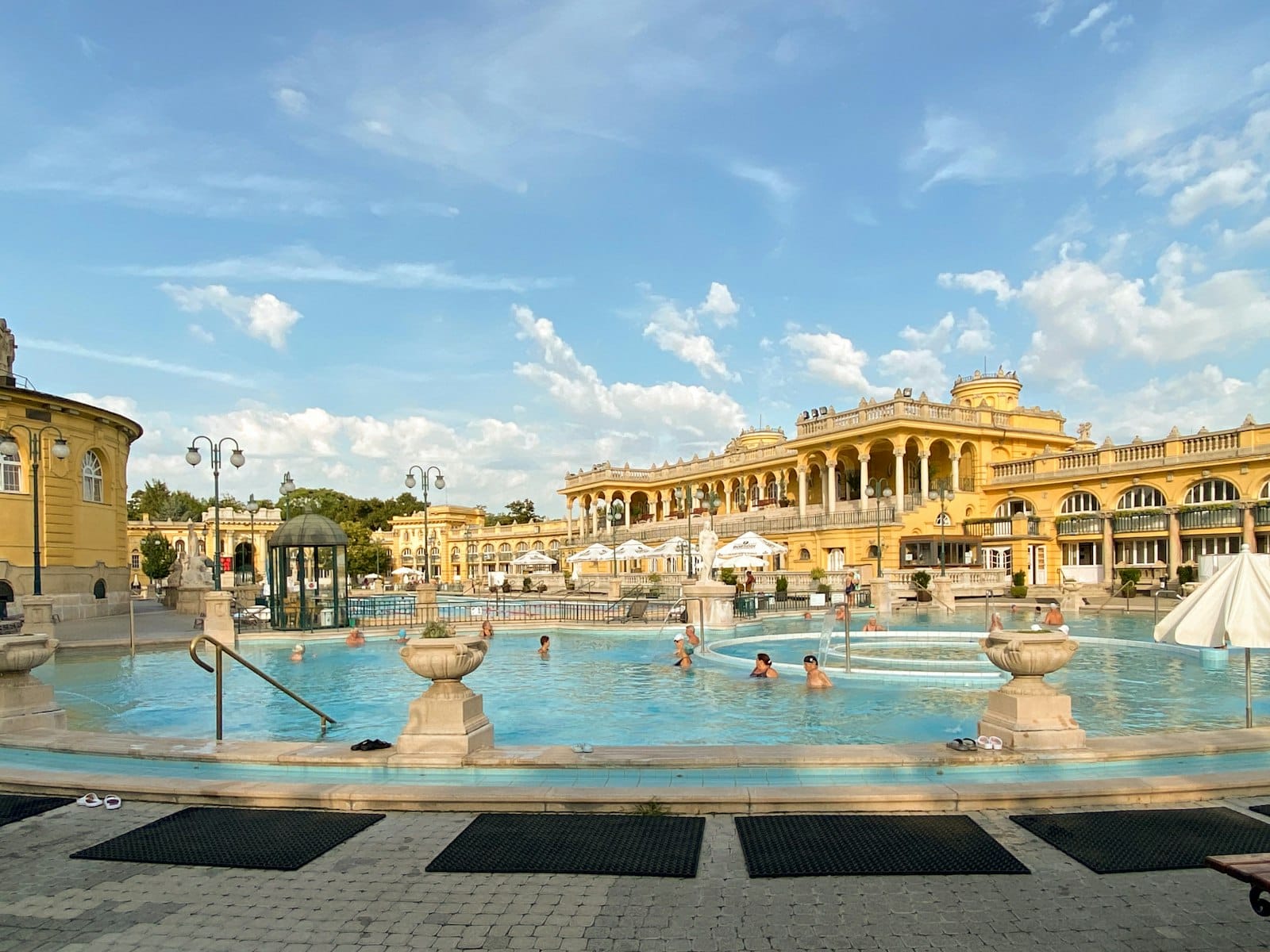
The Széchenyi Medicinal Bath and Swimming Pool is not a spa hotel, a wellness centre, or a boutique retreat. It is a publicly accessible thermal bath complex of considerable scale, built into a Neo-Baroque palace at the edge of City Park. When you step through its main archway on Állatkerti körút, you enter a courtyard containing three large outdoor pools, and behind them, a warren of indoor halls holding 15 more. Eighteen pools in total, fed by thermal springs first discovered during drilling operations in City Park in 1879.
The complex opened in 1913, making it one of Budapest's earlier large public baths. Its architecture was designed to impress: yellow plaster facades, rounded domes, colonnaded corridors, and carved stone details that place it firmly in the imperial European tradition. The building alone earns a look even if you have no intention of bathing.
In terms of size, Széchenyi is consistently described as one of the largest medicinal bath complexes in Europe. Compared with the more intimate Rudas Thermal Bath or the Jugendstil grandeur of Gellért Thermal Bath, Széchenyi trades atmosphere for capacity. That distinction matters when you are planning your visit.
The Pools: Outdoor and Indoor
The three outdoor pools dominate the courtyard and are the visual centerpiece of Széchenyi. The largest is a swimming pool maintained at a cooler temperature, suitable for lap swimming. The two smaller outdoor pools are thermal, held at roughly 36–38°C, and these are where most visitors congregate. On cold mornings, the contrast between the warm water and the winter air produces a theatrical amount of steam, making this one of the more striking thermal bath experiences in the city.
💡 Local tip
The outdoor pools operate year-round, including in snow and frost. A winter morning visit, ideally on a weekday before 10:00, offers the most dramatic steam effects and the fewest crowds.
Indoor facilities include additional thermal pools at varying temperatures, a large swimming hall, saunas, steam rooms, and a range of bookable massage and treatment services. The indoor spaces feel older and more utilitarian than the outdoor courtyard. Tiles show their age in places, and the corridors between changing rooms and pool halls can be confusing on a first visit. Give yourself a few minutes to orient before committing to a direction.
On weekend afternoons, particularly in summer, the outdoor pools fill to a point where the experience shifts from relaxing to social. Groups gather around the pool edges, music occasionally plays, and the atmosphere more closely resembles a lively public park than a wellness retreat. This is not necessarily a drawback, depending on what you are looking for, but it is worth knowing in advance.
Tickets & tours
Live prices and dates from our booking partner. If you book, we may earn a commission at no extra cost to you.
How the Experience Changes by Time of Day
Early morning on a weekday is the quietest window. The bath opens at 07:00 Monday through Thursday and on Friday, and at 08:00 on weekends. Arriving within the first hour, you will share the outdoor pools with mostly local regulars: older men playing chess on floating boards in the corner pool, serious swimmers doing lengths in the main pool, and a low ambient noise level that lets you actually hear the water. The steam is densest at this hour.
By mid-morning on any day, tour groups begin arriving. The outdoor pools gain a different energy: more English, German, and Spanish spoken around you, more selfie-taking on the pool steps, more general buoyancy. The atmosphere is not unpleasant, but the sense of calm diminishes noticeably.
Late afternoon and evening visits are underrated. On Fridays, the bath stays open until 22:00, and the outdoor pools take on a different character under artificial lighting. The crowds thin after 18:00, the temperature drops outside, and the thermal pools become genuinely restorative rather than merely crowded. Friday evenings are worth considering specifically for this reason.
Getting There and Buying Tickets
The most direct route is Metro Line M1, the yellow line, which is itself one of Budapest's most historically significant pieces of infrastructure. The Széchenyi fürdő station deposits you directly at the bath entrance, and the short walk from the platform to the ticket hall takes under two minutes. Line M1 connects through central Pest, with stops at Vörösmarty tér, Deák Ferenc tér, and Bajcsy-Zsilinszky út, making it accessible from most of the main visitor areas.
Trolleybus 72 is an alternative if you are approaching from a direction that suits it. If you are combining Széchenyi with other attractions in City Park, the area is walkable from Heroes' Square in about five minutes.
Tickets are sold in Hungarian forints and priced differently depending on whether you take a locker or a changing cabin, and whether you add treatments. Prices are updated periodically, so check the official prices page at szechenyibath.hu/prices before arriving to avoid surprises. Buying tickets online in advance is available and recommended during busy periods, as walk-up queues at the ticket windows can stretch considerably on summer weekends.
ℹ️ Good to know
The Budapest Card includes discounted or free entry to Széchenyi depending on the card type. If you are visiting multiple paid attractions, this may reduce your overall costs. Verify inclusions on the card's official page before purchasing.
What to Bring and How to Prepare
You will need a swimsuit. Towels and rubber flip-flops (required in some areas) can be rented on-site, but bringing your own is cheaper and more convenient. A small waterproof bag for your phone and locker key wristband is useful. Many visitors bring goggles if they intend to use the swimming pools seriously.
The water is rich in minerals, and repeated exposure can leave skin feeling dry. Bringing a small bottle of body lotion for after is a practical detail many first-timers overlook. The changing facilities include showers and hair dryers are available in some areas, though availability varies.
On accessibility: the official site offers a dedicated accessible version and a phone contact for accessibility queries at +36 20 435 0051 (reachable 08:00 to 17:00). The main outdoor pool area is on ground level, but the bath is not accessible by wheelchair and some interior sections involve steps and older infrastructure that may present challenges. Contact the bath directly in advance if mobility is a consideration.
Photography and the Architecture
The exterior of Széchenyi, particularly the main facade facing the park, photographs best in early morning light when the low sun catches the yellow plasterwork. The inner courtyard, with its pools framed by columns and domed towers at either end, is the signature image of the bath. Wide-angle lenses work well here.
The building fits into a broader conversation about Budapest's architectural heritage. The Neo-Baroque style places it alongside other late 19th and early 20th century landmark buildings across the city. Visitors interested in this period of Budapest's built environment will find more to explore in the Budapest Art Nouveau guide, which covers the wider context of the era.
Photography inside the pools is a grey area. Phones and cameras are technically permitted in many areas, but photographing other bathers without consent is inappropriate and increasingly policed by staff. Keep photography focused on architecture rather than people.
Honest Limitations: When Széchenyi Disappoints
Széchenyi's popularity is its most significant drawback. On summer weekend afternoons, the outdoor pools can feel overcrowded to the point where the restorative element of the experience is largely gone. The water remains warm, but the noise level, the difficulty of finding a free spot on the pool steps, and the general crush of bodies make it feel closer to a theme park than a bath.
The indoor sections, while historically interesting, are functional rather than luxurious. Visitors expecting the lavish tile work and atmospheric grandeur of Gellért's main pool will find Széchenyi's interiors more workmanlike by comparison. If atmosphere and aesthetic experience are your priority over pool variety and scale, Gellért or Rudas may serve you better.
⚠️ What to skip
Avoid visiting on Saturday or Sunday afternoons in July and August unless you enjoy a very social, crowded pool environment. For a genuinely relaxing experience, weekday mornings are the practical answer.
For a fuller picture of Budapest's thermal bath options and how they compare, the Budapest thermal baths guide covers the main choices side by side.
Insider Tips
- The chess players in the corner outdoor pool are a long-standing local tradition. Floating chess boards are set up between bathers, and games can run for hours. You are welcome to watch, and some regulars will accept a challenge from a stranger.
- Friday evening is the single best time slot for most visitors: the bath is open until 22:00, crowds thin after 18:00, and the outdoor pools under lighting in cool air are genuinely atmospheric.
- The locker option is cheaper than a cabin but means changing in a shared room. If you are travelling light with a small bag, a locker is entirely sufficient and saves a meaningful amount on entry cost.
- The M1 metro is itself worth attention: it is one of the oldest underground railway lines in continental Europe, opened in 1896, and the station interiors retain much of their original character.
- Food and drinks are available on-site but are expensive for what they are. Eating beforehand or bringing a snack in your bag for after is the more practical approach.
Who Is Széchenyi Thermal Bath For?
- Travellers visiting Budapest in winter or autumn, when the outdoor pools in steam are at their most dramatic
- Anyone wanting to combine a thermal bath with a walk through City Park and a visit to nearby museums
- Couples looking for a relaxed afternoon that does not require a fixed itinerary
- Solo travellers comfortable in a public social environment with minimal language barrier
- Architecture enthusiasts interested in early 20th century Central European public building
Nearby Attractions
Other things to see while in City Park (Városliget):
- Budapest Zoo & Botanical Garden
Founded in 1866, the Budapest Zoo & Botanical Garden is Hungary's oldest zoological institution, occupying a leafy corner of City Park in District XIV. Its mix of historic Secessionist architecture, diverse animal collection, and botanical exhibits makes it a genuinely rewarding stop for families and architecture-curious travelers alike.
- Museum of Ethnography
Relocated to a landmark new building in City Park in 2022, the Museum of Ethnography (Néprajzi Múzeum) is one of Europe's most significant collections of folk and traditional culture. With over 250,000 objects spanning Hungarian rural life and global ethnographic traditions, it rewards visitors who want more than a postcard version of Hungary.
- Museum of Fine Arts (Szépművészeti Múzeum)
Facing Heroes' Square in City Park, the Museum of Fine Arts holds one of Central Europe's most significant collections of international art, spanning Egyptian antiquities to Spanish masters. Built between 1900 and 1906, the neoclassical building alone is worth the visit. Here is everything you need to plan a worthwhile trip.
- Vajdahunyad Castle
Vajdahunyad Castle in Budapest's City Park is a single complex that condenses a thousand years of Hungarian architectural history into one walkable site. Entry to the courtyards is free and open around the clock, making it genuinely worth an hour or two at any time of day. The Hungarian Agricultural Museum inside adds depth for those who want more than a photo stop.
Planning a trip? Discover personalized activities with the Nomado app.