Budapest Zoo & Botanical Garden: What to Know Before You Visit
Founded in 1866, the Budapest Zoo & Botanical Garden is Hungary's oldest zoological institution, occupying a leafy corner of City Park in District XIV. Its mix of historic Secessionist architecture, diverse animal collection, and botanical exhibits makes it a genuinely rewarding stop for families and architecture-curious travelers alike.
Quick Facts
- Location
- 1146 Budapest, Zoo Boulevard 6–12 (Állatkerti krt. 6–12), City Park, District XIV
- Getting There
- Metro M1 (yellow line), Széchenyi fürdő stop — 2-minute walk to the main gate
- Time Needed
- 2.5–4 hours for a thorough visit; 90 minutes for a focused walk
- Cost
- Adult 5,900 HUF / Child 4,200 HUF (April–November 2026 season pricing; verify before visiting)
- Best for
- Families, architecture enthusiasts, and anyone combining a City Park half-day
- Official website
- zoobudapest.com
Why the Budapest Zoo Deserves More Than a Passing Glance
The Budapest Zoo & Botanical Garden, known in Hungarian as the Fővárosi Állat- és Növénykert, is easy to treat as an afterthought on a City Park afternoon. That would be a mistake. Founded in 1864 and opened to the public in 1866, it is Hungary's oldest zoo and one of the oldest continuously operating zoological gardens in Europe. What sets it apart from a generic city zoo is the architecture: the main entrance gate, the elephant house, and several pavilions are textbook examples of Hungarian Secessionist design, built around the turn of the 20th century when the zoo underwent a major reconstruction. Walking through the grounds feels less like visiting a modern wildlife park and more like moving through an open-air museum that happens to contain living animals.
The zoo sits on the northern edge of City Park (Városliget), directly adjacent to the famous Széchenyi Thermal Bath. This location is a genuine advantage for trip planning: you can pair the zoo with the baths, Heroes' Square, or Vajdahunyad Castle in a single well-structured day without crossing town.
💡 Local tip
The Metro M1 (Budapest's historic underground, the first metro on the European continent) stops at Hősök tere and Széchenyi fürdő, placing you within a few minutes on foot from the zoo's main entrance. It is the most convenient and fastest option from central Pest.
The Architecture: A Zoo Built Like a Palace
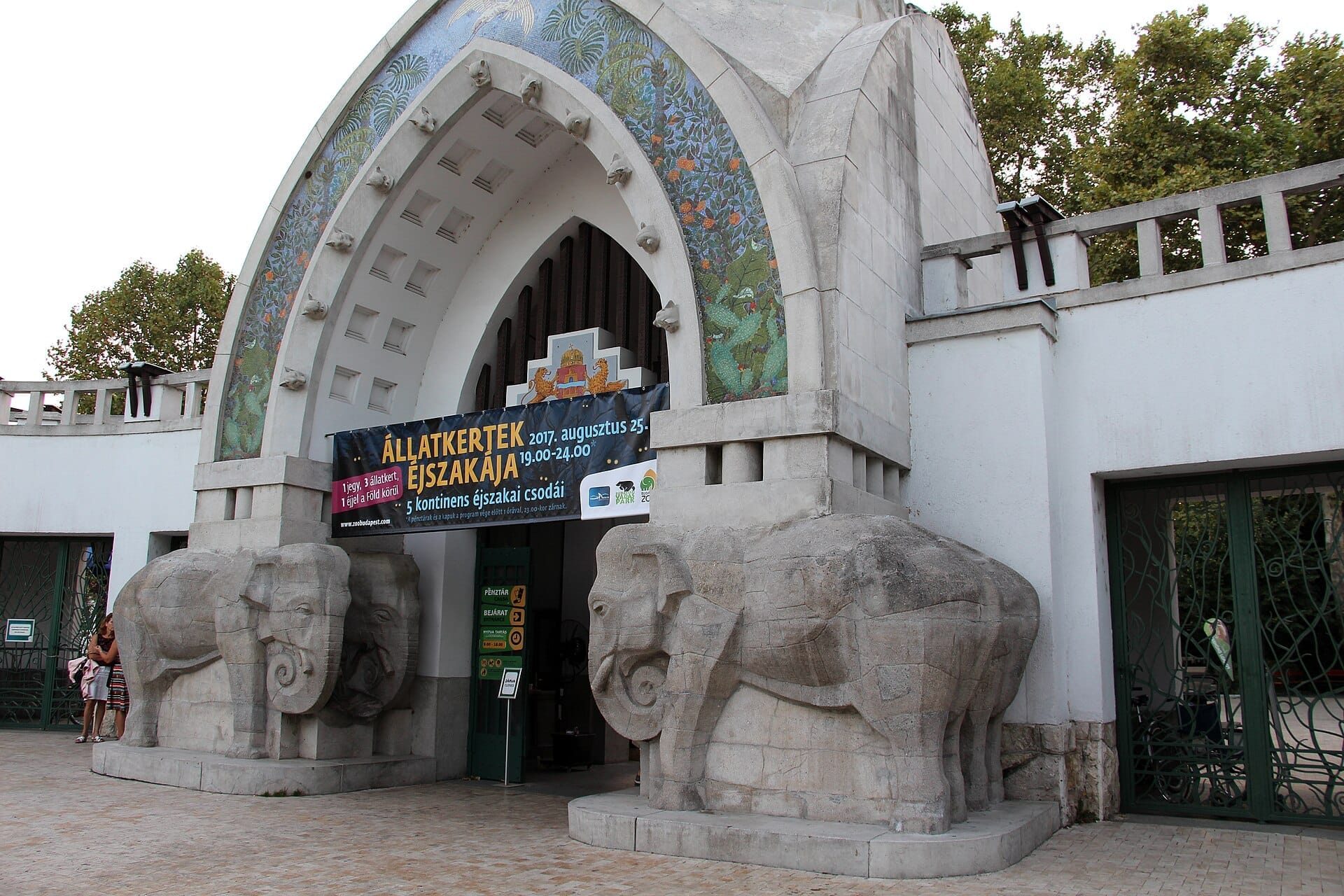
The zoo's visual identity is defined by the reconstruction carried out between 1909 and 1912, led by architects Kornél Neuschloss-Knüsli and Dezső Zrumeczky. The main entrance gate is the most photographed element: a pair of ornate stone towers flanking wrought-iron gates, decorated with animal motifs and ceramic tile work in the style of Ödön Lechner's broader Secessionist influence on Budapest. The towers are topped with stone bears, and the detailing rewards slow inspection — most visitors walk straight past details that took craftsmen weeks to produce.
Inside, the Elephant House is the architectural centerpiece. Its domed roof, decorative tilework, and Moorish-influenced arches make it feel closer to a bathhouse than an animal enclosure. The Palm House, a large 19th-century greenhouse structure, contains tropical plant collections and provides a warm refuge on overcast days. Neither building has been sanitized into something modern: the patina and slight eccentricity of these structures is part of the atmosphere.
If Art Nouveau architecture interests you more broadly, Budapest offers it in unusual concentration. The zoo's Secessionist pavilions sit within the wider context described in our Budapest Art Nouveau guide, which covers the city's defining buildings in that style.
Tickets & tours
Live prices and dates from our booking partner. If you book, we may earn a commission at no extra cost to you.
Budapest Guided E-Scooter Tour by Night
From 60 €Instant confirmationFree cancellationHalf-day tour to Princess Sissi's Godollő royal palace from Budapest
From 41 €Instant confirmationFree cancellationHalf-Day Countryside Wine Tour from Budapest
From 95 €Instant confirmationFree cancellationWalking tour of Pest
From 10 €Instant confirmationFree cancellation
The Animals and Botanical Collections
The zoo houses more than 1,000 animal species across its grounds. The range is broad: large African mammals, big cats, primates, reptile houses, aviaries, and a dedicated aquarium section. The hippopotamus enclosure and the giraffe house tend to draw the longest crowds during peak hours, particularly late morning when keepers are often active in the enclosures.
The botanical element is not just a label. The grounds include labeled specimen trees, a rose garden, and the tropical greenhouse, which houses plants from humid climates that would otherwise be impossible to see in Central Europe outside of indoor collections. In spring, the borders throughout the zoo are well-maintained and colorful. In autumn, the deciduous trees in the park give the whole area a warm, amber quality that makes the visit feel different from the summer crowds experience.
The reptile and aquarium section is housed in a separate building and is worth allocating 20–30 minutes. It is consistently cooler than the outdoor enclosures, which makes it a practical mid-afternoon stop on hot summer days when the zoo is at its most crowded and the outdoor paths feel sluggish.
When to Visit: Time of Day and Season
Opening hours during the April to November 2026 season run Monday through Friday 09:00–18:00 and Saturday through Sunday 09:00–19:00. Arriving at opening time on a weekday is the clearest path to a quieter visit. By 10:30 on weekends, school groups and families with young children have filled the main paths, and the popular enclosures can feel genuinely congested.
Summer (June–August) brings the highest visitor numbers. The zoo is set on relatively flat ground with some tree cover, but the open paths between enclosures offer limited shade on hot days. Bring water. Early morning visits in summer have a noticeably different character: cooler air, more active animals, and substantially thinner crowds near the larger mammal enclosures.
Spring and early autumn are the most comfortable seasons for extended visits. May and September offer mild temperatures — typically 15–20°C — without the July heat. Rain is a possibility in May and June, and a light layer or compact umbrella is worth packing. The botanical sections look their best in May when flowering plants are at peak display.
⚠️ What to skip
Opening hours and ticket prices vary by season. The figures listed here apply to the April–November 2026 period. Check zoobudapest.com directly before visiting, as winter hours and pricing differ.
Practical Walkthrough: How the Visit Actually Flows
The main entrance on Állatkerti körút (Zoo Boulevard) is the natural starting point. Buy tickets at the gate or, if available, online in advance to skip the queue during peak weekend hours. The grounds are not enormous — a full circuit covering all sections takes roughly two to three hours at a relaxed pace. There is a central path that forms a loose loop, with secondary routes branching toward specific houses.
Strollers and pushchairs are manageable on the main paths, which are paved and level. Some secondary paths near older enclosures are less smooth, but the zoo is broadly accessible for visitors with limited mobility. For precise accessibility information, check the official website directly before visiting.
There are several cafes and kiosk-style food stalls inside the zoo. The food is functional rather than notable — think sandwiches, ice cream, and hot drinks. If you are visiting City Park more broadly, the restaurant options in the surrounding park and near Heroes' Square are generally better value. The zoo does not permit outside food to be consumed in some areas, but picnicking is possible in designated sections.
💡 Local tip
Photography is unrestricted in the open enclosures. The Elephant House interior and the Palm House provide interesting architectural backdrops even when animals are not cooperative. Morning light through the greenhouse glass is particularly useful for plant photography.
Honest Assessment: Is It Worth Your Time?
Budapest offers a dense concentration of world-class attractions, and on a short trip the zoo can feel like a lower-priority option compared to the Parliament, the thermal baths, or the castle district. That assessment is fair if you have two days or fewer in the city. But for travelers with children, those spending three days or more, or those specifically interested in Secessionist architecture, the zoo is more rewarding than many short-trip itineraries suggest.
Travelers who skip the zoo and find themselves in City Park regardless should at minimum walk past the main entrance gate — it takes two minutes and costs nothing. For a fuller sense of what City Park contains, the Budapest with kids guide covers the area's family-friendly options in context, and our things to do in Budapest overview helps prioritize across the whole city.
The zoo is not a state-of-the-art modern wildlife park with vast naturalistic habitats. Visitors expecting the scale and investment of major Western European zoos may find some older enclosures modest. The value here is the combination of architectural heritage, botanical content, and animal collection in a single walkable setting, not any single element in isolation.
Insider Tips
- The Metro M1 (yellow line) that serves the zoo is itself a heritage attraction: opened in 1896, it was the first metro line on the European continent. Riding it to the zoo and back from Vörösmarty tér adds low-cost historical texture to the trip.
- The main entrance gate is most photogenic in the late afternoon when the sun falls on the decorated stone towers from the west. Morning light hits the facade flatly; the ornamental detail reads better with some shadow.
- The Elephant House interior is frequently overlooked by visitors who check that elephants are present and move on. Spend five minutes looking at the ceiling and tilework — the craftsmanship in the dome and supporting arches is the architectural highlight of the entire zoo.
- Weekday mornings in May and September represent the lowest-crowd window of the annual calendar. If your trip timing allows any flexibility, these windows offer the same experience with noticeably more space on the paths.
- The zoo shares a perimeter wall with the Széchenyi Thermal Bath complex. If combining both in a single day, visit the zoo first (morning) and the baths in the afternoon: bath crowds peak earlier in the day than most visitors expect.
Who Is Budapest Zoo & Botanical Garden For?
- Families with children under 12 looking for a half-day activity away from the city's adult-oriented attractions
- Architecture enthusiasts interested in Hungarian Secessionist design outside of the standard building-by-building tour
- Travelers on a three-day-plus itinerary who have covered the main landmarks and want a different kind of afternoon
- Visitors combining multiple City Park attractions in a single day
- Botanical and plant photography enthusiasts, particularly in May when the greenhouse and outdoor borders are at peak color
Nearby Attractions
Other things to see while in City Park (Városliget):
- Museum of Ethnography
Relocated to a landmark new building in City Park in 2022, the Museum of Ethnography (Néprajzi Múzeum) is one of Europe's most significant collections of folk and traditional culture. With over 250,000 objects spanning Hungarian rural life and global ethnographic traditions, it rewards visitors who want more than a postcard version of Hungary.
- Museum of Fine Arts (Szépművészeti Múzeum)
Facing Heroes' Square in City Park, the Museum of Fine Arts holds one of Central Europe's most significant collections of international art, spanning Egyptian antiquities to Spanish masters. Built between 1900 and 1906, the neoclassical building alone is worth the visit. Here is everything you need to plan a worthwhile trip.
- Széchenyi Thermal Bath
Opened in 1913 and spanning 18 pools across a Neo-Baroque palace in Budapest's City Park, Széchenyi Medicinal Bath and Swimming Pool is one of the largest thermal bath complexes in Europe. This guide covers what the experience actually feels like, the best times to visit, and the practical details that will save you time on arrival.
- Vajdahunyad Castle
Vajdahunyad Castle in Budapest's City Park is a single complex that condenses a thousand years of Hungarian architectural history into one walkable site. Entry to the courtyards is free and open around the clock, making it genuinely worth an hour or two at any time of day. The Hungarian Agricultural Museum inside adds depth for those who want more than a photo stop.
Planning a trip? Discover personalized activities with the Nomado app.