Heroes' Square (Hősök tere): Budapest's Most Monumental Public Space
At the end of Andrássy Avenue, Heroes' Square frames Hungary's founding mythology in stone and bronze. The Millennium Monument, two flanking museums, and a sweeping open plaza combine to make this one of the most visually commanding public spaces in Central Europe. Entry is free, the metro stops right here, and it rewards visitors at almost any hour.
Quick Facts
- Location
- Hősök tere, 1146 Budapest (end of Andrássy Avenue, edge of City Park)
- Getting There
- Metro Line M1 – Hősök tere station (direct, surface exit at the square)
- Time Needed
- 30–60 min for the square itself; half a day if combining with the flanking museums
- Cost
- Free (square is open 24/7); nearby museums charge separate admission
- Best for
- History, architecture, photography, and anyone arriving from Andrássy Avenue
What You're Actually Looking At
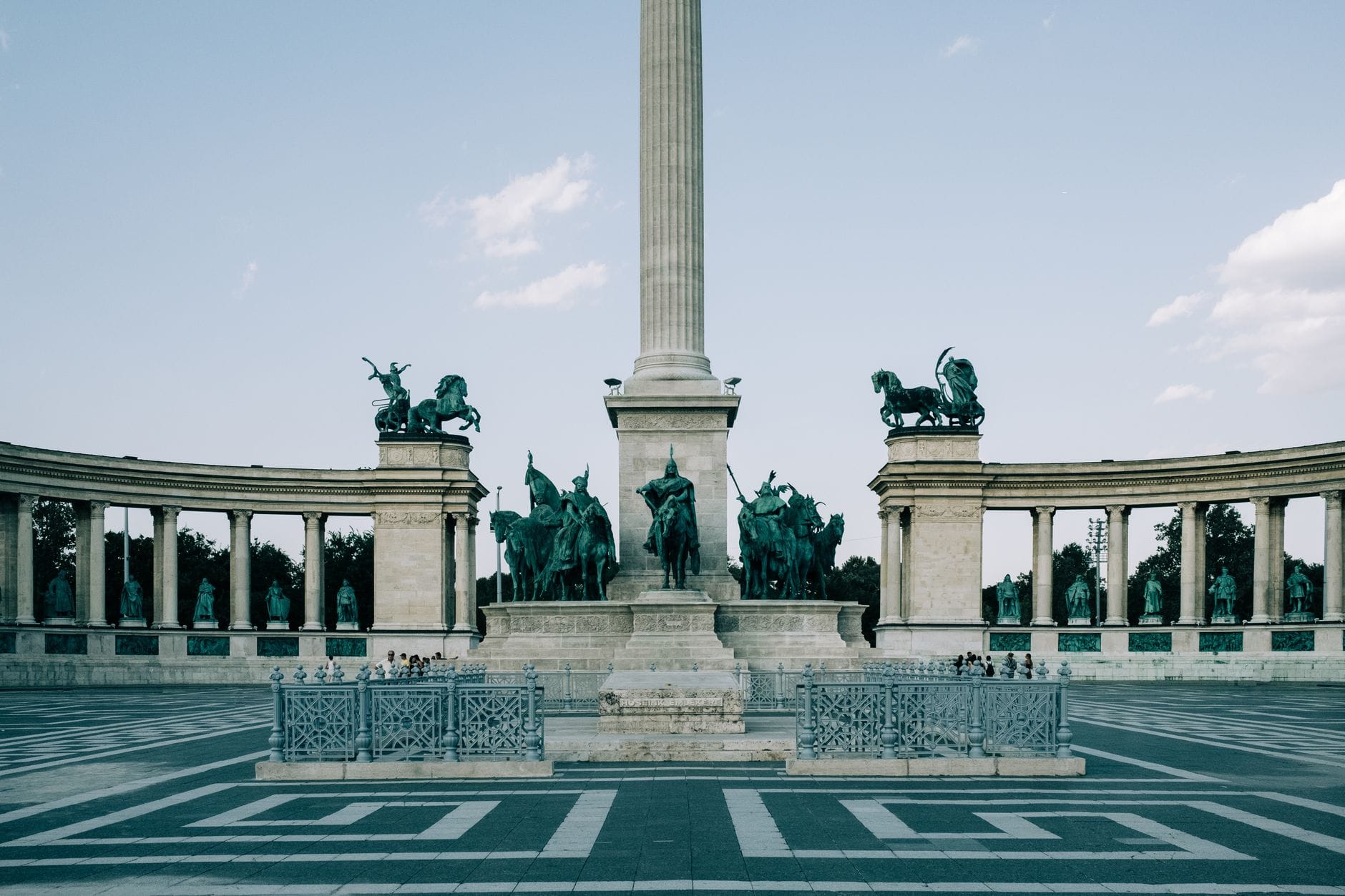
Heroes' Square (Hősök tere) is a UNESCO World Heritage-listed public square that marks the ceremonial terminus of Andrássy Avenue. The centerpiece is the Millennium Monument, a large semicircular colonnade arranged around a 36-meter Corinthian column topped by a gilded figure of Archangel Gabriel. The column and surrounding sculptures were built for Hungary's millennial celebrations in 1896, marking roughly 1,000 years since the Magyar tribes settled the Carpathian Basin under chieftain Árpád.
The monument is structured in two parts. The central column shows Árpád and the six other chieftains who led the Hungarian conquest, their bronze figures arranged around the base in a tight, almost narrative frieze. Behind them, two curved colonnades frame the space symmetrically, each lined with statues of Hungarian kings and national heroes from Stephen I through the 19th century. The names read like a condensed national history: Saint László, King Matthias Corvinus, Prince Ferenc Rákóczi II. Between the colonnades, two large stone blocks function as symbolic sarcophagi honoring unknown soldiers.
What strikes most visitors immediately is the scale. The square's open paving gives it an almost uncomfortable vastness on quiet days, which is part of the point: it was designed as a backdrop for state ceremonies, and it still serves that role. Major state funerals, military parades, and national commemorations have taken place here throughout the 20th century and into the present.
ℹ️ Good to know
The Millennium Monument was completed in stages. Some statues in the colonnades were replaced after World War II when the Communist government removed Habsburg rulers and substituted figures more acceptable to the new political order. The original Habsburg statues were restored after 1989, and the central Memorial Stone of Heroes is often mistakenly referred to as a Tomb of the Unknown Soldier.
The Experience at Different Times of Day
Early morning, usually before 8:30 a.m., the square is largely empty. The pavement reflects the pale sky, pigeons own the space, and the column casts a long shadow across the plaza. This is the best window for photography: no tour groups in the foreground, soft directional light on the bronze reliefs, and a stillness that lets the scale register properly. The nearby Museum of Fine Arts and Kunsthalle (Hall of Art) are closed, so traffic is minimal.
By mid-morning, organized tour groups arrive in waves, often disembarking from coaches that park along the perimeter. The square can absorb large crowds without feeling chaotic, but between roughly 10 a.m. and 1 p.m. the central viewing area around the Árpád group becomes congested. Guided groups cluster for photographs, and the acoustic environment shifts: you'll hear Hungarian, German, English, and Mandarin simultaneously. If you want to read the inscriptions on the colonnade statues at your own pace, come earlier or later.
Late afternoon, especially in spring and autumn when the light comes in low across the avenue, the square takes on warmer tones and the relief work on the sculptures reads more clearly. Local joggers and cyclists cut through from City Park, and the atmosphere becomes less ceremonial and more lived-in. On summer evenings, the open space occasionally fills with outdoor events, so it is worth checking what is scheduled if you plan an evening visit. After dark, the monument is lit, and the colonnade details become partially shadowed in a way that is atmospheric but less useful for reading the iconography.
Tickets & tours
Hand-picked options from our booking partner. Prices are indicative; availability and final rates are confirmed when you complete your booking.
Budapest Guided E-Scooter Tour by Night
From 60 €Instant confirmationFree cancellationHalf-day tour to Princess Sissi's Godollő royal palace from Budapest
From 41 €Instant confirmationFree cancellationHalf-Day Countryside Wine Tour from Budapest
From 95 €Instant confirmationFree cancellation4 Course Dinner cruise with Operetta and Folk show
From 81 €Instant confirmationFree cancellation
Historical and Cultural Context
To understand why this square matters, it helps to know a little about 1896. Hungary had been part of the Austro-Hungarian Empire since 1867 under a dual-monarchy arrangement, and the millennial celebrations were a deliberate assertion of Hungarian national identity within that framework. The Millennium Monument was the anchor of a citywide program that also included the construction of several museum buildings and the inauguration of Metro M1 beneath Andrássy Avenue (Andrássy itself had already been inaugurated in 1876). Metro M1 remains one of the earliest electric underground railways in continental Europe.
The choice of Archangel Gabriel at the top of the column carries theological weight: according to legend, Pope Sylvester II sent a crown to King Stephen I of Hungary at Gabriel's direction, legitimizing Christian kingship in the region. The 1896 monument was thus as much a statement about divine mandate as it was about ethnicity. For visitors interested in how architecture encodes political meaning, Heroes' Square is one of the most readable examples in the region. The history of Budapest is impossible to separate from the ideological layers embedded in this square.
The square's most politically charged moment came in 1989, when the reburial of Imre Nagy, the reformist Prime Minister executed after the 1956 uprising, drew hundreds of thousands of people here. That ceremony is widely considered a symbolic turning point in Hungary's transition away from Communist rule. A small stone marker near the base of the monument references this history, though it is easy to overlook amid the larger sculptural program.
The Two Museums Framing the Square
Heroes' Square is flanked by two grand neoclassical buildings that were both part of the original 1896 development. On the left (north) side stands the Museum of Fine Arts Budapest, which holds one of the largest collections of European art in Central Europe, including significant works by El Greco, Raphael, and Goya. On the right (south) side is the Kunsthalle Budapest (Műcsarnok), a major contemporary exhibition venue with no permanent collection but a high-quality rotating program. Both buildings are worth considering separately from your visit to the square itself; neither is a quick detour.
If you plan to visit the Museum of Fine Arts, check in advance whether the Budapest Card covers admission, as it sometimes does. Ticket prices and opening hours for both institutions change seasonally, so verify details directly before your visit. Neither museum is fully capturable in under two hours.
💡 Local tip
The Museum of Fine Arts is closed on Mondays. If your schedule puts you at Heroes' Square on a Monday, plan on spending your time outside with the monument rather than stepping inside either flanking building.
Getting There and Getting Around
Metro Line M1, the yellow line, is the simplest option. Opened in 1896 as part of the same millennial project as the square itself, it is among the earliest electric underground railways in continental Europe. The Hősök tere station exits directly at the plaza: you walk up the stairs and the column is in front of you. The M1 connects through central Pest, passing stations like Deák Ferenc tér (main interchange hub), Vörösmarty tér, and Opera. If you are coming from the city center, the ride from Deák is about 10 minutes. The journey along Andrássy Avenue above ground is also excellent on foot: the avenue is a UNESCO World Heritage corridor in its own right, lined with grand apartment buildings, embassies, and the Hungarian State Opera House.
Several bus lines also serve the area, stopping nearby on Dózsa György út. Cycling is practical: Budapest has a public bike-share system (MOL Bubi), and a cycling lane runs part of the route from central Pest. The square itself has substantial open paving, which is manageable with a pushchair or wheelchair, and the M1 station, while historic, has limited accessibility infrastructure, so visitors with mobility requirements should check BKK's current station access information before traveling.
Photography, Practicalities, and Who Should Skip It
For photography, a wide-angle lens is useful: the full span of the colonnades from the central column requires stepping back further than many visitors expect. The best single vantage point is from the avenue side, roughly 80 to 100 meters back from the monument, which gives you the full symmetry of the composition. In summer, the midday light is harsh and flat; early morning or the hour before sunset produces the most detail in the bronze reliefs.
The square is exposed and offers almost no shade. On hot summer days (Budapest regularly reaches 30°C in July and August), bring water. In winter, wind funnels down Andrássy Avenue with some force, and the open pavement amplifies the cold. The best months for an outdoor visit are May, early June, September, and October. For a broader sense of when to plan your trip, the best time to visit Budapest guide covers the seasonal trade-offs in detail.
Who might skip this? Travelers with no interest in political history or monumental architecture will find the square underwhelming: it is essentially a large open plaza with statues. If you have very limited time in Budapest and must choose between this and more compact, atmospheric sites, be aware that Heroes' Square is better for contemplation and context than for visceral urban experience. It is not a place you wander through; it is a place you read, slowly. Children under about ten often find the scale impressive for about five minutes and then want to move on toward City Park, which is immediately adjacent.
💡 Local tip
City Park (Városliget) begins directly behind the colonnades. After spending time at Heroes' Square, walking through the park to Vajdahunyad Castle takes under ten minutes and keeps the momentum of the visit going without requiring transport.
Insider Tips
- Stand at the very center of the open plaza and look back toward Andrássy Avenue: the tree-lined boulevard frames the distance perfectly and gives a sense of how deliberately the whole urban axis was designed.
- The stone relief panels along the colonnade bases depict allegorical scenes of Hungarian history. Most visitors photograph the standing statues and ignore the friezes entirely, but they contain the most detailed narrative content in the whole monument.
- Early Sunday mornings, the square is occasionally used by skateboarders and inline skaters before the tourist groups arrive. The long flat paving is ideal for it, and the informal energy is a striking contrast to the monument's severity.
- The Hősök tere M1 station has original late-19th-century platform tiling and wooden fittings. Take a moment on the platform: the station itself is a heritage object, not just a transport stop.
- If you are visiting in late afternoon and the Kunsthalle has a current exhibition, check whether it is on: admission is separate from the square, but the building's interior proportions are worth experiencing even if the show is not your primary interest.
Who Is Heroes' Square (Hősök tere) For?
- History and architecture enthusiasts who want to understand how national identity gets built into physical space
- Photographers looking for wide-open monumental compositions, especially in early morning light
- First-time Budapest visitors following the Andrássy Avenue corridor from the city center
- Travelers pairing the square with a visit to the Museum of Fine Arts or City Park next door
- Anyone interested in 20th-century Central European political history, particularly the events of 1956 and 1989
Nearby Attractions
Other things to see while in Andrássy Avenue:
- Hungarian State Opera House
The Hungarian State Opera House (Magyar Állami Operaház) stands on Andrássy Avenue as one of Europe's most ornate Neo-Renaissance buildings. Whether you attend a performance or join a guided tour, the gilded interior alone justifies the trip.
- House of Terror (Terror Háza)
The House of Terror Museum on Andrássy Avenue occupies the former headquarters of Hungary's fascist Arrow Cross and communist secret police. It is one of the most emotionally direct history museums in Central Europe, combining original architecture with immersive exhibits across two floors and a basement that once held cells.