Museum of Ethnography Budapest: A Living Archive of Hungarian Culture
Relocated to a landmark new building in City Park in 2022, the Museum of Ethnography (Néprajzi Múzeum) is one of Europe's most significant collections of folk and traditional culture. With over 250,000 objects spanning Hungarian rural life and global ethnographic traditions, it rewards visitors who want more than a postcard version of Hungary.
Quick Facts
- Location
- Dózsa György út 35, H-1146 Budapest (edge of City Park, near Heroes' Square)
- Getting There
- Hősök tere station (Metro M1, Millennium Underground); tram and bus lines also serve the area
- Time Needed
- 2–3 hours for the permanent collection; longer if temporary exhibitions are running
- Cost
- Adults approx. 4,000–5,000 HUF; concessions approx. 2,000–2,500 HUF; children under 6 free; family ticket higher than 6,400 HUF. Verify on official site before visiting.
- Best for
- History enthusiasts, design lovers, families, and anyone curious about everyday Hungarian life beyond the Habsburg grandeur
- Official website
- www.neprajz.hu/en
What the Museum of Ethnography Actually Is
The Néprajzi Múzeum, known in English as the Museum of Ethnography, is not a dusty regional folklore archive. Founded as an independent ethnographic collection in 1872 and established as the Museum of Ethnography in 1947, it is one of the oldest and most extensive ethnographic institutions in Europe, holding a collection of roughly 200,000 to 250,000 objects. Those objects document not just Hungarian peasant and rural life but traditional cultures from across Central Europe, Asia, Africa, and the Pacific. The sheer geographic range is genuinely surprising once you walk through the doors.
The museum spent most of its history in a palatial neoclassical building on Kossuth Lajos tér facing the Hungarian Parliament. In 2022, after a long-awaited move, it reopened in a purpose-built contemporary building inside City Park, as part of the Liget Budapest urban development project, with the new building opening to visitors on 23 May 2022. That shift matters for visitors: the new space is dramatically different in atmosphere, scale, and ambition.
ℹ️ Good to know
The museum is open Tuesday through Sunday, 10:00–18:00, and closed on Mondays. Some public holidays may affect hours. Always verify on the official site (neprajz.hu) before making a special trip.
The Building Itself: Architecture Worth Arriving Early For
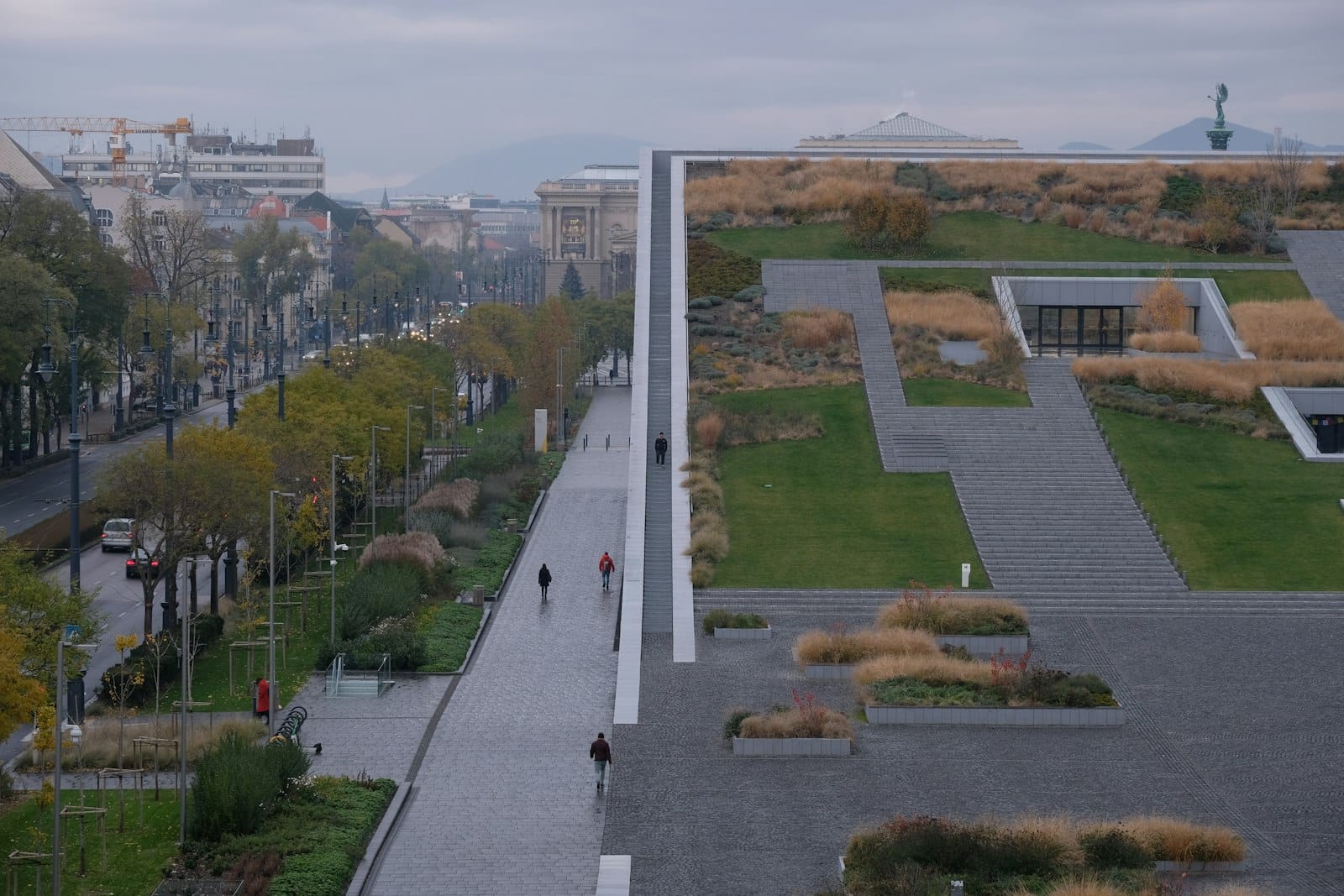
The new structure, designed by Napur Architect, is one of the more architecturally interesting public buildings to open in Budapest in recent years. Its most distinctive feature is a large, publicly accessible roof garden that slopes up from street level like a grass-covered hill, making the building read as a landform rather than a conventional box. From the top, you get clear sightlines toward Heroes' Square and the tree canopy of City Park.
Arriving around opening time on a weekday morning, the plaza in front of the building is calm. The facade uses a mix of glass and natural stone cladding, and light enters the interior through a central atrium that keeps the ground floor from feeling cavernous. The roof walk is free to access and worth doing even if you decide the entry price is not for you on that particular visit.
If architecture is a particular interest, the Museum of Ethnography pairs well with a walk along Heroes' Square and the nearby Vajdahunyad Castle, both within a ten-minute walk through City Park.
Tickets & tours
Hand-picked options from our booking partner. Prices are indicative; availability and final rates are confirmed when you complete your booking.
Budapest Guided E-Scooter Tour by Night
From 60 €Instant confirmationFree cancellationHalf-day tour to Princess Sissi's Godollő royal palace from Budapest
From 41 €Instant confirmationFree cancellationHalf-Day Countryside Wine Tour from Budapest
From 95 €Instant confirmationFree cancellationWalking tour of Pest
From 10 €Instant confirmationFree cancellation
Inside the Collection: What You Will Actually See
The permanent exhibition covers Hungarian traditional culture in layered, thematic sections: agricultural life, religious folk art, textile traditions, architecture, and the rituals that structured rural calendars. Objects range from intricately painted wooden furniture and embroidered ceremonial garments to carved shepherd's tools, ceramic vessels, and iron implements. The craftsmanship in the textiles alone justifies the ticket price.
The international ethnographic holdings occupy a separate wing and draw on material collected during the late 19th and early 20th centuries from Asia, Oceania, and sub-Saharan Africa. Some of this collection carries the uncomfortable colonial-era context that most major ethnographic museums now address openly; the Néprajzi Múzeum makes some effort to contextualize provenance, though the depth of that framing is uneven across galleries.
Temporary exhibitions rotate regularly and have covered topics from Hungarian village photography to cross-cultural research on death and mourning rituals. The quality tends to be high, with strong graphic design that makes even non-Hungarian speakers able to follow the narrative. English-language labeling throughout the permanent galleries is generally clear, though occasionally a case or two relies more heavily on Hungarian text.
💡 Local tip
Pick up a printed floor plan at the entrance desk. The building's layout is not immediately intuitive, and the thematic sections are spread across multiple levels. Having the map saves a significant amount of backtracking.
When to Visit and How Crowds Behave
Weekday mornings between 10:00 and 12:00 are the quietest window. The museum draws school groups in the late morning, particularly on Tuesdays and Wednesdays, so the ground-floor arrival areas can become lively with children by 11:00. Those groups tend to move through quickly and are rarely disruptive in the upper galleries.
Weekend afternoons are the busiest, especially on Saturdays when City Park itself draws large numbers of visitors. The roof garden becomes a social space on warm afternoons, which is pleasant but means fewer quiet moments up there. If you want the rooftop to yourself, arrive right at opening or within the last 45 minutes before closing.
Budapest's climate is worth factoring in. In summer, temperatures can reach 30°C, and the walk from the M1 metro stop to the museum across the open plaza is fully exposed to sun. In winter, the heated interior makes this one of the more comfortable cold-weather cultural stops in the city. For a broader look at timing a Budapest trip, the city's seasonal guide covers month-by-month conditions.
Getting There: Transit and On-Foot Options
The most direct route is Metro Line M1, Budapest's Millennium Underground, which is the oldest electric underground railway in continental Europe. Exit at Hősök tere (Heroes' Square) and the museum entrance is visible within a two-minute walk. The M1 runs frequently and connects directly to central Pest, making it the easiest option for most visitors.
Several tram and bus lines also serve Hősök tere, and the BKK journey planner at bkk.hu is the most reliable tool for current routing from your starting point. If you are walking from Andrássy Avenue, budget about ten minutes from the Kodály Körönd area. The walk through the end section of Andrássy is pleasant and passes some of the finest Art Nouveau architecture in the city.
For visitors planning a full day in the area, City Park contains several other institutions within walking distance, including the Széchenyi Thermal Bath and the Museum of Fine Arts, making it easy to pair visits without additional transit.
Photography, Accessibility, and Practical Details
Photography for personal use is generally permitted in the permanent galleries without flash. Some temporary exhibitions restrict photography, usually indicated clearly at the entrance to that section. The rooftop is fully open to photography, and the elevated angle over the park and toward the Heroes' Square colonnades is one of the more underused photo positions in this part of the city.
The new building was designed with accessibility as a priority. Step-free routes connect all levels via lifts, and the entrance plaza is flat and wide. For specific questions about wheelchair access to particular galleries or accessible toilet facilities, contacting the museum directly via neprajz.hu before your visit is the most reliable approach, as published third-party information on this is inconsistent.
The museum has a cafe and a shop selling books on Hungarian folk art, ethnographic research publications, and quality reproduction prints. The shop selection is more serious than the average museum gift store and worth browsing even if you buy nothing. Bags can be stored in lockers near the entrance, which is helpful if you are carrying luggage between accommodation check-in and check-out.
⚠️ What to skip
Ticket prices and opening hours at Hungarian museums change periodically and may differ from what is listed here. Always confirm current admission fees on the official website at neprajz.hu before your visit.
Honest Assessment: Is It Worth Your Time?
For visitors with a genuine interest in Central European history, folk culture, or ethnographic collections, the Museum of Ethnography is one of the stronger stops Budapest offers. The building alone is interesting, the collection is deep, and the English-language interpretation is solid enough for international visitors to follow without a guide.
For visitors primarily chasing architectural spectacle or quick visual highlights, the museum requires patience. The collection rewards slow looking rather than fast scanning. If your Budapest itinerary is already dense with the Parliament, Buda Castle, and the thermal baths, this works best as a dedicated half-day rather than a rushed 45-minute pass-through.
If you are specifically interested in Budapest's broader museum landscape, the guide to Budapest's best museums helps prioritize based on your interests and available time.
Insider Tips
- The roof garden is accessible without a museum ticket. If you are short on time or budget, walk up for the view and revisit the interior on a future trip.
- Arrive in the first hour after opening on a Tuesday or Wednesday for the fewest crowds in the permanent galleries. School groups pick up after 11:00.
- The museum's shop stocks out-of-print academic volumes on Hungarian textile traditions and folk art that are genuinely hard to find elsewhere in the city.
- Free admission days are offered on certain Hungarian cultural and national holidays. Check the official website for the current schedule before planning around this.
- The English audio guide, when available, adds context that the wall labels alone do not fully provide, particularly for the international collections section.
Who Is Museum of Ethnography For?
- History and cultural heritage travelers who want to understand Hungary beyond its royal and Habsburg narrative
- Design and craft enthusiasts drawn to textile arts, ceramics, and woodworking traditions
- Families with older children (roughly 8 and up) who engage well with object-based storytelling
- Architecture visitors interested in contemporary Hungarian public building design
- Travelers on a second or third Budapest visit looking beyond the main circuit of sights
Nearby Attractions
Other things to see while in City Park (Városliget):
- Budapest Zoo & Botanical Garden
Founded in 1866, the Budapest Zoo & Botanical Garden is Hungary's oldest zoological institution, occupying a leafy corner of City Park in District XIV. Its mix of historic Secessionist architecture, diverse animal collection, and botanical exhibits makes it a genuinely rewarding stop for families and architecture-curious travelers alike.
- Museum of Fine Arts (Szépművészeti Múzeum)
Facing Heroes' Square in City Park, the Museum of Fine Arts holds one of Central Europe's most significant collections of international art, spanning Egyptian antiquities to Spanish masters. Built between 1900 and 1906, the neoclassical building alone is worth the visit. Here is everything you need to plan a worthwhile trip.
- Széchenyi Thermal Bath
Opened in 1913 and spanning 18 pools across a Neo-Baroque palace in Budapest's City Park, Széchenyi Medicinal Bath and Swimming Pool is one of the largest thermal bath complexes in Europe. This guide covers what the experience actually feels like, the best times to visit, and the practical details that will save you time on arrival.
- Vajdahunyad Castle
Vajdahunyad Castle in Budapest's City Park is a single complex that condenses a thousand years of Hungarian architectural history into one walkable site. Entry to the courtyards is free and open around the clock, making it genuinely worth an hour or two at any time of day. The Hungarian Agricultural Museum inside adds depth for those who want more than a photo stop.