Time Out Market Lisboa: What to Expect at Lisbon's Most Famous Food Hall
Housed inside the 1892 Mercado da Ribeira, Time Out Market Lisboa packs 26 curated restaurants, 8 bars, 6 kiosks, and 5 shops into a cavernous iron-framed hall near the Tagus waterfront. Entry is free, seating is communal, and the noise level rises sharply after sunset.
Quick Facts
- Location
- Avenida 24 de Julho, Cais do Sodré, Lisbon
- Getting There
- Cais do Sodré Metro (Green Line), 3-minute walk
- Time Needed
- 1.5 to 2.5 hours
- Cost
- Free entry; food and drinks priced individually
- Best for
- Solo diners, groups with mixed tastes, late-night eating
- Official website
- www.timeout.com/time-out-market-lisboa
What Is Time Out Market Lisboa?
Time Out Market Lisboa opened in May 2014 inside the Mercado da Ribeira, a market hall that has occupied this corner of Avenida 24 de Julho since 1892. It was the first Time Out Market in the world, predating the brand's expansion to Miami, New York, and elsewhere. The concept was straightforward: instead of building a new food destination from scratch, Time Out Portugal used its existing restaurant criticism to curate a single space where only vetted vendors could operate. The vendors change periodically when their Time Out Portugal ratings no longer hold.
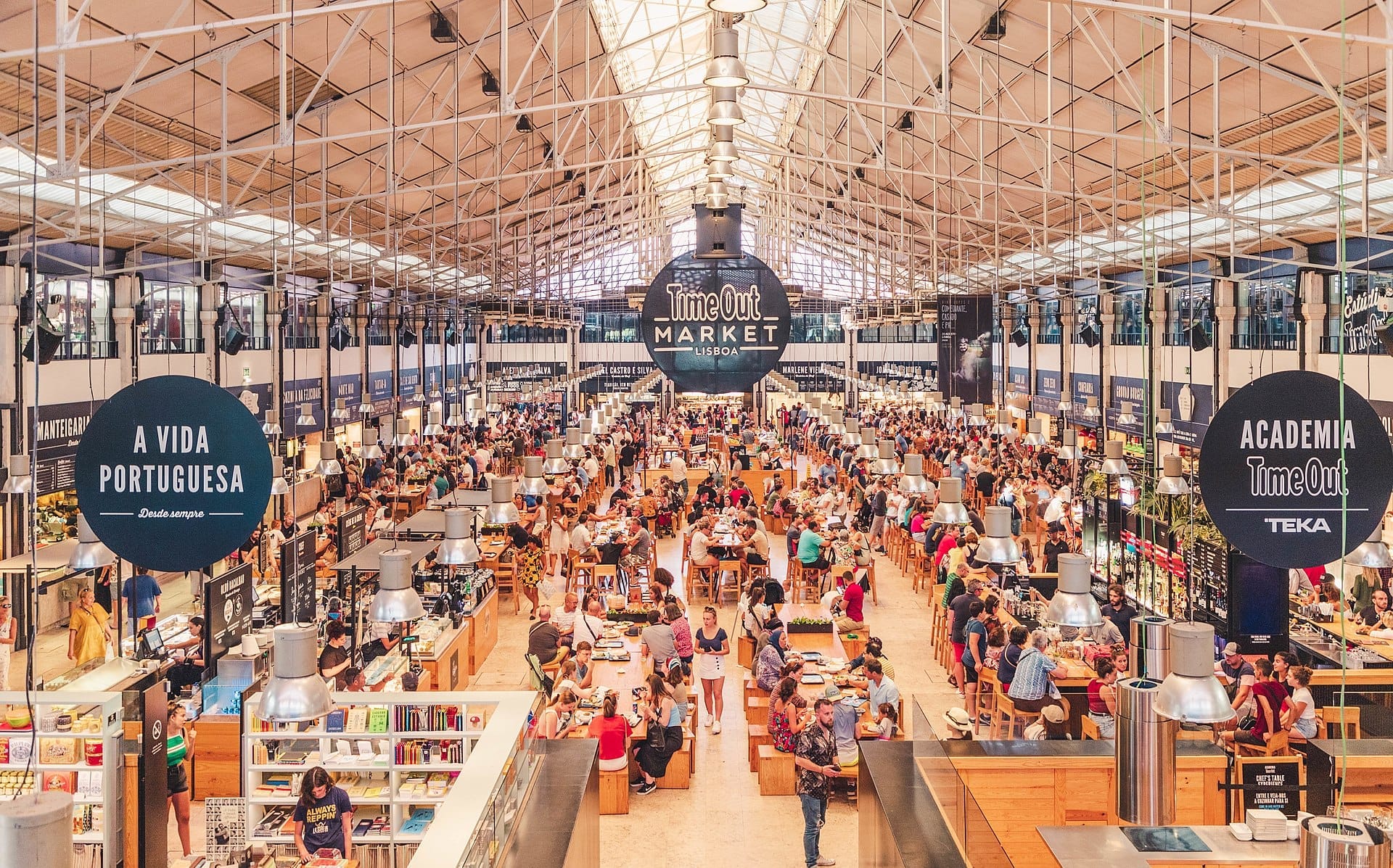
The result is a large food hall with 26 restaurants, 8 bars, 6 kiosks, 5 shops, a cooking academy, an art gallery, a concert venue, a disco/bar, a cowork space, and an events space that holds up to 1,000 people. Seating is communal and unreserved. You collect food from individual stalls and bring it to shared long tables. It's loud, it's informal, and on weekend evenings it's extremely crowded. None of that is a criticism. It's simply the nature of the place.
ℹ️ Good to know
Entry is completely free. You pay only for what you order at individual stalls. Most vendors accept credit cards, though having a small amount of cash avoids any friction at the bar counters.
The Building: More Than a Food Container
The Mercado da Ribeira structure deserves a moment of attention before you start eating. The building is a 19th-century iron-framed market hall with a distinctive domed central section. From the outside it reads as imposing and slightly industrial, consistent with the utilitarian market architecture popular across Lisbon in the late 1800s. Inside, the ceiling rises high above the stalls, giving the space an airy quality that prevents it from feeling claustrophobic despite the crowds.
Before 2014, the eastern wing housed a traditional produce market. That traditional section still operates in the morning on the western side of the building, selling flowers, fruit, and vegetables to locals. The Time Out Market occupies the renovated eastern section. If you arrive before noon on a weekday, the contrast between the quiet produce side and the already filling food hall side is a small but telling detail about how this neighborhood has shifted.
The market sits in the Cais do Sodré district, historically the gritty waterfront zone around Lisbon's main commuter rail terminal. The transformation of this area over the past decade is significant. The nearby Pink Street (Rua Nova do Carvalho) shifted from a red-light district to a bar-lined pedestrian street, and the waterfront promenade along the Tagus is now one of the most pleasant stretches in the city.
Tickets & tours
Live prices and dates from our booking partner. If you book, we may earn a commission at no extra cost to you.
Self-guided Discovery Walk in Alfama and Baixa with outdoor art
From 22 €Instant confirmationFree cancellationBelem and Modern Lisbon bus hop-on hop-off combined tickets
From 28 €Instant confirmationFree cancellationSt. George Castle E-ticket and Audio Tour
From 28 €Instant confirmationLisbon Story Centre entrance tickets
From 7 €Instant confirmationFree cancellation
How the Experience Changes Through the Day
The market opens daily at 10:00 AM. In the first two hours, the hall is quiet enough to hear the kitchen prep sounds and the creak of the building. This is genuinely the best window for people who want to eat without negotiating for table space. Stall queues are short, seating is easy to find, and the light through the high windows is soft. It's an unusual time to visit a food hall but worth knowing about.
By 1:00 PM on any day, the lunch crowd builds significantly. Portuguese workers from nearby offices, tourists from the waterfront hotels, and day-trippers from the Belém route all converge. Queues at the most popular stalls (especially the seafood and petiscos counters) grow to 10 or 15 minutes. If you're visiting on a weekday, arriving at 12:00 PM sharp gives you a comfortable margin before the peak.
Evenings shift the atmosphere considerably. Thursday through Saturday, the market stays open until 2:00 AM and the bar section dominates. The communal tables fill with people who came specifically to drink rather than eat, and the noise level rises to the point where conversation requires some effort. Sunday through Wednesday closing is midnight. If you want food as the main event rather than a backdrop to drinking, weekday evenings before 8:00 PM are the most comfortable slot.
💡 Local tip
For the best experience: arrive at opening (10:00 AM) for a quiet breakfast-style visit, or on a Tuesday or Wednesday evening around 7:00 PM for a relaxed dinner without weekend-level crowds.
The Food: What the Curation Actually Means
The vendors at Time Out Market are selected based on Time Out Portugal's editorial ratings, which gives the lineup a credibility that generic food courts lack. In practice, this means you'll find dishes from some of Lisbon's most respected chefs alongside simpler options. The range spans traditional Portuguese petiscos, fresh seafood, grilled meats, sushi, pastries, and international formats. Prices are higher than you'd pay at a local tasca but reasonable for a curated food hall experience. A full meal with a drink typically runs between €15 and €25 per person.
The eight bars stock a solid selection of Portuguese wines, craft beer, and cocktails. The natural wine options have grown notably in recent years, reflecting the broader shift in Lisbon's drinking culture. If you're unfamiliar with Portuguese wines, the bar staff at most counters are knowledgeable and used to making recommendations to visitors.
Comparing Time Out Market to the traditional market experience available at places like Mercado de Campo de Ourique or the weekly Feira da Ladra is useful context. Time Out Market is polished, consistent, and designed for ease. The others offer a more raw and local atmosphere. Neither is better in absolute terms. They serve different purposes.
Getting There and Getting Around Once Inside
Cais do Sodré Metro station (Green Line) is a three-minute walk from the market entrance. The station is also connected to Cais do Sodré train station, which handles commuter rail to Cascais and Sintra connections via Entrecampos. If you're arriving from Alfama or Baixa on foot, the waterfront promenade along Avenida 24 de Julho is a pleasant 15-minute walk with views across the Tagus.
Inside the market, the layout is straightforward: stalls ring the perimeter and run in central rows, with the communal tables filling the middle. The cooking academy and events space occupy the upper floor, accessible by staircase from the main hall. Navigation is intuitive even on a first visit. Most signage is bilingual in Portuguese and English.
⚠️ What to skip
There is no table reservation system. On Friday and Saturday evenings after 8:00 PM, finding a seat for a group of four or more can take 10 to 15 minutes of patience. Splitting into smaller groups to claim adjacent seats is a common strategy.
Who This Is Right For (and Who Should Look Elsewhere)
Time Out Market works well for solo travelers who want access to multiple cuisines without committing to a single restaurant. It's also a practical solution for groups where people have genuinely different food preferences. The informal seating means you can spread dishes from multiple vendors across one table.
Travelers who prioritize the texture of a sit-down Lisbon meal, including the slower pace, the personal service, and the neighborhood setting, will find Time Out Market a poor substitute. For that experience, the local restaurant scene in neighborhoods like Alfama, Mouraria, or Intendente delivers something that a food hall format structurally cannot. Similarly, anyone hoping to see an 'authentic' daily market should arrive before 10:00 AM to observe the traditional produce section before the tourist traffic builds.
The space is also genuinely family-friendly during daytime hours. Children under twelve will find the open layout easy and the food variety accommodating. Late evenings, as the bar crowd builds, the environment shifts enough that families with young children will be more comfortable elsewhere.
Insider Tips
- The traditional produce market in the western wing of the Mercado da Ribeira operates in the mornings and is free to browse. It gives you a sense of the building's pre-2014 character and sells flowers, fruit, and regional products at local prices.
- If you're visiting in a group, designate one person to hold the table while others queue at different stalls simultaneously. Communal seating is first-come, first-served, and protecting a spot during peak hours is the main logistical challenge.
- The cooking academy on the upper floor runs classes and workshops that are bookable separately. If you're spending more than two or three days in Lisbon, a class here is a structured way to engage with Portuguese food beyond just eating it.
- The waterfront promenade directly outside the market connects westward toward Belém. Walking this stretch at dusk, with the Tagus reflecting the light, is a free and genuinely rewarding addition to a market visit.
- Check the Time Out Market website before visiting for scheduled live music or performance nights. These events use the 1,000-capacity events space and can add unexpected value to an evening visit, or make the market significantly louder depending on your preference.
Who Is Time Out Market For?
- Solo travelers wanting variety without committing to one restaurant
- Groups with mixed dietary preferences or varying appetites
- Late-night eating on Thursday through Saturday when most traditional restaurants have stopped serving
- Visitors new to Lisbon who want a reliable introduction to Portuguese food styles before exploring neighborhood restaurants
- Families with young children during morning and early afternoon hours
Nearby Attractions
Other things to see while in Santos & Cais do Sodré:
- Basílica da Estrela
The Basílica da Estrela is one of Lisbon's most graceful landmarks, a late 18th-century royal church commissioned by Queen Maria I and the first church in the world dedicated to the Sacred Heart of Jesus. Beyond its free-entry nave, a rooftop terrace rewards the climb with sweeping views across the city. Inside, the queen herself is buried beneath the ornate floor.
- Jardim da Estrela
Jardim da Estrela is a 19th-century public garden in the Lapa-Estrela quarter, steps from the Basílica da Estrela. Free, open until midnight, and genuinely beloved by locals, it offers a rare pause from sightseeing crowds. Come for the iron bandstand, the duck pond, and the rare pleasure of sitting where tourists rarely bother to stop.
- LX Factory
A former 19th-century textile factory reborn as Lisbon's most distinctive creative complex, LX Factory fills 23,000 square metres of industrial space with independent bookshops, design studios, cafés, restaurants, vintage boutiques, and street art. On Sundays, its courtyard transforms into one of the city's most atmospheric markets.
- Pink Street (Rua Nova do Carvalho)
Once a rough sailors' red-light district, Rua Nova do Carvalho is now Lisbon's most photographed street after dark. The bright pink pavement, vintage bar fronts, and the legendary Pensão Amor make it the beating heart of the Cais do Sodré nightlife scene.
Planning a trip? Discover personalized activities with the Nomado app.