Thorvaldsens Museum: Copenhagen's Temple of Neoclassical Sculpture
Built to honor Denmark's greatest sculptor, Thorvaldsens Museum opened in 1848 on the island of Slotsholmen and remains one of Copenhagen's most architecturally distinctive museums. It holds a vast collection of Bertel Thorvaldsen's works alongside his personal collections of paintings and antiquities — and his own tomb in the courtyard.
Quick Facts
- Location
- Bertel Thorvaldsens Plads 2, Slotsholmen, Copenhagen — next to Christiansborg Palace
- Getting There
- 10-min walk from Copenhagen Central Station or Nørreport Station; buses 1A, 2A, 9A, 26, and 40 stop nearby
- Time Needed
- 1.5 to 2.5 hours
- Cost
- 110 DKK adults; free for under 18s; free with Copenhagen Card
- Best for
- Art lovers, architecture enthusiasts, history seekers, quiet museum days
- Official website
- www.thorvaldsensmuseum.dk/en
What Thorvaldsens Museum Actually Is
Thorvaldsens Museum is not a general art museum with rotating blockbuster exhibitions. It is a monument to a single artist: Bertel Thorvaldsen (1770–1844), the Danish-born sculptor who became one of the dominant figures of European neoclassicism and spent most of his career in Rome. When Thorvaldsen returned to Copenhagen in 1838 after four decades abroad, he donated his entire collection — sculptures, drawings, paintings, antiquities, and personal objects — to the city of Copenhagen. The museum was built specifically to house it all, opening on 18 September 1848, four years after Thorvaldsen's death. It holds the distinction of being Denmark's first purpose-built public museum.
That founding premise shapes the experience completely. You are not browsing a survey of Western sculpture. You are walking through one man's creative output and collected world, arranged in a building conceived as an act of civic and cultural devotion. The museum sits on Slotsholmen, the small island at the heart of Copenhagen that also holds Christiansborg Palace, and it fits naturally into a neighborhood where every building carries institutional weight.
ℹ️ Good to know
Open Tuesday–Sunday, 10:00–17:00. Closed Mondays. Verify current hours at thorvaldsensmuseum.dk before visiting, as temporary closures can apply.
The Building: Architecture Worth Examining Before You Go Inside
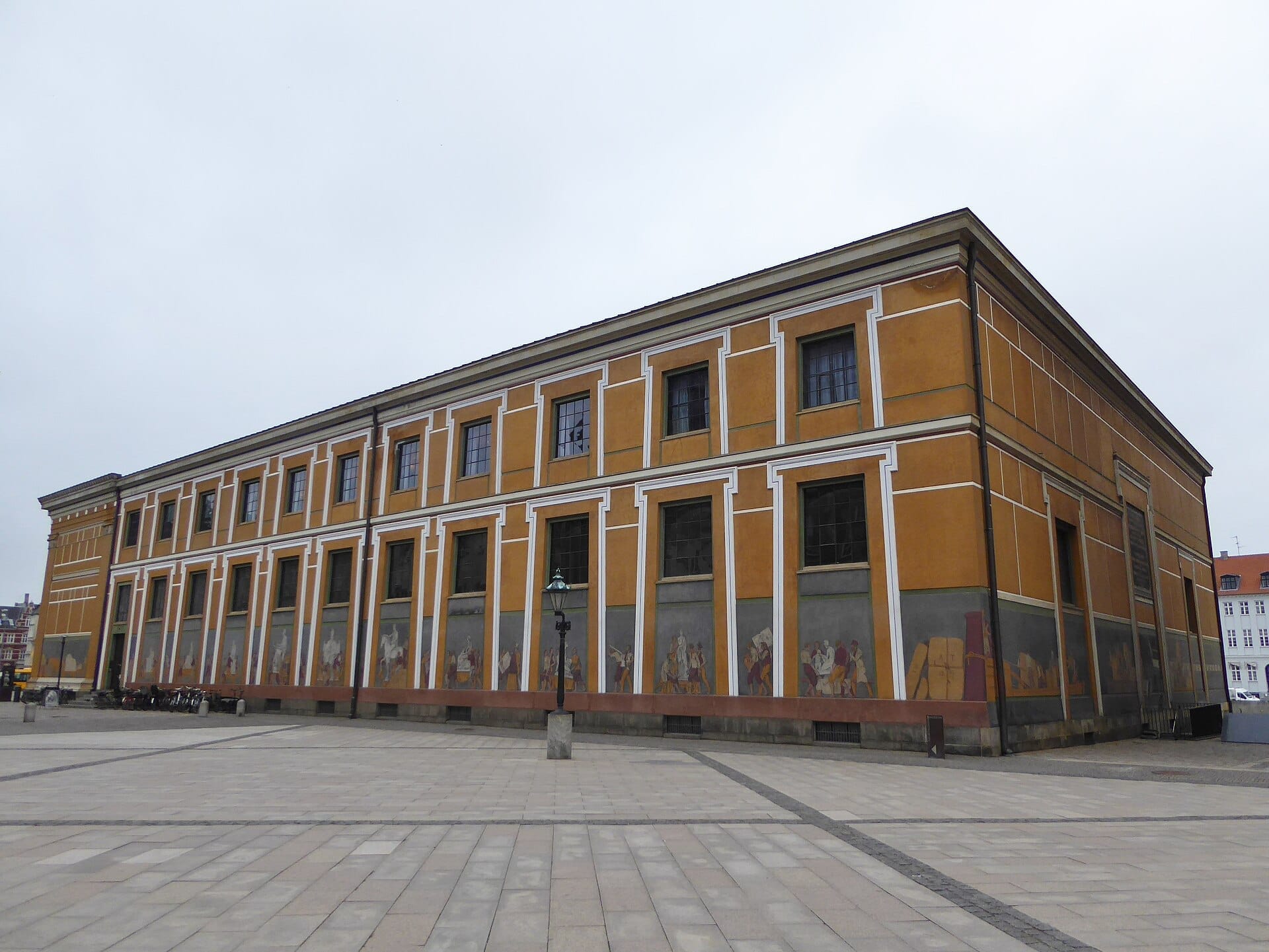
Architect Michael Gottlieb Bindesbøll designed the building between 1839 and 1848, and the result remains one of the most unusual structures in Scandinavia. The exterior is immediately striking: bright polychrome friezes run along the outer walls, depicting the triumphal procession of Thorvaldsen's return to Copenhagen in 1838. These painted scenes, rendered in earthy reds, ochres, and blues against pale stucco, are not typical of Danish public buildings and feel closer to a Greek or Roman civic monument than to northern European convention.
The interior continues the theme. Rooms are arranged around a central courtyard, and the ceiling vaults are painted with sky-blue tones and decorative motifs that recall ancient Roman house decoration. Natural light falls through skylights onto white marble, which means the sculptures almost always look best in the middle of the day when illumination is strongest. The building itself was considered avant-garde at the time of construction and is now recognized as a landmark of Danish Romantic-period architecture.
If you are interested in the history of Copenhagen's built environment, the Danish Architecture Center keeps detailed records on Bindesbøll's work and the museum's place in the city's architectural timeline.
Tickets & tours
Hand-picked options from our booking partner. Prices are indicative; availability and final rates are confirmed when you complete your booking.
Luggage Store in Thorvaldsens Museum
From 6 €Instant confirmationFree cancellation1-hour boat harbour tour in Copenhagen
From 26 €Instant confirmationFree cancellationSmall group 3-hour walking tour in Copenhagen
From 45 €Instant confirmationFree cancellationCopenhagen to Malmo one-day tour
From 56 €Instant confirmationFree cancellation
The Courtyard and Thorvaldsen's Tomb
The central courtyard is open to the sky and planted with a simple garden. At its center is the tomb of Bertel Thorvaldsen himself. This is not a metaphorical memorial — his remains are interred here, beneath a plain sarcophagus surrounded by ivy and seasonal plantings. The quiet of the space stands in sharp contrast to the polished marble halls on all sides.
On overcast days, the courtyard feels enclosed and reflective. On clear days, especially in late spring and early summer, it fills with soft northern light that makes the paving stones and tomb marker look almost luminous. Many visitors spend several minutes here simply because it is one of the few genuinely still spaces in central Copenhagen, in a neighborhood that sees heavy foot traffic near the palace.
The Collection: What You Will See Room by Room
The sculpture galleries occupy the bulk of the museum. Thorvaldsen worked primarily in marble and plaster, and both materials are represented here at scale. His mythological and allegorical works — figures of Ganymede, Hebe, Mercury, Venus — represent the neoclassical ideal at its most refined: smooth surfaces, idealized proportions, and calm, composed expressions. If you have only seen Thorvaldsen's work in reproduction, the physical scale of many pieces is the first surprise. Several of the standing figures exceed two meters and fill their gallery rooms with a presence photographs cannot convey.
The religious works occupy a separate section and include large-scale reliefs depicting scenes from the New Testament. These have a different emotional register than the mythological pieces — more frontal, more monumental, more deliberately grand. They were influential across Europe in the early nineteenth century and were copied and adapted for churches in several countries.
Beyond sculpture, the museum holds the collection of paintings and antiquities that Thorvaldsen assembled during his decades in Rome. The paintings section includes works by contemporaries he knew personally, including German Nazarene painters and Italian genre painters. The antiquities — Greek vases, Roman bronzes, coins, gems — provide context for understanding what Thorvaldsen was looking at and responding to throughout his career. This section is smaller than the sculpture galleries but adds meaningful depth to the visit.
💡 Local tip
Natural light from the skylights is strongest between 11:00 and 14:00. If you want to see the marble sculpture at its best, plan to arrive in the late morning rather than at opening or near closing.
How the Experience Changes by Time of Day
Thorvaldsens Museum operates at a consistently lower visitor volume than the major Copenhagen museums like the National Museum or SMK. Even on busy summer days, the galleries rarely feel crowded. Early mornings after opening — roughly 10:00 to 11:00 — are the quietest, and you can move through the sculpture halls with very few other visitors. The sound environment is notable: polished stone floors and high ceilings mean that even a small group creates a gentle echo, and in off-peak hours the museum approaches genuine silence.
Midday draws slightly more visitors, often in tour groups, and the sculpture halls become more animated. By mid-afternoon, foot traffic thins again. The museum closes at 17:00, and the final hour tends to be relaxed. If you are combining the museum with a visit to nearby Christiansborg Palace, note that the palace has much longer queues at peak times, so visiting Thorvaldsens Museum first in the morning and then crossing to the palace later in the day often produces a smoother experience overall.
The museum's Slotsholmen location makes it a natural companion to Christiansborg Palace, which sits immediately adjacent. Both can be covered in a half-day without feeling rushed.
Practical Walkthrough: What to Know Before You Arrive
Admission is 110 DKK for adults. Children under 18 enter free. The Copenhagen Card covers entry, which makes sense if you are planning four or more major museum visits during your stay.
To reach the museum on foot from Strøget, walk south past the canal on Frederiksholms Kanal — the journey takes about eight minutes. From Nørreport Station, it is around twelve minutes on foot through the old city. If you are arriving by bus, lines 1A, 2A, 9A, 26, and 40 all stop within a short walk. The museum is not directly on a metro station, but it is reachable without difficulty from the central transit network. A broader overview of getting around the city is available in the getting around Copenhagen guide.
Large bags, backpacks, and umbrellas must be stored in the cloakroom before entering the galleries — this is enforced consistently and lockers are available. Photography is generally permitted in the permanent galleries without flash. The gift shop stocks quality art books and prints related to the collection, including scholarly publications on Thorvaldsen's technique and correspondence.
Regarding accessibility: the official website is the most reliable source for current wheelchair access information. Visitors with specific mobility requirements should contact the museum directly before their visit, as the building's historic structure means access may vary by room.
⚠️ What to skip
The museum is closed on Mondays. This is a common point of confusion for visitors who see Christiansborg Palace open on the same day. If you are combining both sites, plan accordingly.
Honest Assessment: Who Will Love This, and Who Might Not
Thorvaldsens Museum rewards visitors who are either already interested in neoclassical art or willing to spend time with the work on its own terms. The collection is coherent, deep, and beautifully housed. The building is architecturally significant and worth attention in itself. The experience is unhurried and relatively uncrowded.
However, visitors looking for variety — contemporary art, interactive displays, broad chronological surveys — will find the museum's focus narrow by design. This is a monographic museum with a specific artistic language: cool marble, mythological subjects, technical perfection. If neoclassical sculpture does not speak to you, the collection offers limited ground for engagement. Children under ten are likely to find the experience underwhelming unless they are specifically interested in ancient myths. The museum does not have the hands-on elements or multimedia programming that family-oriented institutions provide.
Travelers who want a broader survey of Danish art history across periods would be better served by the SMK National Gallery of Denmark, which holds Thorvaldsen's work alongside painting and sculpture from medieval times to the present.
If you are building a broader itinerary for the city's museums and galleries, the best museums in Copenhagen guide places Thorvaldsens Museum in context alongside the other major institutions.
Insider Tips
- The frieze running along the building's exterior walls tells the story of Thorvaldsen's 1838 homecoming. Spend five minutes reading it before entering — it reframes the whole visit as a civic event, not just an art show.
- The plaster originals in the collection are often more interesting than the finished marble versions. Plaster was Thorvaldsen's working material, and the tool marks and surface decisions are visible in ways the polished marble obscures.
- If you hold a Copenhagen Card, note that the card also covers entry to the National Museum of Denmark, which is a ten-minute walk away. The two institutions make a natural pairing for a full museum day in the Slotsholmen area.
- The courtyard is freely accessible during museum hours and provides one of the quieter sitting spots in central Copenhagen. It is worth visiting even if you only have fifteen minutes and do not plan a full tour of the galleries.
- Afternoon light in summer reaches the courtyard garden around 14:00 to 16:00, making it the most photogenic window for outdoor shots of the building's polychrome facade on the south-facing side.
Who Is Thorvaldsens Museum For?
- Travelers with a genuine interest in neoclassical or European Romantic-era art
- Architecture enthusiasts who want to study Bindesbøll's early Danish museum design
- Visitors seeking a quieter, less-crowded museum experience in the city center
- Copenhagen Card holders looking to maximize value on a Slotsholmen half-day
- Anyone combining a visit to Christiansborg Palace with a culturally adjacent indoor stop
Nearby Attractions
Other things to see while in Indre By (Old Town):
- Amalienborg Palace
Amalienborg is the official home of the Danish royal family and one of Copenhagen's most architecturally coherent ensembles. Four near-identical Rococo palaces frame a grand octagonal square, with the Amalienborg Museum open to visitors inside Christian VIII's Palace. The daily changing of the guard at noon is a punctual, unhurried ceremony worth timing your visit around.
- The Black Diamond
The Black Diamond is the modern extension of the Royal Danish Library, clad in polished black granite and angled toward the harbour on Slotsholmen. Entry is free, the atrium is genuinely impressive, and the building rewards visitors who take time to understand what they are looking at.
- Botanical Garden of the University of Copenhagen
Tucked behind Nørreport Station in the heart of the city, the Copenhagen University Botanical Garden is a 10-hectare green sanctuary with a Victorian glasshouse complex, a tranquil lake, and around 8,000 plant species. Entry to the grounds is free, making it one of the most rewarding stops in central Copenhagen for any pace of traveler.
- Christiansborg Palace
Christiansborg Palace sits on the Slotsholmen islet in central Copenhagen, serving simultaneously as the home of the Danish Parliament, the Supreme Court, the Prime Minister's Office, and the Royal Reception Rooms. It is widely described as uniquely housing all three branches of Denmark’s national government under one roof, and its 106-metre tower offers one of the best free panoramic views in the city.