The Junction, Toronto: A West-End Neighbourhood Worth Your Time
The Junction is one of Toronto's most characterful west-end neighbourhoods, built around the railway lines that once made it an industrial hub. Today it runs on independent shops, craft breweries, art studios, and a food scene that earns repeat visits without trying too hard.
Quick Facts
- Location
- Dundas Street West between Keele Street and Runnymede Road, Toronto's west end
- Getting There
- TTC buses 40 (Junction), 30 (High Park), and 41 (Keele) serve Dundas Street West and Keele Street
- Time Needed
- 2 to 4 hours for a relaxed walk; a full afternoon if you sit down to eat or drink
- Cost
- Free to walk; costs are pay-as-you-go at individual shops, cafés, and bars
- Best for
- Independent retail, craft beer, Toronto streetscape history, weekend browsing
- Official website
- torontojunction.ca
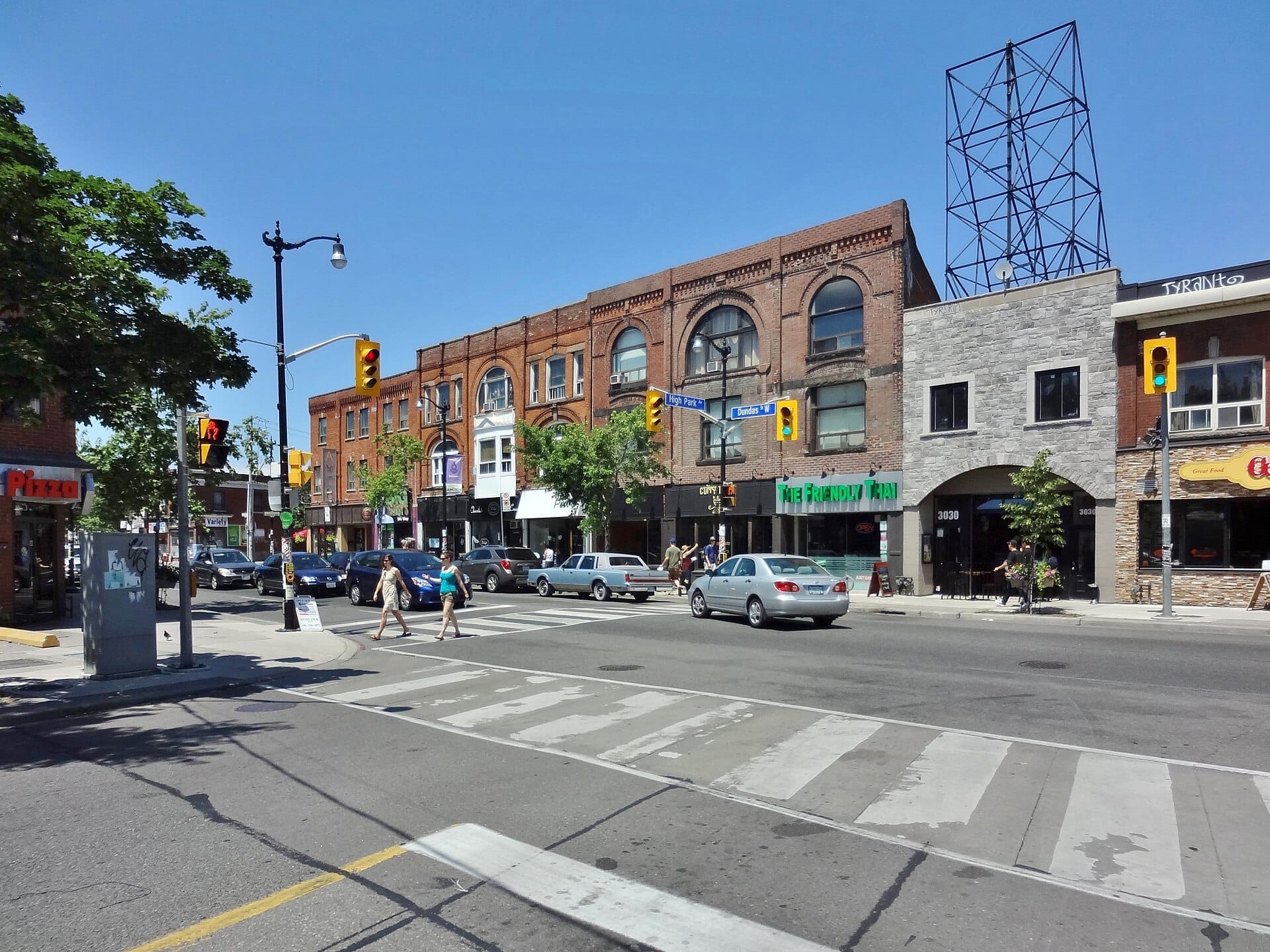
What The Junction Actually Is
The Junction is a west-end Toronto neighbourhood that developed around the convergence of several railway lines, which is precisely how it got its name. The area was its own municipality, incorporated as the Village of West Toronto Junction in 1884, upgraded to a town in 1889, and absorbed into the City of Toronto in 1909. That independent streak never entirely disappeared.
The commercial spine is Dundas Street West, roughly between Keele Street and Clendenan Avenue. The Junction BIA officially defines its footprint as running from Indian Grove to Quebec Avenue along Dundas West. Walk it end to end and you will pass a tightly packed sequence of low-rise Victorian and Edwardian brick storefronts, most of which have been renovated without losing their original bones. The street level changes hands regularly, but the architecture stays.
The neighbourhood sits west of High Park and shares a border mentality with Roncesvalles to the south and Bloor West Village to the east. It is not a destination for grand landmarks. It rewards people who like to read a city block slowly.
The Streetscape: What You Are Actually Looking At
The dominant visual character of The Junction is late-19th and early-20th century commercial architecture in red and buff brick. Many of the two- and three-storey buildings along Dundas West retain their original cornices, transom windows, and recessed entryways. A few have been painted over in ways that obscure the brick, but most have not. If you look at the upper floors instead of the shop signage, The Junction reads like a textbook of working-class commercial Toronto from a century ago.
Interspersed throughout are murals, some commissioned by the BIA and some independent, that range from railway-themed historical illustrations to abstract work that has no particular narrative. They fill the side walls of buildings that back onto laneways and create the kind of visual texture that you notice on a second or third walk but might miss on the first.
💡 Local tip
Look up at the second-floor facades as you walk Dundas West. The original brickwork, stone lintels, and window proportions on upper floors are often far better preserved than anything at street level.
Anyone interested in Toronto's built history will find The Junction pairs well with other architectural walks around the city. The Toronto architecture guide covers the broader picture, but The Junction is one of the few places in the west end where a full block of pre-1914 commercial frontage remains intact.
Tickets & tours
Live prices and dates from our booking partner. If you book, we may earn a commission at no extra cost to you.
Toronto Old Town: Dark Side Exploration Game and Tour
From 12 €Instant confirmationFree cancellationLEGOLAND Discovery Centre Toronto tickets
From 16 €Instant confirmationFree cancellationToronto 'Little Canada' entrance tickets
From 27 €Instant confirmationFree cancellationNiagara Falls evening tour with boat, dinner and Illumination Tower
From 77 €Instant confirmationFree cancellation
How The Neighbourhood Changes Through the Day
Weekday mornings before 10 a.m., The Junction belongs to regulars. The coffee shops fill first, then the used bookstores prop open their doors. The street noise is mostly delivery trucks and the occasional GO train on the nearby rail corridor. It is a good time to walk without crowds, but about a third of the retail will still be closed.
Saturday afternoon is the peak experience. By noon, both sides of Dundas West are in motion. Browsers move between vintage clothing stores, record shops, and home goods studios. The café patios, when the weather cooperates, extend onto the sidewalk and make the narrow street feel more compressed than it is. There is no single focal point; people flow in both directions and double back.
By evening, especially Thursday through Saturday, The Junction pivots to its bar and restaurant character. The craft beer taprooms and wine bars that have opened over the past decade draw a crowd that skews local rather than tourist. The noise levels rise but the scale stays human; this is not a strip built for large groups moving from venue to venue, and the sidewalks are not wide enough for that kind of traffic anyway.
ℹ️ Good to know
Sunday mornings are quieter than Saturday but still active. Several brunch spots on and just off Dundas West draw neighbourhood residents, which makes Sunday a reasonable option for anyone who finds Saturday too crowded.
Shops, Food, and What to Actually Do Here
The Junction's retail identity is built on independence. There are no major chains on Dundas West itself. The shops tend toward the specific: a store that sells only vinyl records, a butcher that also operates a small charcuterie counter, a ceramics studio with a retail front, a bookshop that specializes in art and design. The turnover is real, as in any neighbourhood retail strip, but the category mix has stayed consistent.
Food is a genuine reason to come here rather than just a side effect of walking around. The Junction has a range of sit-down restaurants across price points, and a few of them are serious enough that people come from across the city. There are also several craft beer taprooms that brew on-site or near-site, which has become one of the neighbourhood's clearest identifiers over the past few years.
If you are building a longer west-end day, The Junction works well as a starting or ending point. Roncesvalles Village is a short distance south and has a complementary character, more residential and family-oriented but with its own strong independent food scene.
History: Why The Junction Looks the Way It Does
The Junction's character is not accidental. The neighbourhood grew up as a service and residential district for the railway industry. The rail lines converging nearby meant that the area attracted workers, suppliers, and the commercial infrastructure needed to support them. The brick storefronts on Dundas West were built for that economy, dense, practical, and built to last.
One historical footnote that shaped The Junction's culture for decades: the former municipality of West Toronto Junction passed a prohibition bylaw before amalgamation with Toronto, and the area remained legally dry, meaning no licensed liquor sales, until 2000. That is not a trivial detail. It means the bar and restaurant culture that now defines The Junction's evenings is less than thirty years old. The neighbourhood spent most of the 20th century without a pub.
The post-prohibition era, combined with relatively affordable rents compared to Parkdale or Bloor West Village in the early 2000s, created conditions for a wave of independent businesses and artists to move in. The neighbourhood's current identity was built in roughly the decade between 2005 and 2015, and it has since stabilized rather than accelerated.
ℹ️ Good to know
The Junction remained a legally dry neighbourhood until 2000, nearly a century after prohibition was introduced by the former municipality. That history explains why its bar scene is relatively young, and why the neighbourhood feels like it is still figuring out its evenings.
Getting There, Getting Around, and Practical Notes
Transit is straightforward. TTC bus routes 40 (Junction), 30 (High Park), and 89/189 (Weston) all serve the neighbourhood. From downtown, the most common approach is to take the Line 2 subway west to Dundas West station, then transfer to the 40 bus along Dundas Street West into the neighbourhood or walk/bus a short distance north to Dundas Street West. The ride from Dundas West station to the heart of The Junction takes about ten minutes depending on traffic.
Driving is possible, but street parking on Dundas West is regulated and turns over quickly. Side streets generally have more availability. The neighbourhood is flat and compact enough that once you arrive, you will not need a car or transit to move between stops.
Accessibility varies by business. The streets and sidewalks are city-maintained and meet municipal standards in most areas, but many of the older retail buildings on Dundas West have steps at the entrance and no automatic doors. Anyone who requires step-free access should confirm directly with individual venues before visiting. The street itself is navigable by wheelchair or stroller, though some sections of sidewalk are narrower than others.
⚠️ What to skip
Many buildings in The Junction are pre-1950 commercial stock with original doorways and thresholds. Step-free access is not consistent across the strip. Verify accessibility with specific venues before visiting if this is a requirement.
For broader context on moving around Toronto's west end and beyond, the getting around Toronto guide covers TTC routes, fare structures, and transit options across the city in detail.
Honest Assessment: Who Will Love This, and Who Should Go Elsewhere
The Junction rewards a particular kind of visitor: someone who enjoys a neighbourhood for its texture and pace rather than for a checklist of landmarks. There is no single attraction that justifies a trip on its own. The value is cumulative, a good coffee, an interesting shop, a decent meal, a streetscape that feels like a real place rather than a constructed one.
Visitors on tight itineraries with only two or three days in the city should weigh this carefully. If you have not yet seen St. Lawrence Market or spent time in Kensington Market, those offer more concentrated payoff per hour. The Junction is better suited to a return visit or to travellers who are already interested in how Toronto's west end differs from its downtown core.
Families with young children will find it manageable but not specifically oriented toward them. There are no dedicated attractions for kids on Dundas West itself, though High Park, a short distance away, covers that ground comprehensively. People who find independent retail browsing pleasant will feel at home here. People who need a clear narrative or a visual highlight as the point of a visit may find The Junction underwhelming.
If The Junction sounds like your kind of place, you might also want to look at the Toronto food guide before you go. Several of the neighbourhood's stronger restaurants are mentioned there, and it gives useful context on what makes the west-end dining scene distinct from Queen Street West or Yorkville.
Insider Tips
- The laneways that run parallel to Dundas West behind the commercial strip are worth a detour. Some of the best murals in the neighbourhood are on the rear walls of buildings facing these laneways, and you will rarely share them with more than one or two other people.
- If you are visiting on a weekend afternoon and want to eat without waiting, aim to arrive at restaurants before noon or after 2 p.m. The Saturday lunch rush on Dundas West is real, and several of the better spots do not take reservations.
- The Junction has a concentration of vintage and second-hand shops that rotate stock regularly. If you are a serious buyer, a Tuesday or Wednesday morning visit after a weekend of new arrivals is more productive than a Saturday afternoon browse.
- Several of the craft taprooms in The Junction serve their own beer but also stock a rotating selection from other Ontario breweries. If you want to try multiple producers without leaving the neighbourhood, a single taproom stop can cover a fair amount of ground.
- The railway corridor that runs through the neighbourhood is most visible and audible from certain spots near Pacific Avenue. Hearing a freight train pass while standing among Victorian storefronts is one of those small moments that puts the neighbourhood's history into sensory context.
Who Is The Junction For?
- Independent travellers who enjoy exploring a neighbourhood at their own pace without a structured itinerary
- Craft beer enthusiasts looking for a cluster of taprooms with genuine local character
- Shoppers interested in vintage clothing, vinyl records, used books, and design-oriented retail
- Architecture and history walkers interested in pre-WWI commercial streetscapes
- Visitors returning to Toronto who have already covered the downtown highlights and want to understand a different part of the city
Nearby Attractions
Combine your visit with:
- Aga Khan Museum
The Aga Khan Museum in Toronto is one of North America's only institutions dedicated to the arts of Muslim civilizations. Housed in a purpose-built building designed by architect Fumihiko Maki, it holds over 1,200 masterpieces spanning 14 centuries. Whether you spend 90 minutes or a full afternoon, the experience rewards curiosity at every turn.
- The Village at Black Creek (Black Creek Pioneer Village)
The Village at Black Creek is a fully realized open-air living history museum in northwest Toronto, where around 40 restored historic buildings, heritage breed livestock, and costumed interpreters recreate rural Ontario life from the 1800s. Operated by the Toronto and Region Conservation Authority, it offers a rare, tactile experience of pre-industrial Canada that few urban attractions can match.
- Blue Mountain & Collingwood
Perched on the Niagara Escarpment above Georgian Bay, Blue Mountain and Collingwood form Ontario's most accessible four-season resort destination. Whether you come for winter skiing, summer hiking, or a weekend in the pedestrian village, the area rewards visitors who plan around the season.
- Canada's Wonderland
Canada's Wonderland is the country's largest amusement park, located in Vaughan just north of Toronto. With 18 roller coasters, more than 200 attractions, and a 20-acre water park, it's a full-day commitment that rewards planning. Here's how to make the most of it.
Planning a trip? Discover personalized activities with the Nomado app.