Aga Khan Museum: Toronto's Window into Islamic Art and Culture
The Aga Khan Museum in Toronto is one of North America's only institutions dedicated to the arts of Muslim civilizations. Housed in a purpose-built building designed by architect Fumihiko Maki, it holds over 1,200 masterpieces spanning 14 centuries. Whether you spend 90 minutes or a full afternoon, the experience rewards curiosity at every turn.
Quick Facts
- Location
- 77 Wynford Drive, Toronto, Ontario M3C 1K1
- Getting There
- Eglinton Crosstown LRT – Aga Khan Park and Museum Station, then a short walk through Aga Khan Park; or direct bus from Broadview or Pape subway stations
- Time Needed
- 1.5 to 3 hours
- Cost
- Adults CAD $20 | Seniors CAD $15 | Students CAD $12 | Youth 25 and under FREE | Wednesdays 4–8 pm FREE for all, presented by BMO
- Best for
- Art lovers, architecture enthusiasts, history-minded travelers, families with teens
- Official website
- agakhanmuseum.org
What the Aga Khan Museum Actually Is
The Aga Khan Museum opened on September 18, 2014, and it remains one of the few institutions in North America dedicated entirely to the arts and cultures of Muslim civilizations. The permanent collection holds more than 1,200 works spanning roughly 14 centuries, from illuminated manuscripts and inlaid metalwork to astronomical instruments and architectural fragments. These are not decorative objects in the secondary sense. Many are primary documents of how science, poetry, philosophy, and faith intersected across the medieval Islamic world.
The museum was established by the Aga Khan Trust for Culture, an agency of the Aga Khan Development Network. That origin shapes its curatorial ambition: rather than treating Islamic art as a regional curiosity, the museum frames it as central to world cultural history. You will find a 13th-century Qur'an manuscript displayed in proximity to European medieval books from the same era, with interpretive text that draws connections rather than simply listing provenance.
💡 Local tip
Wednesday evenings from 4 to 8 pm are free for everyone, presented by BMO, and Youth 25 and under are free on any day.
The Architecture Before You Even Walk In
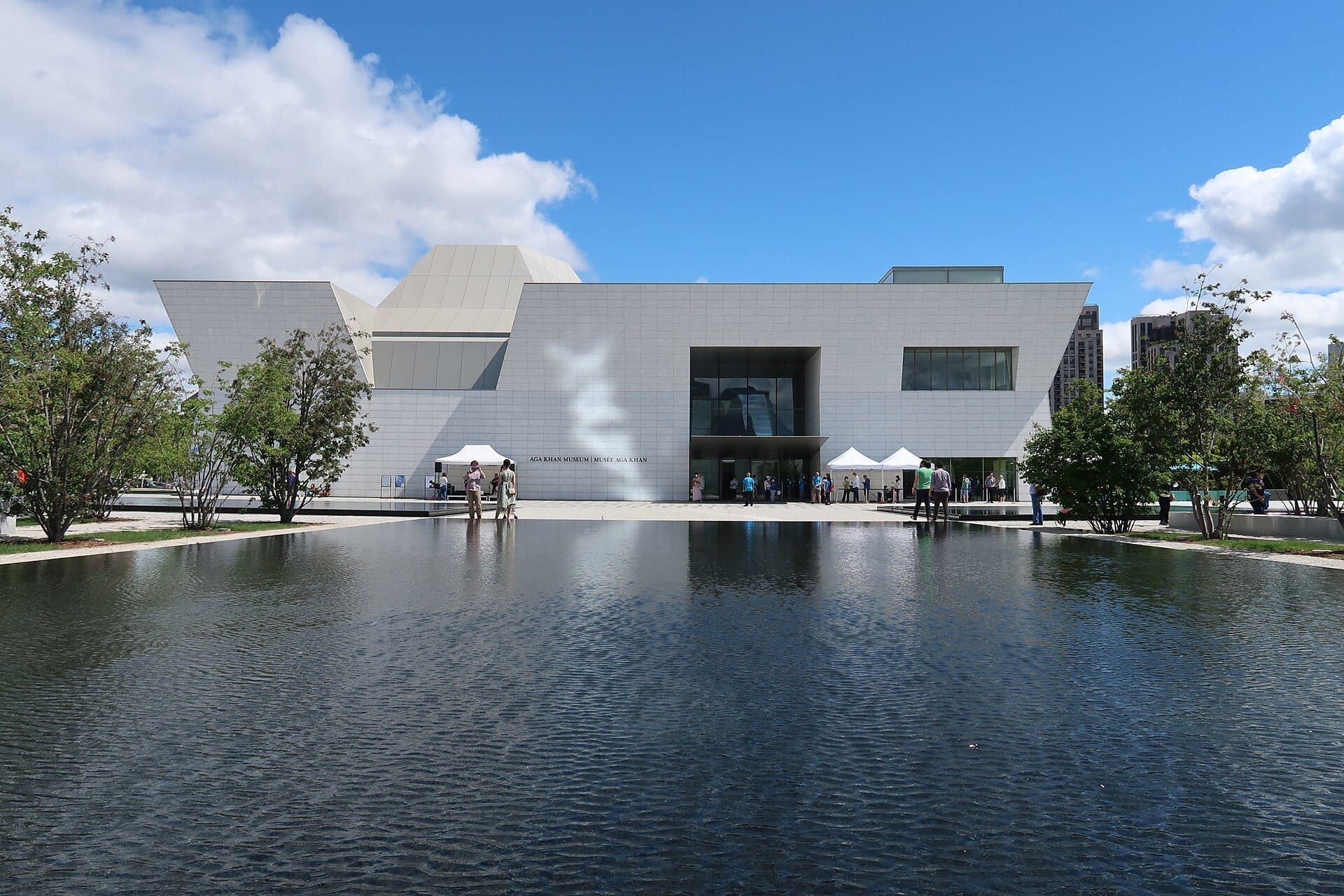
The building itself is a reason to visit. Japanese architect Fumihiko Maki, who received the Pritzker Architecture Prize in 1993, designed the main museum structure. The exterior is clad in white Portuguese granite, cut into geometric panels that catch light differently at different hours. On a clear morning, the facade has a crisp, mineral quality. By late afternoon in summer, the same panels take on a warmer, almost amber tone.
The adjacent Ismaili Centre, designed by Charles Correa, sits on the same grounds and completes the campus. The two buildings are distinct in geometry but share a commitment to light, water, and garden as organizing elements. Between them, Aga Khan Park offers a formal garden landscape designed by landscape architect Vladimir Djurovic, with reflecting pools and stone pathways that continue the visual language of the collection inside.
Arriving via the Eglinton Crosstown LRT and walking through the park is the most rewarding approach. The transition from the urban streetscape to the garden to the museum entrance is deliberate and unhurried. If you are driving, the parking is functional but you miss that sequence entirely. For more on navigating the city's transit options, see the guide to getting around Toronto.
Tickets & tours
Live prices and dates from our booking partner. If you book, we may earn a commission at no extra cost to you.
Niagara Falls evening tour with boat, dinner and Illumination Tower
From 77 €Instant confirmationFree cancellationNiagara Falls tour with local winery visit from Toronto
From 70 €Instant confirmationFree cancellationNiagara Falls tour with boat ride from Toronto
From 87 €Instant confirmationFree cancellationNiagara Falls 9-hours tour from Toronto
From 115 €Instant confirmationFree cancellation
Inside: How the Permanent Collection Is Organized
The main galleries unfold across two levels. The ground floor typically orients visitors with an introductory gallery that establishes geographic and chronological context before you encounter individual works. This is genuinely useful. Without some framework, the breadth of the collection, covering Persia, the Ottoman Empire, Mughal India, Central Asia, and beyond, can feel overwhelming.
Standout objects in the permanent collection include a 14th-century astrolabe from Iran, Mughal-period illustrated manuscripts, and a 16th-century Safavid ceramic tile panel whose cobalt and turquoise glazes remain vivid after five centuries. The metalwork section tends to draw quiet lingering: brass vessels with inlaid silver calligraphy that required hundreds of hours to produce are displayed at eye level, close enough to see individual chisel marks.
The museum also runs a rotating program of temporary exhibitions, which have ranged from contemporary Muslim artists to focused historical surveys of specific dynasties. Check the website before visiting, as these exhibitions significantly shape what you will encounter and how long the visit takes.
ℹ️ Good to know
Opening hours: Tuesday, Thursday, Friday, Saturday, Sunday: 10:00 am–5:30 pm. Wednesday: 10:00 am–8:00 pm. Closed Mondays (open on all statutory holidays except December 25).
Time of Day and Crowd Patterns
Weekday mornings, particularly Tuesday through Friday before noon, are the calmest periods. School groups do visit, so if you arrive mid-morning on a Tuesday or Thursday and find the atrium occupied by a class, the galleries themselves tend to stay quiet. The atrium's coffered ceiling and natural light are worth experiencing without crowd noise if you can manage it.
Saturday afternoons are the busiest. Families with children, weekend visitors, and tour groups converge, and the smaller gallery rooms can feel congested near popular display cases. If Saturday is your only option, aim to arrive at opening at 10:00 am.
Wednesday evenings draw a specific crowd: younger visitors, couples, and people who work nearby and come after office hours. The light inside the museum shifts noticeably as the evening progresses, with warm artificial lighting creating a more intimate atmosphere than the daylight hours. The programming on Wednesday evenings sometimes includes live music or curator-led talks, so check in advance.
Practical Walkthrough: What to Expect on Arrival
Bag check is available at the entrance. The gift shop is well-curated and reasonably priced by museum-shop standards, with books on Islamic art history, small ceramic pieces, and reproductions that are actually worth owning. The on-site restaurant, Diwan, serves food inspired by the culinary traditions of the Muslim world, from the Levant to Persia, though its hours and format can vary; check current details when planning your visit. If you plan to eat there, a reservation on busier days is a practical idea.
The museum is a purpose-built modern facility, which means accessibility is integrated into the design rather than retrofitted. Elevator access connects both levels, surfaces are smooth throughout, and the building's generous proportions accommodate mobility aids without difficulty. If you have specific accessibility requirements beyond this, the museum's contact page offers direct inquiry channels.
The Aga Khan Museum sits in a part of Toronto that is not walkable to other major attractions, so plan your day accordingly. It pairs well with a visit to the Ontario Science Centre, which is a short drive away, or you can combine it with time in Yorkville if you are traveling by transit and do not mind the journey.
Photography, Research, and Who Should Skip This
Photography is generally permitted in the permanent galleries without flash. The geometric architectural details of the building itself are worth photographing: the coffered skylights, the interplay of the exterior granite panels, and the reflecting pool in the park all produce strong images in natural light. For interior gallery shots, the metalwork and tile panels reward close framing.
Researchers and serious students of Islamic art will find the depth of collection cataloguing impressive. The museum's library and study resources extend what a casual visit offers. For visitors building a broader Toronto museum itinerary, the best museums in Toronto guide situates the Aga Khan Museum alongside the Royal Ontario Museum, the Art Gallery of Ontario, and others to help you prioritize.
Who might not find this worth their time: visitors whose primary interest is contemporary art, children under eight who are not yet engaged by historical objects, or anyone expecting immersive or interactive technology-driven exhibits. The Aga Khan Museum is a traditional gallery in format. Its power lies in the objects themselves and the scholarly quality of the interpretive text, not in spectacle. If that kind of slow, attentive looking is not how you prefer to experience a museum, your time may be better spent elsewhere in the city.
⚠️ What to skip
The museum is closed on Mondays (open on all statutory holidays except December 25, when it is closed). Double-check the website before visiting during long weekends in case of special schedules.
Getting There
The most straightforward transit option is the Eglinton Crosstown LRT, which stops at Aga Khan Park and Museum Station. From there, a walk through the formal gardens leads directly to the museum entrance. Direct bus service is also available from both Broadview and Pape subway stations on Line 2.
By car, the museum is a short distance from downtown Toronto via the Don Valley Parkway. Wynford Drive is one light north of Eglinton Avenue off Don Mills Road. Parking is available on site.
If you are combining the museum visit with other Toronto attractions as part of a longer trip, the 3-day Toronto itinerary offers practical sequencing that accounts for travel time between neighborhoods.
Insider Tips
- Wednesday evening free admission (4–8 pm) is the least-publicized good deal at any Toronto museum. The crowd is lighter than weekends and the atmosphere is noticeably more relaxed.
- Before entering the main galleries, spend ten minutes in Aga Khan Park. The reflecting pools and formal garden layout were designed as a continuation of the museum's themes, and arriving through the garden rather than from the parking lot changes how you experience the transition into the building.
- The museum café and restaurant Diwan is worth building into your visit rather than treating as an afterthought. The menu draws on Levantine, Persian, and South Asian traditions and is more interesting than most museum dining in Toronto.
- If you are interested in temporary exhibitions, check the website at least a week before visiting. Temporary shows sometimes require separate timed entry or sell out on weekends, and the permanent collection galleries feel different depending on what is in the adjoining spaces.
- The gift shop stocks a curated selection of academic and popular books on Islamic art that you will not easily find at general Toronto bookshops. Even if you do not buy, it is worth a browse before leaving.
Who Is Aga Khan Museum For?
- Travelers with a genuine interest in world art history, especially anyone who has visited the Louvre's Islamic arts wing or the Aga Khan collections in Geneva and wants North American context
- Architecture enthusiasts who want to study a Pritzker-winning building in person rather than in photographs
- Students and educators looking for one of the most rigorously curated collections of Islamic material culture on the continent
- Families with teenagers who engage with history and craftsmanship, especially the manuscript and metalwork sections
- Budget-conscious visitors on Wednesdays and anyone 25 and under, for whom free admission removes the only real barrier to entry
Nearby Attractions
Combine your visit with:
- The Village at Black Creek (Black Creek Pioneer Village)
The Village at Black Creek is a fully realized open-air living history museum in northwest Toronto, where around 40 restored historic buildings, heritage breed livestock, and costumed interpreters recreate rural Ontario life from the 1800s. Operated by the Toronto and Region Conservation Authority, it offers a rare, tactile experience of pre-industrial Canada that few urban attractions can match.
- Blue Mountain & Collingwood
Perched on the Niagara Escarpment above Georgian Bay, Blue Mountain and Collingwood form Ontario's most accessible four-season resort destination. Whether you come for winter skiing, summer hiking, or a weekend in the pedestrian village, the area rewards visitors who plan around the season.
- Canada's Wonderland
Canada's Wonderland is the country's largest amusement park, located in Vaughan just north of Toronto. With 18 roller coasters, more than 200 attractions, and a 20-acre water park, it's a full-day commitment that rewards planning. Here's how to make the most of it.
- Edwards Gardens & Toronto Botanical Garden
A free public garden in North York where a mid-century estate landscape meets a working botanical institution. Edwards Gardens combines formal rose beds, rock gardens, and a quiet ravine creek with the programming and horticultural expertise of the Toronto Botanical Garden next door.
Planning a trip? Discover personalized activities with the Nomado app.