Ontario Science Centre: What You Need to Know Before You Visit in 2026
The Ontario Science Centre, one of the world's first interactive science museums, permanently closed its iconic Don Mills Road site in June 2024. It now operates interim KidSpark programming at a temporary location at CF Sherway Gardens in Etobicoke, with a larger waterfront hub planned at Harbourfront Centre in summer 2026. This guide covers what the current experience offers, how to get there, and whether it's worth your time.
Quick Facts
- Location
- CF Sherway Gardens, 25 The West Mall, Etobicoke, ON (current interim site; Harbourfront Centre hub planned for summer 2026)
- Getting There
- Kipling Station (subway), then TTC bus service to CF Sherway Gardens (current interim site); future Harbourfront Centre hub will be reachable from Union Station via 509 Harbourfront or 510 Spadina streetcar
- Time Needed
- 1.5 to 2.5 hours for the current KidSpark format at CF Sherway Gardens
- Cost
- Paid admission; check ontariosciencecentre.ca for current prices in CAD
- Best for
- Families with young children, curious kids under 12, rainy-day itineraries
- Official website
- www.ontariosciencecentre.ca
The Big Change: What Happened to the Ontario Science Centre
The Ontario Science Centre spent more than five decades at 770 Don Mills Road in the Flemingdon Park neighbourhood, occupying a striking Brutalist complex designed by architect Raymond Moriyama and opened in 1969. It was among the first interactive science museums in the world, built on the then-radical idea that visitors should touch, experiment, and participate rather than simply observe. For generations of Ontario schoolchildren, a field trip to the Science Centre was a defining memory: the static electricity ball that made your hair stand up, the shadow wall that froze your silhouette in light, the echoing concrete corridors linking exhibit halls that descended the ravine slope in a series of terraced pavilions.
That original site is now closed indefinitely. In June 2024, the provincial government shut down the Don Mills Road location due to concerns over deteriorating infrastructure and the risk of roof failure. The closure was abrupt and controversial, drawing significant public response from Torontonians who had grown up with the institution. The building itself, while architecturally significant, had aged beyond the point of affordable repair.
⚠️ What to skip
Do not travel to 770 Don Mills Road. The original Ontario Science Centre is permanently closed. The current experience operates at CF Sherway Gardens in Etobicoke, with a larger interim hub planned for Harbourfront Centre at 235 Queens Quay West — a completely different location and format from the original Don Mills site.
What remains of the Ontario Science Centre today is KidSpark, a scaled-down pop-up exhibit currently running out of CF Sherway Gardens in Etobicoke, with plans to expand into a larger waterfront hub at Harbourfront Centre. It is a genuine continuation of the institution's hands-on educational mandate, but visitors should arrive with adjusted expectations: this is not the full-scale multi-wing museum of the original site. It is a focused experience, best suited to families with younger children.
KidSpark at Harbourfront Centre: What the Current Experience Actually Looks Like
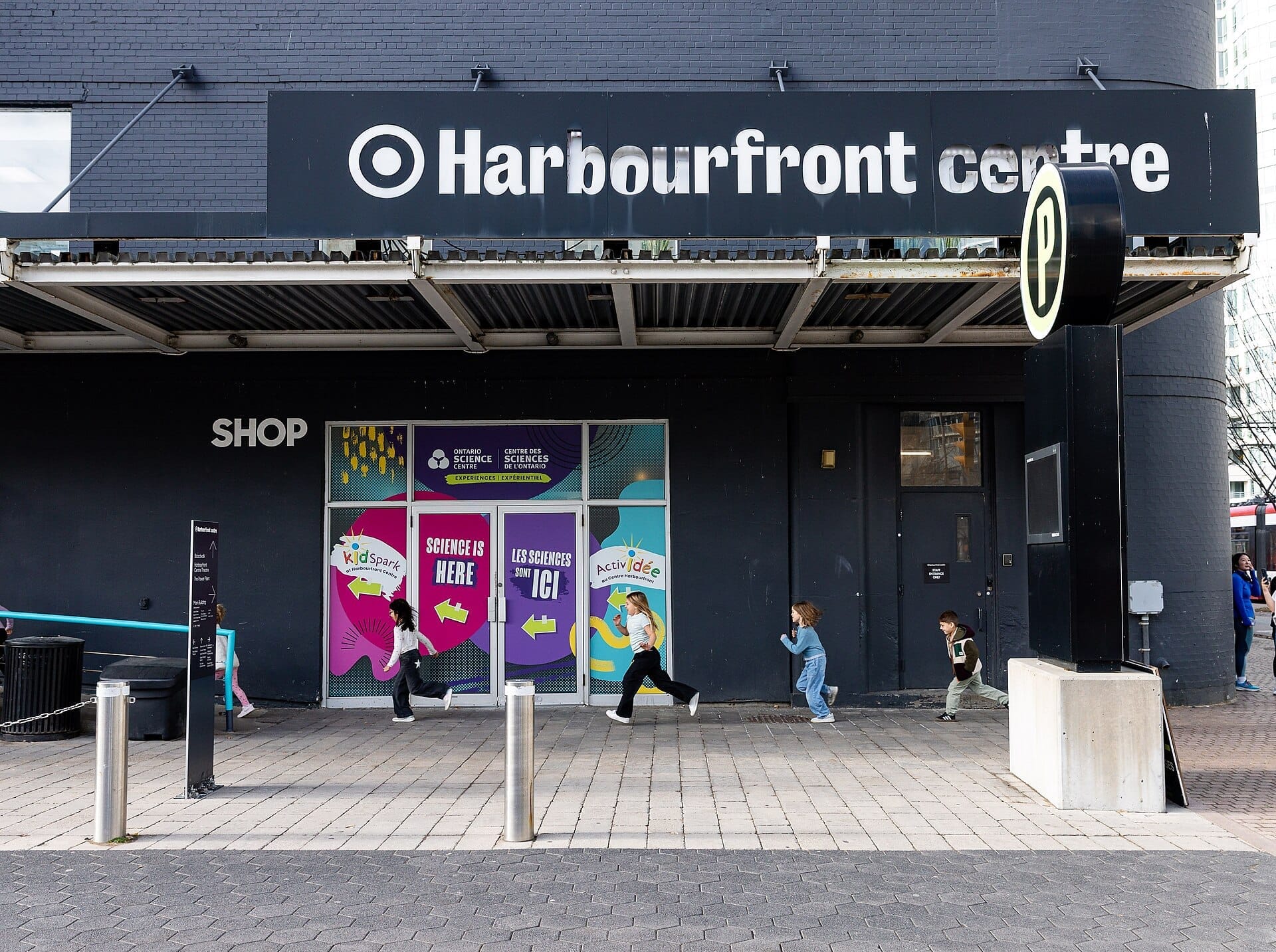
KidSpark carries forward the Science Centre's emphasis on tactile, inquiry-based learning. The format at Harbourfront Centre is compact compared to the original, but well-executed within its scope. Exhibits are designed to engage children through building, experimenting, and exploring scientific concepts in an accessible, low-pressure environment. The space has the feel of an energetic classroom rather than a sprawling museum, which works in its favour for families with shorter attention spans or younger kids who might have been overwhelmed by the scale of the original facility.
Weekday mornings tend to be quieter, drawing a mix of school groups and families with toddlers or preschoolers. Weekend afternoons get significantly busier, particularly when the weather pushes families indoors. If you have flexibility, arriving when the doors open at 10:00 (or at opening time listed for the current interim site) gives you the best chance of moving through exhibits without competition for stations. The space warms up quickly once it fills, so layering is practical advice, particularly in winter when contrast with the cold outside is sharp.
💡 Local tip
KidSpark hours vary by interim location and are subject to change; check the official Ontario Science Centre website for current opening days and times before visiting, as pop-up programming schedules can shift.
Tickets & tours
Live prices and dates from our booking partner. If you book, we may earn a commission at no extra cost to you.
LEGOLAND Discovery Centre Toronto tickets
From 16 €Instant confirmationFree cancellationToronto Old Town: Dark Side Exploration Game and Tour
From 12 €Instant confirmationFree cancellationToronto 'Little Canada' entrance tickets
From 27 €Instant confirmationFree cancellationNiagara Falls evening tour with boat, dinner and Illumination Tower
From 77 €Instant confirmationFree cancellation
Getting There: Current Interim Site and Future Harbourfront Centre by Transit, Car, or Foot
Harbourfront Centre sits directly on the waterfront at Queens Quay West, making it one of the more straightforward Toronto attractions to reach by public transit once it opens as the interim hub, while the current KidSpark site is at CF Sherway Gardens in Etobicoke. From Union Station, you will be able to take the 509 Harbourfront or 510 Spadina streetcar westbound along Queens Quay to the Harbourfront Centre stop once the waterfront hub opens; for the current CF Sherway Gardens site, travel via Line 2 or 1 to Kipling Station and connect to TTC buses serving Sherway Gardens. The streetcar trip from Union Station to Harbourfront Centre takes roughly five to ten minutes depending on traffic and signals. Union Station itself connects to the TTC subway (Lines 1 and 2), GO Transit regional rail, and the UP Express from Pearson Airport. For a broader overview of moving around the city, getting around Toronto covers all transit options in detail.
By car, paid underground parking is available directly at 235 Queens Quay West and additional above-ground parking one block west at Rees Street and Queens Quay for the planned Harbourfront Centre hub, while parking for the current CF Sherway Gardens site is available in the shopping centre’s own lots and parkades. Driving to the waterfront on weekends in summer can be slow; arriving before 11:00 or after 15:00 helps avoid the worst of the Gardiner Expressway and Lake Shore Boulevard traffic.
The Harbourfront area is also a rewarding destination in its own right. The Harbourfront Centre itself hosts theatre, art installations, and seasonal programming, so combining a KidSpark visit with a waterfront walk or a look at what else is on that day is a sensible way to extend the outing.
A Brief History: Why the Ontario Science Centre Mattered
Founded in 1964 and opened five years later, the Ontario Science Centre was a genuinely pioneering institution. At a time when most science museums were display cases and static dioramas, the Science Centre built its entire philosophy around physical engagement. Visitors could operate equipment, conduct basic experiments, and interact with phenomena directly. That model, now standard across science museums worldwide, was not standard in 1969. The Centre helped define what a modern science museum could be.
Raymond Moriyama's building was itself a statement. Rather than a conventional box on flat ground, the structure followed the natural contours of the Don Valley ravine, connecting several exhibit buildings via ramps and bridges that descended through the landscape. The architecture expressed the institution's mandate: the building was something to be navigated and discovered, not just entered. The Don Mills site also housed Ontario's only IMAX Dome theatre, a draw for visitors beyond the museum's core audience.
The closure of that building is a genuine loss for Toronto's cultural landscape. For visitors interested in the city's architectural heritage, the Toronto architecture guide contextualizes the Science Centre's Brutalist legacy alongside other significant buildings in the city.
Accessibility and Practical Details
The Ontario Science Centre states that its experiences are designed to be accessible, with facilities and services to accommodate visitors, but details can vary by interim location. Harbourfront Centre itself is a well-maintained waterfront venue with accessible pathways, elevators, and washrooms. That said, if you have specific mobility or sensory requirements, it is worth calling ahead or checking the official Ontario Science Centre website for the most current accessibility information specific to the KidSpark pop-up format, as pop-up configurations can differ from permanent installations.
Admission fees apply; the official website is the only reliable source for current ticket prices in Canadian dollars, as pricing has not been consistently published in third-party listings. Purchasing tickets online in advance is recommended, particularly for weekend visits or during school holiday periods when capacity can be limited.
Who Should Come — and Who Might Be Disappointed
KidSpark at Harbourfront Centre works well for families with children roughly in the three-to-twelve age range who respond to hands-on activities and don't need the breadth of a large museum to stay engaged. It fits naturally into a waterfront day that might also include the Ripley's Aquarium of Canada or a walk along the Martin Goodman Trail. On a rainy day it is a particularly practical choice, offering a contained, climate-controlled environment for a couple of hours.
Adults visiting without children, or those who remember the original Don Mills Road facility and are hoping to recapture that experience, will likely find the current offering underwhelming. KidSpark is not a replacement for the full Science Centre in scale or scope. It is transitional programming while the institution determines its long-term future. Visiting with that framing in mind will produce a more satisfying outcome than arriving with the expectations set by the original museum's reputation.
If you are building a family-focused Toronto itinerary, the Toronto with kids guide offers a fuller picture of age-appropriate options across the city, many of which complement a KidSpark visit.
Insider Tips
- Arrive at 10:00 when doors open to get the most time at hands-on stations before school groups and weekend crowds fill the space. The difference between 10:00 and 11:30 on a Saturday is significant.
- Harbourfront Centre often has its own free or low-cost programming running concurrently — check their events calendar for the same day so you can extend your visit without extra cost.
- Paid parking at 235 Queens Quay West fills quickly on weekend afternoons in summer. The above-ground lot one block west at Rees Street and Queens Quay is a practical alternative and sometimes easier to access.
- The KidSpark format is a pop-up by nature, meaning programming details, exhibit configurations, and even hours can change with less notice than a permanent institution would give. Always verify on the official Ontario Science Centre website in the week before your visit.
- If your children are older or have already outgrown the target age range, consider pairing the waterfront trip with the Ripley's Aquarium nearby, which offers substantially more content for the eight-to-adult bracket.
Who Is Ontario Science Centre For?
- Families with children aged 3 to 12 seeking hands-on science engagement
- Rainy-day or cold-weather indoor outings on the waterfront
- Visitors already planning a Harbourfront or waterfront itinerary
- Educators or parents looking for curriculum-linked science activities
- Nostalgic visitors wanting to support the institution while it rebuilds toward a permanent home
Nearby Attractions
Other things to see while in Downtown Toronto:
- Allan Gardens Conservatory
Allan Gardens Conservatory is a free, year-round botanical conservatory at 160 Gerrard Street East in downtown Toronto. Housed in six glass display houses anchored by a 1910 Edwardian Palm House, it holds about 1,500 m² of tropical palms, cacti, orchids, and seasonal blooms. One of the oldest parks in Toronto, it remains one of the city's most underrated green spaces.
- Art Gallery of Ontario
The Art Gallery of Ontario is one of North America's largest art museums, housing over 90,000 works inside a landmark Frank Gehry-renovated building in downtown Toronto. From Indigenous Canadian art to European masters and contemporary photography, the AGO rewards focused visitors and casual explorers alike.
- Brookfield Place (Allen Lambert Galleria)
The Allen Lambert Galleria inside Brookfield Place is a free, publicly accessible arcade designed by architect Santiago Calatrava between 1987 and 1992. Its arching steel-and-glass canopy, rising between two of downtown Toronto's tallest towers, is one of the most impressive interior spaces in Canada.
- Campbell House Museum
Built in 1822 for Upper Canada's Chief Justice, Campbell House Museum is the oldest surviving residence from the original Town of York. Moved to its current downtown corner in 1972 and opened as a museum in 1974, it offers an intimate, unhurried window into early colonial Toronto — a sharp contrast to the glass towers surrounding it.
Planning a trip? Discover personalized activities with the Nomado app.