Andrew Jackson's Hermitage: Nashville's Most Historically Complex Attraction
Andrew Jackson's Hermitage is a National Historic Landmark 10 miles east of downtown Nashville, preserving the former U.S. President's 1,120-acre National Historic Landmark estate. The site includes the restored Federal-style mansion, original slave cabins, formal gardens, and Jackson's tomb, making it one of the most visited and extensively interpreted presidential historic sites in the American South.
Quick Facts
- Location
- 4580 Rachel's Lane, Nashville, TN 37076 — about 10 miles east of downtown
- Getting There
- Best reached by car or rideshare; direct public transit service is limited and may require transfers. Close to Gaylord Opryland Resort.
- Time Needed
- 2.5 to 4 hours for a thorough visit including mansion tour, grounds, and exhibits
- Cost
- Paid admission; multiple ticket tiers (grounds pass, mansion tour, specialty tours). Check thehermitage.com for current pricing.
- Best for
- History enthusiasts, American Studies travelers, families with older children, Civil War context seekers
- Official website
- thehermitage.com
What Andrew Jackson's Hermitage Actually Is
Andrew Jackson's Hermitage is not a reconstructed replica or a tidy commemorative park. It is a working historic site on roughly 1,120 acres of land (including the original plantation core) where the seventh President of the United States lived from 1804 until his death in 1845. The property includes more than 30 historic buildings: the restored brick mansion, a formal garden, Jackson's tomb, restored slave cabins, a smokehouse, a garden house, and the original log cabins from the early plantation era. The Andrew Jackson Foundation, which manages the site today, has made a deliberate effort to present the full history of the estate, including the lives of the enslaved people who built and maintained it.
The site was designated a National Historic Landmark and is considered one of the best-preserved presidential estates in the United States. The State of Tennessee purchased the property in 1856, and in 1889 entrusted it to the Ladies' Hermitage Association to operate as a historic site museum, making it one of the earliest organized preservation efforts for a presidential home in the country.
ℹ️ Good to know
The Hermitage is a genuine presidential historic site, not a theme attraction. Visitors who engage with the full narrative, including the slavery history, will find it significantly more rewarding than those who treat it as a quick photo stop.
The Mansion and Its Architecture
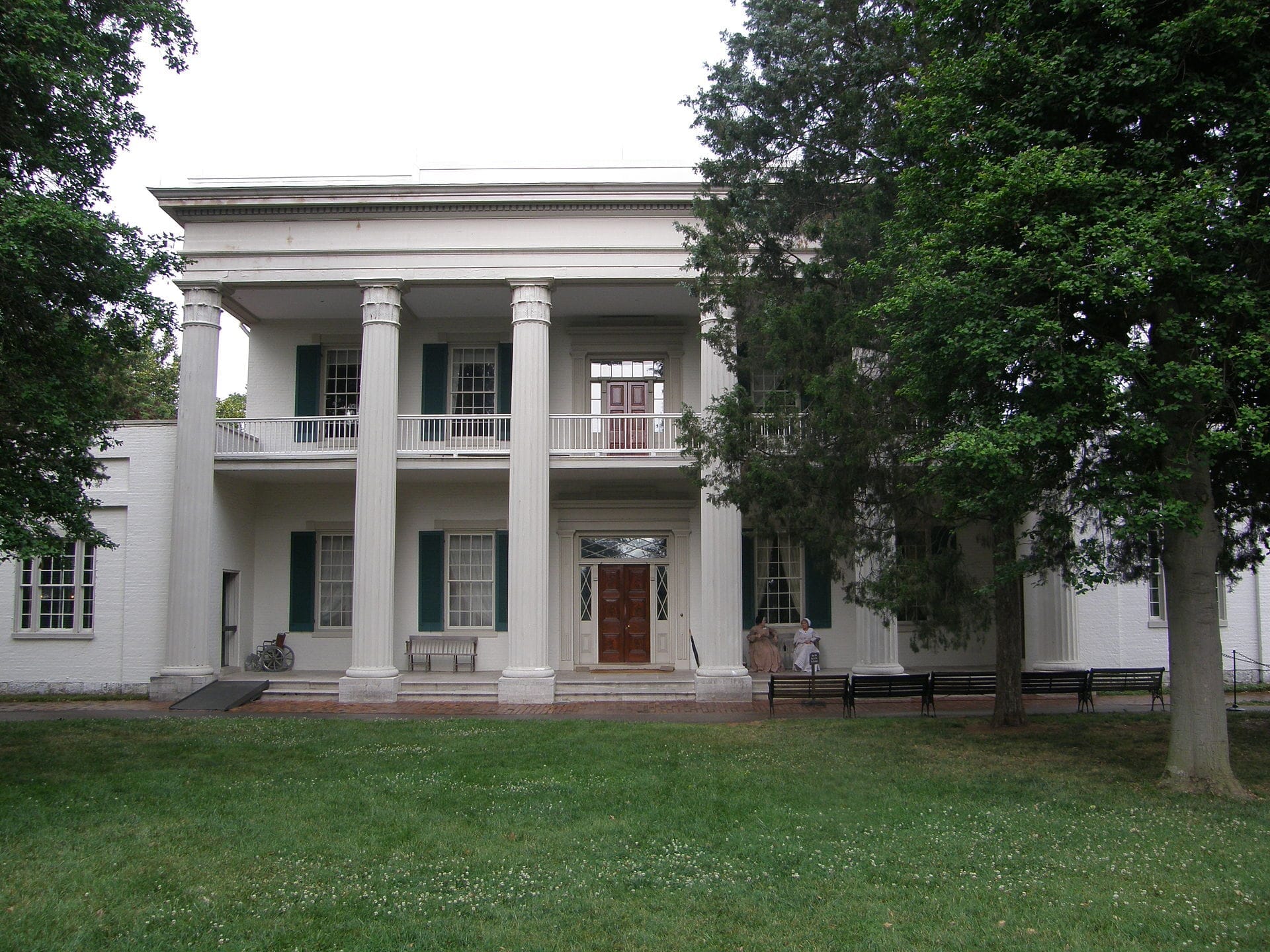
The main house is a Federal-style brick mansion that underwent significant remodeling during Jackson's presidency, with architect David Morrison overseeing updates after an 1834 fire that gave the building its current Greek Revival character. The facade, with its tall white columns and symmetrical proportions, is the image most associated with the site, but the interior tells a more layered story. Original wallpaper, period furnishings, and personal possessions are preserved throughout the rooms, giving the house a lived-in quality that many historic homes lack.
The mansion tour is the centerpiece of most visits. Guided tours move through the main rooms, where guides explain the architectural evolution of the house alongside the political career and personal life of Jackson. The scale is domestic rather than palatial, which makes it feel surprisingly intimate. You are looking at the actual spaces where Jackson received political visitors, where he grieved the death of his wife Rachel, and where he eventually died.
Photography inside the mansion is generally prohibited to protect fragile artifacts and original wallcoverings. Confirm current photography policies at the entrance.
Tickets & tours
Live prices and dates from our booking partner. If you book, we may earn a commission at no extra cost to you.
Old Town trolley tour of Nashville
From 54 €Instant confirmationFree cancellationHatch Show Print guided tour
From 21 €Instant confirmationFree cancellationDowntown walking tour of Nashville
From 21 €Instant confirmationFree cancellationNashville Downtown Underground Donut Tour
From 46 €Instant confirmationFree cancellation
The Grounds: More Than a Garden Walk
The formal garden adjacent to the mansion was designed and tended largely by Rachel Jackson, and it contains the tomb where both Andrew and Rachel Jackson are buried beneath a small domed temple structure. The garden is a quiet, structured space with brick pathways and mature plantings. In spring, flowering plants add considerable visual interest. In summer, the heat here is real: the grounds are largely open, and midday visits in July and August can be uncomfortable without water and sun protection.
Beyond the garden, the grounds include several historic outbuildings. The restored slave cabins are among the most historically significant structures on the property. The Andrew Jackson Foundation has invested in interpreting the lives of the enslaved community at the Hermitage with specific names, documented histories, and archaeological evidence. This interpretive layer is genuinely substantive and distinguishes the Hermitage from many historic plantations that treat enslaved labor as background context rather than central history.
Visitors with a strong interest in this history can also explore the Civil Rights Room at Nashville Public Library for a connected thread of Tennessee's broader racial history, or pair the Hermitage with a visit to the Tennessee State Museum, which provides deep historical context for the antebellum period.
How the Experience Changes by Time of Day and Season
Morning visits, particularly on weekdays, offer the mansion tour with smaller groups, which allows more time for questions and closer observation of individual objects. The light in the formal garden is also noticeably better in the morning, especially for photography of the tomb and the house facade. By midday, school and tour groups arrive in volume, and the visitor center becomes crowded.
Late afternoon, in the hour or two before closing, sees the crowds thin again and the light on the mansion's brick exterior turn warm and photogenic. However, the last mansion tours of the day fill up, so checking the tour schedule at the start of your visit is practical advice worth following.
Spring and fall are the most comfortable seasons for a full grounds visit. Autumn, specifically October and November, brings lower humidity and foliage color across the estate's mature trees. Summer visits require planning: wear light clothing, bring water, and budget extra time if you intend to walk the full grounds. Winter visits are quieter and often discounted, but some specialty programming may not be available.
💡 Local tip
Arrive at opening time (generally around 9:00 AM, though hours vary seasonally) to join the first mansion tour of the day with the smallest group. This makes a real difference in the quality of the guided experience.
Getting There and Practical Logistics
The Hermitage is located at 4580 Rachel's Lane in the Hermitage neighborhood of Nashville, approximately 10 miles east of downtown. A car or rideshare is the practical choice for most visitors. There is on-site parking. The site is also reasonably close to the Gaylord Opryland Resort area, making it a natural addition for visitors staying in that part of the city.
If you are planning a full day in the east Nashville corridor, consider combining the Hermitage with a visit to Gaylord Opryland Resort or the Grand Ole Opry House, both of which are nearby. The guide to getting around Nashville covers rideshare and transit options across the metro area.
Admission is paid, with several ticket types available: a grounds-only pass, standard mansion tour tickets, and specialty tours that cover specific aspects of the site such as the slavery history or the garden. Current prices are listed on the official ticketing page at thehermitage.com. Hours typically fall between roughly 8:30–9:30 AM and 4:00–5:00 PM depending on season, so confirm before you go.
⚠️ What to skip
The Hermitage is a large outdoor-and-indoor site. Some historic buildings have limited accessibility due to their 19th-century construction. Contact the site directly at thehermitage.com for current mobility and accessibility information before planning a visit with specific access needs.
The Historical Weight of the Visit
Andrew Jackson is a genuinely contested historical figure. He was a self-made frontiersman who rose to become a war hero at the Battle of New Orleans and later President, but he was also the architect of the Indian Removal Act of 1830 and the forced displacement known as the Trail of Tears, and he was a slaveholder who enslaved more than 150 people at the Hermitage. The site does not flatten these contradictions. Guides are trained to address the full scope of Jackson's legacy, and the interpretive materials engage with difficult history rather than avoiding it.
This makes the Hermitage a more demanding visit than a purely celebratory presidential shrine. It is also more honest and more intellectually interesting. For visitors who want to understand how the United States grappled with democracy, expansion, and slavery in the early 19th century, this site provides as much material to think with as any history museum in Tennessee.
For more context on Nashville's Civil War and antebellum history, the Nashville Civil War history guide covers key sites across the region, including Fort Negley and the battlefield at Stones River National Battlefield.
Who Will Not Enjoy This Visit
Visitors looking for a quick, high-stimulation experience will find the Hermitage slow-paced. The mansion tour requires patience, and the grounds demand walking. Young children who are not engaged by history may find the visit long. Travelers with limited mobility should review accessibility details before committing, as the uneven grounds and historic buildings present real challenges. Anyone hoping to breeze through in under an hour will likely leave feeling underwhelmed: the site rewards time and attention, and it shortchanges itself when rushed.
Insider Tips
- Book your mansion tour time slot online before arriving, especially during spring and fall weekends, when the first two tour slots of the day can sell out by mid-morning.
- The slave cabin area and the interactive archaeology exhibits near the visitor center are often skipped by visitors focused on the mansion. These sections contain some of the most carefully researched and moving material on the entire site.
- The formal garden is at its best in April and May when spring plantings are in bloom. If you visit in this window, build in extra time for the garden rather than rushing through it.
- The Hermitage occasionally offers specialty tours focused on specific topics (the enslaved community, the garden, the political history) that run separately from the standard mansion tour. Check the official events calendar at thehermitage.com in advance of your visit.
- The on-site café and museum shop are housed in the modern visitor center, which is a practical starting point. Pick up a site map here and plan your route before heading out, especially if you want to cover the full grounds efficiently.
Who Is The Hermitage For?
- American history travelers who want presidential sites with intellectual depth rather than hagiography
- Travelers interested in the history of slavery and plantation life in the antebellum South
- Architecture enthusiasts drawn to Federal and Greek Revival domestic buildings
- Families with older children (middle school age and above) studying early American history
- Visitors combining Nashville's cultural history with outdoor walking on a half-day excursion
Nearby Attractions
Combine your visit with:
- Arrington Vineyards
Arrington Vineyards is a working winery set on 95 acres of rolling Tennessee countryside about 25 miles south of Nashville. With 16 acres of estate vines, five tasting rooms, and a calendar full of live music events, it offers a genuinely relaxed alternative to the city's usual attractions.
- Carnton
Built in 1826 and thrust into Civil War history on a single November night in 1864, Carnton in Franklin, Tennessee stands as one of the most significant and sobering historic sites near Nashville. The mansion served as the principal Confederate field hospital after the Battle of Franklin, and four Confederate generals killed in action were laid on its back porch. Today it operates as a museum alongside the McGavock Confederate Cemetery, one of the largest privately owned Confederate cemeteries in the United States.
- Downtown Franklin Historic District
About 21 miles south of Nashville, the Downtown Franklin Historic District packs genuine 19th-century architecture, Civil War history, and an independently owned Main Street into a walkable few blocks. Entry is free, the streets are open all day, and it rewards slower travelers who actually stop to look up.
- GEODIS Park
Opened in May 2022, GEODIS Park is one of the largest soccer-specific stadiums in the United States, seating over 30,000 fans. Home to Nashville SC and a growing concert calendar, it brings serious sports infrastructure to a city better known for music.
Planning a trip? Discover personalized activities with the Nomado app.