Fort Negley Park: Nashville's Largest Civil War-Era Fortification
Fort Negley Park preserves the largest inland stone fort constructed by Union forces during the Civil War, built in 1862 on a commanding hill just south of downtown Nashville. Admission is free, the grounds are open daily from dawn to dusk, and the site carries the weight of both military history and the forced labor of enslaved and free Black workers who built it.
Quick Facts
- Location
- 1100 Fort Negley Blvd, Nashville, TN 37203 — just south of downtown, adjacent to the Adventure Science Center
- Getting There
- Drive via I-65 Exit 81 following signs for the Adventure Science Center; WeGo Public Transit bus routes serve the broader area. Street parking available on site.
- Time Needed
- 1 to 2 hours for the grounds and Visitors Center; longer if you read every interpretive panel
- Cost
- Free — no admission fee for the park or Visitors Center
- Best for
- History enthusiasts, Civil War researchers, families seeking educational outdoor space, photography
- Official website
- www.nashville.gov/departments/parks/historic-sites/fort-negley
What Fort Negley Actually Is
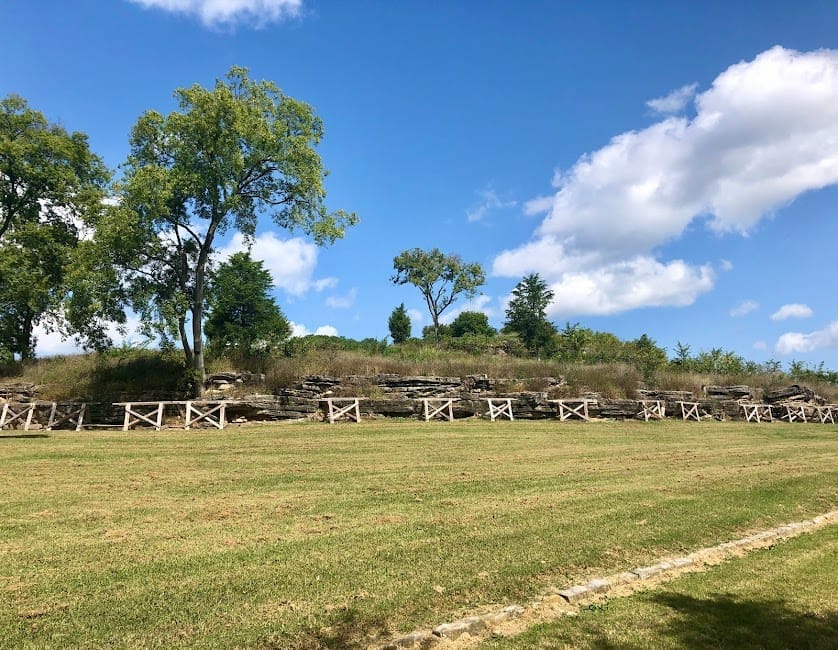
Fort Negley Park sits on a limestone ridge called St. Cloud Hill, about a mile south of Nashville's downtown core. The fort itself is a massive, irregular polygon of Nashville limestone, covering roughly 4 acres and measuring approximately 600 feet long by 300 feet wide. When Union forces occupied Nashville in February 1862, they immediately recognized the city's strategic importance as a supply hub for the Western Theater. Construction of Fort Negley began in October of that year, and the result was the largest inland stone fortification built during the Civil War.
That record comes with a dark footnote that the site does not flinch from. The labor force that built the fort consisted largely of enslaved Black people, freed Black people, and Black refugees who had fled Confederate-held territory seeking Union protection. Many were compelled to work under harsh conditions; some died during construction. In 2019, UNESCO designated Fort Negley a Site of Memory associated with slavery, and the Visitors Center gives that history equal weight alongside the military story. This is not a monument to victory alone.
ℹ️ Good to know
Fort Negley was listed on the National Register of Historic Places in 1975. The Fort Negley Visitors Center opened on December 15, 2007, and is operated by Metro Nashville's Board of Parks and Recreation.
The Experience: Walking the Grounds
Arriving at the park, the first thing you notice is elevation. The approach from the parking area follows a gentle paved path uphill, and within a few minutes the walls of the fort rise ahead of you in rough-cut grey limestone, moss-softened at the base. The structure feels old in a way that Nashville's downtown rarely does. Up close, the stonework is irregular and tactile, nothing like dressed masonry, reflecting the speed and improvisation of wartime construction.
The outer walls channel visitors through a series of bastions, traverses, and terreplein platforms. Interpretive signs are positioned throughout, explaining the fort's defensive logic: the overlapping fields of fire, the placement of artillery, the sight lines to the roads leading into Nashville from the south. On a clear day, the upper platforms offer a panoramic view of the downtown skyline to the north, with the Cumberland River visible in the distance. In the morning, before the heat builds in summer, the light hits the stone walls at a low angle and the city skyline is sharp and quiet behind you.
The grounds are largely open and grassy between the fort's structural elements, with interpretive stations scattered along a self-guided walking route. Allow at least 45 minutes to walk the route attentively; readers of historical markers will want more time. Wear comfortable shoes with grip: while main paths are paved or compacted, some sections near the walls involve uneven stone surfaces. The hilltop is fully exposed, which matters enormously in Nashville's summers, when temperatures regularly reach the upper 80s Fahrenheit. Bring water.
⚠️ What to skip
Summer visits can be genuinely uncomfortable between 11 a.m. and 3 p.m. There is almost no shade on the upper fort platforms. Arrive before 9 a.m. or after 4 p.m. in June through August. In winter, wind exposure on the ridge can make it feel significantly colder than the ambient temperature.
Tickets & tours
Live prices and dates from our booking partner. If you book, we may earn a commission at no extra cost to you.
Old Town trolley tour of Nashville
From 54 €Instant confirmationFree cancellationHatch Show Print guided tour
From 21 €Instant confirmationFree cancellationDowntown walking tour of Nashville
From 21 €Instant confirmationFree cancellationNashville Downtown Underground Donut Tour
From 46 €Instant confirmationFree cancellation
The Visitors Center: History Without Varnish
The Fort Negley Visitors Center is a modest single-story building at the park entrance that delivers far more depth than its footprint suggests. Inside, exhibits cover the fort's construction and military role, but the most substantive and carefully considered material concerns the people who built it. Interpretive displays document the experience of Black laborers, many of whom were promised wages and protection and received neither. The center does not present this history as a footnote; it is the organizing frame of the entire interpretation.
The center is open on a seasonal schedule. During the winter season (September through May), hours are Tuesday through Friday noon to 4 p.m. and Saturday 9 a.m. to 4 p.m. During summer (June through August), hours are currently Tuesday through Saturday 9 a.m. to 4 p.m.; always confirm the latest schedule before visiting. Visits outside those hours can sometimes be arranged by appointment. The park grounds are accessible dawn to dusk every day of the year regardless of whether the center is open.
Staff and volunteers are generally knowledgeable and available to answer questions during open hours. The center is small enough that a thorough walk-through takes 20 to 30 minutes, but if you engage with the material and the staff, closer to an hour is realistic. Admission is free.
Fort Negley's treatment of Civil War history complements what you'll find at the Tennessee State Museum, which holds an extensive Civil War collection a few miles north in downtown Nashville. Together, the two sites give a more complete picture of how the war unfolded in Tennessee.
Historical Context: Why Nashville, Why Here
Nashville fell to Union forces on February 25, 1862, becoming the first Confederate state capital to be captured. The city's position on the Cumberland River and its railroad connections made it immediately valuable as a logistics center. Union commanders understood that holding Nashville required controlling the high ground around it, and St. Cloud Hill, rising about 175 feet above the surrounding terrain, was the most defensible position available.
The fort was designed by Captain James St. Clair Morton of the Army Corps of Engineers, who specified a bastioned polygon capable of holding a large garrison and heavy artillery. Construction proceeded between September and November 1862, driven by a workforce that at its peak numbered over 2,700 people, the majority of them Black. The human cost was significant: disease, exhaustion, and exposure claimed lives. The fort's military story, including the Battle of Nashville in December 1864, in which Union forces under General George Thomas decisively defeated Confederate General John Bell Hood, is inseparable from this labor history.
The broader Civil War history of Nashville and Middle Tennessee is covered in depth in our Nashville Civil War history guide, which includes other sites worth visiting if the period interests you.
Photography and Practical Notes
Fort Negley offers a specific kind of photographic opportunity: massive, textured stonework against open sky, with the Nashville skyline visible from the upper platforms. Morning light from the east illuminates the eastern wall faces well. Overcast days reduce harsh shadows in the irregular stonework and often produce cleaner results than direct midday sun. The view north toward downtown works best at golden hour, when the buildings catch warm light and the stone foreground is still visible.
Drone use in Metro Nashville parks is regulated and generally requires prior permission. Do not assume aerial photography is permitted without checking with Metro Nashville Parks beforehand.
Accessibility is partial. The main paved path from the parking area to the Visitors Center is manageable for wheelchairs and strollers. However, the fort itself involves uneven stone surfaces, grade changes, and narrow passages that make full access difficult for visitors with significant mobility limitations. Metro Nashville's parks department can provide specific accessibility information by phone.
Fitting Fort Negley Into a Nashville Itinerary
Fort Negley is rarely on the first page of Nashville itineraries, which focus on Broadway, honky-tonks, and music venues. That is partly understandable and partly a loss. The site sits less than 2 miles from downtown, adjacent to the Adventure Science Center, making it easy to combine with a family day that includes both. Allow the morning for Fort Negley before the afternoon heat, then walk or drive to the science center.
If your Nashville trip focuses on history rather than nightlife, Fort Negley pairs naturally with the Bicentennial Capitol Mall State Park and the Tennessee State Capitol for a full day of civic and historical sites within a short drive of each other.
For travelers spending multiple days in the city, Fort Negley fits into both a two-day Nashville itinerary and a longer trip. Because admission is free and the grounds are open every day, it is one of the easier sites to work into an existing schedule without logistical friction.
💡 Local tip
The park is less than half a mile from the interstate and easy to reach by car, but there is no dedicated transit stop at the entrance. WeGo bus routes cover the broader area, but the last stretch requires a walk uphill. Check current WeGo schedules before planning a transit-only visit.
Who Should Manage Expectations
Fort Negley is not a sprawling battlefield park, a living history museum, or a site with regular programming. It is a preserved fort with interpretive signage and a small seasonal visitors center. Visitors expecting costumed guides, cannon demonstrations, or the scale of a national park will find it understated. The ruins are authentic but partially reconstructed, and some elements of the site are more evocative than visually dramatic. Travelers who read historical markers and engage with the material will get far more from it than those who expect spectacle.
The outdoor setting means that weather affects the experience substantially. A grey November morning can be genuinely atmospheric here; a July afternoon is genuinely grueling. Plan accordingly rather than fitting it in at whatever time happens to be convenient.
Insider Tips
- The upper fort platforms offer one of the better views of the downtown Nashville skyline available without paying for an elevated bar or observation deck. It is best photographed in the early morning or late afternoon when the light is directional.
- The Visitors Center is staffed by knowledgeable personnel, including volunteers often affiliated with organizations such as the Battle of Nashville Trust, who can provide context that goes well beyond the exhibit panels. If you arrive during open hours, introduce yourself and ask questions.
- Parking directly at Fort Negley is free and almost always available, unlike the paid lots near Broadway. If you are combining it with the Adventure Science Center next door, park once and walk between the two.
- The site is most atmospheric in autumn, when the tree line around the ridge turns and the heat is gone. The stone walls against fall color make for better photography than summer's harsh midday light.
- UNESCO's 2019 designation of Fort Negley as a Site of Memory associated with slavery is not widely publicized in general Nashville tourism. Reading about that designation before your visit will significantly deepen how you understand the site's interpretive approach.
Who Is Fort Negley Park For?
- Civil War and American history enthusiasts who want primary sites rather than museum reconstructions
- Families with older children (middle school and up) looking for educational outdoor experiences
- Photographers seeking Nashville skyline views from an elevated, non-commercial vantage point
- Travelers on a budget: free admission, free parking, open daily
- Visitors interested in African American history and the legacy of enslaved labor in the Civil War era
Nearby Attractions
Other things to see while in Downtown Nashville:
- 3rd & Lindsley
Since 1991, 3rd & Lindsley has been the venue where Nashville musicians play when they want to be heard, not just seen. Located half a mile south of Broadway in the SoBro district, it is an intimate, no-frills room that draws touring acts, local legends, and serious audiences in equal measure.
- Acme Feed & Seed
Housed in a landmark 1943 building at the corner of 1st Avenue and Broadway, Acme Feed & Seed is a multi-level bar, restaurant, and music venue with a rooftop overlooking the Cumberland River. It offers a more layered experience than the typical honky-tonk strip, with a rooftop that earns its reputation for views and a ground floor that still delivers the Broadway energy.
- Adventure Science Center
Adventure Science Center is Nashville's premier interactive science museum, offering 44,000 square feet of hands-on exhibits, a 75-foot adventure tower, and a 63-foot dome planetarium. It has served the city since 1945 and remains one of the most engaging family destinations near downtown Nashville.
- Bicentennial Capitol Mall State Park
Bicentennial Capitol Mall State Park is a free, 19-acre outdoor park in downtown Nashville built to commemorate Tennessee's 200th anniversary of statehood. Anchored by a 200-foot granite map of the state, a 95-bell carillon, and the Rivers of Tennessee Fountains, it doubles as one of the most informative and peaceful green spaces in the city center.
Planning a trip? Discover personalized activities with the Nomado app.