Downtown Franklin Historic District: The Best Day Trip from Nashville You're Probably Underestimating
About 21 miles south of Nashville, the Downtown Franklin Historic District packs genuine 19th-century architecture, Civil War history, and an independently owned Main Street into a walkable few blocks. Entry is free, the streets are open all day, and it rewards slower travelers who actually stop to look up.
Quick Facts
- Location
- Main Street, Franklin, TN 37064 — approx. 21 miles (34 km) south of downtown Nashville in Williamson County
- Getting There
- Drive south on I-65 from Nashville, roughly 20–30 minutes depending on traffic. Street parking and public lots available near Main Street. No direct public transit from Nashville.
- Time Needed
- 2–4 hours for a relaxed walk; a full day if you add a meal and nearby Civil War sites
- Cost
- Free to walk the district. Individual shops, restaurants, and tours charge separately.
- Best for
- History lovers, architecture browsers, shoppers, families, and anyone wanting a calmer alternative to downtown Nashville
- Official website
- downtownfranklintn.com
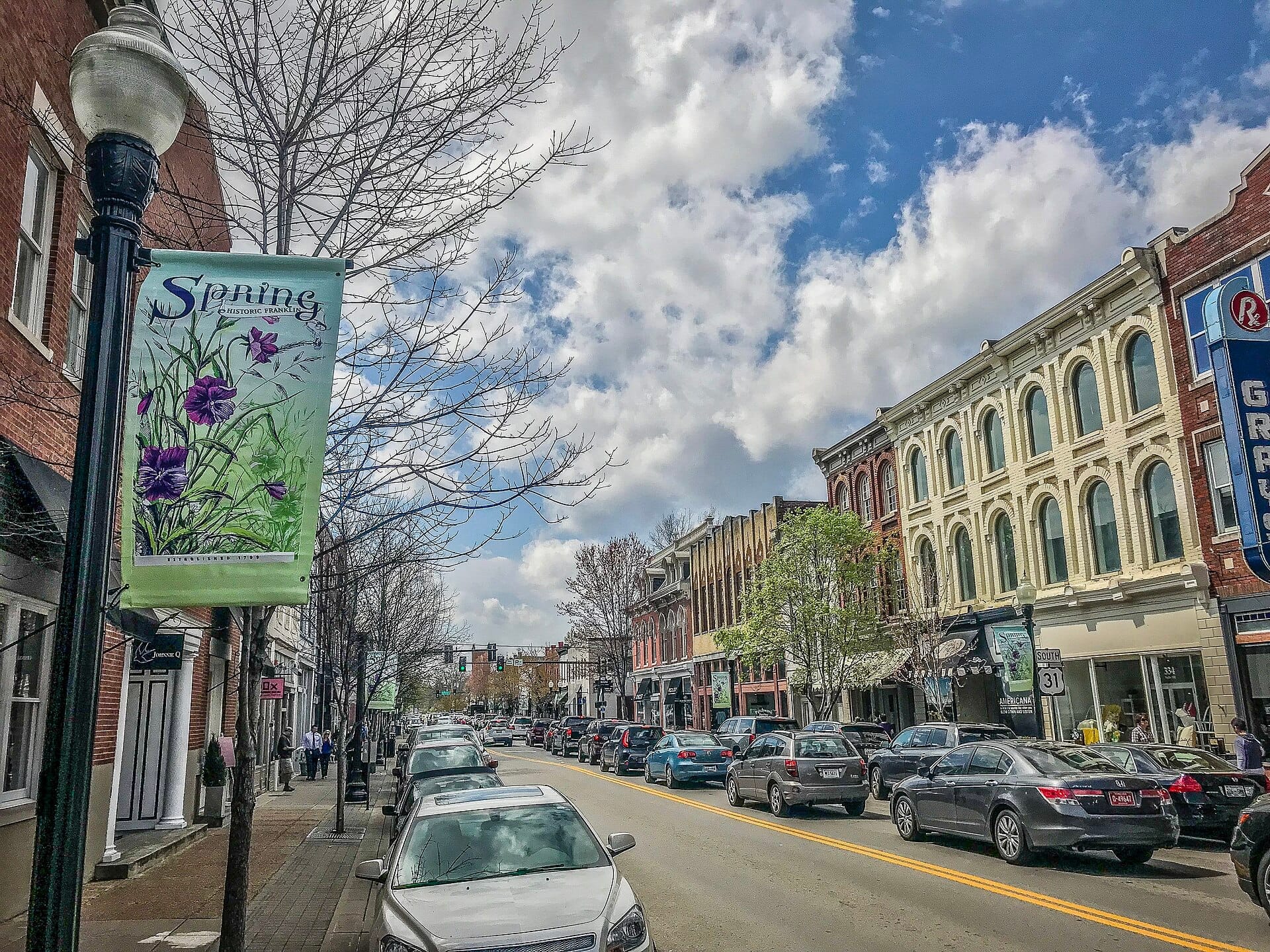
What the Downtown Franklin Historic District Actually Is
The Downtown Franklin Historic District is a preserved commercial and residential core dating to the late 18th century, with some buildings on Main Street tracing back to 1799. It sits at the heart of Franklin, Tennessee, a city of roughly 87,000 people that has grown dramatically while managing to keep its historic center mostly intact. The district is part of Franklin's five National Register of Historic Places districts, and the brick storefronts, covered sidewalks, and two-story Victorian commercial buildings along Main Street are not reproductions. They are the original structures, maintained and in active use.
The Downtown Franklin Association, dedicated to the historic preservation, revitalization & community vibrancy of historic downtown Franklin, oversees the district's preservation and promotion under the umbrella of the Heritage Foundation of Williamson County. That institutional continuity shows. Unlike many American small-town Main Streets that hollowed out in the 1980s and 1990s, Franklin's has remained commercially active, occupied largely by independent businesses rather than national chains.
ℹ️ Good to know
The district is an open public neighborhood, not a ticketed attraction. Streets and sidewalks are accessible at all hours. Business hours vary by establishment — most shops operate during daytime and early evening. Confirm hours directly with individual businesses before visiting.
What You See Walking Main Street
The focal point is Main Street itself, a compact corridor of 19th-century commercial buildings that runs through the town center. The architectural variety is part of what makes it worth slowing down for: Federal-style storefronts sit beside Italianate cornices, and the proportions are human-scale in a way that distinguishes genuinely old downtowns from planned heritage districts. Window transoms, cast-iron columns, and recessed entries are original features, not added-on period detail.
Street-level activity includes a mix of clothing boutiques, antique dealers, home goods shops, specialty food stores, and restaurants. The second stories of many buildings are offices or residences, which gives the district a lived-in quality that pure tourist corridors lack. On weekend mornings, the sidewalks carry a steady stream of locals running errands alongside visitors, and the ratio of residents to tourists feels roughly balanced rather than overwhelmingly one-sided.
The town square area anchors the north end of the main commercial stretch. The historic Williamson County Courthouse, built in 1858 and rebuilt after Civil War damage, still functions as a courthouse and defines the square's character. It is the kind of building that stops people mid-sentence because it genuinely commands attention.
Tickets & tours
Live prices and dates from our booking partner. If you book, we may earn a commission at no extra cost to you.
Downtown walking tour of Nashville
From 21 €Instant confirmationFree cancellationNashville Downtown Underground Donut Tour
From 46 €Instant confirmationFree cancellationSelf-Guided Audio Tour in the Heart of Downtown Nashville
From 6 €Instant confirmationFree cancellationOld Town trolley tour of Nashville
From 54 €Instant confirmationFree cancellation
How the District Changes by Time of Day
Early mornings, roughly before 9am on weekdays, give you the architecture without the foot traffic. The light hits the east-facing brick facades directly and the storefronts are quiet. This is the window for unhurried photography and for reading the historical markers without standing around other people.
Midday on weekends is the district's peak. Restaurants fill up, parking near Main Street becomes harder to find, and the sidewalks carry enough people that walking slows. If your primary interest is atmosphere over convenience, late morning on a weekday is the practical sweet spot: shops are open, foot traffic is manageable, and the covered sidewalks give shade from Tennessee's afternoon heat in summer.
Evening brings a different texture. Restaurants and bars extend activity well past shop-closing time, and the illuminated brick facades have a warmth that midday sun flattens out. In spring and fall, the temperature drops enough after sunset that the outdoor seating along Main Street becomes genuinely pleasant.
💡 Local tip
Summer afternoons in Franklin can reach the high 80s to low 90s°F (31–33°C) with humidity. The covered sidewalk overhangs along Main Street provide meaningful shade, but if you are sensitive to heat, plan to visit before noon or after 5pm between June and August.
The Civil War Context You Cannot Separate from This Place
Franklin cannot be understood without its Civil War history, and the downtown district is where that history sits most visibly. The Battle of Franklin on November 30, 1864, was one of the war's bloodiest single-day engagements. More than 9,000 soldiers were killed, wounded, or missing in roughly five hours of fighting, much of it on ground that is now within or adjacent to the historic district.
The Carter House, at 1140 Columbia Avenue just south of the main commercial strip, served as a Union command post during the battle and still bears bullet holes in its walls. Carnton, a plantation house that became a field hospital during and after the battle, lies about two miles from downtown. It is the largest private Confederate cemetery in the United States. Both sites operate as separate paid attractions that complement a walk through the historic district. For visitors specifically interested in this period, pairing the downtown walk with stops at these sites makes for a coherent half-day itinerary. More on Tennessee's Civil War landscape is covered in the Nashville Civil War history guide.
Several buildings in the downtown district were present during the battle. The Carter House outbuildings and portions of the commercial district sustained damage. Walking the streets with that knowledge changes how the architecture reads: these are not simply old buildings preserved for aesthetic value, but structures with specific historical witness embedded in their fabric.
Practical Walkthrough: How to Approach the District
From Nashville, the drive south on I-65 takes roughly 20 to 30 minutes depending on traffic and your starting point. The interstate has seen significant congestion growth as the Nashville metro area has expanded, so give yourself buffer time if visiting on a weekday during commuting hours. Franklin is part of the Nashville metropolitan area, which had a population of about 2.0 million in 2020. Check the getting around Nashville guide for broader transit context, though note that no direct public bus route currently connects downtown Nashville to Franklin's historic district.
Parking is available in public lots near Main Street and along side streets. Weekday parking is generally straightforward. Weekend midday parking near the town square can require a short walk from a secondary lot. The district is compact enough that once parked, everything worth seeing is on foot.
Wear comfortable walking shoes. The sidewalks are brick in several sections, which is charming in appearance but uneven underfoot. Visitors using mobility aids or strollers will find some sections easier than others — as a historic area, building entrances and sidewalk surfaces vary, and it is worth contacting specific venues in advance if accessibility is a priority.
⚠️ What to skip
A note on expectations: this is a real working downtown, not a theme-park recreation of one. Some storefronts will be occupied by businesses that have nothing to do with history. Foot traffic and parking pressure have increased significantly as Franklin's population has grown. If you are expecting a quiet, undiscovered town square, weekends will not deliver that. Weekday visits are noticeably calmer.
Photography, Shopping, and What Else Is Here
For photography, the east-facing storefronts catch good morning light, and the courthouse square offers clean architectural lines that photograph well in soft late-afternoon sun. The scale of the buildings — two stories, mostly — means wide-angle lenses capture full facades without distortion. The covered sidewalk overhangs create interesting light and shadow patterns at midday that would be harsh in a more open setting.
Shopping leans toward independent and locally owned businesses: antiques, home furnishings, clothing boutiques, and specialty food are the dominant categories. Visitors comparing this to Nashville'sNashville shopping scene will find a slower pace and a tighter edit of merchandise, with more emphasis on quality and local provenance than on volume.
Dining options along and near Main Street range from casual lunch spots to sit-down dinner restaurants. The concentration of independently owned restaurants is a genuine selling point. Franklin's food scene has developed considerably over the past decade, and the proximity to Nashville means it draws chefs and restaurateurs who want a lower-overhead alternative to the city's more competitive market.
Is This Worth the Trip from Nashville?
For travelers whose primary reason for being in Nashville is music history, the answer is: probably not unless you have extra time. The Country Music Hall of Fame, the Ryman Auditorium, and Nashville's own historic districts will occupy available days first. But for travelers interested in American history, architecture, or Southern small-town character, Franklin is genuinely worth a half-day detour.
It also pairs naturally with other Williamson County destinations. Leiper's Fork, a small arts community about 10 miles west of Franklin, is a logical add-on for an unhurried day out of Nashville. The day trips from Nashville guide covers this and other options in more detail.
Who should skip it: visitors with only one or two days in Nashville who have not yet covered the core music and history attractions in the city itself. Franklin deserves proper time and attention, and it does not reward a rushed 90-minute pass-through. If your Nashville itinerary is already tight, save Franklin for a return visit.
Insider Tips
- Arrive before 9am on a weekend morning if you want the storefronts and courthouse square to yourself. The light is better and the streets are quiet in a way they will not be by 11am.
- The Williamson County Courthouse at the town square is still an active courthouse, not a museum. You can walk around the exterior and the square freely, but interior access is limited to court business.
- Several restaurants along Main Street do not take reservations for lunch. If you are visiting on a Saturday, either arrive before noon or be prepared to wait. The wait is usually worth it, but factor it into your timing.
- Building facades often have more going on above the ground floor than at street level. Look up at the second-story cornices, window details, and original signage ghost-painted on brick side walls — some of it is still legible.
- If you plan to visit Carnton or the Carter House alongside the downtown walk, buy tickets in advance online. Both sites have timed tours that sell out on busy weekends, and you cannot simply show up and walk in.
Who Is Downtown Franklin Historic District For?
- History travelers wanting Civil War context beyond battlefield monuments
- Architecture enthusiasts interested in intact 19th-century American commercial streetscapes
- Nashville visitors with a spare half-day looking for something slower-paced than downtown
- Shoppers seeking independent boutiques and antique dealers rather than chain retail
- Families comfortable with a walking-oriented itinerary that mixes history, food, and open streets
Nearby Attractions
Combine your visit with:
- Arrington Vineyards
Arrington Vineyards is a working winery set on 95 acres of rolling Tennessee countryside about 25 miles south of Nashville. With 16 acres of estate vines, five tasting rooms, and a calendar full of live music events, it offers a genuinely relaxed alternative to the city's usual attractions.
- Carnton
Built in 1826 and thrust into Civil War history on a single November night in 1864, Carnton in Franklin, Tennessee stands as one of the most significant and sobering historic sites near Nashville. The mansion served as the principal Confederate field hospital after the Battle of Franklin, and four Confederate generals killed in action were laid on its back porch. Today it operates as a museum alongside the McGavock Confederate Cemetery, one of the largest privately owned Confederate cemeteries in the United States.
- GEODIS Park
Opened in May 2022, GEODIS Park is one of the largest soccer-specific stadiums in the United States, seating over 30,000 fans. Home to Nashville SC and a growing concert calendar, it brings serious sports infrastructure to a city better known for music.
- Harpeth River State Park
Stretching roughly 40 river miles along the lower Harpeth River, this free Tennessee State Park packs archaeological wonders, a 200-year-old hand-dug tunnel, and calm paddling water into a series of non-contiguous sites just west of Nashville. It rewards those who come prepared and take their time.
Planning a trip? Discover personalized activities with the Nomado app.