Templo de Santa Mónica: Guadalajara's Baroque Colonial Treasure
Built from 1720 as part of a convent complex, the Templo de Santa Mónica is one of Guadalajara's finest surviving examples of colonial religious architecture. Located on Calle Santa Mónica in the Centro Histórico, this INAH-listed monument rewards anyone drawn to carved stone facades, quiet devotional interiors, and the layered history of New Spain.
Quick Facts
- Location
- Calle Santa Mónica at the corner of Reforma, Centro Histórico, Guadalajara, Jalisco
- Getting There
- San Juan de Dios station (Line 2, SITEUR light rail); several city bus routes along Avenida Hidalgo and Reforma
- Time Needed
- 20–40 minutes for the church; 1–2 hours if combined with a Centro Histórico walk
- Cost
- Free entry (Catholic church open to the public; donations welcome)
- Best for
- Architecture enthusiasts, history travelers, photography, quiet reflection
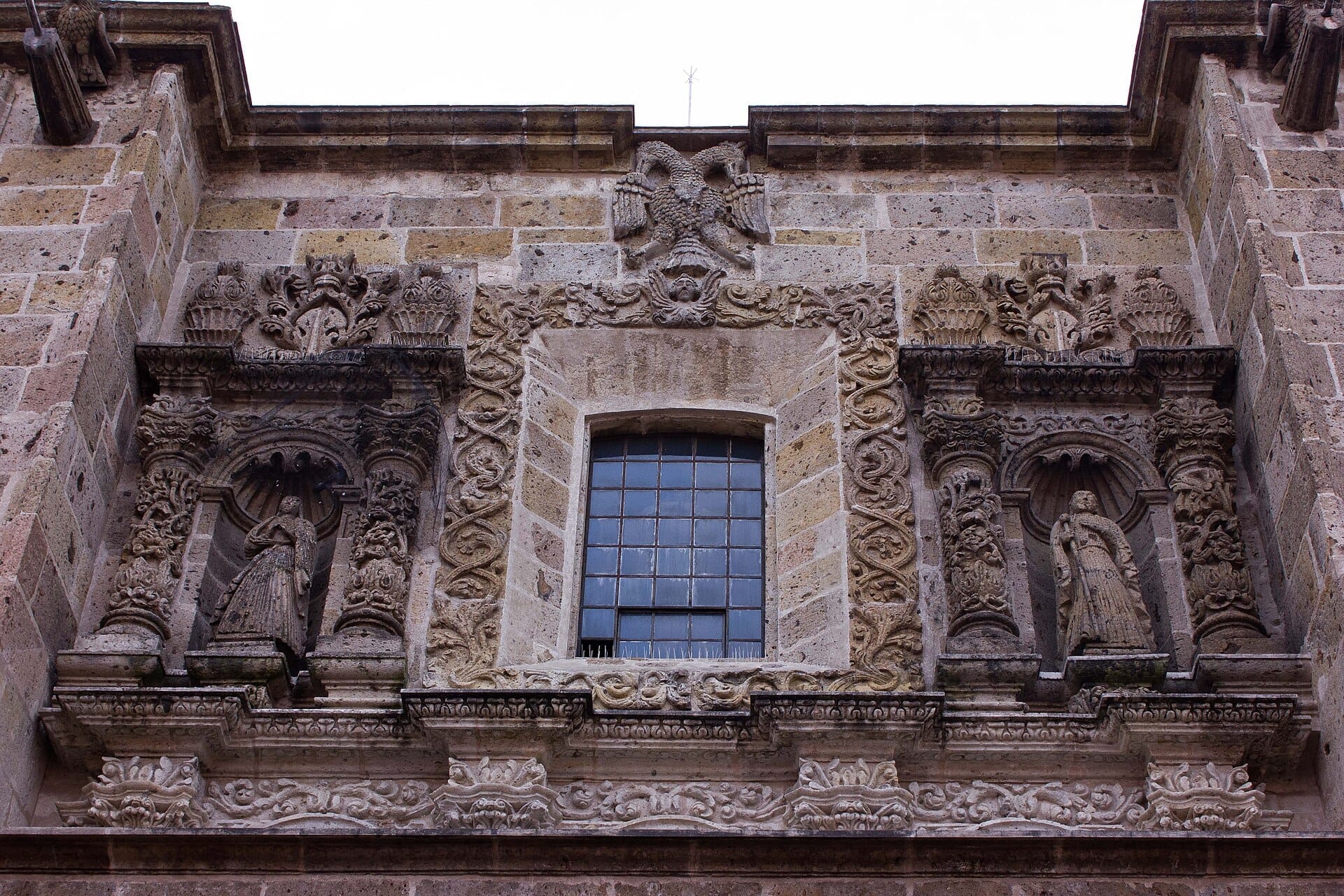
What Is the Templo de Santa Mónica?
The Templo de Santa Mónica is a Catholic church in Guadalajara's Centro Histórico, and it stands as one of the most architecturally intact colonial-era religious buildings in the city. Construction began in 1720 as the church of a convent of Augustinian nuns dedicated to Saint Monica, mother of Saint Augustine. The broader convent complex was largely demolished in the 19th century following the Reform Laws that stripped the Catholic Church of institutional property across Mexico, but the church itself survived and is now classified as a historic monument by INAH, the National Institute of Anthropology and History.
The building sits on Calle Santa Mónica at the corner with Reforma, just a few blocks northwest of the cathedral axis. It is an active parish church, meaning visitors share the space with worshippers. This is not a museum. There are no rope barriers, no interpretive panels, and no souvenir stands. What you get instead is a working place of devotion that has been in near-continuous use for over three centuries.
ℹ️ Good to know
Entry is free. As with all active Catholic churches in Mexico, modest dress is expected: covered shoulders and no shorts or beachwear. Keep voices low, especially during morning Mass.
The Facade: Stone Carving at Its Most Expressive
The exterior of the Templo de Santa Mónica is the primary reason architects, photographers, and architecture students seek it out. The stone facade is a dense composition of churrigueresque and baroque ornament: layered pilasters, shell motifs, carved plant forms, and religious figures arranged in a vertical hierarchy from portal to cornice. The stone used is cantera, the pale volcanic tuff quarried around Jalisco that weathers to a warm cream or golden tone depending on light conditions.
In the morning, when sunlight strikes the facade from the east, the relief carving casts sharp shadows that make the detail legible from across the street. By midday the light flattens and the surface reads as a single plane. Late afternoon, when the sun drops toward the west, the facade falls into partial shade and the overall form becomes more dramatic as a silhouette. Photographers working with natural light will find the window between roughly 8 and 10 in the morning the most rewarding.
💡 Local tip
Stand on the opposite sidewalk on Calle Santa Mónica to photograph the full facade. The street is narrow, so a wide-angle lens or stepping back as far as possible is necessary to capture the entire portal composition.
Tickets & tours
Hand-picked options from our booking partner. Prices are indicative; availability and final rates are confirmed when you complete your booking.
Lake Chapala and Ajijic guided tour from Guadalajara
From 68 €Instant confirmationFree cancellationGuadalajara and Tlaquepaque guided tour
From 73 €Instant confirmationFree cancellation
Inside the Church: Devotion Over Display
The interior of Santa Mónica is quieter and less ornamented than some of Guadalajara's higher-profile churches, which is part of what makes it interesting. The nave is relatively narrow, with side altars in gilded retablo style and a main altar that has been modified over time. The smell inside is the characteristic layering of incense, melted candle wax, and old stone that is common to colonial churches across Latin America. On weekday mornings, elderly women in particular gather at the side altars for private prayer, and the sound is reduced to soft footsteps, the occasional shuffle of a kneeler, and distant street noise filtering through the entrance.
The church is not large, and a careful look at the interior takes perhaps fifteen minutes. What rewards attention is the consistency of the colonial religious aesthetic: the retablos, the polychrome statuary, and the vaulted ceiling are all of a piece with the exterior period. Unlike some Centro Histórico churches that have accumulated mismatched restorations and modern furnishings, Santa Mónica retains a coherence that makes it easier to read as a complete architectural moment.
Historical Context: A Convent That No Longer Exists
To understand what you are looking at, it helps to know what is missing. When the Convento de Santa Mónica was founded in 1720, the church was just one component of a larger institutional complex: cloisters, cells, gardens, communal spaces, and a library serving an Augustinian Recollect convent of nuns. At its height, the complex occupied a significant block of colonial Guadalajara, and would have been one of several major convent complexes shaping the urban fabric of the city.
The Reform Laws of the 1850s and 1860s under President Benito Juárez nationalized Church property across Mexico, and most of the Convento de Santa Mónica was demolished in the early 20th century and its site used for the Seminario Conciliar de Guadalajara. The church itself was spared, as happened with a number of colonial churches in Guadalajara whose religious function continued. The surrounding urban block was reoccupied by the Seminario Conciliar de Guadalajara, so the current institutional buildings give few obvious clues to the scale and layout of the former convent. The church is, in effect, a fragment: remarkable precisely because it survived when so much else did not.
This pattern of religious complex as colonial institution, followed by 19th-century dissolution, is visible across multiple sites in the Centro Histórico. The Templo del Carmen and the Templo Expiatorio offer architectural and historical points of comparison, each representing a different moment in Guadalajara's religious building history.
When to Visit and How the Experience Changes
Early mornings on weekdays are the calmest time to visit. The church is in use for Mass, which typically runs for under an hour, but visitors who are respectful and quiet are generally welcome to observe from the back or wait in the side aisles. By mid-morning the church settles into a pattern of quiet individual prayer and occasional tourists passing through. Weekends bring slightly more foot traffic, particularly Sunday mornings when Mass attendance is higher and the street outside sees more activity.
The surrounding block on Calle Santa Mónica is a low-traffic residential and commercial street, which means the church does not have the exposure of the Cathedral or the Teatro Degollado. You will not be fighting through tour groups to reach it. The relative obscurity is an advantage for anyone who wants to look carefully at the architecture without being rushed.
⚠️ What to skip
Opening hours are not published officially and may vary with liturgical schedules. As with most active parish churches in Mexico, the safest strategy is to arrive between 9 AM and 1 PM or 4 PM and 7 PM, when churches are typically open to visitors. If the doors are closed when you arrive, it is worth returning an hour later.
Getting There and Combining Your Visit
The Templo de Santa Mónica is walkable from most Centro Histórico landmarks. From the Guadalajara Cathedral, it is roughly a 5-minute walk northwest along streets that pass through the older residential and commercial fabric of the historic center. The nearest metro station is San Juan de Dios on Line 1, which places you about a 10-minute walk away. Ride-hailing apps (Uber and DiDi both operate in Guadalajara) provide a convenient and inexpensive option from anywhere in the city.
The church combines naturally with a broader Centro Histórico itinerary. The Museo Regional de Guadalajara is nearby and provides substantial historical context for the colonial period you are observing in the architecture. The Hospicio Cabañas, a UNESCO World Heritage Site and home to José Clemente Orozco's major murals, is also within walking distance and makes for a logical pairing if you want to move from colonial architecture to early 20th-century cultural history in a single afternoon.
If you are planning a fuller exploration of the historic center, the Guadalajara walking tour guide covers a logical route that can be adapted to include Santa Mónica without significant detour.
An Honest Assessment: What This Attraction Is and Is Not
The Templo de Santa Mónica is not one of Guadalajara's headline attractions. It does not have a visitor center, a gift shop, or guided tours. The interior, while historically authentic, is relatively modest compared to larger colonial churches in the city. Travelers who are primarily interested in religious art at scale, or who want an immersive interpretive experience, will find more to engage with at the Cathedral or Hospicio Cabañas.
What Santa Mónica offers instead is a specific quality of experience: a genuinely old building in its original function, with an exterior facade of real artistic achievement, in a neighborhood that still feels like a lived-in part of the city rather than a curated heritage zone. For travelers who find this kind of encounter more satisfying than ticketed attractions, it is worth the 20-minute detour from the main plazas.
Insider Tips
- The morning light on the facade between 8 and 10 AM is significantly better for photography than any other time of day. The east-facing stone carving is at its most legible in raking early light.
- The street is narrow enough that the full facade cannot be captured with a standard lens from directly opposite. If you have a smartphone, use the ultra-wide mode. If you have a DSLR, a focal length of 24mm or shorter on a full-frame body gives you the full height.
- The church is an active parish. If a Mass is in progress when you arrive, waiting 10 to 15 minutes outside is courteous and usually sufficient. The church is rarely locked during daylight hours on weekdays.
- Combine this visit with the Museo Regional de Guadalajara for historical depth. The museum covers the colonial period in detail and makes the architectural context of churches like Santa Mónica far more readable.
- The surrounding streets between Santa Mónica and the Cathedral contain several other colonial-era religious buildings and courtyards. Walking slowly and looking up at rooflines and doorways reveals carved stonework on buildings that are not on any tourist map.
Who Is Templo de Santa Mónica For?
- Architecture and colonial history enthusiasts who want to look closely at baroque stonework
- Photographers seeking morning facade shots without crowds
- Travelers doing a self-guided Centro Histórico walking itinerary
- Anyone interested in the 19th-century Reform period and how it physically reshaped Mexican cities
- Quiet, reflective visits outside of the main tourist circuit
Nearby Attractions
Other things to see while in Centro Histórico:
- Calandrias (Horse-Drawn Carriage Rides)
Calandrias are Guadalajara's traditional horse-drawn carriages, operating through the colonial streets of the Centro Histórico since the early 20th century. A slow, unhurried circuit past cathedral facades, plazas, and pedestrian corridors, they offer a different pace from the city's foot traffic. This guide covers what to expect, when to go, and whether it's worth your time.
- Guadalajara Cathedral (Catedral de Guadalajara)
The Catedral Basílica de la Asunción de María Santísima anchors Guadalajara's historic center, surrounded by four plazas and centuries of layered history. Its twin neo-Gothic spires are the city's most recognized silhouette, and entry is free. Here is everything you need to know before you go.
- Instituto Cultural Cabañas (Hospicio Cabañas)
A UNESCO World Heritage Site at the heart of Guadalajara's Centro Histórico, Hospicio Cabañas houses José Clemente Orozco's most celebrated murals inside a neoclassical complex of staggering scale. This is the single most significant cultural site in western Mexico, and one of the most important in all of Latin America.
- Lienzo Charro de Jalisco
The Lienzo Charro Charros de Jalisco, on Av. R. Michel near Parque Agua Azul, is one of Mexico's most storied charro arenas. Home to one of Mexico's oldest charro associations, this is where Jalisco's equestrian traditions are kept alive through competitive charreadas, pageantry, and music.