Museo Regional de Guadalajara: History, Art, and Two Millennia in One Building
Housed in an 18th-century baroque seminary that once served as a prison, military barracks, and boys' lyceum, the Museo Regional de Guadalajara is the anchor cultural institution of the Centro Histórico. Its collections span paleontology, pre-Hispanic archaeology, colonial art, and regional history, making it one of the most substantive museums in western Mexico.
Quick Facts
- Location
- Liceo 60, Col. Centro, Guadalajara, Jalisco — across from the Rotonda de los Jaliscienses Ilustres
- Getting There
- Centro Histórico is served by Guadalajara's light rail (SITEUR Lines 1 and 3) and Mi Macro Calzada BRT; walkable from most downtown hotels
- Time Needed
- 1.5 to 2.5 hours for a thorough visit; 45 minutes if you focus on highlights only
- Cost
- 100 MXN general admission; free for children under 12, students, teachers, seniors, and people with disabilities with valid official ID; free for Mexican nationals on Sundays. Verify before visiting.
- Best for
- History enthusiasts, architecture lovers, first-time visitors to Guadalajara wanting cultural context
- Official website
- sic.gob.mx/ficha.php?table=museo&table_id=1030
Why the Museo Regional de Guadalajara Matters
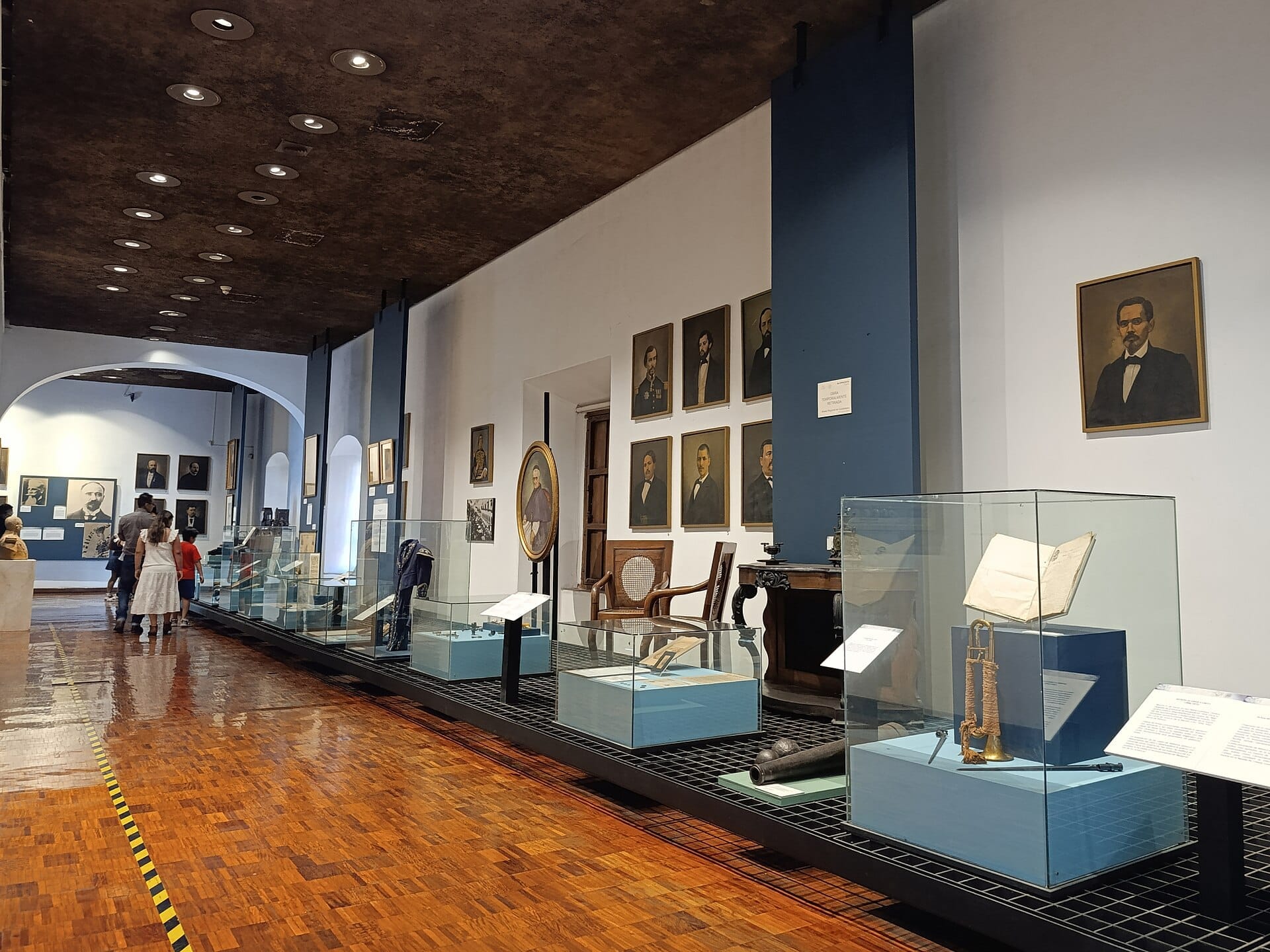
The Museo Regional de Guadalajara is not simply a repository of old objects. It is the building that most efficiently tells you what this city, this state, and this corner of western Mexico are made of. From a fossilized mammoth skeleton excavated from Jalisco soil to oil paintings commissioned during the colonial Viceroyalty period, the museum compresses roughly two thousand years of regional history into a single baroque structure on the edge of downtown's most ceremonial plaza.
It occupies a block on Liceo street in Guadalajara's Centro Histórico, directly opposite the Rotonda de los Jaliscienses Ilustres. That placement is deliberate: this is civic Mexico at its most concentrated, and the museum belongs to it completely.
Managed by INAH (Instituto Nacional de Antropología e Historia), the museum carries institutional authority that smaller private galleries cannot match. The trade-off is that labeling is primarily in Spanish and the presentation style leans toward the scholarly. Come prepared for substance over spectacle.
The Building Itself: Three Centuries of Reinvention
The structure was built between 1742 and 1758 as a seminary, and the baroque stonework of its facade still commands attention from across the street. The carved portal, the proportions of the arcade along its inner courtyard, and the general gravity of the stone all signal a building designed to project permanence and authority.
What makes the building genuinely interesting for a visitor who pays attention to context is its biography. Over the following century and a half, it functioned at various points as a prison, a military barracks, a boys' lyceum, a public library, and a conservatory. It opened as a museum on November 1, 1918, initially dedicated to fine arts. INAH now administrates the museum as part of the Secretaría de Cultura/INAH network.
Each of those institutional lives left traces. The bones of a seminary are not the same as the bones of a museum, and the spatial logic of the building occasionally feels like archaeology in itself: corridors that widen unexpectedly, courtyard proportions more generous than a modern institution would budget, stone floors worn smooth by two centuries of foot traffic. Walking through it, you are already in an exhibit before you reach the first display case.
💡 Local tip
Before entering, take a moment to look at the carved baroque facade and the interior courtyard from the entrance. The architectural detail is part of the experience, not just a backdrop for collections inside.
Tickets & tours
Hand-picked options from our booking partner. Prices are indicative; availability and final rates are confirmed when you complete your booking.
Lake Chapala and Ajijic guided tour from Guadalajara
From 68 €Instant confirmationFree cancellationGuadalajara and Tlaquepaque guided tour
From 73 €Instant confirmationFree cancellation
What the Collections Actually Cover
The museum's scope is regional in the most complete sense. The paleontology section opens with large vertebrate fossils, including the partial skeleton of a mammoth found in Jalisco, which tends to catch visitors off guard. The scale of the animal against the colonial stonework creates an unusual visual tension that no photographer seems to fully resist.
The archaeology rooms move through the pre-Hispanic cultures of western Mexico, a tradition that does not always receive the same international attention as central Mexican sites but is archaeologically significant. Western Mexico produced distinctive shaft tomb traditions, figurine ceramics, and architectural forms, several of which are represented here with labeled pieces and contextual diagrams. The nearby Guachimontones pyramids — a UNESCO-recognized site in the Tequila Valley — are referenced in these sections, giving the regional collections useful geographic grounding.
The colonial and independence-era galleries cover religious painting, ecclesiastical objects, and documents relating to Jalisco's role in Mexican history. For visitors who have already spent time at the Hospicio Cabañas or the Palacio de Gobierno, these rooms provide useful historical scaffolding for what they saw there.
The upper floor tends to be quieter and is where the more interpretive historical exhibits sit. Allow time for it. School groups typically fill the ground-floor paleontology and archaeology rooms during weekday mornings and move through quickly; the upper galleries are where you can slow down.
How the Experience Changes by Time of Day
Morning arrivals, particularly Tuesday through Friday before 11:00, offer the most unobstructed experience. The courtyard is cool at this hour and catches angled light that illuminates the stone arcade and the garden at the center, which is one of the more pleasant architectural moments in the museum. The air inside carries the faint mustiness common to old stone buildings, more pronounced in the lower corridors near the archaeology rooms.
Midday on weekends is noticeably busier. School trips are absent but family groups arrive in numbers, and the paleontology hall in particular becomes crowded around the mammoth display. If you are visiting on a Sunday to take advantage of free entry for Mexican nationals, arrive at opening time rather than mid-morning.
Afternoon light through the courtyard's upper windows shifts dramatically after around 14:00, creating harder shadows on the carved stone surfaces. This is when the building itself looks most photogenic, though the crowds have not yet thinned. By 15:30 the energy drops noticeably as visitors drift toward the door, and the last ninety minutes before closing offer a quieter, more contemplative pace.
ℹ️ Good to know
The museum is closed on Mondays and open the rest of the week only during the stated hours. Hours are Tuesday to Friday 09:30 to 17:30 and Saturday to Sunday 09:00 to 16:00. Confirm current hours before visiting, especially around national holidays.
Getting There and Practical Logistics
The museum sits in the heart of the Centro Histórico, within easy walking distance of the Guadalajara Cathedral, the Plaza de la Liberación, and the Teatro Degollado. Most visitors arrive on foot while exploring the downtown circuit, which is the most logical approach.
If arriving by public transit, Guadalajara's light rail system (SITEUR) connects the broader city to the Centro area, with bus and BRT options along Calzada Independencia nearby. Ride-hailing services such as Uber and DiDi operate in Guadalajara and drop off along Hidalgo or Liceo without difficulty. Street parking in the Centro is limited and congested on weekends; public transit or ride-hailing is the practical choice.
There is a cloakroom (guardarropa) near the entrance where bags can be stored. A small bookshop inside the museum stocks INAH publications and regional history titles, some in English. Guided visits can be arranged in advance by contacting the museum directly. An additional fee may apply for photography with dedicated equipment, though phone cameras are generally not restricted; confirm at the entrance.
Physical accessibility details, such as ramps or elevator availability, are not exhaustively documented in the official registry. Anyone with specific mobility needs should contact the museum before visiting to confirm current conditions. People with disabilities receive free admission with an official Mexican ID.
Honest Assessment: Is It Worth Your Time?
For a first-time visitor to Guadalajara with a genuine interest in regional history, pre-Hispanic cultures, or colonial architecture, the Museo Regional de Guadalajara delivers real value. The collections are substantive, the building is exceptional, and 100 MXN is a reasonable price for two hours of serious engagement with Jalisco's past.
Visitors whose priority is contemporary culture, street life, or art may find the museum less compelling. The Hospicio Cabañas offers a more dramatic visual experience through Orozco's murals, and the MUSA Museo de las Artes at the University of Guadalajara addresses modern and contemporary work with more breadth. The Museo Regional is best understood as a complement to those experiences, not a replacement.
Travelers expecting interactive exhibits, English-language audio guides, or modern museum production values may find the presentation dated. The museum is a working scholarly institution, not a designed visitor experience. That quality is actually its strength for the right visitor, but it is worth naming plainly.
⚠️ What to skip
All exhibit labeling is in Spanish. There are no English-language audio guides available on a walk-in basis. If Spanish is not accessible to you, consider arranging a guided visit in advance or downloading a translation app before entering.
Insider Tips
- The interior courtyard is the architectural heart of the building and worth pausing in at length. Look up at the upper arcade and the carved stone details — most visitors walk through it quickly on the way to the exhibits without stopping to take it in.
- If you are visiting on a Sunday, arrive within the first 30 minutes of opening. Free admission for Mexican nationals means the museum fills faster on Sundays than any other day, particularly the paleontology floor.
- The bookshop near the exit carries INAH regional publications that are difficult to find elsewhere, including academic titles on western Mexico's pre-Hispanic cultures and Jalisco archaeology. Worth a browse even if you are not buying.
- The Rotonda de los Jaliscienses Ilustres directly across from the museum entrance is a natural extension of the visit. The circular pantheon honors Jalisco's distinguished figures and connects directly to the historical narrative inside the museum.
- Guided group visits can be arranged in advance through the museum. For Spanish speakers with deeper interest in the collections, a guided tour provides substantially more context than independent browsing.
Who Is Museo Regional de Guadalajara For?
- First-time visitors to Guadalajara wanting historical and cultural context for the city and region
- Architecture enthusiasts interested in 18th-century baroque colonial structures
- Travelers already visiting the Centro Histórico circuit who want to go beyond plazas and facades
- Anyone with interest in pre-Hispanic western Mexico, including the shaft tomb cultures and the broader Jalisco archaeological record
- Budget travelers, since the admission fee is modest and free for several categories of visitor
Nearby Attractions
Other things to see while in Centro Histórico:
- Calandrias (Horse-Drawn Carriage Rides)
Calandrias are Guadalajara's traditional horse-drawn carriages, operating through the colonial streets of the Centro Histórico since the early 20th century. A slow, unhurried circuit past cathedral facades, plazas, and pedestrian corridors, they offer a different pace from the city's foot traffic. This guide covers what to expect, when to go, and whether it's worth your time.
- Guadalajara Cathedral (Catedral de Guadalajara)
The Catedral Basílica de la Asunción de María Santísima anchors Guadalajara's historic center, surrounded by four plazas and centuries of layered history. Its twin neo-Gothic spires are the city's most recognized silhouette, and entry is free. Here is everything you need to know before you go.
- Instituto Cultural Cabañas (Hospicio Cabañas)
A UNESCO World Heritage Site at the heart of Guadalajara's Centro Histórico, Hospicio Cabañas houses José Clemente Orozco's most celebrated murals inside a neoclassical complex of staggering scale. This is the single most significant cultural site in western Mexico, and one of the most important in all of Latin America.
- Lienzo Charro de Jalisco
The Lienzo Charro Charros de Jalisco, on Av. R. Michel near Parque Agua Azul, is one of Mexico's most storied charro arenas. Home to one of Mexico's oldest charro associations, this is where Jalisco's equestrian traditions are kept alive through competitive charreadas, pageantry, and music.