Teatro Massimo Palermo: Inside Italy's Greatest Opera House
Teatro Massimo Vittorio Emanuele is Italy's largest opera house and one of Europe's most architecturally significant performance venues. Built over 22 years and opened in 1897, it dominates Palermo's Piazza Verdi with a neoclassical grandeur that still stops pedestrians in their tracks. Whether you come for a guided tour or an evening performance, the experience is one of the most rewarding hours you can spend in Palermo.
Quick Facts
- Location
- Piazza Verdi, 90138 Palermo, Sicily, Italy
- Getting There
- Central Palermo; walking distance from most city-center hotels. City buses (AMAT Palermo) serve the area. Taxis readily available.
- Time Needed
- 45–90 minutes for guided tour; 2–3 hours for an evening performance
- Cost
- Guided tour from €3 (school groups) to €12 (full price). Under 26: €6. Family ticket (2 adults + 2 under 26): €30. Children under 6: free.
- Best for
- Architecture lovers, opera fans, culture seekers, photography, rainy-day visits
- Official website
- www.teatromassimo.it/en
What Teatro Massimo Actually Is
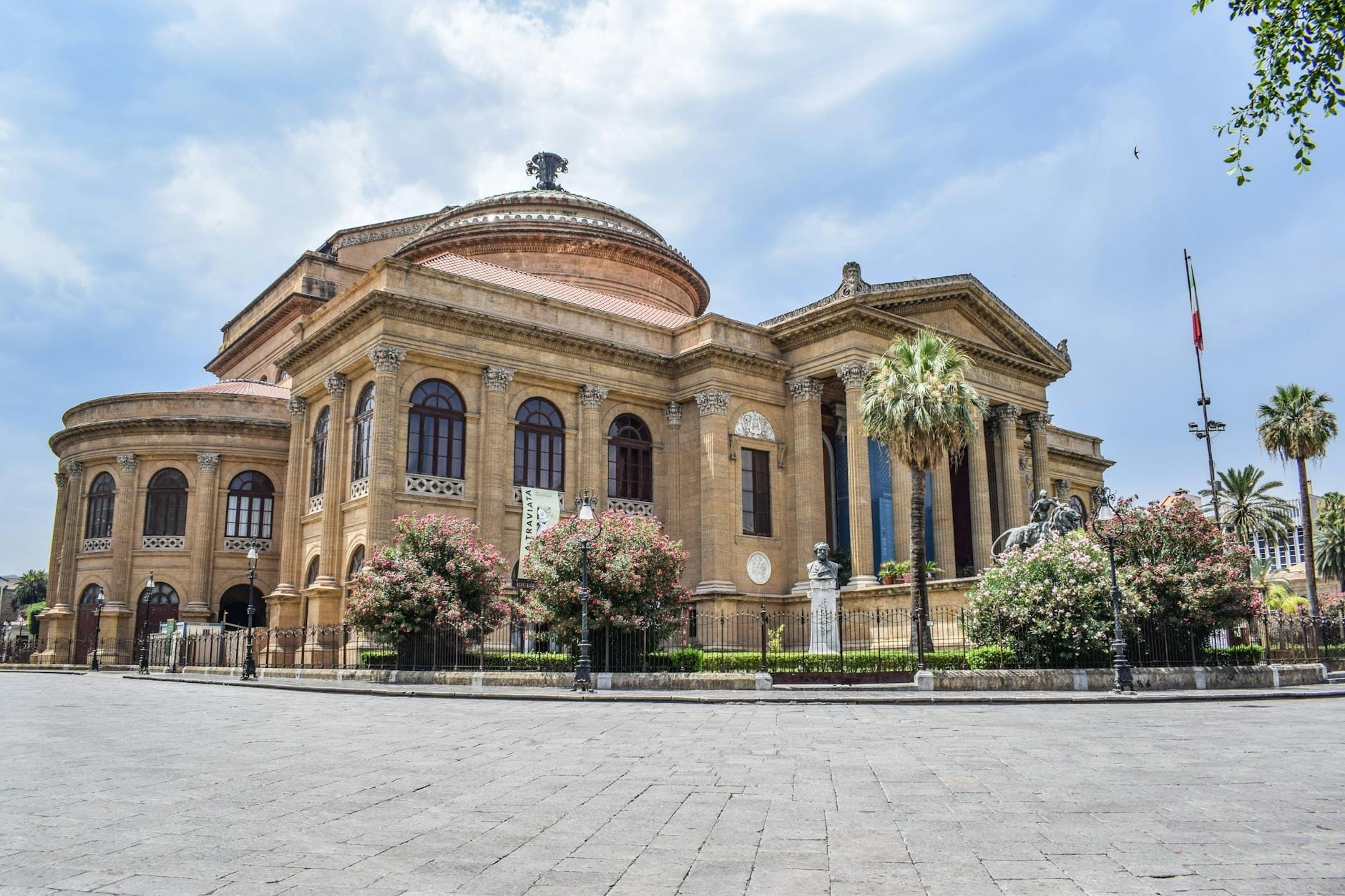
Teatro Massimo Vittorio Emanuele is the full official name, though everyone in Palermo calls it simply Teatro Massimo. It is Italy's largest opera house, with a floor area of 7,730 square metres, and at the time of its inauguration in 1897 it ranked among the largest in all of Europe, often described as third after the Paris Opéra and the Vienna State Opera. That scale is not just a statistical footnote: it shapes every aspect of the building, from the sweep of its colonnaded facade to the five stacked tiers of boxes inside the auditorium, which together were originally designed to seat around 3,000 spectators, though the current capacity is lower (around 1,300 seats).
The theatre sits on Piazza Verdi in the heart of Palermo, at the northern end of Via Maqueda, one of the city's main historic arteries. Its position is deliberate. When construction began in January 1875, the site required the demolition of two convents and a church, a controversial act that reflected the newly unified Italian state's determination to assert secular civic identity over ecclesiastical power. The building that rose in their place was equally deliberate in its symbolism: a neoclassical temple to art, visible from a distance, impossible to ignore up close.
ℹ️ Good to know
Guided tours run daily from 09:30 to 19:00, with the last tour beginning at 18:20. No advance booking is required for individual visitors, but groups of 20 or more should contact the theatre in advance.
The Architecture: What You Are Actually Looking At
The design was the work of Gian Battista Filippo Basile, who won the competition in 1864. Construction was slow, plagued by political complications and funding disputes, and Basile died before the work was complete. His son Ernesto Basile, later famous as one of Sicily's leading Art Nouveau architects, oversaw the finishing stages. The result is a building of unusual coherence given its long gestation.
The facade faces east onto Piazza Verdi and is approached by a broad flight of steps flanked by two bronze sphinx sculptures and, at the top, two female figures representing Tragedy and Lyric Opera. The portico above is supported by six Corinthian columns and crowned by a tympanum with relief sculpture. The copper dome behind it rises to around 50 metres and is one of Palermo's recognisable skyline elements. From the piazza below, particularly in early morning light before tour groups arrive, the geometry of the building reads with striking clarity.
Inside, the lobby opens into a space of red and gold that is the auditorium proper. The horseshoe-shaped hall is wrapped in five levels of boxes, each framed in gilded plasterwork, rising to a painted ceiling. The acoustic design rewards the eye as much as the ear: the shape of the room funnels both sight lines and sound toward the stage with precision. Even on a daytime tour, without a performance underway, standing on the stage and looking out at those empty tiers produces a genuinely affecting sense of scale.
Tickets & tours
Hand-picked options from our booking partner. Prices are indicative; availability and final rates are confirmed when you complete your booking.
Etna South Upper Craters Guided Excursion from Taormina
From 42 €Instant confirmationFree cancellationTaormina private tour with an expert guide
From 42 €Instant confirmationFree cancellationIsola Bella boat tour and snorkeling
From 55 €Instant confirmationFree cancellationSyracuse and Ortygia Island guided tour from Taormina
From 65 €Instant confirmationFree cancellation
The Guided Tour: What Happens and What to Expect
The standard guided tour lasts roughly 45 minutes and covers the main foyer, the auditorium, the royal box, the painted ceiling, and portions of the backstage area. Guides deliver the tour in Italian and English as standard, with other languages available depending on the day and group composition. Audio guides with video content are also provided, and the tour is designed with accessibility in mind: 3D models and tactile maps are available for blind and partially sighted visitors, and a reduced ticket price applies for visitors with disabilities and one accompanying person (typically aligned with the under‑26 concession).
The backstage sections are only partially accessible to visitors with reduced mobility or wheelchair users, so if this matters to your group, contact the theatre before your visit. The official site is the best source for current accessibility details.
💡 Local tip
Arrive at 09:30 when the doors open. Tour groups from cruise ships tend to appear mid-morning, and the difference in atmosphere between a quiet early visit and a crowded late-morning one is significant. You will have the royal box and auditorium largely to yourself in the first hour.
Photography is generally permitted on the tour, though flash and tripods are typically not allowed inside the auditorium. The painted ceiling and the view from the stage back toward the boxes are the two frames most visitors focus on. If you have a wide-angle lens, bring it: the auditorium is too large for a standard phone shot to capture its proportions accurately.
Attending a Performance: A Different Kind of Visit
A guided tour tells you what Teatro Massimo looks like. A performance tells you what it is for. The opera season typically runs from autumn through spring, with ballet, concert, and symphonic programming extending across more of the year. The inaugural production in May 1897 was Verdi's Falstaff, and the theatre has maintained a serious repertoire ever since. Ticket prices for performances vary considerably by seat and production.
On performance evenings, Piazza Verdi takes on a different character. The steps of the theatre fill with people in various states of formality: some Palermitans dress sharply for the opera, others treat it as a casual evening out. There is no strict dress code for the audience, though the atmosphere of the space itself tends to encourage effort. Inside, the bars on the upper levels open before the performance and during the interval, and the crowd noise that builds in those tiers before the lights go down is one of the finer sounds the building produces.
Check the current season programme on the official calendar before you book travel around a specific production. The schedule is published well in advance, and some productions sell out quickly. If you are planning a broader visit to Palermo, it is worth checking whether your dates overlap with a performance worth prioritising.
The Theatre's History: 22 Years of Construction and a Long Closure
The foundation stone was laid on 12 January 1875, following a public ceremony for the laying of the first stone. The theatre opened on 16 May 1897, twenty-two years later. That gap between conception and completion was shaped by the turbulent politics of post-unification Italy, recurring budget shortfalls, and the death of the original architect. When it finally opened, it was a statement of civic arrival for Palermo and for Sicily, a building that said this city belonged in the company of Milan, Naples, and Vienna.
The theatre then endured a different kind of delay: between 1974 and 1997, it was closed for restoration, a full 23 years during which the building sat largely unused while Palermo underwent some of its most difficult decades. The closure became a symbol of institutional dysfunction and civic neglect, discussed openly in the city with a mixture of frustration and dark humor. Its reopening in 1997, on the centenary of its inauguration, was correspondingly significant: the production was again Verdi, and the occasion carried the weight of recovery as much as celebration.
That history gives the theatre a resonance beyond its architectural credentials. Palermo's historic centre has seen repeated cycles of grandeur and neglect across many centuries, and the story of Teatro Massimo fits that pattern precisely. For anyone interested in understanding the city's character more deeply, a visit pairs well with time spent in the La Kalsa district or at the Norman Palace, two other sites where the gap between former glory and present reality remains readable in the fabric of the buildings.
Practical Notes: Tickets, Timing, and Getting There
The theatre is located on Piazza Verdi, at the top of Via Maqueda in central Palermo. It is a straightforward walk from most city-center accommodation: roughly 10 minutes on foot from the Quattro Canti intersection, and around 15 minutes from the main railway station (Palermo Centrale). AMAT city buses serve the surrounding streets, and taxis can drop you directly on the piazza.
Guided tour tickets are priced at €12 for adults, €6 for visitors under 26 or with disabilities (plus one companion), €9 per person for groups of 20 or more, €4 for Palermo residents, and €3 for school groups. A family ticket covering two adults and two visitors under 26 costs €30. Children under six enter free. A combined ticket covering the guided tour plus Palazzo Butera is available at €17. All prices should be verified on the official site before your visit, as they are subject to change.
⚠️ What to skip
The theatre is a working venue. Tours can be cancelled or shortened on rehearsal days or before evening performances. Check the website on the morning of your planned visit if you want to avoid arriving to a closed tour schedule.
Weather does not affect the tour itself since the entire experience is indoors, which makes Teatro Massimo a reliable option during Palermo's rainy winter months. If you are visiting Sicily in the cooler season and want guidance on what to prioritise, the best time to visit Sicily guide covers seasonal considerations in detail.
Is It Worth It? An Honest Assessment
For most visitors to Palermo, yes. The guided tour is well-paced, the building's scale genuinely impresses, and the ticket price is reasonable for what you receive. The architectural story is interesting enough to hold attention even for visitors with no particular interest in opera.
That said, if your time in Palermo is limited to a single day and you are primarily interested in Arab-Norman history or street food, the theatre may not be the highest priority on your list. The Palatine Chapel inside the Norman Palace, the Martorana church, and the Ballarò market each make stronger claims on a short Palermo visit for travellers with those interests. Teatro Massimo rewards visitors who give it their full attention rather than slotting it in as a quick stop.
Those travelling with children should know that younger kids (roughly under eight) tend to find the tour long for what they see. The building is impressive from the outside and the auditorium briefly awe-inspiring, but the narrative context of the tour is aimed at adult visitors. For family itinerary ideas, the Sicily with kids guide is a useful reference.
Insider Tips
- The steps of the theatre on a warm evening, before a performance begins, are one of the better free experiences in Palermo: locals gather, the lighting on the facade is beautiful, and the atmosphere is entirely different from the daytime tourist routine.
- If you are buying a tour ticket at the door, the box office opens at 09:15, giving you a few minutes to settle before the first tour of the day departs. Arriving at 09:20 is usually enough to secure a spot on the 09:30 tour without queuing.
- The combined ticket with Palazzo Butera (€17) represents good value if you plan to visit both. Palazzo Butera is a restored baroque palace on the seafront in La Kalsa, about 20 minutes on foot from the theatre.
- Stand at the back of the stalls, not the front, when you enter the auditorium on the tour. The full sweep of the five-tier horseshoe is visible from that position in a way that it is not from up close.
- For a performance visit, gallery seats (the highest tier) are significantly cheaper than the boxes and the sightlines are perfectly adequate for opera. The acoustic difference between the upper gallery and the stalls is less dramatic than in older European opera houses.
Who Is Teatro Massimo For?
- Architecture and design enthusiasts who want to understand Italian neoclassicism at its most ambitious scale
- Opera and classical music lovers planning their Palermo visit around the performance calendar
- Travellers interested in modern Sicilian history, including the city's long restoration of its civic institutions
- Photography-focused visitors looking for interior grandeur that photographs well in natural light
- Anyone spending more than two days in Palermo who wants to move beyond the Arab-Norman circuit
Nearby Attractions
Other things to see while in Palermo:
- Ballarò Market
Stretching through the Albergheria district from Piazza Ballarò to Corso Tukory, the Mercato di Ballarò is Palermo's oldest continuously operating street market, with roots tracing back over a thousand years to Arab rule. It is free to enter, open daily, and unlike anything else in Sicily for raw atmosphere, local produce, and street food.
- Catacombs of the Capuchins
Below a quiet convent on the western edge of Palermo's historic centre, the Catacombs of the Capuchins hold one of the most extraordinary collections of preserved human remains anywhere in the world. Around 2,000 mummified bodies and skeletons line stone corridors carved from tuff rock, dressed in period clothing and arranged by profession, gender, and social status. It is an intimate, unsettling, and genuinely thought-provoking encounter with how a Mediterranean culture once confronted death.
- Church of the Martorana
Built in 1143 by a Norman admiral and decorated by craftsmen from Constantinople, the Church of the Martorana contains some of the most important Byzantine mosaics in the western Mediterranean. It sits on Piazza Bellini in Palermo's historic center, part of a UNESCO World Heritage site, and rewards visitors who arrive early and look up.
- La Kalsa
La Kalsa is Palermo's oldest neighborhood, founded by Arab rulers in the 9th century as the city's administrative heart. Today it is a layered district of crumbling palazzi, Baroque churches, art-filled piazzas, and some of Palermo's most atmospheric street life. Free to explore and walkable in half a day, it rewards those who slow down.