Tapgol Park: Seoul's First Modern Park and the Birthplace of a Nation's Defiance
Tapgol Park sits quietly in the heart of Jongno, but its 1.5 hectares carry more historical weight than almost any other public space in Seoul. This is where Korea's March 1st Independence Movement was declared in 1919, and the park's stone reliefs, pavilions, and elderly regulars make it one of the most layered and thought-provoking stops in the old city., and the park's stone reliefs, pavilions, and elderly regulars make it one of the most layered and thought-provoking stops in the old city.
Quick Facts
- Location
- 99 Jong-ro, Jongno-gu, Seoul
- Getting There
- Line 1/3/5 Jongno 3(sam)-ga Station, Exit 1 or Line 1 Jonggak Station, Exit 3
- Time Needed
- 30–60 minutes
- Cost
- Free admission
- Best for
- History enthusiasts, solo explorers, and visitors who want to understand modern Korean identity
- Official website
- english.visitseoul.net/nature/Tapgol-Park_/1580
What Is Tapgol Park?
Tapgol Park, known officially as 탑골공원, holds a distinction few urban parks anywhere in the world can claim: it is both a pioneer of public space and a physical monument to a defining moment in national history. Opened to the public in 1920, it is recognized as Seoul's first modern public park. Its older English name, Pagoda Park, was officially retired on May 28, 1992, when the current name came into use. At just 1.8 hectares, it is small by any standard, but its historical designation as a Historic Site of Korea and its central location in Jongno make it one of the most symbolically significant patches of ground in the country., it is small by any standard, but its historical designation as a Historic Site of Korea and its central location in Jongno make it one of the most symbolically significant patches of ground in the country.
The park takes its name from the ten-story stone pagoda at its center, a Joseon-era structure that gives the entire space its identity., a Joseon-era structure that gives the entire space its identity. Everything here, the engraved stone reliefs along the perimeter walls, the bronze statues, the pavilion, exists in deliberate reference to what happened here on March 1, 1919: the public declaration of Korea's independence from Japanese colonial rule. That event, now called the Samil (3.1) Independence Movement, drew crowds into this very space and set off a wave of protests across the peninsula.
ℹ️ Good to know
Opening hours: 09:00–18:00 (March–October) and 09:00–17:00 (November–February), daily. Admission is free.
The Historical Weight of a Small Space
To understand why Tapgol Park matters, you need a little context. By 1919, Korea had been under Japanese colonial administration for nine years. On March 1st of that year, a group of 33 cultural and religious leaders signed the Declaration of Independence and had it read aloud in public, reportedly in or near this park. The declaration called for peaceful resistance and was printed and distributed across the country. The movement that followed involved large numbers of Koreans in protests, and the colonial response was severe., and the colonial response was severe. March 1st is now a national public holiday: Independence Movement Day.
Walking the inner perimeter of the park, you pass a series of carved stone relief panels depicting scenes from the protests: crowds gathering, people being arrested, figures holding the Korean flag. These panels are not decorative. They are graphic and intentional, showing colonial-era violence with a directness that can catch first-time visitors off guard. There is also a prominent statue of Son Byeong-hui, one of the 33 signatories of the declaration, standing near the entrance., one of the 33 signatories of the declaration, standing near the entrance. The ten-story Wongaksa Pagoda at the center of the park predates all of this by roughly 500 years, built during the reign of King Sejo in the Joseon Dynasty.
Tickets & tours
Hand-picked options from our booking partner. Prices are indicative; availability and final rates are confirmed when you complete your booking.
DMZ and Lake Majang Suspension Bridge Tour from Seoul
From 57 €Instant confirmationFree cancellationHalf Day DMZ Tour from Seoul, 3rd Tunnel, Observatory and More
From 47 €Instant confirmationFree cancellationSeoul zombie city exploration game and private tour
From 10 €Instant confirmationFree cancellationLuggage Storage in Seoul
From 7 €Instant confirmationFree cancellation
What to Expect When You Arrive
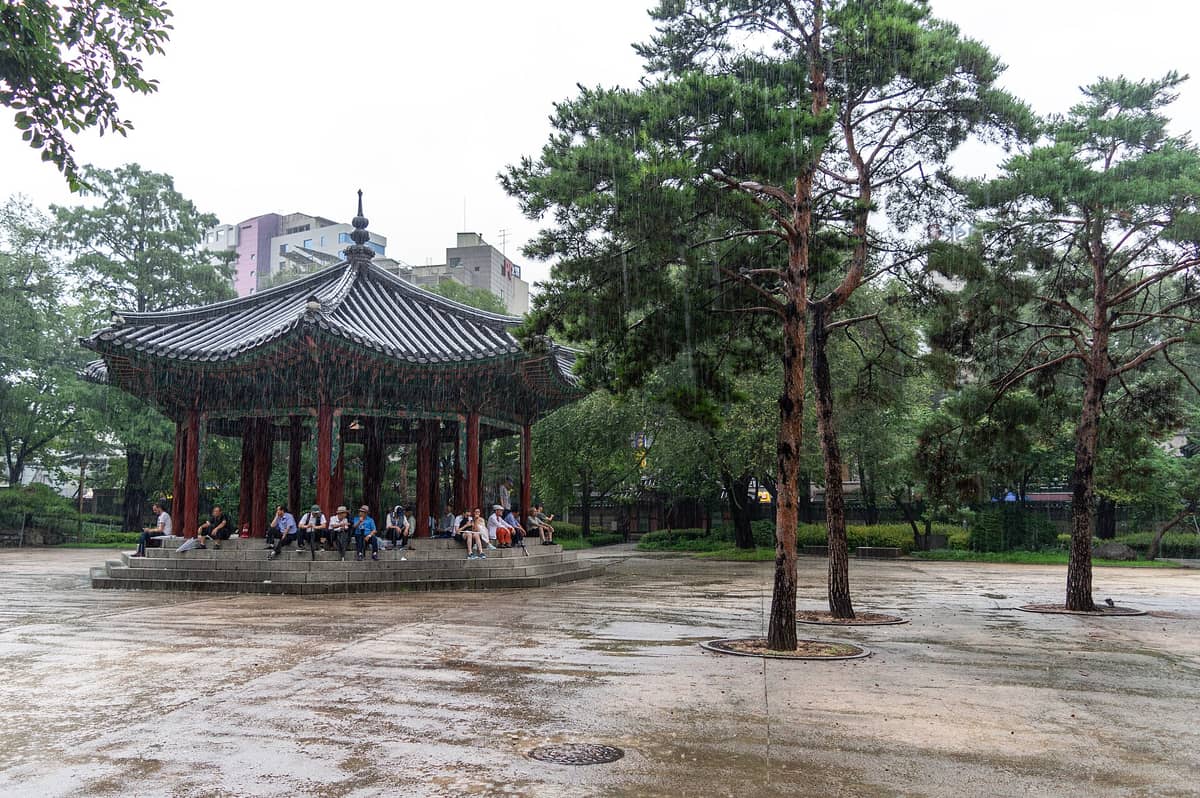
The park sits directly on Jong-ro, one of Jongno's main commercial arteries, but stepping inside through the main gate creates a notable shift in atmosphere. The street noise fades to background. The space is shaded by mature trees, and the pace slows immediately. On most mornings, the benches and sheltered areas fill with elderly Korean men, many of whom spend extended time here, playing chess, talking, or simply resting. This is a consistent feature of Tapgol Park and worth noting: it functions as a social space for the neighborhood's older male population in a way that is quite different from the experience at most Seoul tourist sites.
The park is compact and can be walked in full in under fifteen minutes if you are simply moving through. But most visitors who slow down and actually look at the relief panels, read the Korean-English interpretive signs, and sit with the pagoda for a few minutes will find thirty to forty-five minutes passes naturally. The pagoda itself is enclosed behind a low barrier and cannot be closely approached, which is a minor frustration for photography, but the glazed tile protection structure around it makes the reason clear.
💡 Local tip
Visit on a weekday morning for the calmest experience. On March 1st each year, the park sees large commemorative gatherings and may be crowded or partially restricted.
Time of Day and Seasonal Changes
Morning visits, particularly between 9:00 and 11:00, offer the most reflective experience. The elderly regulars are present but the tourist flow is minimal, and the tree canopy filters early light across the pagoda in a way that makes photography more rewarding than midday. On weekday afternoons, the park gets a modest but steady stream of school groups and domestic tourists. Weekend afternoons can feel more social than contemplative, as families and younger visitors move through at a faster pace.
In spring, the trees add softness to what is otherwise quite a stone-heavy environment, and the mild temperatures make the park genuinely pleasant to sit in. Autumn brings similar conditions with better light. Summer visits are entirely workable, as the tree cover provides shade, but the heat and humidity of July and August can make extended outdoor stops in Jongno feel draining. Winter visits are possible within the reduced 09:00–17:00 window, and the bare trees expose the pagoda more fully to the sky, which has its own visual appeal.
The Pagoda and the Architecture
The Wongaksa ten-story stone pagoda is the park's architectural centerpiece and one of the oldest surviving stone structures in central Seoul. It dates to 1467, commissioned under King Sejo of Joseon at the site of what was then Wongaksa Temple. The temple was later destroyed, but the pagoda survived. Its white marble has weathered to a soft grey-cream, and despite the protective enclosure, the carved detail on each tier remains visible. The style reflects a blend of Korean and Chinese Buddhist architectural influence characteristic of mid-Joseon stone craftsmanship.
The park also contains Palgakjeong, the octagonal pavilion where the 1919 declaration was read aloud. The combination of Joseon-era stonework, colonial-period historical narrative, and the very lived-in quality of the space as a neighborhood gathering point creates an atmosphere that is genuinely layered. For visitors already exploring the major Joseon palaces, Tapgol Park provides a useful complement: not the grandeur of royal architecture, but the quieter persistence of a stone structure that outlasted empires.
Getting There and Getting Around the Area
Tapgol Park is straightforward to reach by subway. The most direct approach is Seoul MetroTapgol Park is straightforward to reach by subway. The most direct approach is Lines 1, 3, or 5 to Jongno 3(sam)-ga Station, using Exit 1. From there the walk is a few minutes north along Jong-ro. Alternatively, Line 1 to Jonggak Station, Exit 3, puts you slightly further west but still within easy walking distance. The park sits at the edge of a neighborhood with considerable foot traffic, so street-level navigation is easy once you are on Jong-ro.
The surrounding area rewards exploration on foot. The traditional craft and gallery street of Insadong is a short walk south, and Bukchon Hanok Village is accessible on foot heading northeast. Jongno's older alleyways and small food stalls are immediately adjacent to the park's walls, and lunch options within five minutes' walk are plentiful and affordable.
Accessibility: VisitSeoul notes that facilities for visitors with disabilities are available at the site. The park itself is mostly flat, with paved paths throughout.
Is Tapgol Park Worth Your Time?
Tapgol Park is not a destination that delivers the immediate visual payoff of, say, Namsan Seoul Tower or the sensory intensity of Gwangjang Market. It is quiet, historically dense, and requires some background reading to fully appreciate. Visitors who arrive with zero knowledge of the March 1st Movement will find an interesting old pagoda and some stone carvings but may wonder what the fuss is about. Visitors who arrive with even a basic understanding of modern Korean history will find it genuinely moving.
Travelers in search of active experiences, shopping, or food should treat Tapgol Park as a fifteen-minute detour on the way to somewhere else rather than a standalone destination. For anyone with an interest in Korea's 20th-century history, colonial-era memory, or the urban sociology of public space, it warrants a longer and slower visit. It is also, straightforwardly, free, central, and covered in shade, which makes it a practical stop on any Jongno itinerary regardless of historical interest.
⚠️ What to skip
The park closes earlier in winter (17:00 instead of 18:00). If you are planning an evening stop between November and February, plan accordingly.
Insider Tips
- Read about the Samil Independence Movement before you visit. Even a five-minute overview will transform the stone reliefs from interesting carvings into a genuinely powerful document of resistance.
- The park is used daily by elderly Jongno residents as a social gathering space. Be respectful and unobtrusive, especially in the western shaded areas where groups tend to cluster.
- Photography of the pagoda is best in the morning when the light comes from the east and is not blocked by surrounding buildings. Midday light tends to flatten the carved detail on the stone tiers.
- Combine this stop with nearby Jogyesa Temple, less than ten minutes' walk north, for a half-morning that covers both Buddhist cultural heritage and modern Korean history without retracing any steps.
- On March 1st (Independence Movement Day), the park is the focal point of national commemorations. The atmosphere is significant, but crowds and ceremony logistics may limit free movement around the site.
Who Is Tapgol Park For?
- History-focused travelers wanting to understand the roots of modern Korean national identity
- Visitors doing a full Jongno walking day who want a calm, shaded pause between major sites
- Photographers interested in aged stone architecture and authentic neighborhood life
- Travelers exploring Korea's Buddhist and Joseon-era heritage alongside its 20th-century history
- Budget travelers: completely free, central, and easily combined with other no-cost Jongno attractions
Nearby Attractions
Other things to see while in Jongno & Bukchon:
- Bukchon Hanok Village
Bukchon Hanok Village (북촌한옥마을) is a preserved residential district of roughly 860 traditional Korean hanok houses in central Seoul, situated between Gyeongbokgung and Changdeokgung palaces. Unlike a museum or theme park, it is a real neighborhood where people still live, which shapes every aspect of visiting it. Entry is free, but access to certain alleys is restricted to protect residents.
- Changdeokgung Palace & Secret Garden
Changdeokgung Palace is the best-preserved of Seoul's five Joseon-era royal palaces, and its rear garden — the Huwon, known as the Secret Garden — remains one of the most atmospheric green spaces in the entire city. Together, they form a UNESCO World Heritage Site that rewards visitors who plan ahead.
- Changgyeonggung Palace
One of Seoul's five grand Joseon-era palaces, Changgyeonggung Palace sits in Jongno-gu and offers a quieter royal grounds experience. With late evening opening hours, low admission, and centuries of layered history, it rewards visitors who arrive without high expectations and leave with quiet satisfaction.
- Gwanghwamun Square
Gwanghwamun Square stretches 40,300 square meters through the center of Seoul, framed by Gyeongbokgung Palace to the north and the distant peaks of Bugaksan beyond. It is free, open 24 hours, and carries more historical weight than most visitors realize on first pass.