Blue Heron Lake (Stow Lake): Golden Gate Park's Quiet Center
Blue Heron Lake, formerly known as Stow Lake, is Golden Gate Park's largest body of water. Encircling Strawberry Hill and home to a colony of great blue herons, it offers one of the most genuinely peaceful escapes in San Francisco, with boat rentals, shaded walking paths, and an electrically pumped waterfall.
Quick Facts
- Location
- Golden Gate Park, San Francisco, CA (off Blue Heron Lake Drive/JFK Drive)
- Getting There
- Muni 5 Fulton bus to Fulton St, then a short walk south into the park
- Time Needed
- 1 to 2 hours for a full loop and boat ride; 30 minutes if just passing through
- Cost
- Free to enter; boat rentals at the boathouse are paid (check current rates at blueheronboathouse.com)
- Best for
- Families, solo walkers, wildlife watchers, couples on a relaxed afternoon
- Official website
- sfrecpark.org/facilities/facility/details/Stow-Lake-410
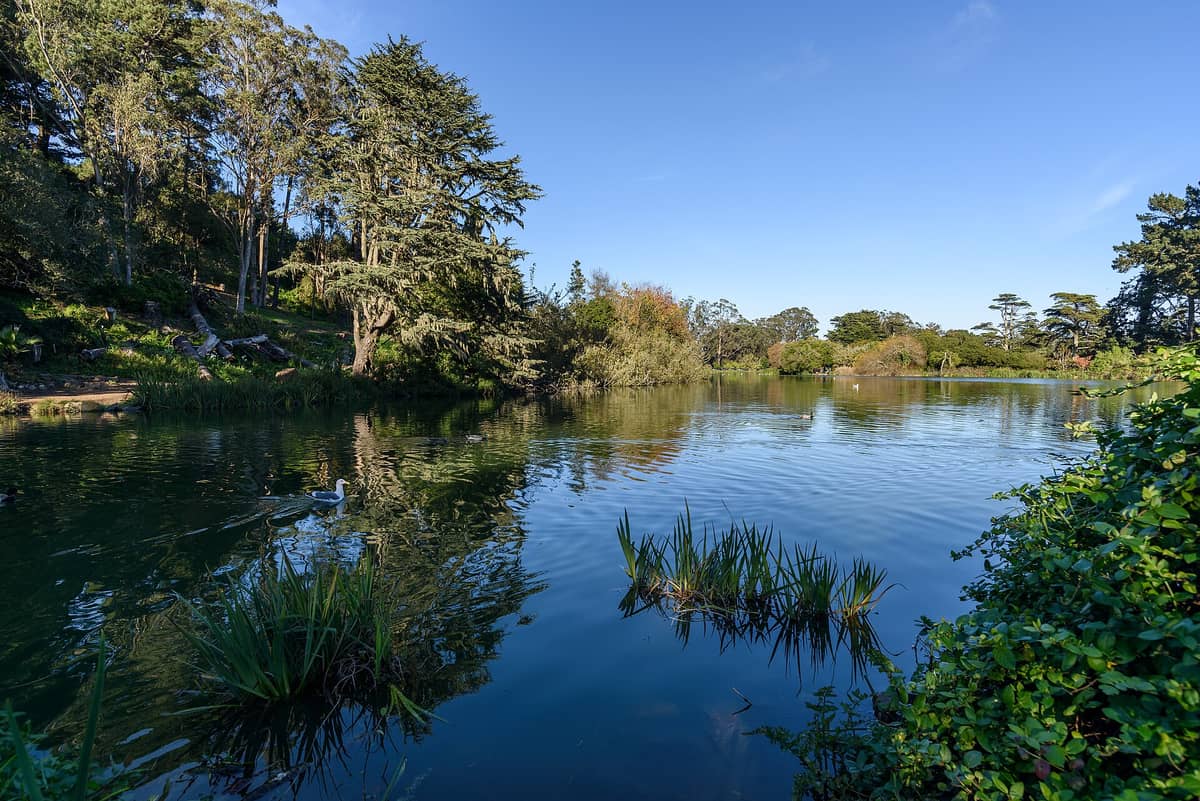
What Blue Heron Lake Actually Is
Blue Heron Lake is the largest lake in Golden Gate Park, and it sits close enough to the geographic center of the park that you can easily miss it entirely if you follow only the main drives. The lake is artificial, created in 1893 after philanthropist William W. Stow donated $60,000 for its construction. For well over a century it was known as Stow Lake, until 2024, when the San Francisco Recreation and Park Commission officially renamed it Blue Heron Lake to recognize the great blue herons that nest and forage here year-round.
What makes the lake unusual is its structure. Rather than an open basin, Blue Heron Lake encircles an island called Strawberry Hill, the highest natural rise in Golden Gate Park. A paved path loops the entire shoreline, just over one mile (about 1.1 miles), with two stone bridges connecting the mainland to the island. An electrically pumped waterfall spills down the north face of Strawberry Hill into the lake, audible from the water and from the path below.
ℹ️ Good to know
The lake and park are generally accessible daily from 5:00 am to midnight. There is no admission charge. Boat rentals at the Blue Heron Boathouse are a separate paid service; check current rates directly at blueheronboathouse.com before your visit, as prices can change seasonally.
How the Lake Changes Through the Day
Early morning, roughly 7:00 to 9:00 am, is when the lake earns its name most clearly. The herons are active and often visible standing motionless at the waterline or lifting silently from the upper branches of the eucalyptus on Strawberry Hill. The surface of the water is calm at this hour, reflecting the hill and the surrounding tree canopy with enough clarity to make the whole scene feel staged. Joggers and dog walkers move at a brisk pace around the outer loop, but the pace rarely feels crowded.
By late morning on weekends, particularly from April through October, the boathouse area picks up significantly. Families line up for pedal boats and rowboats, children crowd the railing to watch the ducks and turtles congregate below, and the flat area near the boathouse becomes a loose social gathering point. The smell of eucalyptus mixes with the faint damp-stone scent of the waterfall area. If you want the lake to yourself, arriving before 9:00 am or on a weekday afternoon between 1:00 and 3:00 pm is the most reliable approach.
In summer, particularly June through August, San Francisco's marine fog layer often sits over the park until 11:00 am or later. The lake in fog is genuinely atmospheric, the waterfall sounds louder in the damp air, and the herons are easier to spot against the grey light. Bring a layer. Even on ostensibly warm forecast days, the park runs several degrees cooler than the rest of the city, and the shade from the tree canopy around the lake path makes it feel cooler still.
September and October bring the most reliably clear and warm conditions, with afternoon temperatures in the high 60s Fahrenheit. These are the best months for boat rentals and for sitting on the stone bridge railings without needing to check a weather forecast first.
Tickets & tours
Hand-picked options from our booking partner. Prices are indicative; availability and final rates are confirmed when you complete your booking.
Sonoma and Napa Valley wine tour from San Francisco
From 127 €Instant confirmationFree cancellationGo City | San Francisco Explorer Pass
From 76 €Instant confirmationFree cancellationMuir Woods and Sausalito guided tour with transportation
From 82 €Instant confirmationFree cancellationSan Francisco CityPASS
From 77 €Instant confirmationFree cancellation
Walking the Loop and Climbing Strawberry Hill
The paved path circling the lake takes between 20 and 30 minutes at a leisurely pace. It is mostly flat with good sightlines across the water. The north side of the loop passes closest to the waterfall, and there is a bench-lined section here where it is common to see people sitting for extended periods, sometimes just watching the herons, sometimes reading. The footing is even and the path is wide enough for strollers and wheelchairs along most of the circuit, though the island trails up to the summit of Strawberry Hill are unpaved and steeper.
Strawberry Hill rises high enough to offer clear views over the treetops toward the ocean on clear days. The climb from the lakeside bridge to the summit takes 10 to 15 minutes on a shaded, winding dirt path. At the top, a stone pavilion provides a rest point and a 360-degree orientation to the park and surrounding neighborhoods. It is one of the few spots in Golden Gate Park where you can see over the canopy without leaving the park itself.
💡 Local tip
Wear shoes with some grip if you plan to ascend Strawberry Hill. The dirt paths can become slick after rain, which is common from November through March. The lake loop itself stays navigable year-round.
Boat Rentals and the Boathouse
The Blue Heron Boathouse sits on the eastern shore of the lake and has operated here in various forms since the mid-20th century. The current boathouse offers pedal boats and rowboats for rent by the hour. Pedal boats are the more popular choice for families and couples; rowboats are quieter and move more efficiently for those who want to circle the island properly. From the water, the scale of the lake becomes much clearer. Strawberry Hill looms overhead, the stone bridges frame each approach, and the resident waterfowl, including Canada geese, mallards, and the namesake great blue herons, are encountered at close range.
The boathouse also has a small food and drink service area. On busy weekend mornings it can have a wait for rentals, particularly during spring and summer. Arriving at opening time generally eliminates any queue. Check the boathouse website directly for current rental rates, hours, and any seasonal closures, as these are managed by a private operator and subject to change.
Wildlife and Natural Character
The great blue herons that gave the lake its new name are a legitimate draw, not incidental. They are large birds, standing up to four feet tall, and their presence along the shoreline is consistent enough that patient observers will almost always see one. They tend to favor the quieter western and northern edges of the lake, away from the boathouse activity. Early mornings and overcast days bring them closer to the path. Beyond the herons, the lake supports a high density of red-eared slider turtles, which congregate on any exposed rock or log in sunlight. On warm afternoons, it is common to count a dozen or more stacked on a single log near the north bridge.
The surrounding park ecosystem, the wider context of which is described in our complete Golden Gate Park guide, supports a range of bird species beyond the herons. Egrets, cormorants, and migratory waders pass through seasonally. The tree canopy around the lake is predominantly eucalyptus and Monterey cypress, both of which create a particular low-light, resinous atmosphere that feels distinctly different from the open meadow sections of the park.
Getting There and Practical Logistics
By public transit, the Muni 5 Fulton bus runs along Fulton Street on the northern edge of Golden Gate Park. From Fulton Street, the lake is a roughly 10-minute walk south into the park. The 44 O'Shaughnessy bus also stops near the park's eastern end, and the N Judah light rail runs along Lincoln Way on the park's southern edge, with the lake approximately a 15-minute walk north from there.
By car, Blue Heron Lake is signed from both John F. Kennedy Drive and Martin Luther King Jr. Drive inside the park. Parking is available along the internal park roads, though spaces near the boathouse fill quickly on weekend mornings from spring through fall. Note that JFK Drive has pedestrian and cycling-only closures on certain days; consult the San Francisco transit and getting around guide for current details on park road access before driving in.
Bicycle access is excellent. The park has designated cycling paths, and the lake loop is easily incorporated into a longer cycling route through Golden Gate Park. Bike rentals are available near the park's eastern entrances.
⚠️ What to skip
Golden Gate Park is subject to San Francisco's marine fog, particularly in the mornings from June through August. Even if downtown looks clear, the park can be cold and grey until late morning. Pack a windproof layer regardless of the forecast.
Photography Notes
The lake photographs well in the hour after sunrise and in the 90 minutes before sunset when the low-angle light catches the waterfall and reflects off the water without the harsh midday contrast. The north bridge over the waterfall channel is the most consistently productive shooting location. From there, you get the falls, the hill, and the reflections in a single frame. A wide lens works better than a telephoto for the overall scene; a longer lens is useful for isolating individual herons across the water.
Overcast days eliminate the dappled-shade problem that the heavy tree canopy creates at midday. Flat light conditions produce the cleanest reflections on the lake surface. On foggy mornings, the eucalyptus trees create a strongly atmospheric backdrop that is difficult to replicate in clearer conditions.
Who Will Not Enjoy This
Blue Heron Lake is a slow, contemplative attraction. If you are working through a packed itinerary and measuring value in terms of landmark density, it will feel underwhelming. There is no entry experience, no dramatic architectural feature, and no singular photo opportunity that demands a visit. Travelers who want to maximize sightseeing hours should prioritize other Golden Gate Park destinations with more structured programming, like the California Academy of Sciences or the de Young Museum, and treat the lake as a secondary stop if time allows.
It is also worth noting that the lake sits at ground level within a forested park. If you want a sweeping panoramic view of San Francisco from elevated terrain, you will need to climb Strawberry Hill or look for that experience elsewhere, such as at Twin Peaks.
Insider Tips
- The stone bridge on the north side of the lake, directly below the waterfall, is the least-crowded sitting area. Most visitors cross both bridges and return to the boathouse without spending time there, which makes it the best spot for uninterrupted wildlife watching.
- If you see the herons standing on the far western bank, cross to the island and walk to the western shore path. The herons are substantially less reactive to people approaching slowly from the island side than from the main lake loop.
- The boathouse food service area has outdoor seating that faces the water. It is a reasonable place for a coffee stop even if you are not renting a boat, and it is far less expensive than cafes in the tourist-heavy sections of the park.
- The waterfall is electrically pumped, which means it runs at consistent volume throughout the year. It is loudest and most visible from the water level, specifically from a rowboat or pedal boat passing below it, rather than from the bridge above.
- On many weekends and some weekdays, sections of JFK Drive inside the park are closed to cars and open to pedestrians and cyclists only. The lake loop on those car-free times is significantly quieter than on a typical Saturday, and foot traffic is spread across a wider park area.
Who Is Blue Heron Lake (Stow Lake) For?
- Families with young children who want outdoor space and a low-key boat rental experience
- Wildlife and bird watchers, particularly those interested in great blue herons and waterfowl
- Couples looking for a quiet midday or late-afternoon walk away from the city's main visitor corridors
- Photographers seeking reflective water surfaces, forest light, and wildlife subjects in an urban park setting
- Anyone spending a half-day in Golden Gate Park who wants a central rest point between the park's main institutions
Nearby Attractions
Other things to see while in Golden Gate Park:
- California Academy of Sciences
The California Academy of Sciences packs a four-story rainforest, a deep-sea aquarium, and a planetarium under a single grass-covered roof in Golden Gate Park. Founded in 1853 and rebuilt in 2008, it is one of the largest natural history museums in the western United States, and one of the few places in San Francisco where you can spend half a day without running out of things to look at.
- Conservatory of Flowers
Built in 1879, the Conservatory of Flowers is the oldest building in Golden Gate Park and one of the finest surviving Victorian wood-and-glass greenhouses in the United States. Five climate-controlled galleries shelter rare tropical plants, towering palms, and flesh-eating specimens that most visitors won't find anywhere else in San Francisco.
- de Young Museum
The M. H. de Young Memorial Museum is San Francisco's flagship fine art museum, set inside a striking copper-clad building by Herzog & de Meuron in the heart of Golden Gate Park. From American art to Oceanic textiles to world-class traveling exhibitions, the de Young rewards both a casual afternoon and a full-day deep dive.
- Dutch Windmill (Golden Gate Park)
Standing 75 feet tall at the northwest corner of Golden Gate Park, the Dutch Windmill is a piece of Victorian infrastructure that once pumped 30,000 gallons of water per hour to irrigate the park. Free to visit, open year-round with the exception of scheduled garden closures in May and October, and surrounded by seasonal tulip gardens, it rewards the curious traveler willing to venture to San Francisco's western edge.