St. Peter's Church, Riga: The Tower That Has Watched Over the City for Eight Centuries
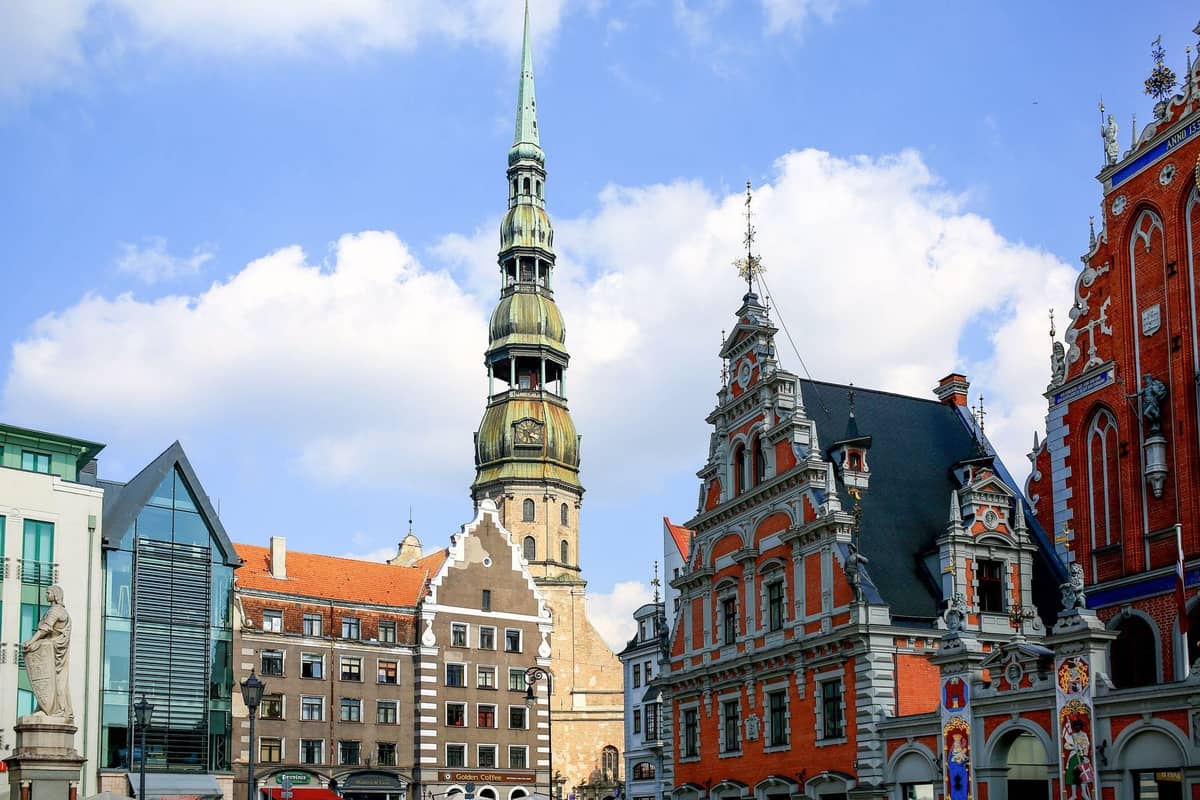
St. Peter's Church is the highest church in Riga and one of its oldest, a 13th-century Gothic landmark with a later Baroque spire rising above the cobblestones of Old Town. Its spire-topped tower offers the clearest panoramic view of the medieval city, while the interior holds centuries of history from Catholic origins through Lutheran transformation to wartime destruction and painstaking reconstruction.
Quick Facts
- Location
- Skārņu iela 19, Old Town Riga (Vecrīga), LV-1050
- Getting There
- 10-15 min walk from Riga Central Station; multiple tram and bus lines stop near Old Town. The church is a short walk from Town Hall Square.
- Time Needed
- 1 to 2 hours (30 min for the interior, 30-60 min for the tower and views)
- Cost
- Adults €9 for combined church and tower access, Students €7, Children under 7 free. Verify current prices at peterbaznica.riga.lv before visiting.
- Best for
- Architecture enthusiasts, panoramic photography, history lovers, first-time visitors to Riga
- Official website
- peterbaznica.riga.lv
What St. Peter's Church Actually Is
St. Peter's Church, known in Latvian as Rīgas Svētā Pētera baznīca, is the defining vertical landmark of Riga's Old Town. Its tiered Baroque spire climbs above the surrounding rooftops to become the first thing most visitors notice when approaching the historic center on foot. The church occupies the southern edge of Old Town near Town Hall Square, and its sheer scale within a district of narrow medieval lanes makes it feel almost out of proportion, which is precisely the point. For centuries, this was the tallest structure in the city.
The building is a functioning Evangelical Lutheran church, part of the Evangelical Lutheran Church of Latvia since 1991, but it operates simultaneously as a cultural monument, a concert venue, and a tourist attraction. The tower, accessible by lift, provides what many consider the best elevated view of Riga's Old Town, the Daugava river, and the wider city skyline. For a first-time visitor, this is a logical early stop that orients you spatially before exploring the streets below.
💡 Local tip
Visit the tower in the morning on a weekday if possible. Weekend afternoons can see queues at the ticket office, and the small lift means groups move slowly. Arriving within 30 minutes of opening avoids the peak tourist rush.
Eight Centuries of History in One Spire
The church dates to the early 13th century, making it one of the oldest surviving structures in Riga. It began as a Roman Catholic parish church and served in that role until 1524, when the Reformation swept through the Baltic German merchant community. By 1526, St. Peter's had become a Lutheran German parish church, a status it held until 1940. The decades of Soviet occupation disrupted that continuity, but the congregation was re-established after Latvian independence, and the church resumed its Lutheran identity in 1991.
The tower itself has a complicated architectural biography. The original Gothic tower, completed at the end of the 15th century, collapsed in 1666 and was rebuilt, culminating in a wooden Baroque spire. That wooden spire burned in 1721, reportedly after a lightning strike following its completion reached the structure. The current Baroque tower dates from the 18th century and reflects a Baroque sensibility layered over the Gothic nave. Then came World War II: in 1941, German artillery fire destroyed the spire and badly damaged the interior. The reconstruction that followed began in the 1950s and was completed in 1973, and the church was used for cultural exhibitions during the Soviet period rather than as a place of worship.
This layered history, Catholic, Lutheran, wartime ruin, Soviet exhibition hall, restored church, is part of what makes St. Peter's more than an architectural set piece. It mirrors the broader experience of Riga itself. To understand that context more fully, the Museum of the Occupation of Latvia sits only a few minutes' walk away and fills in the Soviet-era gaps with direct documentary evidence.
Tickets & tours
Hand-picked options from our booking partner. Prices are indicative; availability and final rates are confirmed when you complete your booking.
Canal boat sightseeing tour in Riga
From 13 €Instant confirmationArt and culture walking tour of Riga with a local
From 66 €Instant confirmationFree cancellationSelf-guided discovery walk in Riga - the essential old town and its secrets
From 30 €Instant confirmationFree cancellationExclusive private guided tour of Riga's architecture with a local
From 175 €Instant confirmationFree cancellation
The Tower: What You See and When to Go
The tower viewing platform is the primary draw for most visitors, and it earns its reputation. The lift takes you up to a covered observation gallery that wraps around the spire at height, offering a full 360-degree view of Riga's Old Town directly below, the wide grey sweep of the Daugava to the west, and the Art Nouveau districts to the north and east. On clear days in summer, the view extends far beyond the city limits.
The quality of the experience shifts significantly with the time of day and season. In the morning, particularly in spring and summer, the light falls across the red tile rooftops from the east, giving the Old Town a warm and relatively clean appearance for photography. Midday in peak summer (July and August) brings the highest foot traffic and the most predictable haze. Late afternoon, roughly 90 minutes before closing, sees fewer visitors and the light begins to angle more dramatically across the cathedral spires and medieval towers below.
In winter, the tower is colder and windier than many visitors expect, and the shorter daylight hours mean the late afternoon slot can tip quickly into dusk. That is not entirely a disadvantage: the silhouette of the Old Town against a winter sky has its own quality, and the Christmas market in Town Hall Square, visible from the platform in November and December, adds a theatrical element from above.
⚠️ What to skip
The observation gallery is partially open to the elements. In rain or strong wind, the experience is uncomfortable and photography is difficult. Check weather before paying tower admission, especially in autumn and early spring.
Opening Hours and Practical Walkthrough
The church is closed to visitors on Mondays. On other days it is generally open from late morning to early evening, with exact hours and any seasonal variations published on the official website and at the ticket office. These hours apply to the tower and general visitor access; religious services follow a separate schedule.
Ticket prices at the time of writing are €9 for adults and €7 for students for combined church and tower access, with children under seven admitted free. These prices are subject to change, so confirm the current rates at peterbaznica.riga.lv or at the ticket office on arrival. The combined ticket covers both the interior of the church and tower access via lift.
On entry, you pass through the nave before reaching the tower lift. The nave itself is worth a deliberate few minutes. The interior is sparse in the way that Northern European Lutheran churches typically are, stripped of the Catholic iconography that once populated it, but the Gothic structural proportions are still present: high arched ceilings, thick stone walls, and an atmosphere that the size and age of the building generate regardless of the decor.
The church sits directly adjacent to Riga's Town Hall Square and a two-minute walk from the House of the Blackheads. Combining all three in a single morning is entirely manageable and covers the core of Old Town's medieval civic heart.
The Surroundings: Reading Old Town From the Tower
One of the underappreciated uses of the St. Peter's tower visit is that it teaches you Old Town's layout before you walk it at street level. From the platform, you can trace the lines of the major medieval streets, identify the other church spires that punctuate the district, and locate the Daugava waterfront. The river is wide and pale, and the opposite bank shows the newer Soviet-era districts in stark contrast to the compact medieval fabric directly below.
To the north, the distinctive Art Nouveau facades of the Centre district are visible beyond Old Town's edge. If that architectural world interests you, the Alberta iela is the street most worth visiting, and the Riga Art Nouveau Museum nearby provides the background context for what you will see there.
Directly below the tower, the cobblestone square around the church is a useful orientation point. The Bremen Town Musicians sculpture, a gift from Bremen to Riga, stands nearby. Street musicians sometimes set up here in summer. The smell of the surrounding streets shifts depending on the season: in summer, coffee from the outdoor terraces and warm stone; in winter, the faint wood-smoke quality that comes off the market stalls and the cold, damp Baltic air.
Photography Notes and Accessibility
For photography from the tower, a wide-angle lens or smartphone with a wide mode handles the rooftop-level compositions well. The dominant subjects are the red tile roofs of Old Town, the Dome Cathedral, the Daugava river, and the radiating street pattern below. Portraits with the city as backdrop work in any direction. The south-facing view toward the river tends to photograph cleanest because it has the fewest obstructions at the railing level.
Accessibility to the tower is via lift, which makes the elevation accessible to most visitors who cannot manage stairs. However, the cobblestone approaches through Old Town may present difficulty for wheelchair users or those with limited mobility. The interior of the church itself is generally accessible at ground level. Visitors who need specific accessibility information should contact the church directly or check the official website, as this is an area where conditions can vary.
ℹ️ Good to know
St. Peter's also functions as a concert venue. The acoustic conditions in the Gothic nave make it a respected chamber music space, and evening concerts are held periodically. Check the official website or local listings if you want to experience the building after dark.
Is It Worth Your Time?
St. Peter's Church is not the most surprising or unconventional thing you can do in Riga. It is, however, genuinely useful as a visitor experience: the tower view is the clearest panoramic orientation you will find in Old Town, the historical depth of the building is real and legible even without a guided tour, and the tower access is priced fairly for what it delivers.
Visitors who find Gothic churches and their interiors less interesting and who are primarily motivated by the view might weigh this against the Latvian Academy of Sciences panorama, which offers a different perspective from a Soviet-era tower in the Centre district. The two views are genuinely complementary rather than redundant: St. Peter's shows you medieval Riga; the Academy of Sciences shows you the rest of the 20th century city.
Those who want pure architecture without paying tower admission can still study the exterior and the nave for free, and the surrounding square is a legitimate stop on any Old Town walk. The church exterior, particularly the graduated tiers of the Baroque spire rising from Gothic walls, is one of the most photographed facades in the city. It rewards slow looking.
Insider Tips
- The lift to the viewing platform is small and handles groups sequentially. If a tour bus has just arrived, waiting 15 to 20 minutes before joining the queue saves meaningful time.
- The south-facing side of the tower platform gives the cleanest river view, but the north-facing side shows the full spread of Old Town rooftops and is better for architectural photography in morning light.
- Evening concerts in the nave are listed on the official website and are often underbooked. Attending one is the best way to experience the building's acoustics and scale in conditions where it does not feel like a tourist attraction.
- The church is closed on Mondays. Many visitors discover this on arrival. Plan your Old Town itinerary around this if St. Peter's is a priority.
- From the tower, the seasonal market structures in Town Hall Square are directly visible below. In late November and December, this overhead perspective on the Christmas market is better than any street-level angle.
Who Is St. Peter's Church For?
- First-time visitors to Riga who want a spatial overview of Old Town before exploring on foot
- Architectural history enthusiasts interested in Baltic Gothic and Baroque construction
- Photographers looking for elevated rooftop compositions of the medieval city
- Travelers combining a Baltic church trail with Riga's Dome Cathedral and St. James's Cathedral
- Anyone visiting in winter who wants an enclosed, culturally rich stop between outdoor walking
Nearby Attractions
Other things to see while in Old Town (Vecrīga):
- Bremen Town Musicians Sculpture
Standing on Skārņu iela in Riga's medieval Old Town, this bronze sculpture of four stacked animals tells a Brothers Grimm story while carrying a quietly powerful political message about the end of the Iron Curtain. Cast in 1990 and gifted by the city of Bremen, it's free to visit, open around the clock, and one of the most photographed corners of Vecrīga.
- House of the Blackheads
Standing on Town Hall Square in Riga's Old Town, the House of the Blackheads is a reconstructed 14th-century guild hall with an ornate Dutch Renaissance facade that stops pedestrians cold. Behind the stone and gilded detail lies a layered story of medieval merchant culture, wartime destruction, and Latvian national pride.
- Museum of the Occupation of Latvia
Housed in the heart of Riga Old Town, the Museum of the Occupation of Latvia documents 51 years of Soviet and Nazi rule from 1940 to 1991. It is one of the most carefully assembled historical museums in the Baltic states, and a visit here fundamentally changes how you understand the country around you.
- Powder Tower & Latvian War Museum
The Powder Tower (Pulvertornis) is the sole surviving tower from Riga's medieval city walls, first recorded in 1330. Today it houses the Latvian War Museum, a free, well-curated institution spanning centuries of Baltic military history. It stands at the northern edge of Old Town, easy to find and easier to underestimate.