St. Patrick's Cathedral: Gothic Grandeur in the Heart of Midtown
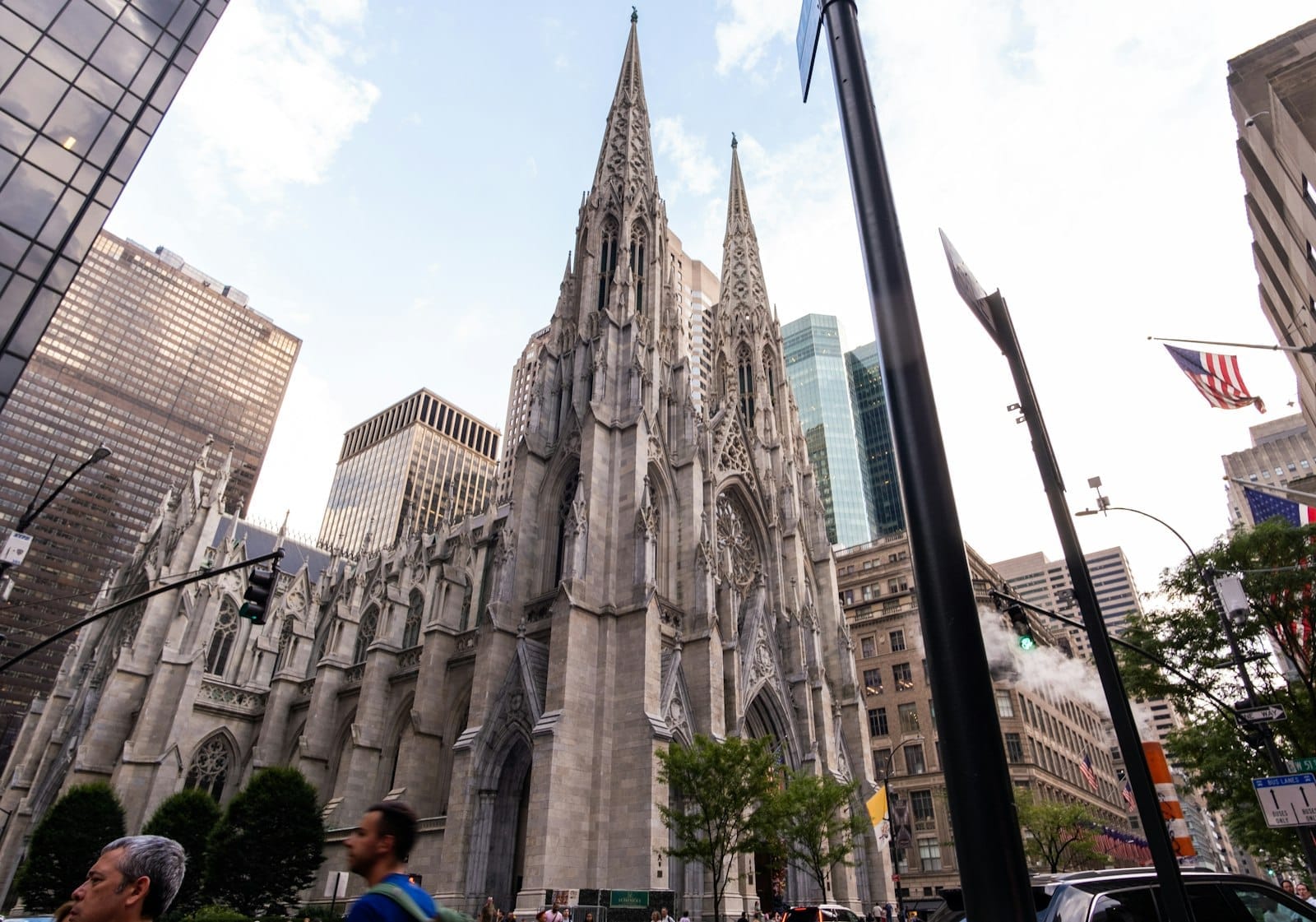
Rising above Fifth Avenue between the glass towers of Midtown Manhattan, St. Patrick's Cathedral is the largest Gothic Revival Catholic cathedral in North America. Its free-to-enter interior rewards visitors with soaring vaulted ceilings, intricate stained glass, and an atmosphere of quiet that feels genuinely earned amid the noise of the city around it.
Quick Facts
- Location
- 5th Avenue between 50th & 51st Streets, Midtown Manhattan
- Getting There
- E/M to 5th Ave/53rd St; 6 to 51st St; B/D/F/M to 47–50 Sts–Rockefeller Center
- Time Needed
- 30–60 minutes for a self-guided visit
- Cost
- Free to enter (donations welcome; verify any guided tour fees on the official site)
- Best for
- Architecture lovers, those seeking a quiet midday refuge, photography, and history enthusiasts
- Official website
- www.saintpatrickscathedral.org
What St. Patrick's Cathedral Actually Is
St. Patrick's Cathedral is the seat of the Roman Catholic Archdiocese of New York, and by any architectural measure it is one of the most ambitious buildings ever constructed in the United States. It occupies an entire city block bounded by Fifth Avenue, Madison Avenue, 50th Street, and 51st Street. The cathedral's twin spires reach approximately 330 feet, high enough that they were among the tallest structures in New York City at the time of completion. Today they are dwarfed by the towers around them, which makes the cathedral's presence on the avenue feel like a deliberate act of defiance.
The cornerstone was laid in 1858, and the cathedral was consecrated in 1879, a timeline that spans the Civil War and the chaotic decades of post-war reconstruction. Architect James Renwick Jr. drew heavily on French Gothic cathedrals, particularly Cologne and Reims, but adapted the form to local materials: the exterior is clad in white marble quarried in New York and Massachusetts, giving it a brightness unusual for European Gothic precedents built in darker stone.
ℹ️ Good to know
Entry is free, but access may be restricted during Masses, ceremonies, or major holidays. Check the official website at saintpatrickscathedral.org for the current schedule before visiting. Third-party platforms sometimes list ticketed tours — these are not official cathedral admission fees.
The Exterior: Reading the Building Before You Walk In
The best first view of St. Patrick's Cathedral is from the opposite sidewalk on Fifth Avenue, ideally from somewhere around 51st Street looking south. From here, the full facade is visible: the deeply recessed central portal flanked by pointed arches, the rose window above it, and the twin spires climbing into whatever the sky is doing that day. On clear mornings, the white marble takes on a warm tone. On overcast days, it goes cool and grey, which actually suits the Gothic style better.
The bronze doors at the main entrance on Fifth Avenue are worth a close look before you push through. Each panel depicts a figure significant to Catholic and New York history. The scale of the doors is easy to underestimate from a distance; up close, they are genuinely massive, a detail that snaps the scale of the whole building into focus.
The cathedral sits directly across Fifth Avenue from Rockefeller Center, and this pairing is one of the more striking spatial contrasts in Midtown. The 1930s Art Deco complex and the 1870s Gothic Revival cathedral face each other across one of the world's most photographed stretches of road. The tension between them is part of what makes this block interesting architecturally.
Tickets & tours
Hand-picked options from our booking partner. Prices are indicative; availability and final rates are confirmed when you complete your booking.
St. Patrick's Cathedral skip-the-line tickets audio tour and Rockefeller Center walking tour
From 32 €Instant confirmationFree cancellationNYC Combo: Statue of Liberty Cruise, St Patrick's Cathedral and Dave and Buster's
From 113 €Instant confirmationFree cancellationNYC Combo: The Edge Observation Deck, St Patrick's Cathedral and Dave & Buster's
From 113 €Instant confirmationFree cancellationSt. Patrick's Cathedral behind the scenes VIP official guided tour
From 120 €Instant confirmationFree cancellation
Inside: Scale, Light, and Silence
Stepping inside St. Patrick's Cathedral from the Fifth Avenue entrance, the first thing most visitors register is the height. The nave vaults rise to roughly 108 feet. Compared with the compressed street-level experience of Midtown, the interior feels enormous. The second thing most visitors notice is the relative quiet. The stone walls absorb or deflect the traffic noise from outside, and the cathedral's size means that even moderate crowds spread out enough that the ambient noise stays low.
The stained glass windows are the interior's clearest technical achievement. There are 70 of them, and the largest, the great rose window above the Fifth Avenue entrance, is approximately 26 feet in diameter. On sunny mornings, the light through the south-facing windows throws colored bands across the white marble columns, an effect that shifts noticeably as the sun moves. A mid-morning visit on a sunny day is the optimal time if stained glass is your primary interest.
The side chapels running along both aisles deserve attention that many visitors skip because they are focused on the main nave. Each chapel is dedicated to a different saint and contains its own altar, sculpture, and often a different quality of light. The Lady Chapel at the far end of the building, behind the main altar, is the most architecturally refined section of the entire cathedral and frequently the quietest.
💡 Local tip
Photography is generally permitted in the public areas of the cathedral, but flash and tripods are not appropriate during services. Wide-angle lenses work well for the nave; for stained glass detail, a longer focal length from the back of the church reduces distortion.
How the Experience Changes by Time of Day
Early morning, roughly from opening until around 9 a.m., is when the cathedral is at its most atmospheric. The light is low and directional, the crowds are thin, and the smell of candle wax and cool stone is most noticeable without the body heat and noise of a full visitor load. If a morning Mass is underway, a section of the cathedral will be in use for worship, but visitors can still move through the side aisles.
Midday is the peak period, particularly on weekends and during summer months. The nave can fill with tour groups, school visits, and general foot traffic from Fifth Avenue. The experience is still worthwhile, but the contemplative quality disappears. If you are visiting primarily for the architecture and want to think clearly about what you are looking at, midday is the least favorable window.
Late afternoon, roughly from 3 p.m. onward on a clear day, produces the most dramatic light inside the cathedral as the western-facing windows begin to catch the lower sun. Crowd levels tend to taper off in the late afternoon on weekdays. The combination of better light and fewer people makes this the second-best window for a visit after early morning.
Getting There and Getting Around
The cathedral's Fifth Avenue address puts it within easy walking distance of several subway lines. The E and M trains stop at 5th Avenue/53rd Street, about a three-minute walk. The 6 train stops at 51st Street, which deposits you almost directly at the corner of the building. The B, D, F, and M trains stop at 47-50 Sts/Rockefeller Center, a short walk to the south. Any of these connections work; the choice depends on which line is most convenient from your starting point.
The cathedral is a natural anchor point for a broader Midtown architecture walk. Rockefeller Center is immediately across Fifth Avenue. Grand Central Terminal is about ten minutes east on foot. The Chrysler Building is another short walk beyond that. For travelers interested in New York's architectural range, this corridor is one of the most concentrated in the city.
Wheelchair access is available at the 51st Street and Fifth Avenue corner entrance. The interior floor is largely flat marble, though the side chapels have slight changes in level. Verify current accessibility arrangements on the official website before visiting if this is a primary concern.
Historical and Cultural Weight
When construction on St. Patrick's Cathedral began in 1858, the site was considered remote from the center of New York City. The project was partly a statement of ambition by the Irish Catholic community in New York, which was large, largely working class, and frequently subject to discrimination. Building the largest Gothic Revival Catholic cathedral in North America on what would become the city's most prestigious commercial avenue was an architectural and social argument made in stone and marble.
The cathedral has been the site of funerals for several prominent figures in American Catholic and political life, and it remains an active place of worship with daily Masses. It is a functioning cathedral first and a tourist attraction second, which distinguishes it meaningfully from heritage sites that have become purely museum experiences. This is worth keeping in mind if you are visiting while services are underway. For broader context on Midtown's density of significant buildings, the New York City architecture guide covers the major structures and styles across the borough.
Who This Attraction Is Not For
If your interest in New York City's religious and architectural heritage runs toward the less-visited end of the spectrum, St. Patrick's Cathedral is by definition on the high-traffic end of the scale. On busy days, particularly summer weekends and major Catholic feast days, the interior can feel more like a transit corridor than a cathedral. Visitors who find crowds actively unpleasant, and who cannot manage an early morning or late-week visit, may find the experience frustrating relative to expectations.
Those seeking a quieter religious or architectural experience might find more reward at the Cathedral of St. John the Divine in Morningside Heights, which is similarly ambitious in scale and significantly less visited.
Insider Tips
- Arrive within the first 30 minutes of opening on a weekday for the thinnest crowds and the best quality of morning light through the eastern windows.
- The Madison Avenue side of the cathedral is far less photographed and less trafficked than the Fifth Avenue facade. The exterior detailing on this face is equally fine and visible without jostling for position.
- The Lady Chapel behind the high altar is easy to miss if you turn around at the main nave. Walk the full length of the cathedral to reach it. It is smaller, quieter, and architecturally more delicate than the main space.
- During the Christmas and Easter seasons, the cathedral schedules special services that draw large attendance. If you want access to the interior during those periods, either arrive very early or check the official schedule to time your visit between services.
- The gift shop, accessible from inside the cathedral, stocks a small selection of books on the building's history and architecture that go beyond what the interior signage conveys. If you want to understand what you just saw, they are worth a look.
Who Is St. Patrick's Cathedral For?
- Architecture and design enthusiasts drawn to Gothic Revival construction and stained glass
- Travelers who want a free, meaningful cultural experience in the middle of a Midtown sightseeing day
- Photographers looking for interior light conditions and exterior contrast with modern skyscrapers
- Visitors seeking a genuine pause from the noise and pace of Fifth Avenue
- Anyone with an interest in Irish-American history and the social context of 19th-century New York
Nearby Attractions
Other things to see while in Midtown Manhattan:
- Broadway Theater District
The Broadway Theater District in Midtown Manhattan is the center of American live theater, home to 41 official Broadway houses spanning nearly a century of performance history. Whether you're booking months in advance or hunting same-day discount tickets, this guide covers everything from curtain times to architectural details.
- Bryant Park
Tucked behind the New York Public Library on Sixth Avenue, Bryant Park is an 8-acre public park that holds its own against the surrounding skyscrapers. Free to enter year-round, it shifts character dramatically by season, from a winter ice rink to a summer outdoor cinema — and remains one of the most functional and well-managed public spaces in New York City.
- Carnegie Hall
Carnegie Hall has anchored Midtown Manhattan's cultural life since 1891. With three auditoriums ranging from 268 to 2,790 seats, it hosts everything from orchestral premieres to intimate recitals. This guide covers the halls, the history, and exactly how to make the most of a visit.
- Chrysler Building
Completed in 1930 and briefly the tallest building on earth, the Chrysler Building remains the finest example of Art Deco architecture in New York City. Visitors generally can't go inside beyond the main lobby, but the experience of standing beneath its gleaming stainless steel crown is genuinely unforgettable.