St. Michael's Cathedral Basilica: Toronto's Gothic Heart Downtown
Standing at the corner of Bond and Shuter streets in downtown Toronto, St. Michael's Cathedral Basilica has anchored the city's Catholic community for over 180 years. With soaring Gothic Revival stonework, intricate stained glass, and free admission, it rewards visitors who step inside from the surrounding urban noise.
Quick Facts
- Location
- 65 Bond Street, Toronto, ON M5B 1X5 (downtown, near Church & Shuter)
- Getting There
- Queen subway station (Line 1) or Dundas subway station — roughly 4–5 min walk each
- Time Needed
- 30–60 minutes for a self-guided visit; longer if attending Mass
- Cost
- Free admission; donations welcomed
- Best for
- Architecture enthusiasts, history seekers, photography, quiet reflection
- Official website
- www.stmichaelscathedral.com
What St. Michael's Cathedral Basilica Actually Is
St. Michael's Cathedral Basilica is the cathedral church of the Roman Catholic Archdiocese of Toronto, and one of the oldest surviving churches in the city. It sits on Bond Street, just south of Dundas and east of Yonge, in a part of downtown Toronto that most visitors pass through quickly on their way elsewhere. That's a mistake worth correcting.
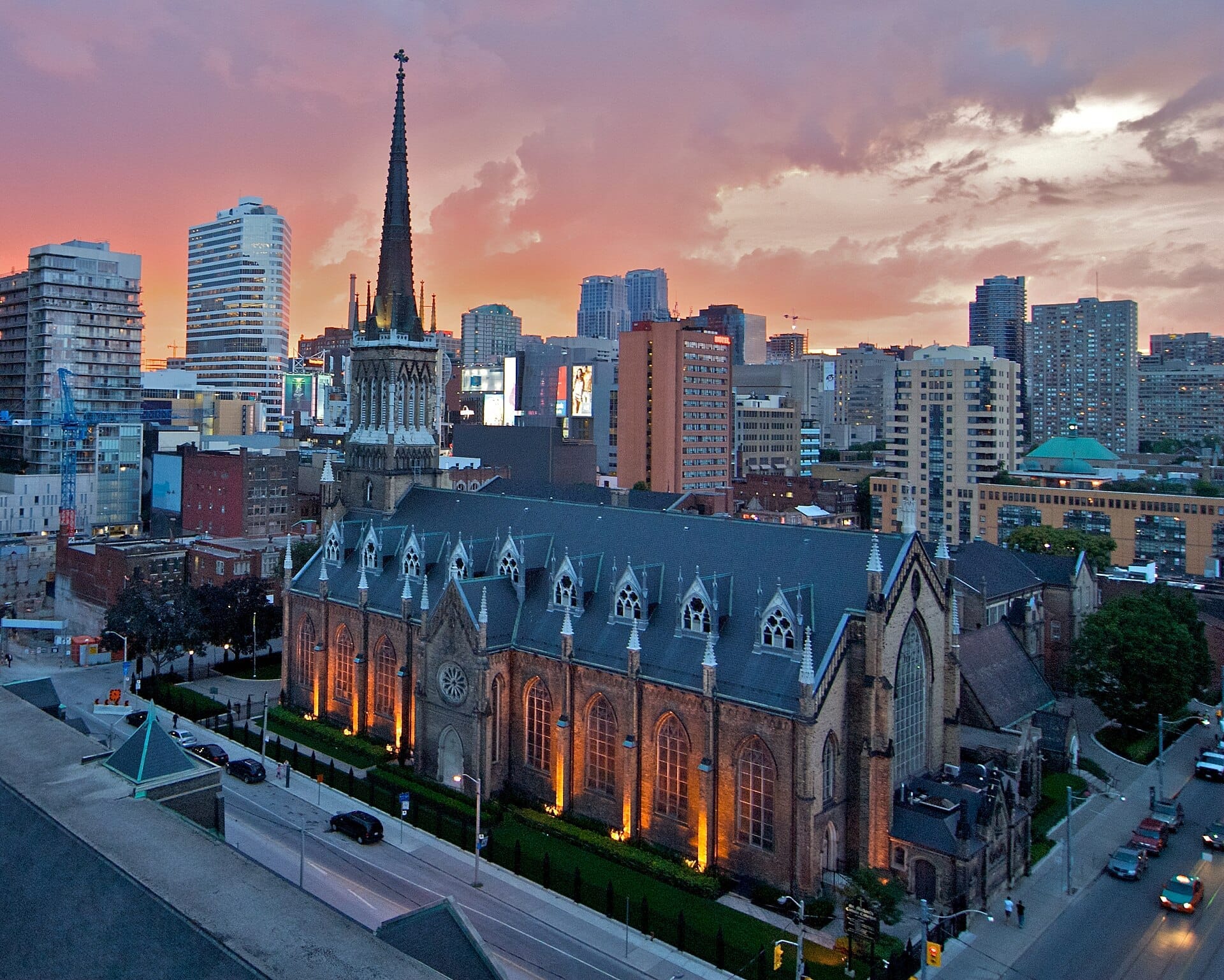
The building is a serious work of Gothic Revival architecture, constructed in the mid-1800s at a time when Toronto was barely a generation old as a city. For over 180 years it has served as both a working parish church and a landmark that, from certain angles on Shuter Street, frames surprisingly well against the steel towers behind it. The contrast between the cathedral's grey limestone and the surrounding office glass is one of downtown Toronto's more striking visual moments.
ℹ️ Good to know
Admission is free. The cathedral is most accessible to individual visitors during or just before Daily Mass (Monday–Friday at 12:10 PM ET, Sunday at 12:00 PM ET). No advance notice is needed to attend Mass or drop in during open hours, though hours for casual sightseeing outside of Mass times are not published on the official site — call 416-364-0234 to confirm before making a special trip.
The Architecture: What You're Actually Looking At
The exterior follows the English Gothic Revival style that was popular for major ecclesiastical commissions in mid-nineteenth century North America. The facade is marked by pointed arches, stone tracery, and a verticality that was deliberate: the architects wanted the building to read as sacred space from the street, not just another civic structure. The spire draws the eye upward well before you reach the entrance.
Step inside and the scale becomes clearer. The nave is long and relatively narrow, which concentrates the sense of height. The ribbed vaulting overhead, the stone columns running the length of the interior, and the way natural light filters through the stained glass windows on both sides create an atmosphere that is genuinely different from the ambient city outside. The floor underfoot is hard and cool; the air carries that characteristic stone-and-candle smell that older churches share regardless of denomination.
The stained glass deserves careful attention. The windows are detailed and richly coloured, and on a clear day when sunlight is at the right angle — typically mid-morning on the south-facing windows, later afternoon on the north — they produce the kind of projected colour on stone floors that photographers specifically plan visits around. On overcast days the interior reads quieter and more austere, which is its own kind of atmosphere.
If Toronto's architectural heritage interests you broadly, the cathedral fits naturally into a wider exploration of the city's historic built environment. Our Toronto architecture guide covers the full range of significant buildings across the downtown core and beyond.
Tickets & tours
Live prices and dates from our booking partner. If you book, we may earn a commission at no extra cost to you.
Toronto Old Town: Dark Side Exploration Game and Tour
From 12 €Instant confirmationFree cancellationLEGOLAND Discovery Centre Toronto tickets
From 16 €Instant confirmationFree cancellationToronto 'Little Canada' entrance tickets
From 27 €Instant confirmationFree cancellationNiagara Falls evening tour with boat, dinner and Illumination Tower
From 77 €Instant confirmationFree cancellation
How the Experience Changes by Time of Day
Morning visits, particularly on weekdays before the noon Mass, tend to be quiet to the point of near-silence. A handful of people may be seated in prayer, but the nave is largely yours to walk. The quality of light in the morning favours the south-side windows and fills the upper nave with warm tones. This is the best window for unhurried photography without crowds.
The daily 12:10 PM Mass (Monday through Saturday) draws a modest, regular congregation, many of them office workers from the surrounding downtown core. Attending is straightforward even for non-Catholic visitors who want to experience the space as it was designed to function, not simply as a tourist site. The liturgy is conducted in a way that is accessible, and the acoustics during sung portions reveal something about the space that no amount of silent observation will.
Late afternoon on clear days produces the most dramatic interior light, particularly in autumn and winter when the sun sits lower. By early evening the building tends to be quiet again, though evening services and special events alter this. Sunday Mass at noon draws larger attendance and a fuller sense of the cathedral as a living community space.
💡 Local tip
For stained glass photography, aim for a weekday morning visit in spring or summer when direct sun hits the south-facing windows. Bring a camera that handles low-light contrast well — the difference between the bright windows and the dark stone can be challenging for phone cameras.
Historical and Cultural Context
Construction of St. Michael's began in 1845, at a moment when Toronto's Catholic community was growing rapidly, largely due to waves of Irish immigration. The cathedral was designed to be a clear statement of permanence and presence in a Protestant-majority city. The choice of Gothic Revival was not merely aesthetic: it was a deliberate alignment with the grandest European cathedral-building tradition, transposed onto what was then a relatively new colonial city on the northwestern shore of Lake Ontario.
The building has undergone significant restoration work over the decades. A major restoration project completed in recent years addressed structural and cosmetic deterioration that had accumulated over more than a century and a half of Toronto winters. The restored interior and exterior now present the building closer to its original intent than it had appeared for some time, making this a genuinely good moment to visit.
In 2025, the Catholic Church is observing an Ordinary Jubilee Year, which carries additional significance for Catholic visitors and adds certain specific liturgical observances to the calendar that will also be reflected in the life of the cathedral. This may affect crowds and atmosphere around particular dates, so checking the cathedral's website before visiting is advisable if you have specific timing preferences.
The cathedral sits within downtown Toronto, a neighborhood dense with other significant historical sites. The Old City Hall and Osgoode Hall are both within a short walk, making this part of the city worth treating as a half-day architectural circuit.
Getting There and Practical Walkthrough
The cathedral's address is 65 Bond Street, Toronto. By subway, both Queen station and Dundas station on Line 1 put you within a 4–5 minute walk. From Queen station, walk north on Yonge and turn right on Shuter; from Dundas, walk south on Bond Street. The route from either direction passes through a stretch of downtown that is lively during the day and straightforward to navigate.
There is no parking lot associated with the cathedral. Street parking in the immediate area is limited; arriving by TTC is significantly more practical. If you're visiting as part of a broader downtown loop, the cathedral pairs well with a stop at St. Lawrence Market to the southeast or a walk through the Eaton Centre area to the northwest.
If you're planning a broader downtown Toronto itinerary, see our 3 days in Toronto itinerary for how to cluster this visit with nearby attractions efficiently.
⚠️ What to skip
The cathedral is an active place of worship, not a museum. Visitors are expected to dress modestly (covered shoulders and knees is a reasonable baseline), speak quietly inside, and avoid photographing worshippers during Mass without clear consent. During services, exploratory wandering around the nave is not appropriate.
Accessibility and Group Visits
The official website does not publish a detailed accessibility statement. Visitors with mobility requirements or specific needs are advised to contact the parish directly at 416-364-0234 or via the parish office at 200 Church Street before visiting, particularly if planning to attend a service with accessibility requirements. Group visits can also be arranged through the same contact.
Who Should Temper Their Expectations
Visitors looking for a visitor-centre experience — interpretive panels, audio guides, gift shops, timed entry tickets — will not find that here. St. Michael's is not set up as a tourist attraction in the managed sense. The experience rewards patience and a degree of self-direction. If you walk in expecting docent-led tours and clear visitor programming, you are likely to feel the absence of structure.
Similarly, if your primary interest is in very early Canadian history or Indigenous history, this building's story is specifically Catholic institutional history from the mid-nineteenth century onward. For broader Toronto history, other sites speak more directly to those narratives. And if large religious buildings leave you indifferent, the cathedral's appeal is genuinely architectural rather than experiential in the way that a park or market would be — this is a space for quiet attention, not activity.
For those who prefer outdoor history, Fort York offers a very different window into Toronto's formative decades, with guided interpretation and outdoor grounds.
Insider Tips
- The north side of Shuter Street, looking west toward the cathedral's facade with the downtown towers rising behind it, is the single best exterior photography angle. Come in the late afternoon in autumn when the stone picks up warm golden light.
- Weekday mornings between roughly 9 AM and 11:30 AM — before the noon Mass congregation begins arriving — offer the quietest interior access. The building is often nearly empty, which makes slow observation of the windows and vaulting far more rewarding.
- The cathedral's restoration work was completed relatively recently, meaning the stonework and interior finishes currently look cleaner and more intact than they have in decades. This is an unusually good moment to see the building close to its intended state.
- If you plan to attend Mass, arriving 10–15 minutes early lets you settle and observe the full interior before the liturgy begins. The first few minutes after the congregation takes their seats, before Mass starts, are particularly good for noticing the acoustic properties of the space.
- For group visits or any special request — including accessibility needs or photography permissions for professional use — contact the parish office directly at 416-364-0234 rather than assuming access or permissions.
Who Is St. Michael's Cathedral Basilica For?
- Architecture and heritage enthusiasts who want to study one of Toronto's most significant Gothic Revival buildings up close
- Photographers seeking interior stained glass and stone vaulting shots in natural light
- Travellers looking for a genuine moment of quiet in the middle of a dense downtown day
- Catholic visitors for whom the Jubilee Year 2025 carries specific devotional significance
- Anyone building a half-day walking circuit of downtown Toronto's historic built environment
Nearby Attractions
Other things to see while in Downtown Toronto:
- Allan Gardens Conservatory
Allan Gardens Conservatory is a free, year-round botanical conservatory at 160 Gerrard Street East in downtown Toronto. Housed in six glass display houses anchored by a 1910 Edwardian Palm House, it holds about 1,500 m² of tropical palms, cacti, orchids, and seasonal blooms. One of the oldest parks in Toronto, it remains one of the city's most underrated green spaces.
- Art Gallery of Ontario
The Art Gallery of Ontario is one of North America's largest art museums, housing over 90,000 works inside a landmark Frank Gehry-renovated building in downtown Toronto. From Indigenous Canadian art to European masters and contemporary photography, the AGO rewards focused visitors and casual explorers alike.
- Brookfield Place (Allen Lambert Galleria)
The Allen Lambert Galleria inside Brookfield Place is a free, publicly accessible arcade designed by architect Santiago Calatrava between 1987 and 1992. Its arching steel-and-glass canopy, rising between two of downtown Toronto's tallest towers, is one of the most impressive interior spaces in Canada.
- Campbell House Museum
Built in 1822 for Upper Canada's Chief Justice, Campbell House Museum is the oldest surviving residence from the original Town of York. Moved to its current downtown corner in 1972 and opened as a museum in 1974, it offers an intimate, unhurried window into early colonial Toronto — a sharp contrast to the glass towers surrounding it.
Planning a trip? Discover personalized activities with the Nomado app.