St. James's Cathedral, Riga: The Catholic Heart of the Old Town
St. James's Cathedral (Rīgas Svētā Jēkaba katedrāle) is Riga's Roman Catholic cathedral, one of the oldest churches in the city. Located steps from the Parliament and Riga Castle, it offers free entry, a quiet interior, and over 700 years of layered religious history.
Quick Facts
- Location
- Jēkaba iela 9, Riga Old Town (Vecrīga), near Riga Castle and the Saeima Parliament
- Getting There
- Walk 10–15 minutes from Riga Central Station; all Old Town bus and tram stops are within walking distance
- Time Needed
- 20–45 minutes for a thorough visit
- Cost
- Free entry (donations welcome)
- Best for
- History seekers, architecture lovers, travelers wanting a quiet moment away from Old Town crowds
- Official website
- jekabakatedrale.lv
What Is St. James's Cathedral?
St. James's Cathedral (Rīgas Svētā Jēkaba katedrāle) sits on Jēkaba iela 9, on the northwestern edge of Riga's Old Town, separated from the Saeima (Latvia's Parliament) by just a narrow lane and a short courtyard walk from Riga Castle. It is the Roman Catholic cathedral of Riga and the seat of the Archdiocese of Riga, dedicated to Saint James the Greater. The building is one of the oldest surviving churches in the city, and its age shows in the way different centuries have left their mark: medieval stonework, layers of renovation, and a solemn interior that belongs more to contemplation than tourism.
This is not Riga's most photographed church. That title usually goes to St. Peter's Church with its famous tower, or to the Riga Dome Cathedral with its grand interior. St. James's is quieter, less promoted, and genuinely more atmospheric for it. Visitors who stumble in often remark that it feels like a working church rather than a tourist attraction — which is exactly what it is.
ℹ️ Good to know
Opening hours: Typically open daily, with hours varying by day and centered on Mass times; check the official website or posted schedule before visiting, especially around lunchtime.
History: Eight Centuries of Changing Hands
The origins of St. James's Cathedral stretch back to the medieval period, making it one of the oldest ecclesiastical structures in Latvia. Like many of Riga's religious buildings, it did not remain in any single denomination's hands for long. The Reformation swept through Riga in the 16th century, and the church passed between Catholic and Lutheran control at different points across the following centuries, reflecting the volatile religious politics of the Baltic region under Swedish, Polish-Lithuanian, and later Russian imperial rule.
The cathedral's current identity as Riga's Catholic cathedral dates to the early 1920s, when it was returned to the Catholic community (formally in 1922–1923) following Latvian independence and designated the archdiocesan cathedral. That timing matters: Latvia had only just declared independence in 1918, and the reconstitution of Catholic institutions in this period was part of a broader cultural and religious recovery. Under Soviet occupation, religious practice was suppressed across Latvia, and the cathedral's fate during those decades is part of the wider story of religious life under Soviet rule.
For travelers interested in this broader context of occupation and religious suppression, the Museum of the Occupation of Latvia provides detailed coverage of the Soviet and Nazi occupation periods, including their impact on Latvian cultural and religious institutions.
Tickets & tours
Hand-picked options from our booking partner. Prices are indicative; availability and final rates are confirmed when you complete your booking.
Canal boat sightseeing tour in Riga
From 13 €Instant confirmationArt and culture walking tour of Riga with a local
From 66 €Instant confirmationFree cancellationSelf-guided discovery walk in Riga - the essential old town and its secrets
From 30 €Instant confirmationFree cancellationExclusive private guided tour of Riga's architecture with a local
From 175 €Instant confirmationFree cancellation
What the Interior Actually Looks Like
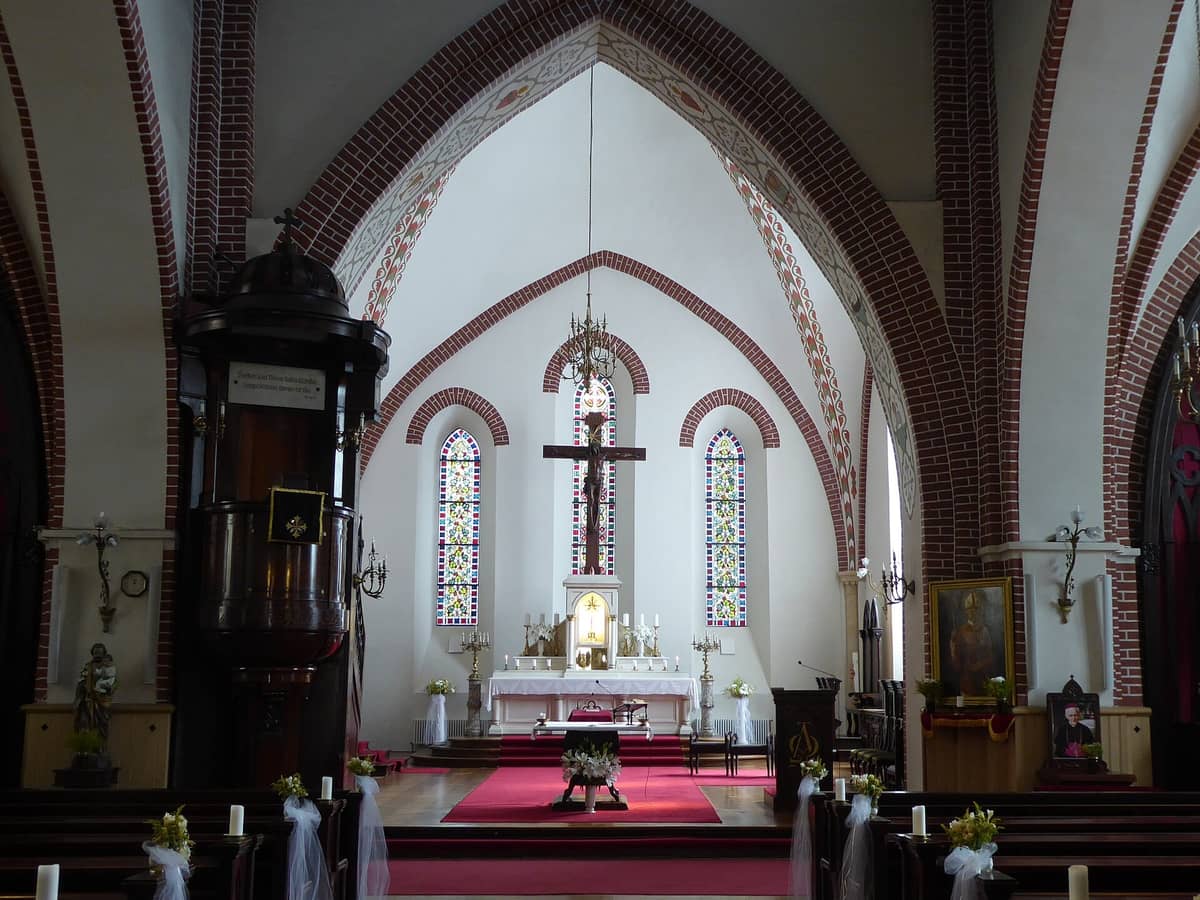
Step through the main entrance and the temperature drops noticeably, even in summer. The interior is relatively modest by Central European cathedral standards: a long nave with stone floors, dark wooden pews, and an altar framed by quiet Catholic iconography. The light filtering through the windows is diffuse and cool, giving the space a contemplative quality that encourages silence rather than conversation.
The building's medieval bones show in the proportions of the nave and the weight of the walls, while later additions and restorations add elements from different periods. It is not a baroque showpiece. The visual tone is restrained and northern, consistent with Riga's architectural character generally. Candles near the altar are usually lit during morning hours, adding warmth to an otherwise stone-grey palette.
Because the cathedral is an active place of worship with daily services, visitors should be respectful of the atmosphere regardless of their own beliefs. Photography is typically permitted in Catholic churches in Latvia, but flash photography near an active Mass would be inappropriate. If you arrive just before a service begins, consider waiting or returning after the 14:30 reopening rather than walking through while clergy and congregation are present.
How the Experience Changes by Time of Day
Early morning, between 07:00 and 09:00, is when the cathedral is most authentically itself. The light entering from the east-facing windows is soft, locals attending daily Mass occupy the pews, and the Old Town outside is quiet. If you are staying in the Old Town, this is worth building into a morning walk before the tourist crowds gather.
Midmorning brings more foot traffic as visitors work through the standard Old Town circuit. The cathedral is close enough to Riga Castle and the Three Brothers ensemble that it naturally falls into any walking route through this part of Vecrīga. By late morning, small tour groups occasionally enter, though the space absorbs them easily given its size.
Afternoons, particularly after the 14:30 reopening, tend to be quieter again. The midday closure effectively filters out casual tourists who do not plan ahead. If you are doing a full Old Town walking tour, this is a good spot to include on the second half of your route when the light has shifted and the morning crowds have dispersed.
💡 Local tip
The cathedral may close between services or outside posted visiting hours; check the current schedule and avoid planning a visit right around lunchtime without confirming opening times first.
Location, Getting There, and What Surrounds It
Jēkaba iela 9 places the cathedral at the northwestern edge of the Old Town, in the quieter institutional zone near the Parliament building and Riga Castle. This part of Vecrīga sees fewer souvenir stalls and outdoor restaurant seating than the area around the Town Hall Square or Livu Square, and the atmosphere is correspondingly more subdued. The streets here are narrow and cobbled, typical of this part of the Old Town.
From Riga's main central area, it is a straightforward 10 to 15 minute walk through the Old Town. The area is very walkable, and the cathedral fits naturally into a route that also takes in the Three Brothers (the oldest residential ensemble in the city, just steps away), Riga Castle, and the Swedish Gate.
Accessibility note: the cathedral’s immediate surroundings are cobblestoned and may present challenges for mobility aids. Travelers with limited mobility should factor this in when planning a visit and, if needed, contact the cathedral in advance about current accessibility options.
How It Compares to Riga's Other Major Churches
Riga's Old Town contains several significant religious buildings within a short radius of each other, and travelers with limited time often face a choice. St. Peter's Church offers a paid observation tower with panoramic city views. The Riga Dome Cathedral has the largest interior space, a famous organ, and a museum. St. James's Cathedral offers neither a tower nor a museum. What it offers is authenticity: it is the only one of the three that functions primarily as an active Catholic parish rather than a visitor attraction.
For travelers drawn to religious architecture for spiritual or aesthetic reasons rather than for sightseeing infrastructure, St. James's often leaves the strongest impression. For those who want a viewpoint, clear signage, or a ticket to purchase, it will feel underwhelmingly minimal. That gap in expectations is worth being honest about.
⚠️ What to skip
St. James's Cathedral has no observation tower, no museum, and no cafe. If your priority is a view over Riga, head to St. Peter's Church or the Latvian Academy of Sciences Panorama instead.
Insider Tips
- Arrive before 09:00 on a weekday morning if you want the space almost entirely to yourself. The morning light through the nave windows is at its best in this window.
- The streets immediately around the cathedral are among the least touristy in the Old Town. Walk one block in any direction and you find yourself away from the main tourist circuit, which makes this end of Vecrīga feel noticeably more authentic.
- The cathedral's exterior rooster weathervane is a detail easy to miss. Roosters on church steeples in Riga are traditional and associated with various local legends—look up before you go inside.
- If you are visiting in winter, the interior is heated and offers a genuine respite from the cold. Riga winters can be harsh, and a few quiet minutes in a candlelit cathedral is a different kind of city experience.
- The Parliament building (Saeima) is immediately adjacent. You cannot enter without a prior arrangement, but the exterior and the small square between it and the cathedral are worth pausing at — the combination of medieval church and Baltic democratic institution in one frame is visually striking.
Who Is St. James's Cathedral For?
- History and architecture travelers who want to move beyond the headline attractions
- Travelers seeking a genuinely quiet space in the middle of a busy Old Town itinerary
- Catholic visitors for whom attending Mass in the archdiocesan cathedral has personal significance
- Photographers interested in interiors: the diffuse light and stone textures reward careful composition
- Walkers doing a full Old Town circuit who want to include every major medieval structure
Nearby Attractions
Other things to see while in Old Town (Vecrīga):
- Bremen Town Musicians Sculpture
Standing on Skārņu iela in Riga's medieval Old Town, this bronze sculpture of four stacked animals tells a Brothers Grimm story while carrying a quietly powerful political message about the end of the Iron Curtain. Cast in 1990 and gifted by the city of Bremen, it's free to visit, open around the clock, and one of the most photographed corners of Vecrīga.
- House of the Blackheads
Standing on Town Hall Square in Riga's Old Town, the House of the Blackheads is a reconstructed 14th-century guild hall with an ornate Dutch Renaissance facade that stops pedestrians cold. Behind the stone and gilded detail lies a layered story of medieval merchant culture, wartime destruction, and Latvian national pride.
- Museum of the Occupation of Latvia
Housed in the heart of Riga Old Town, the Museum of the Occupation of Latvia documents 51 years of Soviet and Nazi rule from 1940 to 1991. It is one of the most carefully assembled historical museums in the Baltic states, and a visit here fundamentally changes how you understand the country around you.
- Powder Tower & Latvian War Museum
The Powder Tower (Pulvertornis) is the sole surviving tower from Riga's medieval city walls, first recorded in 1330. Today it houses the Latvian War Museum, a free, well-curated institution spanning centuries of Baltic military history. It stands at the northern edge of Old Town, easy to find and easier to underestimate.