SoWa Art + Design District: Boston's Creative Quarter Worth Knowing
Tucked into the South End south of Washington Street, SoWa Art + Design District packs over 80 working artist studios, more than 20 galleries, and a beloved seasonal open market into a few converted industrial blocks. Entry to the district is free, and the monthly First Friday openings make it one of Boston's most accessible art experiences.
Quick Facts
- Location
- 450 Harrison Ave, South End, Boston, MA 02118
- Getting There
- MBTA bus stops at Union Park St or Herald St (approx. 6-min walk); no direct T station
- Time Needed
- 1–3 hours depending on events; allow a full afternoon for First Friday or Sunday Market
- Cost
- Free to walk the district; First Friday gallery openings free; Sunday studios free; some special events charge admission
- Best for
- Art lovers, design enthusiasts, Sunday market shoppers, and anyone wanting a non-touristy Boston afternoon
- Official website
- www.sowaboston.com
What Is SoWa, and Why Does It Matter?
SoWa Art + Design District takes its name from its geography: it sits South of Washington Street, in Boston's South End neighborhood. The label itself is a relatively recent one, created by developer GTI Properties as part of a deliberate effort to rebrand a cluster of underused late-19th-century warehouse buildings into a working creative district. The transformation worked. What was once a stretch of neglected industrial blocks now holds over 20 galleries within a two-block radius and over 80 artist studios at 450 Harrison Ave alone, spread across three floors.
This is not a curated tourist attraction with a ticket booth and a gift shop at the end. It is a functional creative ecosystem where working artists make and sell their work, galleries rotate exhibitions regularly, and the Sunday open market draws locals who treat it as a weekly ritual rather than a sightseeing detour. That distinction matters for managing expectations: SoWa rewards visitors who engage with it on its own terms rather than treating it as a scenic backdrop.
The South End itself is one of Boston's largest Victorian-era residential districts, and SoWa sits at its southern edge where the brick row houses give way to converted brick warehouses. For a broader sense of how SoWa fits into the neighborhood's character, the Boston history guide provides useful context on how the city's industrial past shaped its current creative districts.
The Three Rhythms of SoWa: First Friday, SoWa Sunday, and Everyday
SoWa operates on three distinct tempos, and visiting on the wrong day can mean walking mostly empty corridors. Understanding which mode you are arriving into is the single most useful piece of planning advice for this district.
First Fridays are the district's signature event. On the first Friday of each month, artist studios and galleries at 450 and 460 Harrison Ave open from 5 pm to 9 pm, free to the public. The energy is social: artists stand in or near their studio doorways, conversations flow easily, and the hallways smell faintly of oil paint and turpentine as you move between floors. The lighting is warm and uneven, the way working studios tend to be. This is the version of SoWa most worth planning around, particularly for first-time visitors.
SoWa Sundays offer a quieter, more browsable counterpart. Studios at 450 Harrison Ave open from 11 am to 4 pm year-round, making it a reliable option even outside the open market season. The pace is slower than First Friday, which can actually be an advantage if you want extended time with specific artists or work. Foot traffic picks up around noon and trails off after 3 pm.
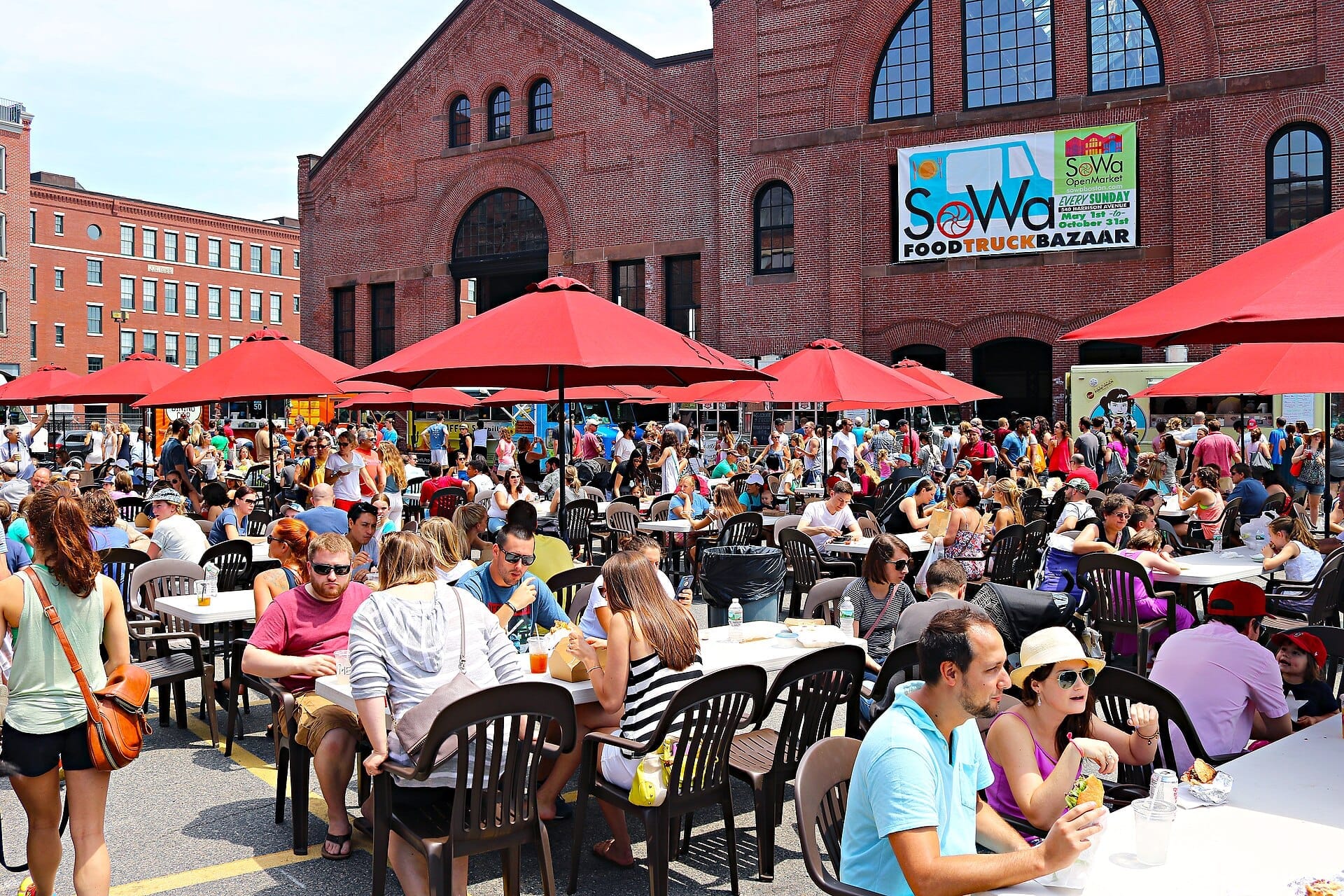
From May through October, the SoWa Open Market runs alongside the Sunday studio hours on the street and lots adjacent to Harrison Ave. Vendors sell independent food products, vintage goods, plants, handmade objects, and clothing. The market draws a noticeably different crowd than the galleries, younger on average and more browse-and-brunch in orientation, and the two experiences layer well together in a single Sunday visit.
💡 Local tip
If you can only visit once, make it the first Friday of the month between 6 pm and 8 pm. The studios are open, the galleries are staffed, and the district feels fully alive. Arriving before 5 pm on any other weekday will often mean locked studio corridors.
Tickets & tours
Hand-picked options from our booking partner. Prices are indicative; availability and final rates are confirmed when you complete your booking.
Day Trip to Martha's Vineyard from Boston with optional Island tour
From 106 €Instant confirmationFree cancellationBoston Tea Party Ships and Museum tickets
From 27 €Instant confirmationFree cancellationHarborwalk and tea party self-guided audio tour in Boston
From 7 €Instant confirmationFree cancellationBoston Summer Night Trolley Tour and River Cruise
From 27 €Instant confirmationFree cancellation
Inside 450 Harrison Ave: What to Expect on the Floors
The main building at 450 Harrison Ave is the physical heart of the district. From the outside it reads as a plain brick industrial block, but once inside the conversion becomes apparent: high ceilings, wide corridors, and the particular acoustic quality of a building designed to move heavy goods rather than people. On First Fridays and SoWa Sundays, the studio doors along each floor are propped open, creating an informal corridor gallery effect where you move at your own pace.
The work varies considerably across the three floors: oil painters, sculptors, printmakers, photographers, ceramicists, and textile artists all maintain studios here. There is no curatorial uniformity, which is the point. Some studios are spare and production-focused, with canvases stacked against walls and work tables covered in materials. Others are arranged for presentation, with work hung and lit more deliberately. Either way, the access to process and context is more direct than any gallery white wall can offer.
Note that accessibility varies by floor and studio. The building has been updated for public events, but specific accessibility features including elevators, ramp access, and restroom availability should be confirmed directly with SoWa Artists Guild or the building management before visiting if this is a concern.
The Gallery Cluster and What Changes Seasonally
The more than 20 galleries concentrated at 450 and 460 Harrison Ave represent a dense independent gallery cluster. The galleries tend toward contemporary fine art, design objects, and craft, with exhibition rotations that keep the district worth revisiting multiple times in a year. Some galleries maintain regular Tuesday through Saturday hours outside of event nights; others operate primarily around First Fridays. Checking individual gallery websites before a non-event visit is advisable.
The SoWa Power Station, a converted transformer building adjacent to the main cluster, hosts larger-scale events and pop-ups, some of which charge admission. These range from design fairs and art sales to seasonal markets. The SoWa Art + Design District page and GTI Properties' events calendar are the most reliable places to track what is scheduled.
For visitors interested in Boston's broader museum and gallery landscape, the guide to the best museums in Boston covers institutions like the ICA and MFA that complement a SoWa visit well.
Getting There and Moving Around the District
SoWa sits in a gap between MBTA subway lines, which means it requires a bus or a longer walk from the nearest T stations. MBTA buses serve the Union Park Street and Herald Street stops, both approximately a 6-minute walk from 450 Harrison Ave. From Back Bay Station on the Orange and commuter rail lines, the walk takes roughly 15 minutes south through the South End streetscape, which is pleasant enough in good weather.
Driving is viable, particularly for First Fridays and SoWa Sundays when parking is generally available around 450 Harrison Ave. Street parking in the South End can be tight on Sunday mornings when the market is running, so arriving before 11 am or after 1 pm tends to be easier. Rideshare drop-off directly in front of 450 Harrison Ave is straightforward.
ℹ️ Good to know
The district spans roughly from East Brookline Street to East Berkeley Street, and from Shawmut Ave to Albany Street. Most of the gallery and studio activity is concentrated on Harrison Ave between those cross streets, so you rarely need to walk more than two blocks to see the core of the district.
If you are planning a full South End afternoon, combining SoWa with a walk up to Boston Public Market or along the Rose Kennedy Greenway adds a logical geographic arc to the day.
Who Gets the Most Out of SoWa
SoWa is not for everyone, and it is worth being direct about that. Visitors expecting a polished, fully open attraction any day they arrive will be disappointed on weekday afternoons outside event hours, when the building corridors are locked and the district reads as little more than a restaurant and cafe strip. The experience is event-dependent in a way that most urban attractions are not.
The atmosphere on First Fridays can also feel insider-facing for visitors who do not speak the language of contemporary art. The work is not explained or labeled in most studio settings. If that sounds uncomfortable rather than interesting, the Sunday open market is a more accessible entry point to the neighborhood without requiring any familiarity with the art world.
Weather affects the Sunday market meaningfully. The outdoor vendor section runs rain or shine in principle, but a wet Sunday in June draws significantly fewer vendors and visitors than a clear one in September. The indoor studio component at 450 Harrison Ave is unaffected by weather, making it a more reliable fallback.
Visitors who find SoWa compelling may also enjoy the Institute of Contemporary Art Boston in the Seaport, which provides a more formal institutional counterpart to SoWa's informal studio culture. The Isabella Stewart Gardner Museum is another strong complement, particularly for visitors drawn to the intersection of art and architecture.
Insider Tips
- First Fridays in September and October draw some of the largest crowds. If you want depth over breadth, a quieter First Friday in January or February gives you more direct artist access with less corridor congestion.
- The third-floor studios at 450 Harrison Ave tend to be the least visited during events, simply because many people turn around after the first or second floor. The artists on the upper floor often have more time to talk, and the work there is just as strong.
- The Sunday open market vendor lineup changes week to week. The SoWa Boston Instagram account posts previews of which vendors will be present, which is useful if you are making the trip specifically for a food vendor or maker you have seen before.
- Street parking on Albany Street, one block east of Harrison Ave, is often easier to find than on Harrison itself during busy Sundays, even when the main lot is full.
- Some galleries in the district maintain individual mailing lists with preview hours and opening events separate from the district-wide First Friday. Picking up a few gallery cards during your first visit and subscribing to their lists pays off if you plan to return.
Who Is SoWa Art + Design District For?
- Working artists and art students who want direct access to Boston's studio culture
- Sunday-morning shoppers looking for local food, design objects, and handmade goods at the open market
- First-time Boston visitors wanting an experience outside the Freedom Trail and major museum circuit
- Design-focused travelers interested in how creative districts reshape industrial neighborhoods
- Couples or solo travelers looking for a distinctly local Friday evening activity that costs nothing
Nearby Attractions
Combine your visit with:
- Arnold Arboretum
Founded in 1872, the Arnold Arboretum is the oldest public arboretum in North America — a free, 281-acre landscape in Jamaica Plain managed by Harvard University. With over 15,000 accessioned plants and sweeping hillside views, it draws botanists, dog walkers, and curious visitors in equal measure across all four seasons.
- Blue Hills Reservation
Ten miles south of downtown Boston, Blue Hills Reservation spreads across more than 7,000 acres of forested hills, rocky ridgelines, and glacial wetlands. Free to enter and open year-round from dawn to dusk, it offers 125 miles of trails ranging from easy pond-side loops to a genuine summit climb at 635-foot Great Blue Hill.
- Boston Duck Tours
Boston Duck Tours puts you aboard a replica World War II DUKW amphibious vehicle for an 80-minute circuit of the city's most historic landmarks, finishing with a splash into the Charles River. Running seasonally from late March through late November, it's one of the few tours in Boston that covers both street-level sights and a Charles River perspective in a single trip.
- Boston Harbor Islands
Boston Harbor Islands National and State Park puts 34 islands and peninsulas within easy ferry reach of downtown Boston. From Civil War earthworks on Georges Island to the oldest lighthouse station in the United States on Little Brewster, the park rewards visitors who are willing to trade the city's brick sidewalks for salt air and open water.