Institute of Contemporary Art Boston: What to Expect Before You Go
The Institute of Contemporary Art / Boston sits on the edge of Fort Point Channel in the Seaport District, housed in a landmark building that cantilevers dramatically over the waterfront. It combines serious contemporary art with one of the most distinctive architectural experiences in the city, and offers free admission every Thursday evening from 5 to 9 PM.
Quick Facts
- Location
- 25 Harbor Shore Drive, Seaport District, Boston, MA 02210
- Getting There
- MBTA Silver Line: Courthouse or World Trade Center stations (short walk)
- Time Needed
- 2 to 3 hours for galleries; longer if attending a program or event
- Cost
- Paid admission; free for all visitors every Thursday 5–9 PM (advance timed ticket required). Check icaboston.org for current prices.
- Best for
- Contemporary art, architecture lovers, waterfront walks, date nights, curious travelers on a budget (Thursday evenings)
- Official website
- www.icaboston.org
What the ICA Actually Is
The Institute of Contemporary Art / Boston, known locally as ICA/Boston, is one of New England's leading contemporary art museums. It historically did not emphasize a permanent collection in the traditional sense, which makes every visit slightly different. Instead, the ICA organizes rotating exhibitions, commissions new work, and brings in pieces from artists who are actively shaping the contemporary art world. If you want historical survey shows of Impressionism or Greek antiquities, this is not your museum. If you want to see what artists are making right now, it is one of the better places in the Northeast to do that.
The museum was founded in 1936 as the Boston Museum of Modern Art and, after several name changes, adopted the current name Institute of Contemporary Art in 1948. For most of its history it occupied borrowed or rented spaces around Boston, never quite settling. That changed in 2006 when the ICA opened its purpose-built waterfront home in the Seaport District, a move that both anchored the institution and placed it at the center of Boston's fastest-changing neighborhood.
The Building: Architecture as Part of the Experience
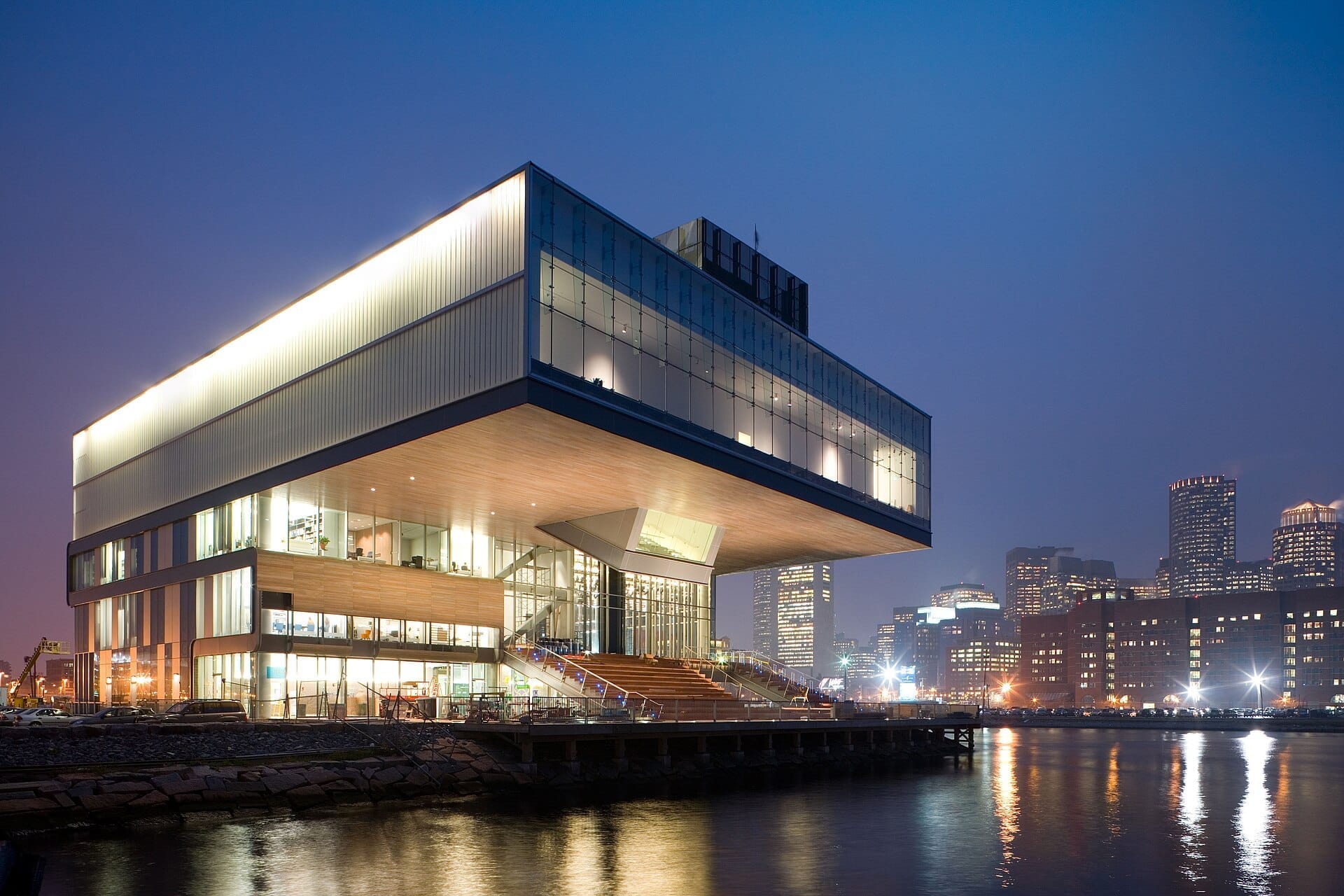
The building itself is worth the trip, even for visitors with only a passing interest in contemporary art. Designed by the New York firm Diller Scofidio + Renfro and completed in 2006, the structure spans about 65,000 square feet and performs a quiet architectural trick: its upper half cantilevers out over the harbor, so the main gallery floors appear to float above the water. Standing beneath that overhang and looking up gives you a vertigo that photographs do not quite capture.
Inside, the column-free galleries reach 15.5 feet in height, which is a practical decision with significant aesthetic consequences. Large-scale installations that would feel compressed in older museum buildings breathe here. Natural light enters carefully, and the relationship between the interior and the harbor outside shifts depending on the time of day and the weather. On an overcast morning, the galleries feel cool and contemplative. On a clear afternoon, light off the water pours in and changes the character of whatever is on the walls.
The building sits at the edge of Fort Point Channel in the Seaport District, a neighborhood that has transformed from industrial warehouses into one of the densest concentrations of new development in Boston. The ICA arrived before much of that construction and is still one of the few cultural landmarks that gives the neighborhood a sense of identity beyond hotels and tech offices.
💡 Local tip
For the best exterior photograph of the building, walk to the small waterfront promenade on the south side and shoot with the harbor as a backdrop. Morning light is ideal and crowds are minimal before 11 AM.
Tickets & tours
Hand-picked options from our booking partner. Prices are indicative; availability and final rates are confirmed when you complete your booking.
Day Trip to Martha's Vineyard from Boston with optional Island tour
From 106 €Instant confirmationFree cancellationBoston Tea Party Ships and Museum tickets
From 27 €Instant confirmationFree cancellationHarborwalk and tea party self-guided audio tour in Boston
From 7 €Instant confirmationFree cancellationBoston Summer Night Trolley Tour and River Cruise
From 27 €Instant confirmationFree cancellation
What You See Inside: Galleries and Programming
Because the ICA does not maintain a fixed permanent collection on display, the galleries are in constant rotation. Major solo and group exhibitions typically run for several months, while smaller projects and commissions change more frequently. Before visiting, it is worth checking the ICA website to see what is currently showing. Arriving without that context is not a problem, but knowing the shows in advance helps you decide how much time to budget.
The ground floor often features a project space for newer or emerging work, while the upper galleries handle the larger thematic or solo shows. The building also includes a theater used for film screenings, performances, and lectures, a reading room with art publications, and a well-stocked museum shop. The shop is quite good, with a selection of art books, prints, and objects that goes beyond the usual gift store formula.
One feature that surprises many first-time visitors is the Harbor View Lounge, a glass-enclosed space on the upper level with unobstructed views across the water toward the Boston waterfront and airport beyond. It is free to access with museum admission and is one of the better indoor waterfront views in the city.
How the Experience Changes Through the Day
The ICA is generally open Tuesday through Sunday starting at 10 AM and is closed Mondays, with occasional holiday Monday openings. Weekday mornings are reliably quiet. Galleries that can feel crowded on a Saturday afternoon are often nearly empty on a Tuesday or Wednesday, and that affects how you experience the work. Large video installations are easier to absorb when you are not managing around other visitors. Photography of empty gallery spaces is also significantly better.
Thursday evenings from 5 to 9 PM are the outlier. The museum offers free general admission during those hours, which draws a different crowd: younger visitors, local art students, people combining a museum visit with dinner in the Seaport. The atmosphere is social rather than contemplative, and the building, lit up against the darkening harbor, looks particularly striking from outside. If you are comfortable with moderate crowds and want to keep costs down, Thursday evening is an excellent window. Free tickets are required, so reserve them on the ICA website in advance.
ℹ️ Good to know
The ICA offers free general admission every Thursday from 5–9 PM. Timed free tickets are required and must be reserved in advance at icaboston.org. Slots fill up, especially in summer.
Getting There and Practical Logistics
The Silver Line is the simplest option from most parts of central Boston. The MBTA Silver Line runs as bus rapid transit from South Station and connects directly to the Seaport. Courthouse and World Trade Center stations are both within a short walk of the museum. From South Station, the ride typically takes around ten minutes. Parking in the Seaport is limited and expensive, and the neighborhood's streets are still finding their permanent configuration, so driving is not worth the hassle for most visitors.
The ICA is also walkable from the Rose Kennedy Greenway and the waterfront, making it a natural addition to a longer waterfront day. The Boston Harborwalk passes directly in front of the building, and you can combine a visit with a walk along the channel toward the Fort Point neighborhood or back toward Downtown.
The museum is described as fully accessible to visitors with disabilities. Elevators serve all gallery levels, assisted listening devices and sign-language interpretation are available with advance notice, strollers are permitted in all gallery spaces, and changing stations are located on site. Coat check is available, which matters in winter when managing a heavy coat through galleries becomes its own task.
⚠️ What to skip
Parking near the ICA is limited and metered. The Seaport District does not have abundant cheap parking options. Plan to use the Silver Line or take a rideshare.
Who This Museum Is For
The ICA rewards visitors who are comfortable with open-ended, sometimes challenging work. If your Boston museum time is limited and you want a comprehensive art-historical experience, the Museum of Fine Arts or the Isabella Stewart Gardner Museum will likely feel more immediately satisfying. The ICA operates in a different register: it asks more questions than it answers, and not every show will land for every visitor.
That said, the building itself, the harbor views, and the quality of the rotating program make the ICA worthwhile for a broad range of visitors, not just dedicated contemporary art followers. Families with older children and teenagers often respond well to the hands-on and immersive elements that contemporary shows tend to incorporate. Young children are physically welcome (strollers permitted, changing stations available), but attention spans may not match the pace of most exhibitions.
For travelers interested in where the ICA fits in Boston's broader cultural geography, the best museums in Boston guide lays out the full range of options across the city, from natural history to fine art to living history.
Weather and Seasonal Considerations
Boston has a humid continental climate with cold winters and warm summers, and the Seaport District sits fully exposed to harbor winds. In winter, the walk from the Silver Line station to the museum entrance is short but cold on windy days, and the harbor views that make the building spectacular in summer look stark and grey in January. That is not necessarily a deterrent: the galleries are warm, crowds are thinner in winter, and there is something fitting about looking at serious contemporary art while grey Atlantic light filters through the windows.
Summer is the peak season for the Seaport and the ICA alike. The outdoor waterfront area in front of the museum becomes a gathering point. Late spring and early fall are widely considered the most comfortable times to visit Boston, and for the ICA specifically, September and October tend to bring new exhibitions that opened over the summer with fresh energy. For more on planning a Boston trip around the seasons, the best time to visit Boston guide covers the specifics.
Insider Tips
- Reserve your free Thursday evening tickets well in advance, especially during summer. They are entirely free but limited, and weekends regularly sell out hours before the 5 PM opening.
- The Harbor View Lounge on the upper level is accessible with general admission and offers one of the few indoor waterfront panoramas in the Seaport. Spend at least ten minutes there regardless of the current exhibitions.
- The ICA reading room is a free, low-key space for browsing art publications. It is quieter than the galleries and a good place to decompress if you have arrived on a busy day.
- Check the ICA's public program calendar before visiting. Film screenings, artist talks, and performances are often scheduled on weekday evenings and are separate from general admission. Some are free or low cost.
- The museum shop stocks a curated selection of artist monographs and small editions that you will not find in chain bookstores. Even if you are not buying, it is worth browsing as an extension of the exhibitions.
Who Is Institute of Contemporary Art (ICA) For?
- Contemporary art enthusiasts tracking current practice in painting, installation, and video
- Architecture and design lovers interested in Diller Scofidio + Renfro's work
- Budget travelers who plan around the free Thursday evening hours
- Couples or solo travelers looking for a thoughtful cultural stop in the Seaport
- Teenagers and older children who respond to immersive and large-scale installations
Nearby Attractions
Other things to see while in Seaport District:
- Boston Children's Museum
Founded in 1913 and now one of the most visited family attractions in New England, Boston Children's Museum sits along Fort Point Channel in the Seaport District. With hands-on exhibits across multiple floors, it rewards families with children under 10 — but requires planning, especially on weekends.
- Boston Harborwalk
The Boston Harborwalk is a free, publicly accessible waterfront pathway stretching 43 miles along Boston Harbor, connecting neighborhoods from East Boston and Charlestown to the Seaport, South Boston, and Dorchester. It is one of the longest urban waterfront trails in the United States and has free public access, though individual parks and facilities along the route may have their own operating hours.
- Boston Tea Party Ships & Museum
The Boston Tea Party Ships & Museum puts you inside one of the most consequential nights in American history through live actor-led tours, full-scale replica ships moored on Fort Point Channel, and the only known surviving tea chest from the December 16, 1773 event. It is one of Boston's more immersive history attractions, but it comes with a price tag and a structure worth understanding before you buy your ticket.
- Harpoon Brewery
Harpoon Brewery at 306 Northern Avenue is where Boston's craft beer story began. Holding Massachusetts Brewing Permit #001 since 1986, the Seaport District brewery offers guided tastings, a spacious Beer Hall, and seasonal outdoor seating steps from the waterfront.