Soviet War Memorial Treptow: Berlin's Most Solemn Monument
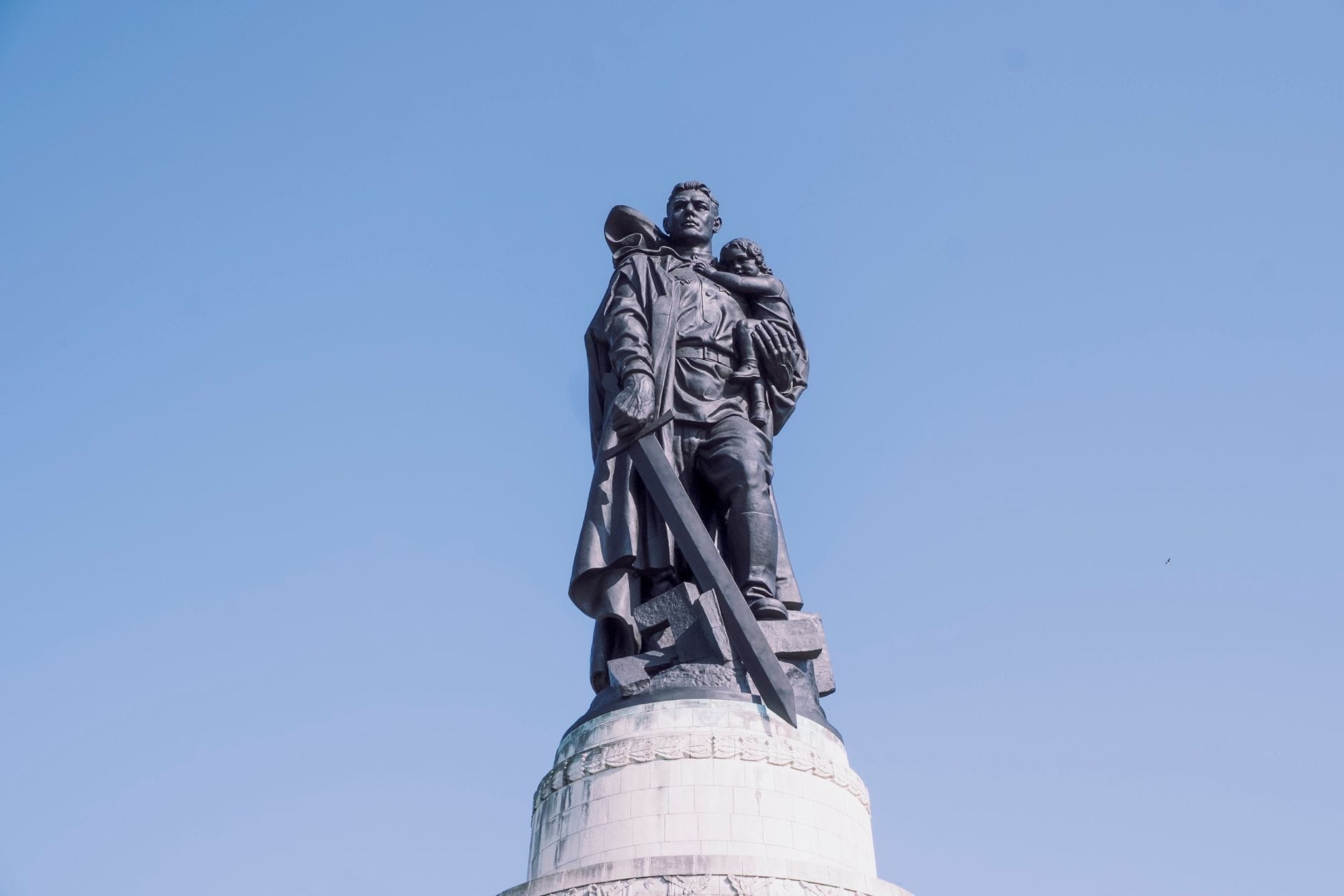
The Soviet War Memorial in Treptower Park is the largest World War II memorial in Germany. Built between 1946 and 1949, it covers nine hectares, contains the graves of around 7,000 Red Army soldiers, and culminates in a 12-metre bronze soldier standing atop a monumental mound. Entry is free and the site is open at all hours.
Quick Facts
- Location
- Puschkinallee, 12435 Berlin (Treptower Park)
- Getting There
- S-Bahn: S+U Treptower Park (S8, S9, S41, S42) — short walk through the park
- Time Needed
- 45–90 minutes
- Cost
- Free, no ticket required
- Best for
- History, architecture, quiet reflection, photography
- Official website
- www.visitberlin.de/en/soviet-memorial-treptow
What the Soviet War Memorial Treptow Actually Is
The Soviet War Memorial Treptow, officially the Sowjetisches Ehrenmal im Treptower Park, is not a museum or an exhibition. It is a working war cemetery and monument on a scale that most visitors are not fully prepared for. The complex covers roughly nine hectares of Treptower Park in southeast Berlin, and it holds the remains of approximately 7,000 Red Army soldiers who died in the Battle of Berlin in the final weeks of the Second World War. Around 80,000 Soviet soldiers perished in that battle. This place exists in their memory.
It is, by most accounts, the largest World War II memorial in Germany. Dedicated on 8 May 1949, the fourth anniversary of Germany's surrender, it was built under Soviet direction in the early years of the German Democratic Republic. The scale, the symbolism, and the craftsmanship all reflect the propaganda ambitions of postwar Soviet culture. That does not make it less impressive. In many ways it makes the experience more complex and more worth your time.
ℹ️ Good to know
Entry to the Soviet War Memorial Treptow is completely free. The site is within Treptower Park, which has no gates or ticketing. You can enter from Puschkinallee to the north or from Straße am Treptower Park to the south.
The Layout: How the Memorial Is Structured
The memorial follows a strict processional axis. You arrive through a gateway flanked by two massive stone figures of grieving Soviet mothers, rendered in white stone. These figures mark the entrance to a wide ceremonial avenue lined with weeping birch trees. The birches soften the geometry overhead and, depending on the season, frame the approach very differently.
The central field opens into a vast sunken plaza. On each side stand five large sarcophagi, ten in total, each carved in bas-relief with scenes from the war. The reliefs alternate between battle imagery and Soviet ideology, with inscriptions from Stalin that were retained even after German reunification, which gives the site an added layer of historical discomfort. At the far end, a red granite mound rises from a landscaped hill. Atop it stands the monument's centrepiece: a 12-metre bronze Soviet soldier holding a small child rescued from the rubble, his lowered sword resting on a shattered swastika.
The geometry is relentless and deliberate. Everything points toward the soldier statue. The visual journey from entrance to statue is roughly 400 metres, and each stage is designed to increase the sense of scale and weight. It takes more time to walk through than you might expect, partly because the proportions are so large that distances are deceptive.
Tickets & tours
Hand-picked options from our booking partner. Prices are indicative; availability and final rates are confirmed when you complete your booking.
Sachsenhausen Concentration Camp Memorial in Berlin by Bus
From 60 €Instant confirmationFree cancellationBerlin Wall and Cold War Bike Tour in Dutch
From 34 €Instant confirmationFree cancellationExcursion to Sachsenhausen concentration camp by train from Berlin
From 0 €Instant confirmationFree cancellationBerlin Wall and Cold War Bike Tour in English
From 36 €Instant confirmationFree cancellation
How the Experience Changes by Time of Day and Season
Early mornings are by far the most affecting time to visit. Before 9am, the memorial is almost entirely empty. The only sounds are birdsong from the trees along the axis and, occasionally, the distant rumble of an S-Bahn passing. The granite and concrete hold the cold in winter and the coolness of shade in summer. The site has a stillness that is not easily found in central Berlin.
Midday brings families with children, joggers cutting through the park, and clusters of tourists. The memorial does not become crowded in the way that the Brandenburg Gate or Checkpoint Charlie do, but the meditative quality fades as the foot traffic increases. School groups sometimes visit on weekday mornings, which can make the site feel busier than expected between 10am and noon.
In winter, the bare birch trees and grey sky give the site a stripped-down severity that matches its purpose. Snow changes the colour contrast dramatically: dark grey granite, white stone figures, white ground. In late spring and summer, the tree canopy fills in, and the lawns turn the kind of green that softens everything. Both versions are worth experiencing. May is particularly striking because the site holds commemorations around Victory Day on 8 and 9 May each year, when Russian-speaking communities and diplomatic delegations place flowers at the statue.
💡 Local tip
If your visit coincides with early May, check whether any commemorations are planned around 8–9 May (Victory Day). The memorial takes on a different character during these occasions and can be more crowded but also more historically significant to witness.
Historical and Cultural Context
The Battle of Berlin began in mid-April 1945 and ended with Germany's surrender on 8 May 1945. Soviet casualties in that battle alone were enormous. The decision to build a monument of this scale in the Soviet-controlled eastern sector of Berlin was not simply commemorative. It was also a political statement about Soviet sacrifice, power, and presence. Understanding that dual function makes the visit richer. For a broader picture of the ideological landscape that shaped this part of the city, the German Historical Museum provides excellent context on the period from 1933 through the Cold War.
The sculptor Yevgeny Vuchetich designed the central statue. The same sculptor later created the famous Motherland Calls monument in Volgograd (then Stalingrad). The Treptow statue was cast in bronze in Leningrad and shipped to Berlin in pieces.
The memorial sits within a broader landscape of Cold War history in Berlin. The Cold War sites across the city each carry different angles on the same period: ideological, human, political. Treptow operates at the grandest and most ceremonial scale of all of them.
Practical Walkthrough: Getting There and Moving Through the Site
The most straightforward route from central Berlin is the S-Bahn to S+U Treptower Park station. From there, the northern entrance on Puschkinallee is about a 10-minute walk through the park. The path is flat and well-maintained. The southern entrance from Straße am Treptower Park is slightly further from the station but puts you at the opposite end of the ceremonial axis, which some visitors prefer as an alternative approach.
The site itself is paved along the central axis with wide stone walkways, making most of the memorial accessible on flat ground. However, reaching the hilltop where the main statue stands requires climbing an incline and a short flight of stairs. There is no lift or ramp alternative to the stairs on the hill. Visitors with limited mobility can view the statue from the base of the mound and still experience the full length of the ceremonial avenue.
Allow at least 45 minutes if you walk the full axis and take time with the bas-reliefs on the sarcophagi. 90 minutes is more comfortable if you want to read the inscriptions, enter the mausoleum hall, and sit for a while. There are no cafés or shops within the memorial complex, so bring water if visiting in warm weather. The nearest options are back near Treptower Park station.
⚠️ What to skip
There are no toilets inside the memorial complex. The nearest public facilities are in Treptower Park near the station or in the surrounding streets. Plan accordingly before you enter.
Photography and What to Expect Visually
The memorial is an exceptional photography subject, but it requires patience with the light. The axis runs roughly north-south, meaning morning light comes from the east and catches the eastern bas-reliefs well. The main statue faces south and is backlit in the morning hours. Late afternoon gives the best frontal light on the soldier statue from the approaching processional direction.
Wide-angle lenses work well for capturing the full ceremonial avenue with the statue in the distance. The mosaic interior of the memorial elements is dim and requires either a fast lens or a camera that handles low light well. No tripods are needed for outdoor shots, and photography is permitted throughout the site.
For those planning a broader photography itinerary around Berlin's monuments and viewpoints, the Berlin viewpoints guide covers perspectives across the city, and the Berlin memorials guide situates Treptow within the wider landscape of commemorative sites.
Who This Is For, and Who Might Skip It
This memorial rewards visitors who are willing to move slowly and engage with what they are looking at. If you are visiting Berlin primarily for its nightlife, food scene, or contemporary art, this is unlikely to be a priority, and that is fine. The site is in southeast Berlin, away from the central tourist circuit, so a visit requires a deliberate choice.
For visitors interested in the full texture of 20th-century Berlin, Treptow is essential. It belongs in the same itinerary as the Topography of Terror, the Holocaust Memorial, and the Berlin Wall Memorial. Each of these sites addresses a different aspect of the same catastrophic period from a different ideological vantage point.
Young children will find little to engage with here. The scale is abstract, the subject matter is heavy, and the site offers no interpretive materials in child-friendly formats. Teenagers studying European history or the Second World War will likely find it genuinely moving. Adults with any background in 20th-century history will find it one of the most powerful outdoor monuments in Europe.
Insider Tips
- Visit on a weekday morning before 9am. The site empties out entirely, the birch trees block out street noise, and the proportions of the monument hit much harder without other visitors in frame.
- Read the bas-reliefs on the sarcophagi slowly. Each one tells a distinct part of the war narrative, and the craftsmanship is exceptional up close. Most visitors walk past them quickly on their way to the statue.
- If there is access beneath the statue during your visit, step inside to see the interior details, which many visitors overlook because there is little obvious signage directing you there.
- The Stalin inscriptions on the sarcophagi were not removed after reunification and remain in Russian and German. This is worth noting as a deliberate preservation choice by unified Germany, and it adds a complicated layer to what you are reading.
- Combine this visit with a walk along the nearby Spree riverbank or a stop at the East Side Gallery, both reachable on public transport from Treptower Park, to make the journey worthwhile as part of a longer east Berlin afternoon.
Who Is Soviet War Memorial Treptow For?
- History and WWII enthusiasts who want scale and context beyond a typical museum
- Photographers looking for dramatic monumental architecture with strong light potential
- Visitors building a Cold War-era itinerary across east Berlin
- Travellers who want a genuinely quiet, contemplative experience away from the central tourist zones
- Architecture students or anyone interested in Soviet monumentalist design
Nearby Attractions
Combine your visit with:
- Grunewald Forest
Grunewald Forest is Berlin's largest forested area, stretching across 3,000 hectares in the city's west. Free to enter and open at all hours, it offers lakes, woodland trails, a Renaissance hunting lodge, and genuine quiet within one of Europe's great capital cities.
- House of the Wannsee Conference (Gedenk- und Bildungsstätte)
On 20 January 1942, fifteen Nazi officials met in a lakeside villa southwest of Berlin and coordinated the systematic murder of European Jews. The House of the Wannsee Conference is now a permanent memorial and educational site. Admission is free. The experience is unforgettable.
- Olympiastadion Berlin
Built for the 1936 Summer Olympics and thoroughly renovated in 2004, the Olympiastadion Berlin is one of Europe's most architecturally significant sports venues. With a capacity of about 74,500, it hosts Hertha BSC matches, major concerts, and regular sightseeing visits that take you from pitch level to the roof walkway.
- Sanssouci Palace and Park (Potsdam)
Built for Frederick the Great between 1745 and 1747, Sanssouci Palace is Germany's most celebrated royal summer retreat. Set within a UNESCO-listed park of terraced vineyards, fountains, and baroque pavilions just outside Potsdam, it rewards visitors who arrive early and stay long.