Sint-Jakobskerk (St James's Church): Bruges' Overlooked Treasure of Flemish Art
Sint-Jakobskerk, the parish church of Sint-Jakobsplein in Bruges' historic centre, holds one of the densest collections of altarpieces, paintings, and carved epitaphs of any church in the city. Entry is free, crowds are thin, and the atmosphere is quietly spectacular.
Quick Facts
- Location
- Sint-Jakobsplein 1, 8000 Brugge — corner of Sint-Jakobstraat and Moerstraat, historic centre
- Getting There
- 15-minute walk from Markt square; buses run from Bruges train station to the city centre (De Lijn, €3 single)
- Time Needed
- 45–75 minutes for a thorough visit; 30 minutes if you browse selectively
- Cost
- Free entry (no admission fee)
- Best for
- Art lovers, history enthusiasts, anyone seeking a peaceful alternative to the busier churches
- Official website
- www.kerkinbrugge.be
What Sint-Jakobskerk Actually Is
Sint-Jakobskerk, known in English as St James's Church, sits on the small square of Sint-Jakobsplein in the northern part of Bruges' historic centre. It is a Roman Catholic parish church, still actively used for worship, and it functions as one of the city's most art-rich interiors. Where the Groeningemuseum displays Flemish masters behind glass in climate-controlled galleries, Sint-Jakobskerk presents a comparable density of paintings, sculptures, carved epitaphs, and ornate altarpieces in exactly the architectural setting they were made for.
The church is part of Bruges' Open Churches network, which means it keeps regular visiting hours outside of services and is genuinely intended for curious travellers, not just the devout. Entry is free. There is no audio guide to rent, no timed ticket to book, and no queue at the door. You simply walk in.
ℹ️ Good to know
Opening hours: currently open daily 13:00–17:00. Hours are subject to change around services and may vary by season. Check with the parish (secretariaat@kerkinbrugge.be or +32 50 33 68 41) or Visit Bruges before making a special trip.
History: From Modest Chapel to Merchant Showpiece
The first structure on this site dates to around 1240, when a modest chapel served the growing parish north of the city's commercial core. By the 15th century, Bruges was the wealthiest trading city in northwestern Europe, and the congregation of Sint-Jakobskerk reflected that prosperity. Wealthy merchant families, Burgundian court officials, and guild leaders competed to endow chapels and commission artwork, funding a major expansion that transformed the building into the Gothic hall church visible today.
That 15th-century enlargement is the reason Sint-Jakobskerk looks and feels different from Bruges' other major churches. The nave is relatively broad and the side chapels are numerous, each one historically attached to a specific family or guild. The result is a building that reads almost like a map of late-medieval Bruges society: who had money, who wanted to be remembered, and how they chose to express that through art and stone.
For a broader understanding of how Flemish artists and patrons shaped the churches of Bruges during this period, the guide to Flemish art in Bruges provides useful context before or after your visit.
Tickets & tours
Hand-picked options from our booking partner. Prices are indicative; availability and final rates are confirmed when you complete your booking.
Historium Bruges entrance tickets
From 19 €Instant confirmationFree cancellationBruges food tour with full meal
From 139 €Instant confirmationFree cancellationBruges walking audio guided tour
From 9 €Instant confirmationBruges Family Walking Tour
From 259 €Instant confirmationFree cancellation
Inside the Church: What You Will Actually See
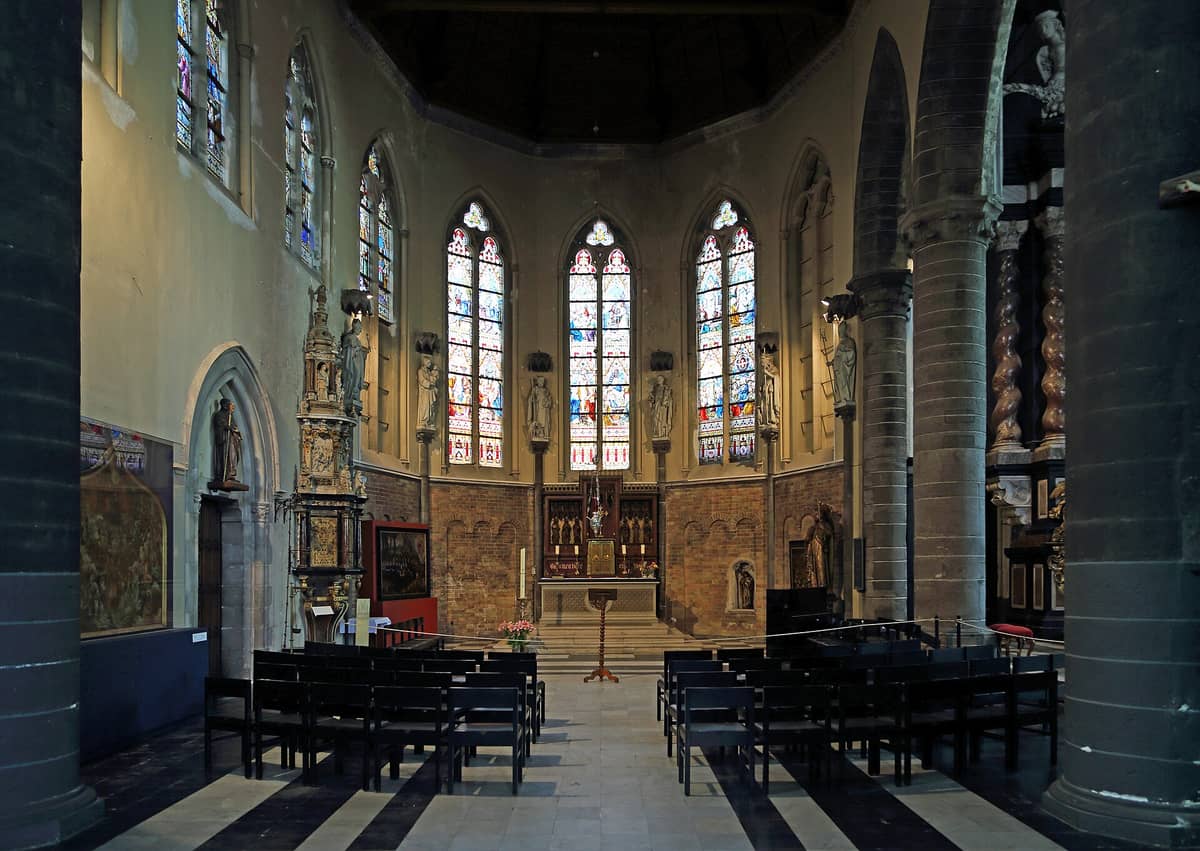
The interior is Gothic in structure but densely layered with Baroque additions, which is exactly what centuries of continuous patronage produces. The nave is lit by tall pointed windows, and as your eyes adjust from the relative brightness outside, the sheer quantity of objects begins to register. Altarpieces in carved wood and painted panels fill the side chapels. Epitaphs and memorial slabs cover sections of the walls and floor. Gilded frames crowd the spaces between columns.
The light inside changes significantly depending on the time of day and the season. On a bright afternoon in summer, the nave receives warm, diffuse light through its windows and the atmosphere is relatively open. On an overcast October afternoon, the interior feels considerably more enclosed, the carved stonework more shadowed, and the gilt on the altarpieces more dramatic by contrast. Both are worth experiencing, but the summer afternoon light is friendlier for seeing the detail in the paintings.
The floor is partly composed of worn memorial stones, some dating back several centuries. Walking across them gives the church a tactile quality that photographs do not capture. The stone is cold underfoot even in summer, and the air inside retains a faint smell of old stone and candle wax that is characteristic of churches that have been in continuous use for this long.
💡 Local tip
Bring a small flashlight or use your phone torch to read the inscriptions on the carved epitaphs on the walls — the church's ambient lighting leaves many of them in partial shadow, and the Latin and Middle Dutch inscriptions reward close inspection.
Crowds, Timing, and the Practical Reality of a Visit
Sint-Jakobskerk receives a fraction of the visitors who pass through the Basilica of the Holy Blood or the Church of Our Lady each day. On most afternoons, you will share the space with a handful of other visitors and perhaps a local who has stopped in for a quiet moment. This is not a church where you need to navigate around tour groups or wait for a clear photograph. It is, by the standards of Bruges' popular circuit, genuinely quiet.
The current opening window of 13:00–17:00 means that morning visitors to Bruges cannot include it in an early itinerary. If you are following a tight one-day schedule, plan for an early afternoon visit. The church is roughly 15 minutes on foot from the Markt, heading northwest along Sint-Jakobstraat, and can be combined naturally with a walk through the quieter streets of the northern historic centre.
If you are planning a full day in the city and want to structure your route, the Bruges one-day itinerary shows how Sint-Jakobskerk fits alongside the other central sights without excessive backtracking.
Photography, Accessibility, and What to Wear
Photography is generally permitted inside the church, though you should be respectful if a service is in progress — in that case, wait or return later. The interior presents real challenges for photography: very high contrast between the windows and the shadowed interior, and artwork positioned in low-light side chapels. A phone with a competent night mode will handle most situations, but expect some images to be more atmospheric than technically precise.
As with all active churches in Bruges, modest dress is appropriate. There is no official dress code enforced at the door, but shoulders covered and avoiding shorts is a reasonable standard. The floor is uneven in places and the side chapels involve short steps; contact the parish directly if wheelchair access is a specific requirement, as the building's medieval structure means access varies by section.
⚠️ What to skip
The church is an active place of worship. If you arrive to find a service underway, the visiting area may be restricted or the church closed to general visitors. Check times in advance, particularly on Sundays and Catholic feast days.
How Sint-Jakobskerk Compares to Bruges' Other Churches
Bruges has several major churches worth visiting. The Church of Our Lady holds Michelangelo's Madonna and Child and charges an admission fee for its art sections. The Sint-Salvatorskathedraal is the city's cathedral, grander in scale and visited by large numbers of tourists daily. Sint-Jakobskerk sits in a different category: free, quieter, and rich in art that does not appear in many guidebooks.
The trade-off is that Sint-Jakobskerk lacks a single headline object. There is no Michelangelo, no single painting with a famous name attached that drives visitors through the door. What it offers instead is accumulation: layer after layer of memorial art, devotional painting, and carved stonework that together tell you more about the real social fabric of medieval and early modern Bruges than almost any other single building in the city.
Visitors specifically interested in the sacred art collections of Bruges may also want to visit Memling in Sint-Jan, the former St John's Hospital which houses Hans Memling's altarpieces in their original setting — a complementary experience to what Sint-Jakobskerk offers.
Who Should Skip Sint-Jakobskerk
If your time in Bruges is limited to a single afternoon and you are prioritising the canal views, the Belfry climb, and chocolate shopping, Sint-Jakobskerk is easy to leave off the list without regret. It does not offer a dramatic visual payoff from the outside, the square it faces is modest, and the experience is entirely interior. Visitors who find extended time inside churches draining, or who have no particular interest in Flemish religious art and funeral monuments, will find little to hold their attention here.
It is also worth noting that the current afternoon-only opening window limits flexibility. Families with young children who are working around nap schedules or school-age attention spans may find the dense, dark interior of limited appeal compared to more active attractions nearby.
Insider Tips
- Arrive within the first 15 minutes of opening at 13:00 — the church is at its emptiest in that window before the afternoon foot traffic from the nearby Markt filters through.
- The side chapels along the north aisle contain some of the oldest and most detailed carved epitaphs in the building. Most visitors walk down the central nave and miss them entirely.
- Sint-Jakobsplein itself is a quiet square with a neighbourhood feel that contrasts sharply with the tourist-heavy streets nearby. Sitting on one of the benches after your visit gives you a sense of Bruges that the main sights do not.
- If you want the best natural light inside, visit on a sunny afternoon in May or June when the sun is at the right angle to illuminate the nave windows fully — overcast days in autumn and winter make the interior noticeably darker.
- The church contact (secretariaat@kerkinbrugge.be) can provide information on any temporary exhibitions or special access arrangements — occasionally the sacristy or other areas are opened for specific events.
Who Is St. James's Church (Sint-Jakobskerk) For?
- Art and architecture enthusiasts who want Flemish religious art in its original context, without admission fees
- Travellers who have already done the main Bruges circuit and want something quieter and less predictable
- History researchers and genealogists interested in the merchant and guild families of medieval Bruges
- Photographers looking for moody, low-light interior shots away from crowded tourist attractions
- Visitors following the Open Churches walking route through Bruges' historic centre
Nearby Attractions
Other things to see while in Historic Centre:
- Basilica of the Holy Blood
The Basilica of the Holy Blood (Basiliek van het Heilig Bloed) stands on Burg Square in Bruges' historic centre, housing a relic venerated since the Middle Ages. Entry to the basilica is free; the treasury costs €5. With two architecturally distinct chapels stacked on top of each other, it rewards visitors who take time to explore both levels.
- Belfry of Bruges (Belfort)
Standing 83 metres above the Markt, the Belfry of Bruges has dominated the city's skyline since the 13th century. The climb is steep and the staircase narrow, but the rooftop view over the canal network, church spires, and Flemish rooftops rewards the effort. Here is everything you need to know before you go.
- Burg Square
Burg Square, known locally as the Burg or Burgplein, is the political and ceremonial core of Bruges, framed by some of the finest medieval and Renaissance civic architecture in Belgium. Free to enter at any hour, it rewards careful exploration and rewards visitors who stay long enough to watch the light shift across its stone facades.
- Choco-Story Bruges
Choco-Story Bruges traces the story of chocolate from Maya and Aztec cacao rituals to the artisan praline shops lining today's Bruges streets. Located on Wijnzakstraat in the historic centre, it combines genuine cultural history with live chocolate demonstrations that make it one of the more substantive stops on the city's well-worn tourist circuit.