Shanghai Astronomy Museum (Shanghai Planetarium): The Complete Visitor Guide
Opened in July 2021, the Shanghai Astronomy Museum is the world's largest planetarium by building area, located in Pudong's Lingang district. It combines striking architecture with immersive dome films and hands-on science displays, though the remote location requires real planning.
Quick Facts
- Location
- 380 Lingang Avenue, Pudong New Area, Shanghai 201306
- Getting There
- Metro Line 16, Dishui Lake Station, then ~10–15-minute walk
- Time Needed
- 3–5 hours (longer if watching a dome film)
- Cost
- Adults ¥30 | Students/children 6+ ¥15 | Seniors 60–69 ¥25 | Under 6, seniors 70+, disabled: free (zero-yuan reservation required) | Dome film: ¥40 extra
- Best for
- Families, science enthusiasts, architecture admirers, rainy-day visits
- Official website
- www.sstm-sam.org.cn
What Is the Shanghai Astronomy Museum?
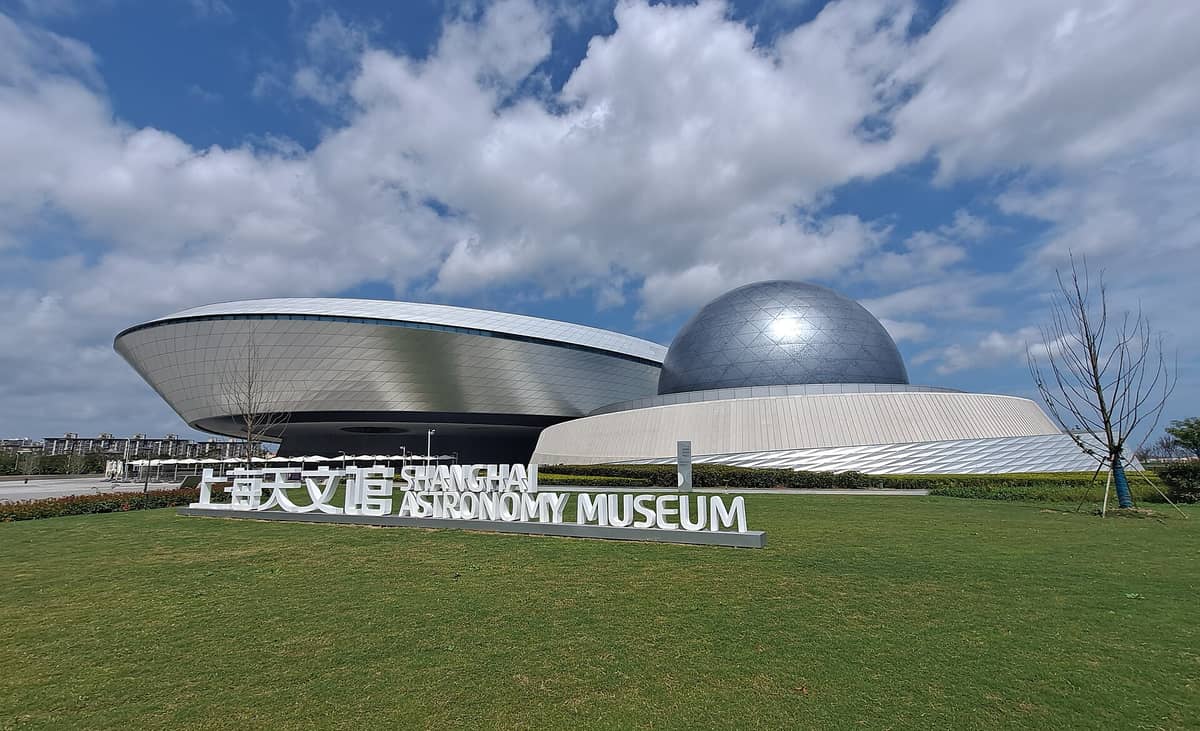
The Shanghai Astronomy Museum, officially named 上海天文馆 in Chinese and known internationally as the Shanghai Planetarium, opened its doors on 18 July 2021. By floor area, it is the world's largest planetarium, part of the Shanghai Science and Technology Museum system. It sits in the Lingang district at the southeastern edge of Pudong New Area, roughly 40 kilometers from the city center — a location that is deliberate, placing it far from light pollution and closer to the open coastal landscape of the Yangtze River delta.
The building itself is the first thing that stops people mid-stride. Designed by Ennead Architects, the structure is organized around three circular openings: a tilted oculus in the main dome, a 23-meter inverted glass dome, and a spherical planetarium theater that appears to float above a reflecting pool. These are not decorative choices. Each aperture tracks astronomical events with precision — the oculus admits a focused shaft of light that moves across the floor at the solstices and equinoxes. On those mornings, a small crowd gathers quietly at the appointed time, watching light travel across the exhibition floor in a line.
⚠️ What to skip
Online booking is mandatory. There are no walk-up tickets. General admission opens 7 days in advance at 09:30 via the official WeChat mini program or the museum's ticket portal. Dome film tickets go on sale separately the same morning. Weekend slots sell out quickly — book as early as possible, especially during school holidays.
The Architecture: Worth the Journey on Its Own
Before you enter, spend time outside. The exterior plaza is expansive and largely paved, which means it can feel bleak under winter grey or oppressively hot in August midday, but in clear morning light, the geometry of the building is extraordinary. The spherical theater protrudes from the main structure on a narrow neck, hovering over a shallow pool that reflects its curved underside. The inverted glass dome cuts downward into the ground floor, allowing natural light to flood a subterranean exhibition space. These are engineering feats that also serve a poetic function: the building is itself about observation and the relationship between earth and sky.
For anyone tracing Shanghai's remarkable recent architectural story, the planetarium belongs alongside the towers of Lujiazui as evidence of a city that takes building ambition seriously. It pairs well with a broader look at the city through the lens of the Shanghai architecture guide, which covers everything from Art Deco Bund facades to contemporary Pudong landmarks.
Tickets & tours
Hand-picked options from our booking partner. Prices are indicative; availability and final rates are confirmed when you complete your booking.
Shanghai city and Zhujiajiao water town private tour with lunch
From 371 €Instant confirmationFree cancellationShanghai private tour with iconic landmarks of the old and new city
From 284 €Instant confirmationFree cancellationShangai Yuyuan Garden entrance tickets
From 9 €Instant confirmationFree cancellation
Inside the Museum: What You Actually See
The interior is organized across multiple levels, with exhibition zones covering the solar system, stellar evolution, galaxies, cosmology, and the history of human astronomical observation. The presentation leans heavily on immersive display technology: large curved screens, interactive simulations, and physical scale models. A full-scale replica of a lunar landing module occupies one section. Another area recreates the surface of Mars with enough detail to disorient visitors briefly.
The exhibitions are primarily in Mandarin Chinese, with English translations on most major panels but not on every interactive terminal. If your group includes children who read Chinese or adults with any Mandarin, the depth of content increases significantly. That said, the visual design is strong enough that the experience does not collapse without language access. Scale models, video installations, and hands-on stations carry large portions of each zone.
The inverted glass dome houses a section called the 'Home' exhibition zone, which is flooded with soft natural light throughout the day. It tends to be calmer and less crowded than the upper floors, and the light quality inside shifts notably as the sun moves. Morning visits catch this zone at its most photogenic, with warm light diffusing through the glass and casting circular shadows on the floor below.
💡 Local tip
Book a dome theater ticket at the same time as your general admission. Films run in multiple sessions and cover topics from black holes to the story of Earth's formation. The dome experience, projected in full 360 degrees above and around seated visitors, is one of the most technically impressive in East Asia. Don't leave it as an afterthought — film slots run out before the museum itself fills.
When to Visit: How the Experience Changes by Time of Day
The museum’s regular daytime hours start at 09:30, and the first two hours are consistently the least crowded on most days. This is also when the light through the oculus is most active, angling across the floor in a way that shifts noticeably within thirty minutes of arrival. If you are traveling with children, arriving at opening means lower noise levels, more access to interactive terminals, and shorter queues for the dome film.
From around 11:00 onwards on weekends and public holidays, the museum fills substantially. School groups arrive in organized cohorts, the solar system exhibition zones become congested around the physical interactive displays, and the cafe on the ground floor develops a queue. By 13:00 on a busy Saturday, the atmosphere shifts from exploratory to managed. If you cannot avoid a midday arrival, use that time for the dome film rather than the open exhibition floors — the theater experience is unaffected by crowd numbers.
During July and August, the museum has historically offered Saturday evening openings, extending hours to around 20:00 with last entry at 19:00. These 'Museum Night' sessions are quieter, and the outdoor plaza at dusk, with the spherical theater illuminated against the coastal sky, is genuinely striking. Check the official site for current scheduling before planning an evening visit, as these sessions require separate advance booking and availability is limited.
Weather matters more here than at most Shanghai attractions. The Lingang area is exposed and flat, with wind coming off the coast. In winter, the walk from Dishui Lake metro station to the museum can feel significantly colder than central Shanghai. In summer, the exterior plaza offers almost no shade. Check the forecast before you go. For general seasonal guidance on visiting Shanghai, the best time to visit Shanghai covers the full climate calendar.
Getting There: The Logistics Are Real
This is not a quick side trip from the Bund. The museum sits at the far southeastern edge of Pudong, and the journey from central Shanghai typically takes 60 to 90 minutes each way including metro transfers, depending on your starting point and connection times. Plan the full day around it.
The most straightforward route is Metro Line 16 from Longyang Road Station to Dishui Lake Station, the terminus. Depending on train type, the ride takes roughly 35–50 minutes from Longyang Road, which is itself accessible from central areas via Lines 2 and 7. From Dishui Lake Station, the museum is a 10–15-minute walk through a relatively quiet, wide-avenue district that is still developing around the Lingang new town project.
Taxis and ride-hailing via Didi are alternatives but cost significantly more than the metro combination. If you are traveling with young children or elderly visitors who cannot manage the walk, a Didi from Dishui Lake Station to the museum entrance is a practical option. The fare for that short section is minimal.
ℹ️ Good to know
The museum is generally open Tuesday through Sunday, 09:30–16:00, with last admission around 15:00. It is closed on Mondays, except when Monday falls on or is adjusted for a national public holiday or special event. Confirm hours on the official site before your visit, particularly around Chinese New Year, National Day (Golden Week), and other major holidays when schedules and occasional evening extensions adjust.
Photography, Accessibility, and Practical Details
Photography is permitted throughout the general exhibition areas without flash. The best shots are architectural: the oculus shaft of light in the morning, the reflected sphere over the exterior pool, and the upward view from inside the inverted glass dome. The dome theater does not permit photography during screenings.
The museum is wheelchair accessible, with ramps and elevators throughout. Visitors with disabilities receive free admission on presentation of valid documentation. Baby-changing facilities are available on-site. There is a cafe and a gift shop, both reasonably priced by Shanghai museum standards. The gift shop carries astronomy-themed merchandise, including decent quality star charts and educational kits that hold up as gifts better than the usual souvenir fare.
If the journey to Lingang feels long for a single attraction, consider combining the visit with Dishui Lake itself, a man-made circular lake adjacent to the metro station, or reading up on other things to do in Shanghai that can be grouped by district to reduce transit time.
Who Should Think Twice
Travelers on a short trip to Shanghai (two or three days) should weigh the 90-minute round trip carefully against everything else competing for that time. The museum rewards people with a genuine interest in science or architecture, but for someone ticking landmarks off a list, the distance-to-payoff ratio may not work. The exhibitions, while visually strong, are not the most narrative-driven or deeply bilingual, which can limit the experience for non-Mandarin visitors at certain interactive stations.
Visitors primarily focused on Shanghai's art scene may find the Power Station of Art or the Long Museum West Bund more aligned with their interests and far easier to reach from central districts.
Insider Tips
- Book dome film tickets as soon as reservations open (usually 3 days in advance) for your visit date; they can disappear within minutes on weekends. Set a phone alarm the night before to be ready when sales open.
- The oculus light projection is most dramatic within the first hour after opening (09:30–10:30) on clear days. Arrive at opening if this is a priority — cloud cover eliminates the effect entirely.
- Line 16 trains run less frequently than central metro lines, with headways that lengthen outside peak times. Check the timetable before your return journey and add buffer time to avoid missing a connection at Longyang Road.
- The museum cafe is serviceable but limited. Bring snacks or a packed lunch if visiting with children — there is little else in immediate walking distance.
- For the summer evening openings (July–August Saturday sessions), the exterior reflects beautifully at dusk. Bring a jacket: coastal Lingang cools quickly after sunset even in summer.
Who Is Shanghai Planetarium For?
- Families with children aged 6 and up who have an interest in science or space
- Architecture enthusiasts wanting to see one of China's most ambitious recent public buildings
- Travelers visiting Shanghai in autumn or spring with a full free day available
- School-age groups and educational travelers
- Anyone who has already covered central Shanghai and wants something genuinely different
Nearby Attractions
Other things to see while in Pudong:
- Century Park
Century Park is the largest ecological urban park in downtown Shanghai, stretching across Pudong's grid of glass towers and wide boulevards. Since May 2024, entry is free and the fences are gone, making it one of the most accessible green spaces in the city. Whether you come at dawn for tai chi or late afternoon for a lakeside stroll, the park rewards visitors who know how to read it.
- China Art Museum
The China Art Museum occupies the striking red former China Pavilion built for Expo 2010, making it one of the most architecturally dramatic museum experiences in Shanghai. Permanent collections are free, the scale is genuinely impressive, and most visitors are surprised by how much is on display across multiple floors.
- Jin Mao Tower
Standing 420.5 metres above Pudong's Lujiazui financial district, Jin Mao Tower is one of Shanghai's most architecturally distinctive skyscrapers. Its 88th-floor observatory delivers panoramic views across the Huangpu River and the historic Bund, while the building's pagoda-inspired silhouette remains one of the most recognisable on the city skyline.
- Lujiazui Riverside Promenade
The Lujiazui Riverside Promenade stretches roughly 2.5 km along Binjiang Avenue in Pudong, offering unobstructed views of the Bund from the opposite bank. It is open 24 hours, costs nothing to walk, and delivers one of the most dramatic urban skylines on earth at any time of day.