Long Museum West Bund: Shanghai's Private Art Powerhouse on the River
Long Museum West Bund sits inside a converted industrial complex on Shanghai's Huangpu riverfront, housing one of China's most significant private collections of modern and contemporary art. Expect grand architectural spaces, rotating blockbuster exhibitions, and a serious curatorial vision that punches well above most municipal museums.
Quick Facts
- Location
- 3398 Longteng Avenue, Xuhui District, Shanghai (West Bund Culture Corridor)
- Getting There
- Metro Line 7 or Line 12 to Middle Longhua Road Station (Exit 5), then ~14 min walk east
- Time Needed
- 2–3 hours for main galleries; half a day if combining with West Bund waterfront
- Cost
- Approx. ¥50–100 general admission; major special shows up to ¥280. Free on the first Tuesday of each month (excluding special exhibitions and public holidays). Verify current pricing before visiting.
- Best for
- Contemporary art lovers, architecture enthusiasts, and visitors exploring the West Bund cultural corridor
- Official website
- http://www.thelongmuseum.org/en
What Is the Long Museum West Bund?
The Long Museum West Bund (龙美术馆西岸馆) is a privately funded art museum located at 3398 Longteng Avenue in Xuhui District, Shanghai. Founded by collectors Liu Yiqian and Wang Wei, it operates as part of a two-campus institution alongside the Long Museum Pudong, making it one of the most ambitious private art enterprises in mainland China. The West Bund campus opened in 2014 and is the larger, more architecturally distinctive of the two.
The museum anchors the West Bund Culture Corridor, a strip of repurposed industrial land along the western bank of the Huangpu River that has been systematically transformed into a cultural district over the past decade. Neighboring institutions include the Tank Shanghai contemporary art space and the Yuz Museum, which means a visit here can easily connect to a broader half-day or full-day circuit of the area.
If you are building a Shanghai itinerary and trying to decide which museums to prioritize, the Long Museum West Bund belongs in serious consideration alongside the Power Station of Art and the Shanghai Museum. Unlike those institutions, this one carries the particular energy of a private collection with strong opinions, which shows in both the curation and the caliber of visiting exhibitions.
The Architecture: Why the Building Itself Is Worth the Visit
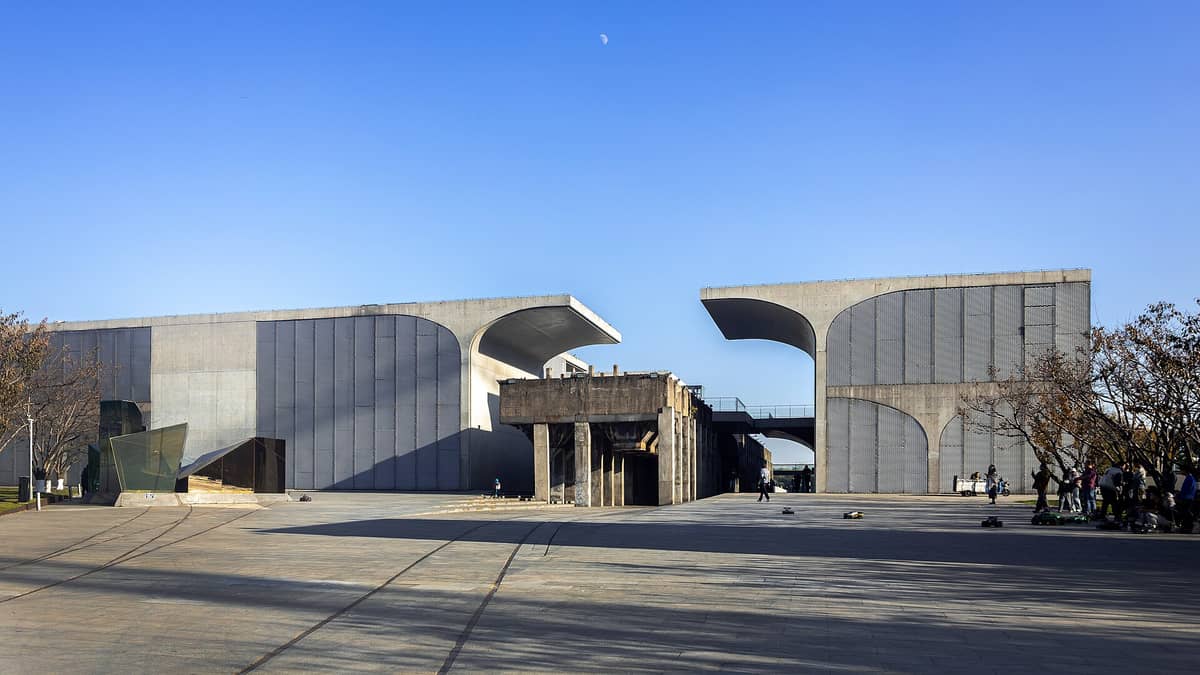
The building was designed by Chinese architect Atelier Deshaus in collaboration with his firm, and is widely recognized as one of the stronger examples of adaptive industrial reuse in Shanghai. The structure retains and references the original coal hopper unloading bridge that once served the riverside coal wharf on this site. The result is a series of massive umbrella-shaped concrete canopies that cantilever over the galleries, creating column-free interior spaces up to 18 meters high.
Standing in the main hall, the raw concrete overhead feels simultaneously heavy and buoyant. The surfaces are unpolished and clearly industrial in origin, yet the proportions are carefully controlled. Natural light enters through strategic gaps, so the quality of illumination shifts noticeably depending on time of day and weather outside. On overcast mornings, the light inside is flat and even, ideal for studying detail in artworks. On sunny afternoons, shafts of harder light create drama across large-format canvases.
The building is one of the reference points in Shanghai's ongoing conversation about what contemporary institutional architecture can look like. If this topic interests you, the broader Shanghai architecture guide covers how the West Bund fits into the city's design trajectory.
💡 Local tip
Arrive between 10:00 and 11:00 on a weekday to have the main hall almost entirely to yourself. Weekend afternoons bring steady foot traffic, especially during high-profile exhibitions, and the lobby area can feel congested.
Tickets & tours
Hand-picked options from our booking partner. Prices are indicative; availability and final rates are confirmed when you complete your booking.
Shanghai city and Zhujiajiao water town private tour with lunch
From 371 €Instant confirmationFree cancellationShanghai private tour with iconic landmarks of the old and new city
From 284 €Instant confirmationFree cancellationShangai Yuyuan Garden entrance tickets
From 9 €Instant confirmationFree cancellation
The Collection and Exhibitions
The Long Museum's core collection spans Chinese modern art from the revolutionary period through the post-reform era, alongside a significant roster of international contemporary works. Liu Yiqian and Wang Wei are known for acquiring at the top end of the auction market, including works by Chinese masters like Zhang Daqian and Qi Baishi, as well as Western figures from Modigliani to Basquiat. The permanent holdings are rotated across the campus, so what you see on a given visit reflects curatorial choices rather than a fixed display.
Temporary exhibitions here tend to be large in scale, sometimes occupying entire wings. Major retrospectives of internationally recognized artists have been mounted at the West Bund campus, and the ceiling heights make it one of the few venues in Shanghai genuinely suited to monumental installation work. However, the programming is not predictable from a tourist planning perspective: shows vary significantly in scope, and ticket prices for special exhibitions can be substantially higher than standard admission, which is high for Shanghai.
Honest assessment: if you visit during a between-shows transition period or a modest permanent-collection rotation, the experience is less spectacular than during a flagship temporary exhibition. Check the museum's official website for the current program before building your day around a visit. During a major international show, the Long Museum West Bund operates at a level comparable to mid-tier European institutions.
ℹ️ Good to know
The first Tuesday of each month is a free entry day (general admission only, excluding special exhibitions and public holidays). This is a practical option if your schedule allows, though it does attract larger crowds than a typical Tuesday.
Opening Hours and Getting There
The museum is open Tuesday through Sunday. From April 1 to October 31, hours run 10:00 to 18:00 on Tuesday through Thursday and 10:00 to 21:00 on Friday through Sunday, with last entry one hour before closing. From November 1 to March 31, the museum closes at 17:30 Tuesday through Thursday and 20:00 Friday through Sunday, with last entry one hour before closing. The museum is closed on Mondays, except on public holidays. Some sources note extended Friday and Saturday evening hours during summer and major exhibitions; confirm this on the official website before planning an evening visit.
To reach the museum by metro, take Line 7 or Line 12 to Middle Longhua Road Station and exit through Exit 5. From there, a 14 to 15-minute walk heading east brings you to the entrance at 3398 Longteng Avenue. The walk passes through the northern section of the West Bund riverside strip, which is pleasant in autumn and spring but exposed and hot in July and August. There is no direct metro connection to the museum entrance, so budget the walk time into your schedule.
Taxis and ride-hailing via Didi are straightforward from central districts. From the Bund or Xintiandi, the journey typically runs 15 to 25 minutes depending on traffic. The museum's address in Chinese (上海市徐汇区龙腾大道3398号) is worth having on your phone for the driver.
⚠️ What to skip
Opening hours, ticket prices, and exhibition schedules change periodically. Always check the official Long Museum website at thelongmuseum.org/en before your visit, especially for special exhibitions where admission costs significantly more than standard pricing.
The West Bund Context: More Than Just One Museum
The Long Museum West Bund does not stand in isolation. It sits within the West Bund cultural district, a planned arts corridor that has grown considerably since the mid-2010s. Flanking the museum along the riverfront are Tank Shanghai, the Yuz Museum, and a series of galleries and creative spaces, all connected by a waterfront promenade.
The wider neighborhood has a specific atmosphere that is different from, say, the density of M50 or the commercial energy of Tianzifang. Here the scale is larger, the distances between venues slightly longer, and the ambiance closer to a post-industrial arts precinct than a pedestrian lane. On weekday mornings, the area is nearly quiet. Weekend afternoons bring a mix of art tourists, local families using the riverside paths, and architecture students photographing the buildings.
If you are specifically interested in Shanghai's contemporary art scene, the Shanghai contemporary art guide maps out how the West Bund relates to other major venues across the city, including M50 Creative Park and the Rockbund.
Practical Details for Your Visit
Wheelchair rental is available at the museum with a CNY 100 deposit; the wheelchair itself is free to use. The galleries are on a single level for the most part, with the industrial-scale halls being fully navigable without stairs in the main exhibition spaces. Group guided tours can be reserved in advance; contact the museum directly to arrange this.
For photography, the architecture lends itself well to wide-angle interior shots, particularly the umbrella canopies overhead and the interplay between the raw concrete structure and the artworks below. Photography policies within specific exhibitions vary and are displayed at gallery entrances; some shows prohibit photography entirely, particularly those with major international loans.
The museum has an on-site café and a bookshop carrying art publications in both Chinese and English. The bookshop selection is curated and often includes exhibition catalogues that are not widely available elsewhere in Shanghai. Both are accessible without purchasing a museum ticket.
Who Might Not Enjoy This Visit
Travelers primarily interested in traditional Chinese culture, history, or classical artifacts will find the Long Museum West Bund a poor match. The collection skews toward 20th-century and contemporary work, and the building itself communicates nothing of imperial or historical China. Visitors with very limited time in Shanghai who have not yet seen the Bund, Yu Garden, or a traditional temple should probably prioritize those before making the journey to the West Bund. The 14-minute walk from the metro station is also a genuine inconvenience in summer heat or wet weather.
Insider Tips
- Check the current exhibition calendar at thelongmuseum.org before you go. The gap between a standard permanent collection rotation and a major international retrospective is significant in terms of both experience and ticket cost.
- The free first-Tuesday policy applies only to the base admission ticket. If a high-profile temporary exhibition is running simultaneously, entry to that show still costs extra. Plan accordingly.
- Combine your visit with the broader West Bund riverside walk, heading north toward the Huangpu River waterfront after the museum. The 20-minute walk covers several other cultural venues and provides river views without any additional entry cost.
- The museum bookshop near the entrance does not require a ticket. If you are uncertain about paying for admission during a quieter exhibition period, browse the bookshop first to get a sense of what is currently showing from the materials on display.
- Winter weekday mornings (November through February, Tuesday to Thursday before noon) consistently offer the quietest conditions inside the galleries and the most favorable light in the main hall.
Who Is Long Museum West Bund For?
- Contemporary art collectors and enthusiasts who follow the international exhibition circuit
- Architecture visitors interested in adaptive industrial reuse and the work of David Chipperfield
- Travelers planning a full West Bund cultural day combining multiple venues along the riverfront
- Repeat visitors to Shanghai looking beyond the standard tourist itinerary
- Anyone visiting on the first Tuesday of the month looking for a free, high-quality cultural experience
Nearby Attractions
Other things to see while in West Bund & Xuhui:
- Longhua Temple and Pagoda
Standing in Xuhui District since at least the Tang era, Longhua Temple (龙华寺) is Shanghai's largest active Buddhist temple and home to one of the city's oldest surviving pagodas. Unlike many heritage sites reduced to museums, this is a working place of worship where monks chant, incense smoke drifts through gilded halls, and the city's noise recedes entirely.
- Shanghai Film Museum
Housed on the former grounds of the legendary Shanghai Film Studio in Xuhui District, the Shanghai Film Museum traces more than a century of Chinese filmmaking through props, archives, interactive exhibits, and restored production equipment. It is one of the most substantive cinema museums in Asia, and one of the few in Shanghai where the building itself carries as much history as the collection inside.