Longhua Temple and Pagoda: Shanghai's Living Buddhist Heart
Standing in Xuhui District since at least the Tang era, Longhua Temple (龙华寺) is Shanghai's largest active Buddhist temple and home to one of the city's oldest surviving pagodas. Unlike many heritage sites reduced to museums, this is a working place of worship where monks chant, incense smoke drifts through gilded halls, and the city's noise recedes entirely.
Quick Facts
- Location
- 2853 Longhua Road, Xuhui District, Shanghai
- Getting There
- Longhua Station, Metro Lines 11 & 12 (Exits 1, 3, or 4)
- Time Needed
- 1.5 to 2.5 hours
- Cost
- Low-cost general entry (around 10 CNY; verify at gate, as pricing and special events may charge separately)
- Best for
- History lovers, architecture enthusiasts, spiritual seekers, photography
Why Longhua Temple Stands Apart
Longhua Temple and Pagoda is not a relic carefully preserved behind glass. Monks live here. Incense burns through opening hours every day. Families arrive with paper offerings and grandparents lead grandchildren to bow at each hall. This is what separates Longhua from the city's more theatrical heritage sites: the place has not been preserved so much as it has continued.
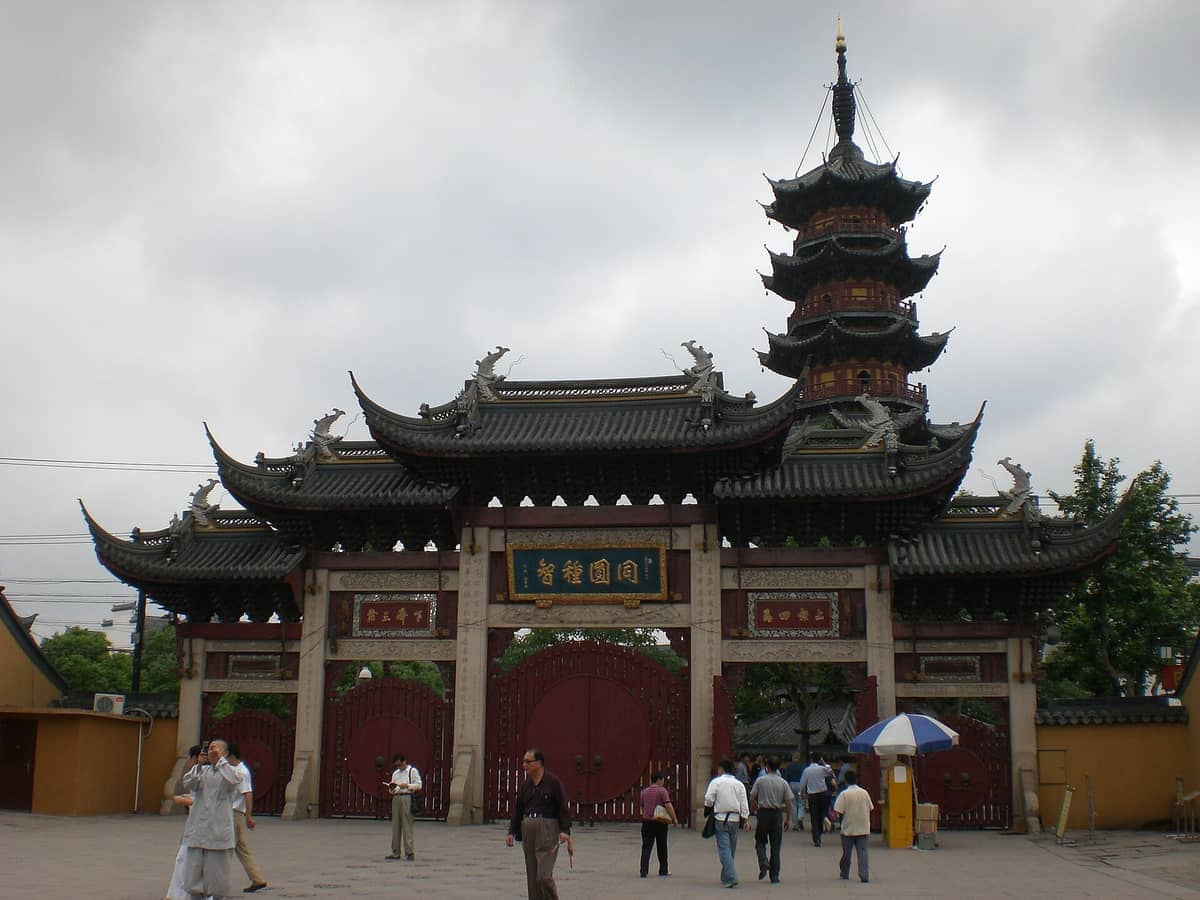
The complex traces its origins to the mid-3rd century CE, during the Three Kingdoms period, with successive restorations through the Tang and Song dynasties shaping what visitors see today. The Longhua Pagoda, a seven-story brick-and-wood structure dating in its current form to a 10th-century Song-era reconstruction, is among the oldest surviving pagodas in Shanghai and serves as the visual anchor of the entire compound. It does not permit interior access, but viewed from the forecourt or the adjacent peach blossom grove in spring, it earns every photograph.
💡 Local tip
General entry is currently reported as low-cost (around 10 CNY) as of 2025–2026, and pricing at religious sites can change. Confirm the exact amount at the gate on arrival. The New Year bell-striking ceremony carries a separate ticket fee.
The Grounds: What You Actually See
Longhua Temple is organized along a traditional south-to-north central axis, a layout that reflects centuries of Chinese Buddhist architectural planning. Entering through the main gate, visitors pass through a succession of halls: the Maitreya Hall, the Heavenly King Hall, the Grand Hall of Great Strength (the primary worship space), and further inner courtyards housing the Three Saints Hall and the Abbot's Chamber. Each threshold is raised, requiring visitors to step over a wooden beam, a design intentionally symbolic of leaving the secular world behind.
The Grand Hall of Great Strength is the emotional center of the visit. Inside, three large gilded Buddha figures sit beneath a lacquered ceiling, flanked by eighteen smaller luohan statues lining the walls. The air is dense with sandalwood incense. On weekday mornings, monks conduct chanting services here, and the low rhythmic sound carries into the surrounding courtyards. Visitors are welcome to observe respectfully from the back.
The pagoda itself stands just southwest of the main axis. It rises seven stories in the Song dynasty style, with upturned eaves on each level edged with small bronze bells that chime faintly when the wind moves through the complex. The stonework at the base shows genuine age: uneven, darkened, and patched in places over the centuries. This visual evidence of time is part of what makes Longhua more compelling than a fully restored replica.
Tickets & tours
Hand-picked options from our booking partner. Prices are indicative; availability and final rates are confirmed when you complete your booking.
Shanghai city and Zhujiajiao water town private tour with lunch
From 371 €Instant confirmationFree cancellationShanghai private tour with iconic landmarks of the old and new city
From 284 €Instant confirmationFree cancellationShangai Yuyuan Garden entrance tickets
From 9 €Instant confirmationFree cancellation
Time of Day and Crowd Behavior
The early morning, between 07:00 and 09:00, is the most atmospherically rewarding window to visit. The light is low and directional, hitting the pagoda from the east and picking out the texture of the brickwork. Worshippers arrive with fresh incense, and the pace of the complex is unhurried. Tour groups are rare at this hour, and the sound of chanting from within the halls is more audible without the ambient noise of crowds.
Midday on weekends draws noticeably larger crowds, particularly families and school groups. The atmosphere shifts from contemplative to sociable, which is not necessarily a drawback: watching Shanghai residents interact with a place of active religious and cultural significance is its own kind of insight. That said, if still photography is a priority, midday crowds complicate composition around the pagoda and main forecourt.
On the 1st and 15th days of the lunar calendar, the temple opens earlier (sometimes as early as 05:00 or 06:00) for incense-burning ceremonies. These dates draw larger numbers of devout visitors than standard days, and the atmosphere shifts considerably: the smell of burning incense is heavier, the queues at the main hall longer, and the energy more intensely devotional. Check a lunar calendar before planning around these dates.
ℹ️ Good to know
Standard opening hours are roughly 07:00–16:30 daily, with earlier opening (around 05:00–06:00) on incense-burning days such as the 1st and 15th of the lunar month. Hours may extend or vary on lunar calendar festival days. Verify the posted gate notice upon arrival, as on-site hours take precedence.
Historical and Cultural Context
Longhua Temple's origins are traditionally placed in 247 CE, with subsequent expansions during the Tang dynasty (618–907 CE) and a major reconstruction in the Song dynasty (960–1279 CE) that gave the pagoda its current form. The temple belongs to the Chan (Zen) school of Buddhism, and its community of resident monks maintains daily liturgical practice. For travelers exploring Shanghai's religious landscape, Longhua provides a useful counterpoint to the more centrally located Jade Buddha Temple in Jing'an: Longhua is older, larger, and set within a dedicated park rather than embedded in an urban street grid.
The adjacent Longhua Martyrs' Cemetery and Memorial Hall, located immediately beside the temple complex, commemorates revolutionaries executed here in the 1920s and 1930s. This layer of 20th-century history sits in direct proximity to a 1,700-year-old religious site, and the contrast is very Shanghai: the ancient and the modern, the sacred and the political, occupying the same block. The memorial is a separate site with its own entry and hours.
Longhua is Shanghai's largest active Buddhist temple by physical scale and congregation size, which gives it a different character from the more intimate Jing'an Temple. Where Jing'an sits dramatically against a backdrop of glass towers, Longhua sits within a quieter, more residential pocket of Xuhui District, surrounded by the temple's own peach grove and gardens.
The Peach Blossom Festival: One Season Worth Planning Around
In late March and early April, the peach trees in the grounds surrounding the temple come into full bloom. The Longhua Peach Blossom Festival is one of Shanghai's more photogenic seasonal events, drawing significant crowds to what is normally a calm neighborhood. The combination of pink blossom against the pagoda's dark eaves and upturned roof lines produces images that circulate widely each spring.
If you are timing a visit to Shanghai around seasonal highlights, the peach blossom window (typically two to three weeks in late March) overlaps with the city's broader spring charm. For context on what else the season offers, the guide to Shanghai in spring covers timing and expectations across multiple neighborhoods.
⚠️ What to skip
During the Peach Blossom Festival, the area around the temple sees significant footfall. Arrive before 09:00 to photograph the pagoda and blossom without dense crowds in the frame.
Getting There and Practical Walkthrough
The simplest approach is Metro Lines 11 or 12 to Longhua Station. Exits 1, 2, and 3 all deposit you within a few minutes' walk of the temple gate on Longhua Road. The walk is straightforward: follow Longhua Road south and the pagoda becomes visible above the roofline before you reach the entrance. From central Shanghai (People's Square area), the metro journey takes roughly 15 to 25 minutes depending on line transfers.
Longhua sits in the southwestern part of Xuhui District, within the broader West Bund and Xuhui area. A visit here pairs naturally with the West Bund museum corridor along the Huangpu River, about 15 to 20 minutes on foot or a short taxi ride. The Long Museum West Bund and the Power Station of Art are both accessible for an afternoon extension.
Wear flat, comfortable shoes. The temple's central path uses uneven stone paving, and the raised thresholds between halls require attention underfoot. A step-free alternative route reportedly exists; ask staff at the main gate if needed. An accessible restroom is available on-site, though some interior areas of the complex may involve steps.
Dress modestly, particularly in the main worship halls. Shoulders and knees do not need to be covered by any posted requirement, but the dress norm at an active place of worship leans conservative. If you are visiting primarily as a photographer, a compact camera or phone is entirely appropriate. Large tripods are disruptive in the worship halls and are best limited to the open courtyards during quieter hours.
Who Should Reconsider
Travelers looking exclusively for museum-style presentation, with English-language interpretation panels and curated audio guides, will find Longhua underwhelming in that respect. Signage is primarily in Chinese, and the site assumes a degree of prior knowledge or curiosity. Similarly, visitors who need fully flat, unobstructed access throughout may find the stone pathways and hall thresholds challenging despite the general wheelchair accessibility designation.
If your priority is skyline spectacle or modern architectural drama, Longhua is not the right stop. The pagoda is striking but modest in scale compared to Pudong's towers. The value here is texture, age, and active religious culture, not panoramic views or interactive technology.
Insider Tips
- The bell tower at Longhua is the source of one of Shanghai's most famous New Year traditions: the New Year's Eve bell-striking ceremony, where tickets (typically around 120 CNY) sell quickly and the line forms well before midnight. Book through official tourism channels if attending this event.
- The vegetarian restaurant inside the temple grounds serves simple, inexpensive meals prepared according to Buddhist dietary rules. It is popular with local worshippers and operates during temple hours. Do not expect an English menu, but pointing at what others are eating works fine.
- Lunar calendar dates (1st and 15th of each month) bring the most authentic devotional atmosphere but also the heaviest incense smoke. If you are sensitive to smoke, a standard weekday morning is cleaner air and equally rewarding culturally.
- The peach grove is on the northwestern side of the complex, slightly off the main visitor axis. Many visitors following the central hall sequence miss it entirely. Walk around the back of the main hall cluster to find it.
- Photography inside the main worship halls is technically permitted but use judgment: monks conducting morning chanting should not be photographed directly, and flash is inappropriate throughout. The exterior pagoda shots are unrestricted and best in morning or late afternoon light.
Who Is Longhua Temple and Pagoda For?
- Travelers with an interest in Chinese Buddhist architecture and living religious practice
- Photography enthusiasts, especially in late March during peach blossom season
- History-oriented visitors who want Shanghai's oldest surviving pagoda in context
- Those pairing cultural sites with the West Bund museum corridor on the same day
- Early risers who want a calm, contemplative hour before the city wakes fully
Nearby Attractions
Other things to see while in West Bund & Xuhui:
- Long Museum West Bund
Long Museum West Bund sits inside a converted industrial complex on Shanghai's Huangpu riverfront, housing one of China's most significant private collections of modern and contemporary art. Expect grand architectural spaces, rotating blockbuster exhibitions, and a serious curatorial vision that punches well above most municipal museums.
- Shanghai Film Museum
Housed on the former grounds of the legendary Shanghai Film Studio in Xuhui District, the Shanghai Film Museum traces more than a century of Chinese filmmaking through props, archives, interactive exhibits, and restored production equipment. It is one of the most substantive cinema museums in Asia, and one of the few in Shanghai where the building itself carries as much history as the collection inside.