Jade Buddha Temple: Shanghai's Living Buddhist Sanctuary
The Jade Buddha Temple (玉佛禅寺, Yùfó Chán Sì) is one of Shanghai's most significant active Buddhist monasteries, housing two exceptional jade Buddha statues brought from Burma in the late 19th century. Unlike many temples that have become purely ceremonial attractions, this one functions as a working monastery, with monks in residence and daily rituals that visitors can witness firsthand.
Quick Facts
- Location
- 170 Anyuan Road, Putuo District (上海市普陀区安远路170号), at the junction with Jiangning Road
- Getting There
- Metro Line 13, Jiangning Road Station (Exit 3), 5–10 min walk; or Line 7, Changshou Road Station, ~20 min walk
- Time Needed
- 1–2 hours for a thorough visit; 45 minutes if moving quickly
- Cost
- General entry to the temple grounds is currently free; an additional fee applies to enter the Jade Buddha Chamber and related jade halls — verify locally before visiting, as these details can change.
- Best for
- History enthusiasts, travelers seeking authentic religious culture, architecture admirers, and those wanting a quieter counterpoint to Shanghai's commercial pace
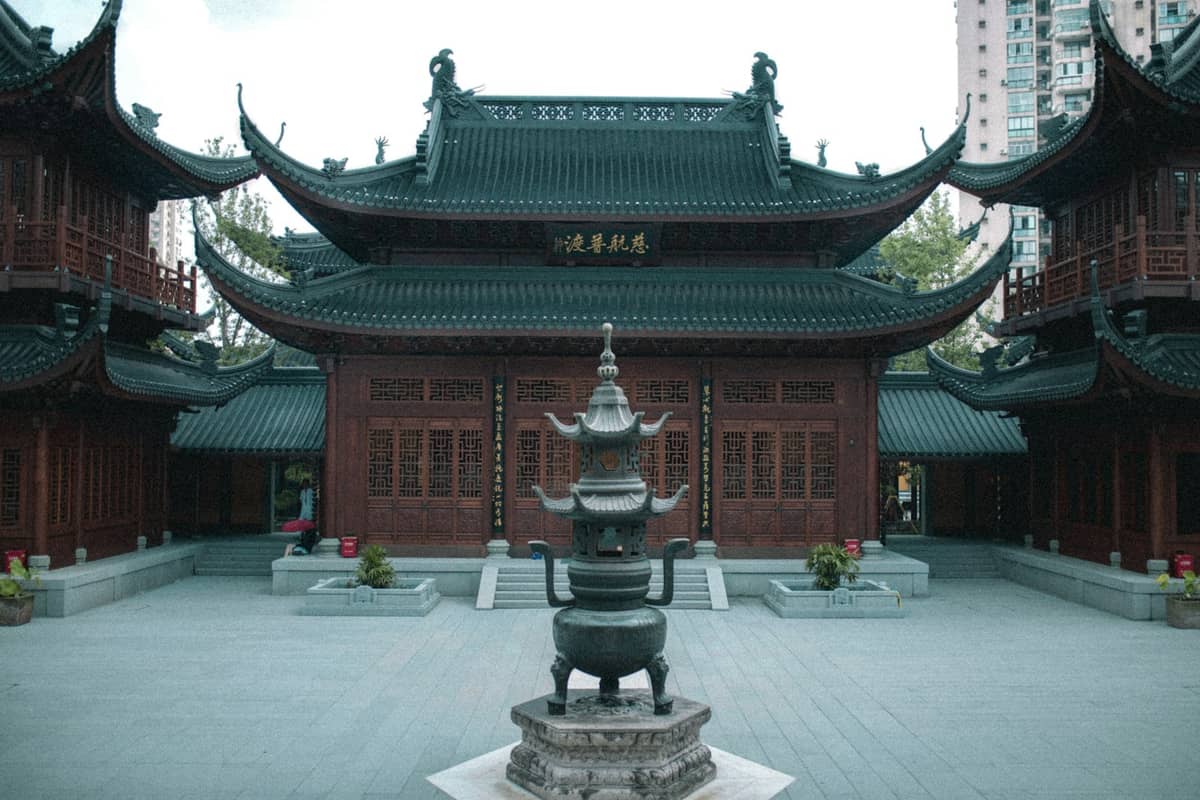
What the Jade Buddha Temple Actually Is
The Jade Buddha Temple, known in Chinese as 玉佛禅寺 (Yùfó Chán Sì), is not a museum replica of religious life. It is an active Chan (Zen) Buddhist monastery in Shanghai's Putuo District, where resident monks chant sutras at dawn, incense smoke thickens the air in the main courtyard throughout the day, and laypeople come to pray for practical things: job offers, exam results, good health for aging parents. Tourists and worshippers share the same cobblestoned space, which gives the temple an energy that purely touristic sites cannot manufacture.
The complex is built in the southern Chinese architectural style, with characteristic yellow-ochre walls, upward-curving roof eaves glazed in green tile, and ornate carved timber detailing. It reads as traditional and cohesive despite being largely a product of the reconstruction period between 1918 and 1928, which followed damage to the original 1882 structure and relocation of the temple to Anyuan Road.
ℹ️ Good to know
Opening hours are commonly listed as 08:00–16:30 daily, with ticket sales typically ending around 16:00–16:30. On major Buddhist observance days (the 1st and 15th of the lunar calendar), the temple may open earlier, sometimes from around 05:30 or 07:00. Verify current hours directly with the temple before visiting, as these details change.
The History Behind the Statues
The story of this temple begins with a journey. In 1882, a monk named Huigen traveled to Burma (present-day Myanmar) and returned with five jade Buddha statues. Two became the centerpiece of a small temple built in Shanghai's Jiangwan area to house them. That original structure did not survive in its intended form, and the current temple complex on Anyuan Road took shape during the reconstruction between 1918 and 1928.
The statues themselves are the reason for the temple's existence and its enduring reputation. The seated Jade Buddha on the upper floor of the Jade Buddha Chamber is carved from a single piece of white Burmese jade and stands approximately 1.9 meters tall, adorned with gemstones. The reclining Buddha, depicting Shakyamuni entering parinirvana, is housed in a separate hall and is smaller in scale but no less carefully worked. Both pieces are genuinely old and genuinely significant to practicing Buddhists. Photography is prohibited inside the Jade Buddha Chamber, a rule enforced consistently.
For visitors interested in Shanghai's wider religious landscape, the Jade Buddha Temple sits alongside several other important sites covered in our guide to Shanghai's best temples.
Tickets & tours
Hand-picked options from our booking partner. Prices are indicative; availability and final rates are confirmed when you complete your booking.
Shanghai city and Zhujiajiao water town private tour with lunch
From 371 €Instant confirmationFree cancellationShanghai private tour with iconic landmarks of the old and new city
From 284 €Instant confirmationFree cancellationShangai Yuyuan Garden entrance tickets
From 9 €Instant confirmationFree cancellation
How the Experience Changes by Time of Day
Morning is the most atmospheric window for a visit. Between 08:00 and 10:00, the light is soft, the tourist crowds have not yet peaked, and the scent of sandalwood incense from the first worshippers of the day is at its strongest. The sound of chanting from the monks' quarters drifts across the main courtyard, and elderly Shanghainese residents kneel before the deity halls with a practiced, unhurried devotion that feels entirely separate from tourism.
By mid-morning and into the afternoon, the tempo shifts. Tour groups arrive in volume, particularly on weekends, and the courtyards become noticeably more crowded. The experience is still worthwhile, but the contemplative quality evaporates. If you arrive after 13:00 on a Saturday, expect to queue for the Jade Buddha Chamber and to navigate tight clusters of visitors in the narrow interior corridors.
The 1st and 15th days of the lunar calendar draw the largest crowds of local worshippers. On these days the temple is at its most spiritually charged, with the courtyards thick with incense smoke and devotees carrying large bundles of joss sticks. It is genuinely worth experiencing, but it is not a quiet visit.
💡 Local tip
Arrive at opening (08:00) on a weekday for the calmest experience. The first hour is when the atmosphere is most distinct and the crowds thinnest. Wear comfortable flat shoes — the temple floors are uneven in places, and the Jade Buddha Chamber requires climbing stairs.
A Practical Walkthrough of the Complex
The temple is entered from Anyuan Road through a main gate flanked by two large stone lions. The ticket counter is just inside. After passing through, you move into the first courtyard, where a large bronze incense burner occupies the center. The smell here is immediate and distinctive: a dry, resinous warmth from burning incense that clings to your clothes long after you leave.
The main hall straight ahead is the Mahavira Hall (大雄宝殿), housing three large gilded Buddhas representing the past, present, and future. The figures are monumental in scale and elaborately decorated. On either side of the hall are the Hall of Heavenly Kings and subsidiary deity halls. The temple grounds are not enormous, but there is enough layering of courtyards and side halls to reward slow exploration.
The Jade Buddha Chamber is accessed via a staircase and requires a separate entry fee beyond the general admission. The queue for this room is typically the longest bottleneck in the visit, especially on busy days. The room itself is small, the statue commands it completely, and the quality of the carving is immediately apparent even without context. Visitors are ushered through at a reasonable pace, so linger as long as the flow permits.
A vegetarian restaurant operates on the temple grounds and is open to all visitors, not just Buddhist practitioners. Lunch service typically runs around midday. The food is straightforward and inexpensive by Shanghai standards, and eating here adds a dimension to the visit that a quick circuit of the halls does not.
Getting There and Practical Logistics
The temple's address is 170 Anyuan Road, Putuo District (上海市普陀区安远路170号). The most direct metro option is Line 13 to Jiangning Road Station, using Exit 3, followed by a 5–10 minute walk to the temple on Anyuan Road. Alternatively, Line 7 to Changshou Road Station involves a longer walk of around 15 minutes. Several bus routes, including lines 19, 36, 68, and 206, stop near the Anyuan Road and Jiangning Road junction.
For a broader overview of navigating the city's metro system and transport options, the getting around Shanghai guide covers everything from card top-up to late-night options.
Ticket prices have varied across sources and change over time. Recent information has cited figures ranging from free general entry with a separate charge for the Jade Buddha Chamber, to combined entry fees. Verify the current pricing at the gate or through the temple's official Chinese-language website before your visit. Children under a certain height are typically admitted free, and student discounts may apply.
⚠️ What to skip
The Jade Buddha Chamber involves a staircase with no elevator access noted in available sources. Visitors with significant mobility limitations should plan accordingly. The temple grounds also include uneven stone paving throughout.
Dress Code, Photography, and Behavior
This is an active place of worship, not a heritage park, and the etiquette matters. Modest dress is expected: shoulders and knees covered is the sensible baseline. Loud conversation in the halls and deity rooms is out of place, and visitors who treat the space respectfully will find that monks and worshippers are entirely untroubled by their presence.
Photography is generally permitted in the courtyards and main halls. The Jade Buddha Chamber is a strict no-photography zone, enforced by staff at the entrance, and attempting to take pictures inside will result in being asked to delete them. Respect the rule. The statue is extraordinary and the temptation is real, but the prohibition is consistent and non-negotiable.
If photography is a priority in your Shanghai itinerary, the best photo spots in Shanghai guide covers locations where you can shoot freely and get strong results.
Is It Worth Your Time?
For travelers with an interest in religious architecture, living Buddhist practice, or the contrast between Shanghai's historic spiritual life and its contemporary financial identity, the answer is clearly yes. The jade statues are genuinely remarkable objects, the architecture is well-preserved and coherent, and the active monastery quality gives the visit a texture that a purely museum experience cannot replicate.
For travelers whose priority is Shanghai's modern skyline, contemporary art, or food scene, the temple may feel like an obligation rather than a highlight. It is not that the temple is unimpressive — it is that if religious culture leaves you unmoved, 90 minutes here will feel like a long time. The jade statues alone are worth 20 minutes; the rest of the experience rewards those who slow down and pay attention.
If you are building a full Shanghai itinerary and want to understand how the temple fits alongside other major draws, the things to do in Shanghai overview is a useful starting point.
Insider Tips
- Arrive at 08:00 on a Tuesday or Wednesday for the fewest tourists and the most authentic atmosphere. The early hour coincides with morning chanting, which you may hear from the adjacent monks' quarters.
- The vegetarian restaurant inside the grounds serves lunch around midday. It is open to all visitors, inexpensive, and rarely mentioned in standard guides. The braised tofu dishes are consistently good by local accounts.
- Lunar calendar dates matter here. The 1st and 15th of each lunar month draw the largest crowds of local devotees — avoid these days if you want space, or embrace them if you want the most immersive experience of active worship.
- The Jade Buddha Chamber queue moves faster in the first hour after opening than at any other point in the day. If this is your main reason for visiting, go straight there before exploring the other halls.
- The temple sells small incense bundles near the entrance. Participating in the offering ritual — placing lit incense in the courtyard burner — is welcomed and gives you a more engaged relationship with the space than simply walking through it.
Who Is Jade Buddha Temple For?
- Travelers interested in active Buddhist culture and living monastic traditions
- Architecture enthusiasts who want to study southern Chinese temple construction and ornamental detail
- First-time visitors to Shanghai who want historical and spiritual context alongside the city's modern face
- Photographers focused on documentary and cultural images, particularly during morning light in the courtyards
- Visitors combining the temple with nearby Jing'an District attractions for a half-day cultural circuit
Nearby Attractions
Combine your visit with:
- Chongming Island
Chongming Island sits at the mouth of the Yangtze River, a vast alluvial island that functions as Shanghai's rural counterweight. Wetland reserves, a national forest park, cycling paths through farmland, and virtually no high-rises make it a genuinely different Shanghai experience.
- ERA Acrobatics Show
Running nightly at Shanghai Circus World in Jing'an District, ERA2 – Spirit of Shanghai is the city's flagship acrobatics production. Expect gravity-defying stunts, dramatic lighting, and a 60-to-100-minute show that needs no translation. Here is everything you need to know before buying a ticket.
- Jinshan City Beach
Jinshan City Beach (金山城市沙滩景区) is a man-made coastal resort on Hangzhou Bay, about 60 km south of central Shanghai. It is the closest thing to a genuine beach day the city offers, with designated swimming zones, a long promenade, and seasonal facilities. This guide covers what to realistically expect, when to go, and how to get there.
- M50 Creative Park
Built inside a former 1937 textile mill on the banks of Suzhou Creek, M50 Creative Park is Shanghai's most established contemporary art district. Over 100 galleries and studios occupy the preserved industrial buildings at 50 Moganshan Road, and entry to the grounds is free. Here is what to expect before you go.