Chongming Island: Shanghai's Yangtze Delta Escape
Chongming Island sits at the mouth of the Yangtze River, a vast alluvial island that functions as Shanghai's rural counterweight. Wetland reserves, a national forest park, cycling paths through farmland, and virtually no high-rises make it a genuinely different Shanghai experience.
Quick Facts
- Location
- Chongming District, Shanghai — Yangtze River estuary, north of urban Shanghai
- Getting There
- Metro Line 6 to Wuzhou Avenue (Exit 2), then Shenchong bus; or ferry from Baoyang/Wusong pier (~45–60 min crossing); or drive via G40 and Shanghai Yangtze River Bridge/Tunnel (~1–1.5 hrs).
- Time Needed
- Full day minimum; overnight recommended for birdwatching and cycling
- Cost
- Island access free; Dongping National Forest Park ~¥70, Dongtan Bird Area ~¥69, Xisha Wetland Park free, Shou'an Temple ~¥10 (verify before visiting)
- Best for
- Cyclists, birdwatchers, families wanting green space, urban escapees
- Official website
- www.shcm.gov.cn/wwb/index.html
What Chongming Island Actually Is
Chongming Island is one of the largest alluvial islands in the world, formed over centuries by silt deposited at the Yangtze River's mouth. It now forms the core of Shanghai's Chongming District, but stepping onto it feels nothing like stepping into Shanghai. There are no towers, no metro lines running across the fields, and no rooftop bars. What you find instead is flat, green agricultural land, extensive wetland reserves, a national forest park, and a pace of life shaped by fishing and farming rather than finance.
The island spans roughly 1,200 square kilometres and sits administratively within Shanghai Municipality, which makes it one of the city's 16 districts, yet it couldn't feel more removed from the urban core. It's connected to the mainland via the Shanghai Yangtze River Bridge and Tunnel corridor, plus ferry services from multiple piers. That combination of proximity and genuine rurality is precisely what makes a day here feel restorative rather than simply scenic.
ℹ️ Good to know
Chongming Island does not have a single entrance or ticket gate. It's a functioning district with villages, farms, and parks. Budget for individual attraction fees (Dongping Forest Park, Dongtan Bird Area, etc.) rather than a blanket entry fee.
The Landscape: What You Actually See
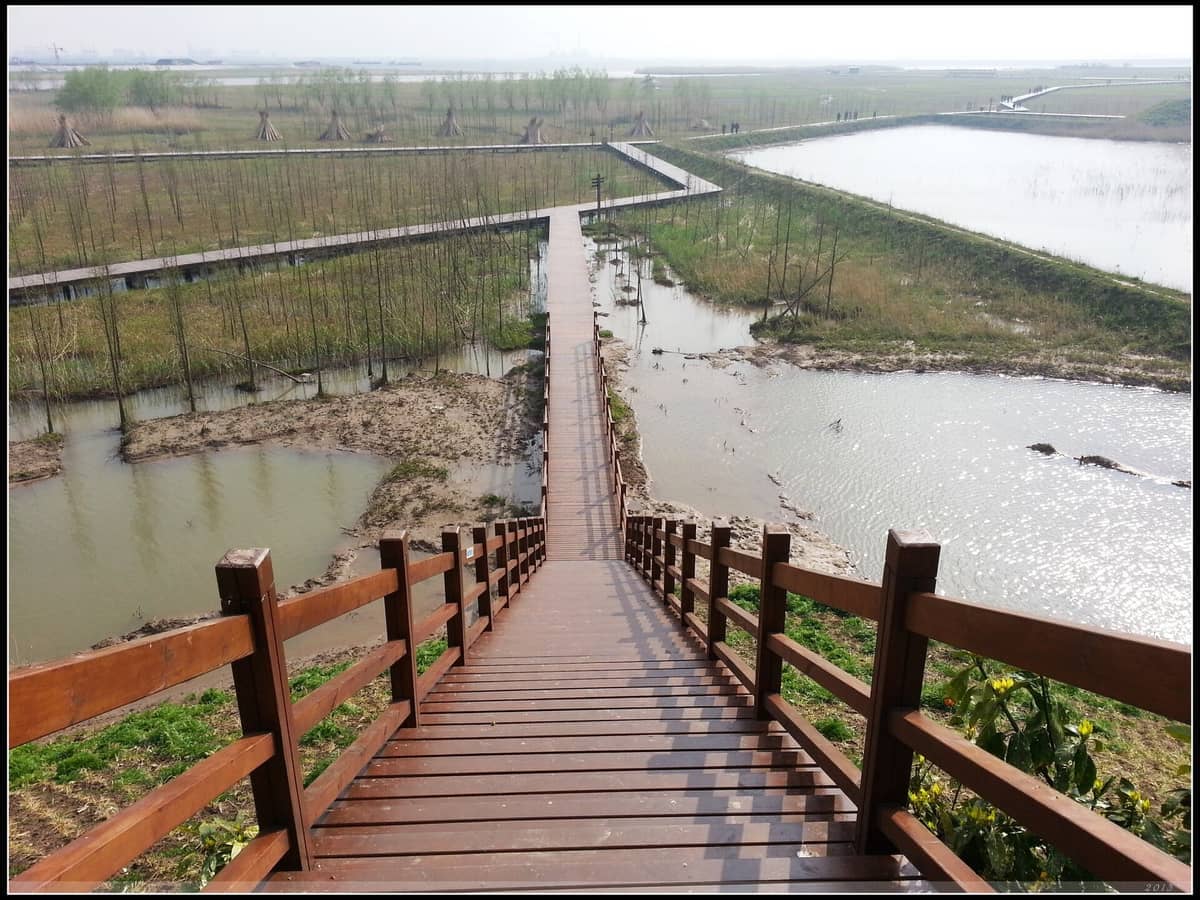
The overriding impression is flatness and scale. The island's interior is a patchwork of vegetable fields, orchards, and fish ponds broken by concrete farm roads and occasional rows of poplars. In spring, rape blossoms turn fields yellow-gold. In autumn, reed beds along the eastern shore shift from green to silver-grey as winds push off the estuary. The air smells different here: brackish near the water, earthy and faintly smoky in the farming villages.
The eastern edge of the island is where the island's ecological significance concentrates. The Dongtan Wetland area, part of the Chongming Dongtan National Nature Reserve, is a critical stopover on the East Asian-Australasian Flyway, one of the world's major bird migration routes. During spring (March-May) and autumn (September-November) migration seasons, hundreds of thousands of shorebirds, waders, and waterfowl pass through. Even outside peak migration, the reed marshes hold egrets, black-faced spoonbills, and various duck species year-round.
In the island's centre, Dongping National Forest Park offers something rarer in Shanghai's broader landscape: dense tree cover. The park contains planted woodland across several hundred hectares, with paved cycling tracks, deer enclosures, and artificial lakes. It's organised and managed, not wild, but on a weekend morning when mist sits low over the tree line, it's genuinely atmospheric. If you want a genuinely undeveloped green space closer to the urban core, Century Park in Pudong is a reasonable alternative, but Dongping is substantially larger and quieter.
Tickets & tours
Hand-picked options from our booking partner. Prices are indicative; availability and final rates are confirmed when you complete your booking.
Shanghai city and Zhujiajiao water town private tour with lunch
From 371 €Instant confirmationFree cancellationShanghai private tour with iconic landmarks of the old and new city
From 284 €Instant confirmationFree cancellationShangai Yuyuan Garden entrance tickets
From 9 €Instant confirmationFree cancellation
How the Island Changes Through the Day
Arrive before 9:00 and you catch the island in its working rhythm: farmers on motorbikes, vegetable stalls opening along the main town roads in Chengqiao (the district capital), and the parks almost empty. Dongping Forest Park opens at 08:00, and the first hour is noticeably calmer than midday. The light is softer and the bird activity higher, especially along the park's lake edges.
By late morning, day-trip groups from central Shanghai start arriving, mostly by tour bus and private car via the bridge tunnel. The parks get busier around 10:30-12:00. If you're cycling, the farm roads between the parks see very little traffic at any hour, which makes them the most pleasant part of the day regardless of when you ride.
Late afternoon is worth staying for. Around 16:00-17:00, the estuary light turns amber and the reed beds along the Xisha Wetland area shift colour noticeably. If you can stay overnight in one of the rural guesthouses (called minsu, a farmstay model common across China's countryside), the early morning hours before 07:00 are exceptional for birdwatching: quiet, low light, and minimal human disturbance near the wetland edges.
💡 Local tip
Dongtan Migratory Bird Protection Area opens at 06:00, earlier than most attractions on the island. Serious birdwatchers should plan to be at the reserve entrance by opening time, particularly during autumn migration (October-November).
Key Attractions and How to Sequence Them
The island has several distinct sites, and trying to cover all of them in a single day without a car is stressful and ultimately unsatisfying. Pick one or two focal points and spend real time there.
Dongping National Forest Park
This is the most visited single attraction on the island. Admission costs approximately ¥70 and includes access to the park's cycling trails, lakeside paths, and animal enclosures. Bicycle hire is available inside the park gates for an additional fee. Opening hours are 08:00-17:00. The park covers enough ground that you can lose the crowds simply by taking the less-signposted trail loops toward the northern sections.
Xisha Wetland Park
Free to enter, Xisha is a smaller, more intimate wetland on the island's western side. Open 08:30-16:00, it offers elevated boardwalks through reed marsh and tidal flat areas. It's quieter than Dongping and better suited to photography and slow walking. The close boardwalk access to reed beds here is genuinely unusual for a free public attraction within Shanghai's administrative boundaries.
Dongtan Migratory Bird Protection Area
On the island's eastern shore, this is the ecologically significant one. Admission is approximately ¥69. Opening hours are 06:00-18:00. The reserve sits within the broader Chongming Dongtan National Nature Reserve, which forms part of a UNESCO-recognised important bird habitat. Bring binoculars. The viewing platforms and hides along the sea wall give clear sight lines over mudflats where shorebirds concentrate. Outside migration season, expect fewer species but reliable sightings of common waders and herons.
Shou'an Temple
A functioning Buddhist temple in a rural setting, charging a modest entry of around ¥10. Open 07:00-16:30. It draws local worshippers rather than tourist crowds, which gives it a quieter, more authentic atmosphere than larger Shanghai temples. Dress modestly, as with any active religious site.
For comparison, if Shanghai's central temples are your primary interest, Jade Buddha Temple and Longhua Temple are more architecturally significant and better connected by public transit.
Getting There: Practical Routes
There is no metro line serving Chongming Island directly. All routes from the Shanghai urban metro network require a transfer to either a bus or a ferry. Factor this in: getting to the island takes time, and the journey is part of the experience rather than a problem to solve.
The most common public transport route is Metro Line 6 to Wuzhou Avenue Station (Exit 2), then a Shenchong Line bus to Nanmen Bus Station on Chongming. Shenchong bus fares are approximately ¥8–20 CNY depending on the line and destination. Travel times vary. Ferries from Baoyang Port or Wusong Port cross to Baozhen or Nanmen Port on Chongming in approximately 45–60 minutes, with fares around ¥16–23 CNY. Check current schedules before travelling, as ferry timetables can change seasonally.
Driving is the most flexible option. Via the G40 Shanghai-Xi'an Expressway and the Shanghai Yangtze River Bridge and Tunnel, driving time from central Shanghai is roughly 1 to 1.5 hours depending on traffic. A rental car or Didi gives you real freedom to move between the parks, which are spread across a large area.
⚠️ What to skip
Without a car, moving between Dongtan (east coast), Dongping Forest Park (centre), and Xisha Wetland (west) is genuinely difficult in a single day. Local buses exist but schedules are limited. Plan to focus on one or two sites, or arrange a driver for the day.
Weather, Seasons, and When to Go
Chongming's wetland and outdoor character means weather affects the experience significantly. Summer (June-August) brings high humidity and temperatures regularly above 32°C, which makes cycling and walking uncomfortable and increases mosquito activity near the wetlands. The island is exposed and flat, meaning there is little shade outside the forest park.
Autumn (October-November) is the strongest season for a visit: temperatures drop to a comfortable 15-22°C, migration bird numbers peak at Dongtan, and the reed beds are at their most photogenic. Spring (March-May) brings warmer light and rape flower blooms across the farming areas. Winter visits are possible but cold and often grey; the island's appeal diminishes substantially without foliage and birdlife. For context on Shanghai's broader seasonal patterns, the best time to visit Shanghai guide covers city-wide climate considerations in more detail.
Chongming also hosts the Ironman 70.3 Shanghai Chongming triathlon, typically held in late spring or early summer, when parts of the island see unusual activity and accommodation books up fast. If cycling or nature are what draw you to the island and you want to combine it with a day trip elsewhere in Shanghai's outskirts, day trips from Shanghai includes additional options for context.
Photography and Practical Notes
Chongming rewards wide-angle and telephoto lenses in equal measure. The flat estuary landscape suits wide compositions: empty roads cutting through reed beds, farm plots receding to the horizon, the low silhouette of the sea wall against grey sky. At Dongtan, a 300mm+ telephoto or a spotting scope makes the difference between seeing shorebirds and genuinely observing them.
For mobility access, the island's main parks have paved paths and some boardwalk areas, but terrain varies considerably between sites. Xisha Wetland's boardwalks are generally level and accessible. The forest park has wider paths suitable for wheelchairs in the main areas but rougher terrain on secondary trails. Visitors with limited mobility should check directly with each park before travelling, as facilities may change.
Carry cash. Rural areas on Chongming are well behind urban Shanghai in accepting mobile payment from foreign visitors, and card acceptance at smaller food stalls and ferry ticket counters is unreliable. Bring water and snacks if you plan to cycle between sites, as convenience options thin out quickly once you leave the main towns.
If you're drawn to Shanghai's quieter outdoor spaces more broadly, the Suzhou Creek Walk offers a very different but comparably unhurried experience within the urban core itself.
Insider Tips
- Rent a bicycle in Chengqiao town (the island's main settlement) rather than inside Dongping Forest Park: prices are lower, and you get the flexibility to ride between parks on the quiet farm roads that cross-cut the island.
- The Shenchong buses from the metro are often crowded on weekend mornings. Take an earlier metro to reach Wuzhou Avenue before 08:30, and you'll board a less packed bus and arrive at the parks before the main tour groups.
- Xisha Wetland Park is free and frequently overlooked in favour of the paid parks. Its elevated boardwalks give some of the island's best photography angles over reed marsh without the entrance queue.
- Local farmstay guesthouses (minsu) near the eastern shore offer simple overnight accommodation that puts you within minutes of Dongtan at dawn. Booking via a Chinese travel platform with a local SIM or WeChat Pay is typically required.
- Bring insect repellent if visiting between May and September. The wetland edges are productive for mosquitoes, particularly in the hour after sunset near Xisha and Dongtan.
Who Is Chongming Island For?
- Birdwatchers and wildlife photographers, especially during autumn migration (October-November)
- Cyclists wanting long, flat, low-traffic routes through farmland and park landscapes
- Families seeking a full day of open outdoor space without urban noise or crowds
- Travellers wanting to understand Shanghai's ecological and agricultural geography beyond the skyline
- Anyone willing to slow down: Chongming does not reward rushing
Nearby Attractions
Combine your visit with:
- ERA Acrobatics Show
Running nightly at Shanghai Circus World in Jing'an District, ERA2 – Spirit of Shanghai is the city's flagship acrobatics production. Expect gravity-defying stunts, dramatic lighting, and a 60-to-100-minute show that needs no translation. Here is everything you need to know before buying a ticket.
- Jade Buddha Temple
The Jade Buddha Temple (玉佛禅寺, Yùfó Chán Sì) is one of Shanghai's most significant active Buddhist monasteries, housing two exceptional jade Buddha statues brought from Burma in the late 19th century. Unlike many temples that have become purely ceremonial attractions, this one functions as a working monastery, with monks in residence and daily rituals that visitors can witness firsthand.
- Jinshan City Beach
Jinshan City Beach (金山城市沙滩景区) is a man-made coastal resort on Hangzhou Bay, about 60 km south of central Shanghai. It is the closest thing to a genuine beach day the city offers, with designated swimming zones, a long promenade, and seasonal facilities. This guide covers what to realistically expect, when to go, and how to get there.
- M50 Creative Park
Built inside a former 1937 textile mill on the banks of Suzhou Creek, M50 Creative Park is Shanghai's most established contemporary art district. Over 100 galleries and studios occupy the preserved industrial buildings at 50 Moganshan Road, and entry to the grounds is free. Here is what to expect before you go.