M50 Creative Park: Shanghai's Best Contemporary Art District
Built inside a former 1937 textile mill on the banks of Suzhou Creek, M50 Creative Park is Shanghai's most established contemporary art district. Over 100 galleries and studios occupy the preserved industrial buildings at 50 Moganshan Road, and entry to the grounds is free. Here is what to expect before you go.
Quick Facts
- Location
- No. 50 Moganshan Road, Putuo District, Shanghai
- Getting There
- Metro Line 13, Zhongtan Road Station (Exit 3), then ~10-min walk; also Lines 3 & 4 nearby
- Time Needed
- 1.5 to 3 hours depending on how many galleries you enter
- Cost
- Free to enter the park; most galleries free; special exhibitions approx. ¥30–80
- Best for
- Contemporary art lovers, photographers, architecture enthusiasts, slow Sunday explorers
What M50 Creative Park Actually Is
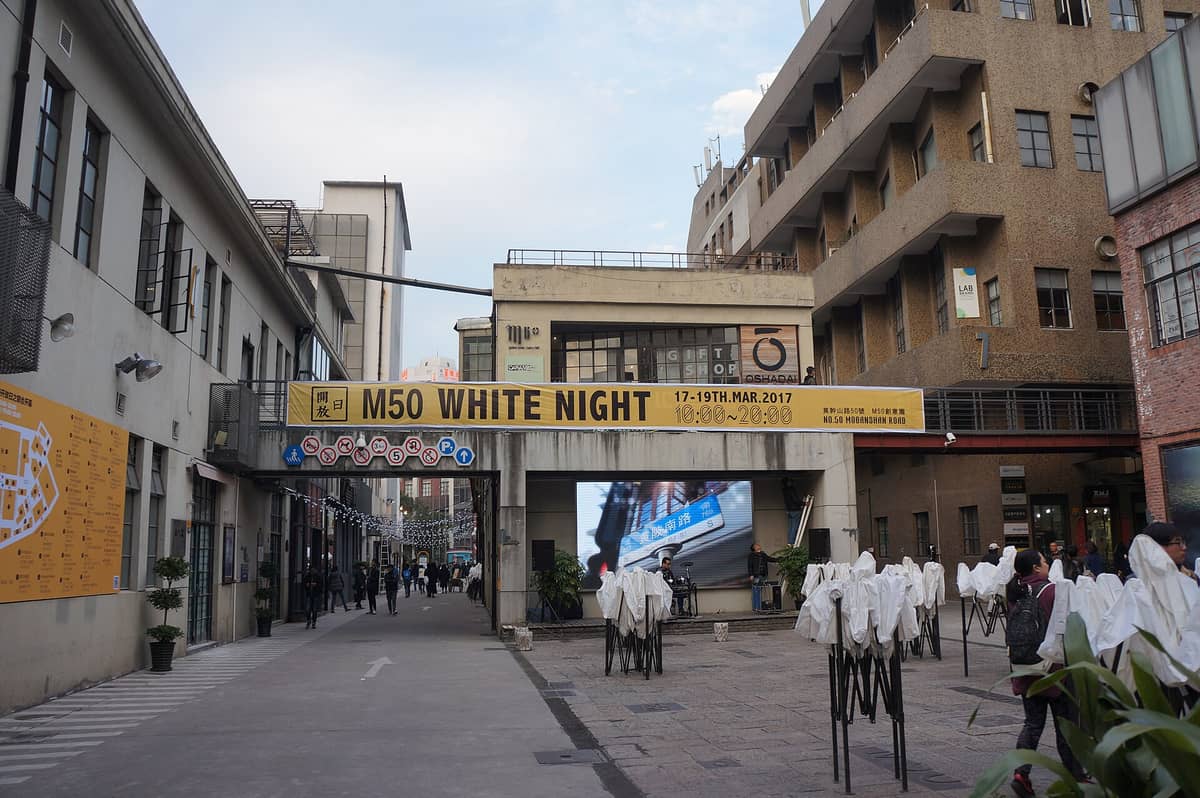
M50 Creative Park is a contemporary art and creative industry complex housed in a network of preserved industrial buildings at 50 Moganshan Road, Putuo District. The site was originally the Chunming coarse textile mill, established in 1937. Today those brick warehouses, low factory sheds, and rusting water towers shelter more than 100 galleries, artist studios, design agencies, and independent shops spread across several linked courtyards along Suzhou Creek.
Unlike a traditional museum, M50 is not a single curated experience. It is closer to an art neighborhood: each gallery operates independently, sets its own hours, and shows whatever its director decides to exhibit. On any given visit you might walk from a solo show of ink paintings into a photography exhibition, then through a studio where a sculptor is actively working. The range is wide and the quality is uneven, which is both the charm and the honest limitation of the place.
ℹ️ Good to know
Entry to the M50 grounds is free with no ticket required. Most permanent gallery shows are also free. Dedicated temporary exhibitions inside individual spaces may charge around ¥30–80. Check posted signs at each gallery entrance. (Verify prices before visiting as these are subject to change.)
The Industrial Setting: Architecture and Atmosphere
The buildings at M50 are the main reason to visit even if you have no strong interest in art. The mill complex retains the bones of its 1937 construction: load-bearing brick walls stained with decades of industrial grime, exposed steel trusses spanning high ceilings, concrete floors worn smooth in patterns that trace old machinery paths. This is not a sanitized heritage-park interpretation of industrial architecture. The textures are genuinely aged.
Outdoor walls between buildings are used as rotating street art canvases. Large-scale murals cover gable ends and corridor walls, some commissioned, some added informally. The combination of intact industrial structure and applied street art gives the lanes between buildings a layered visual density that repays slow walking rather than a quick pass-through.
The Suzhou Creek waterfront on the northern edge of the complex adds a further dimension. The creek itself is now considerably cleaner than it was two decades ago, and from certain vantage points along the bank you can see the water with the brick facades behind. Photographers working the best photography locations in Shanghai often include M50 for this exact combination of water reflection, industrial texture, and mural color.
Tickets & tours
Hand-picked options from our booking partner. Prices are indicative; availability and final rates are confirmed when you complete your booking.
Shanghai city and Zhujiajiao water town private tour with lunch
From 371 €Instant confirmationFree cancellationShanghai private tour with iconic landmarks of the old and new city
From 284 €Instant confirmationFree cancellationShangai Yuyuan Garden entrance tickets
From 9 €Instant confirmationFree cancellation
How the Experience Changes by Time of Day
Morning visits, roughly 9:00 to 11:00, offer the quietest experience. The park grounds are open from 08:00, but galleries do not typically open until 10:00 or 11:00. This window is good for photography: light falls at a low angle into the courtyards, there are few crowds, and you can walk the full perimeter of the complex and assess which spaces you want to return to when they open. The smell in the morning is creek air mixed with coffee from the handful of cafés that open early.
Midday on weekdays is when the complex is most practical for gallery-hopping. Most spaces are open, lighting inside the converted factory units is better than you might expect, and the crowd level stays manageable. Weekday afternoons are particularly good if you want to find artists actually present in their studios.
Weekends from late morning onward bring noticeably more visitors, particularly young Shanghainese and domestic tourists. The complex does not feel overcrowded by Shanghai standards, but the narrower lanes between buildings do fill up, and popular gallery openings can create genuine congestion. Weekend evenings, when the park grounds stay open until around 22:00 but most galleries have closed, see a different crowd: couples walking the creek-side paths, small groups photographing the lit murals.
💡 Local tip
Tuesday through Friday, late morning, is the optimal visiting window. Galleries are open, crowds are light, and you have the best chance of speaking directly with gallery staff or artists rather than navigating a weekend group.
Navigating the Complex: A Practical Walkthrough
M50 has no formal entry gate or ticketing point. You enter through one of several ground-level openings off Moganshan Road. A printed map is often available at the main entrance area, though the layout rewards wandering as much as planning. The complex is made up of several linked sub-sections with buildings numbered individually, so galleries and studios are identified by both their names and building numbers.
Plan a full loop of the exterior lanes first, which takes about 20 to 30 minutes. This gives you a sense of scale and shows you which galleries have current exhibitions posted in their windows. Then work inward through the courtyards, entering spaces that look interesting. Do not skip the upper floors of the multi-story buildings: some of the larger gallery spaces with the best natural light through factory skylights are on the second or third floors.
Wear flat, practical shoes. The floors inside industrial spaces are often uneven concrete or original tile, and some transitions between buildings involve shallow steps or cobbled sections. The main paths are wheelchair-accessible, but individual galleries vary considerably. Partly for this reason, M50 is commonly described as only partially accessible for wheelchair users.
M50 sits on the Suzhou Creek Walk route, one of Shanghai's more rewarding self-guided urban walks. If you have time, combining the two makes for a half-day itinerary that covers waterfront industrial heritage and contemporary creative output in a single arc.
The Art: What to Realistically Expect
The galleries at M50 represent the full spectrum from commercial and decorative work aimed at buyers to serious experimental and conceptual exhibitions. There is no curatorial throughline. A gallery showing photorealist oil paintings of the Bund may sit next to a space running a video installation by an artist with international exhibition history. Both co-exist without hierarchy.
Several galleries have established genuine reputations in Shanghai's contemporary art circuit. If you want to go beyond browsing, it is worth checking current exhibition listings for the district before your visit. Some spaces actively show emerging Chinese artists working in media that rarely appear in commercial gallery settings elsewhere in the city.
For visitors who want a deeper read on Shanghai's broader art landscape, the Shanghai contemporary art guide covers M50 alongside other major institutions including the Power Station of Art and the Rockbund Art Museum, and helps calibrate expectations for what each offers.
⚠️ What to skip
Monday closures: a significant number of individual galleries follow a Tuesday to Sunday schedule and close on Mondays. If Monday is your only available day, the park itself is open and worth visiting for the architecture and street art, but expect limited gallery access.
Getting There: Transit and Directions
The most straightforward route is Shanghai Metro Line 13 to Jiangning Road Station. Exit 1 (or the closest marked exit toward Moganshan Road) brings you out near Moganshan Road, and it is roughly an 8–10-minute walk south to the M50 entrance at No. 50. The walk itself passes older low-rise streetscapes that give a sense of the pre-gentrification character of this part of Putuo District.
Alternative metro access is available via Lines 3 and 4 at Zhongtan Road Station, which share infrastructure with Line 13 at this interchange. From central areas like People's Square or Jing'an Temple, journey times are generally under 25 minutes. Taxis and ride-hailing via Didi are also practical options, as Moganshan Road is easily searchable and drivers recognize the destination.
If you are combining M50 with other Putuo or Jing'an attractions, the guide to getting around Shanghai has current metro line maps and fare information to help you plan connections efficiently.
Honest Assessment: Is It Worth Your Time?
M50 Creative Park is worth a half-morning or early afternoon if you have any interest in contemporary art, industrial architecture, or urban photography. The combination of preserved 1937 mill buildings, Suzhou Creek waterfront, and functioning gallery culture is genuinely distinctive and not replicated elsewhere in Shanghai at this scale.
However, M50 is not a substitute for a structured museum visit. There is no permanent collection, no guaranteed quality threshold across all spaces, and no single focal exhibition that justifies the trip on its own. Visitors who arrive expecting the coherence of a museum will likely be underwhelmed. Visitors who approach it as an art neighborhood to wander and discover will find more than expected.
Who should skip it: travelers on very tight schedules who are not specifically interested in art or industrial heritage, and anyone who finds unstructured gallery-browsing more tedious than rewarding. For families with young children, the space is navigable but offers limited engagement specifically designed for children.
Those interested in a broader art and culture itinerary might pair M50 with a visit to the Power Station of Art or the Rockbund Art Museum, both of which offer more structured exhibitions in equally significant architectural settings.
Insider Tips
- Check the outer windows of galleries before entering: most spaces post their current exhibition title and start date on the door, which lets you quickly assess whether the show is recent or has been running long enough to have little foot traffic.
- The creek-side path on the northern edge of M50 is only a few minutes long, but it is the best vantage point for photographing the brick warehouses reflected in Suzhou Creek. Visit this spot early in the morning before the light becomes too harsh.
- Several working artist studios are mixed in among the commercial galleries. If a studio door is open and someone is inside working, it is generally acceptable to look in briefly. A polite nod often leads to a short conversation or an invitation to see work in progress.
- Bring cash for any café or small shop purchases inside the complex. Most galleries accept WeChat Pay and Alipay, but a few smaller independent vendors are cash only. Foreign visitors without Chinese payment apps should keep small denominations of yuan available.
- The park is broadly pet-friendly in practice, which means weekend afternoons see a notable number of dogs. If that affects your experience, weekday mornings give you essentially the same visit without the crowds or pets.
Who Is M50 Creative Park For?
- Contemporary art enthusiasts who want to see Shanghai's gallery scene outside of institutional settings
- Photographers looking for industrial architecture, mural art, and waterfront compositions in a single location
- Architecture-focused travelers interested in adaptive reuse of pre-1949 industrial buildings
- Slow travelers with a free morning who prefer unstructured exploration over ticketed attractions
- Anyone combining M50 with the Suzhou Creek Walk for a longer half-day urban itinerary
Nearby Attractions
Combine your visit with:
- Chongming Island
Chongming Island sits at the mouth of the Yangtze River, a vast alluvial island that functions as Shanghai's rural counterweight. Wetland reserves, a national forest park, cycling paths through farmland, and virtually no high-rises make it a genuinely different Shanghai experience.
- ERA Acrobatics Show
Running nightly at Shanghai Circus World in Jing'an District, ERA2 – Spirit of Shanghai is the city's flagship acrobatics production. Expect gravity-defying stunts, dramatic lighting, and a 60-to-100-minute show that needs no translation. Here is everything you need to know before buying a ticket.
- Jade Buddha Temple
The Jade Buddha Temple (玉佛禅寺, Yùfó Chán Sì) is one of Shanghai's most significant active Buddhist monasteries, housing two exceptional jade Buddha statues brought from Burma in the late 19th century. Unlike many temples that have become purely ceremonial attractions, this one functions as a working monastery, with monks in residence and daily rituals that visitors can witness firsthand.
- Jinshan City Beach
Jinshan City Beach (金山城市沙滩景区) is a man-made coastal resort on Hangzhou Bay, about 60 km south of central Shanghai. It is the closest thing to a genuine beach day the city offers, with designated swimming zones, a long promenade, and seasonal facilities. This guide covers what to realistically expect, when to go, and how to get there.