Jing'an Temple: Shanghai's Golden-Roofed Buddhist Heart
Founded in 247 AD and rebuilt to striking effect on the corner of one of Shanghai's most commercial corridors, Jing'an Temple is a working Buddhist monastery encased in gilded roofs and deep-red walls. Here is everything you need to know before you visit.
Quick Facts
- Location
- 1686 West Nanjing Road, Jing'an District, Shanghai
- Getting There
- Jing'an Temple Station, Metro Lines 2, 7, and 14 (direct exit)
- Time Needed
- 45–90 minutes for a thorough visit
- Cost
- ¥50 standard (includes incense); about ¥100 during the first 15 days of the first lunar month; free entry on the 1st and 15th days of other lunar months (verify locally).
- Best for
- History, Buddhist culture, architecture, photography, quiet reflection mid-morning
- Official website
- http://www.shjas.org
What Jing'an Temple Actually Is
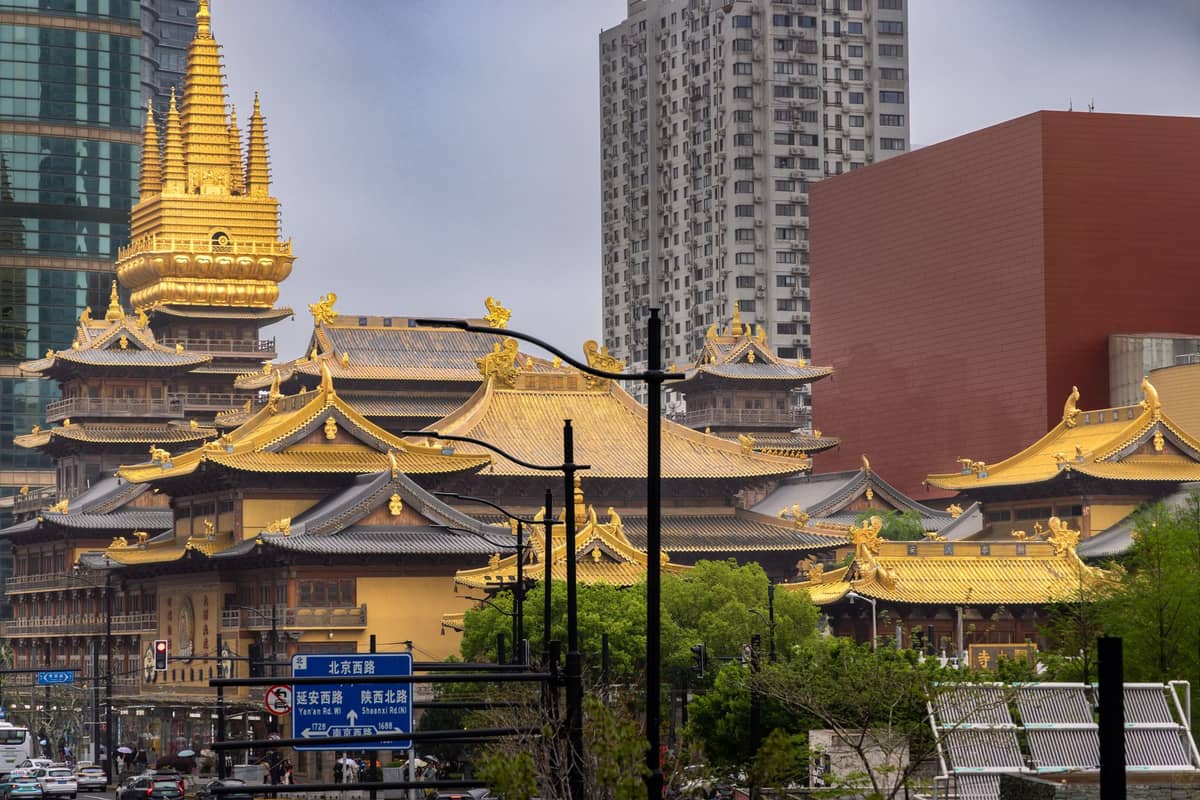
Jing'an Temple is an active Buddhist monastery that has occupied various spots along the Suzhou Creek and Nanjing Road corridor since its founding in 247 AD during the Wu Kingdom of the Three Kingdoms period. That makes it one of the oldest continuously venerated religious sites in the Yangtze River delta region. The current address at 1686 West Nanjing Road dates to a relocation in 1216 during the Southern Song dynasty, but what you see today, the multi-tiered golden roofs, the deep crimson walls, the layered courtyards, results from extensive reconstruction carried out across the 1980s through the early 2000s.
The contrast with its surroundings is immediate and striking. The temple sits directly beside Jing'an Temple Station, flanked by glass-fronted shopping malls and high-rise office towers. Incense smoke drifts past luxury-brand shopfronts. That collision is not a flaw in the experience; it is the experience. Jing'an Temple is one of the clearest examples of how Shanghai layers centuries without apology.
ℹ️ Good to know
Jing'an Temple is an active place of worship, not a heritage museum. Monks conduct daily rituals here. Visitors are welcome but are expected to behave respectfully: speak quietly, do not point feet at altars, and ask before photographing worshippers.
The Architecture: What You Are Looking At
The temple's exterior is dominated by three pagoda-style towers with glazed golden tiles that catch direct sunlight in a way that is almost aggressively photogenic. The style is southern Chinese Buddhist architecture, referencing Tang and Song dynasty forms, though the current reconstruction is modern. Pillar carvings, decorative eaves, and heavy stone lion guardians at the gate all follow traditional iconographic conventions.
Inside the complex, three main halls are arranged on a central axis in the standard Buddhist monastery layout. The first hall, nearest the entrance, contains guardian figures. The Great Hall at the center houses a large gilded Buddha, and further altars are dedicated to specific bodhisattvas. The interiors are dark and heavily lacquered, with the persistent smell of sandalwood incense and the low resonance of recorded or live chanting providing a clear sensory contrast to the noise of Nanjing Road outside.
For architectural context across the city, the Shanghai architecture guide covers how temple-building traditions sit alongside the city's European concession-era and contemporary structures.
Tickets & tours
Hand-picked options from our booking partner. Prices are indicative; availability and final rates are confirmed when you complete your booking.
Shanghai city and Zhujiajiao water town private tour with lunch
From 371 €Instant confirmationFree cancellationShanghai private tour with iconic landmarks of the old and new city
From 284 €Instant confirmationFree cancellationShangai Yuyuan Garden entrance tickets
From 9 €Instant confirmationFree cancellation
How the Experience Changes by Time of Day
Early morning, from around 07:30 to 09:00, is the most rewarding window for most visitors. The first worshippers of the day are local residents: older men and women in everyday clothes carrying their own incense, kneeling at each altar with practiced efficiency. The air is cooler, the crowds thin enough that you can stand quietly in the main hall, and the monks conducting morning rituals add a layer of authenticity that afternoon tourist flows tend to displace.
By mid-morning, domestic tour groups begin arriving and the central courtyard tightens considerably. The incense braziers are fully alight by this point, and the smoke can be thick enough to sting the eyes on still days. Between roughly 11:00 and 14:00, the temple is at its most crowded on ordinary days. If you visit then, move counter-clockwise through the halls and spend more time in the side corridors and smaller shrines that most groups skip.
On the 1st and 15th days of the lunar calendar, the temple opens at approximately 04:30–05:30 for incense offerings. These mornings draw far larger crowds of devoted worshippers and the queue can extend outside. Admission on these days is usually free, but verify this locally before assuming. During the first 15 days of the first lunar month, extended hours apply and ticket prices can rise to around ¥100. The atmosphere on those occasions is charged and cinematic, but it is not the place for quiet contemplation.
💡 Local tip
The best photography window is around 08:00 on a clear day. The golden rooftops catch morning light from the east and the temple forecourt is manageable enough to frame uncluttered shots. Bring a wide-angle lens or shoot from across Nanjing Road for the full facade with street context.
Getting There and Practical Logistics
Access is straightforward. Jing'an Temple Station on Metro Lines 2, 7, and 14 has exits that deposit you directly at the temple's main gate. Line 2 is particularly useful: it connects Pudong International Airport to People's Square and continues west to Jing'an Temple Station, making the airport-to-temple journey around 60 to 75 minutes for roughly ¥7 to ¥10 (verify current fares before travel). From The Bund area, allow around 25 to 30 minutes on Line 2 including walking and transfers.
The temple is also a natural stop on a longer walk through the neighborhood. The Wukang Road area and the broader Jing'an district reward exploration on foot, with a concentration of early 20th-century lane houses and independent cafes within a few blocks.
Standard admission is ¥50, which typically includes incense sticks provided at the entrance. Students and seniors aged around 60 and above can usually receive discounted entry with valid ID; confirm current concessions at the gate. Photography is permitted in the courtyards and on the exterior. Individual hall policies vary: look for posted signs and follow the lead of other visitors.
Dress modestly. There is no strict dress code enforced at the gate, but shorts and sleeveless tops can feel conspicuous and slightly disrespectful in the prayer halls. The paved courtyards are level, but there are steps between the main halls, which may present difficulty for visitors with limited mobility. Some accessible facilities are available in the surrounding commercial area connected to the metro station.
⚠️ What to skip
Opening hours are 07:30 to 17:00 daily, with last entry around 16:30. These details should be confirmed before your visit as hours occasionally adjust for festivals or operational reasons. The official site is http://www.shjas.org (Chinese language).
Cultural Weight: Why This Temple Matters
Jing'an Temple's history spans nearly eighteen centuries, though the physical structure has been rebuilt repeatedly. The temple was a center of Buddhist learning and a destination for pilgrims before Shanghai became the port city the world knows today. During the Republican era, it was known for its abbot Khi Ven, who reportedly kept multiple concubines and a personal bodyguard force, an episode that illustrates how dramatically institutional Buddhism in Shanghai diverged from its doctrinal ideals during that turbulent period.
The Cultural Revolution brought the temple's activities to a halt and the building was repurposed as a plastics factory for a period. Restoration began after 1983 and continued in phases for two decades. What emerged is a reconstruction that some scholars critique as more theatrical than historically accurate, but which functions fully as a place of worship and community for Shanghai's Buddhist population. That is worth holding in mind: this is not a preserved artifact. It is a living institution that was deliberately rebuilt to continue a lineage.
For travelers interested in how Shanghai's Buddhist and Taoist traditions compare across the city, the guide to Shanghai's best temples provides useful context and comparisons with sites like Longhua Temple in the south.
Honest Assessment: Is It Worth Your Time?
Jing'an Temple earns its place on most itineraries, but with realistic expectations. The complex is compact. A thorough visit takes between 45 and 90 minutes, not a half-day. The interiors, though atmospheric, are relatively small, and the reconstructed nature of the architecture means it lacks the worn authenticity of older temple sites elsewhere in China.
Where Jing'an Temple genuinely excels is the urban juxtaposition and the active religious life. Watching elderly Shanghainese conduct their morning prayers beside a Louis Vuitton flagship is a uniquely Shanghai experience that no amount of guidebook prose fully captures. If you are visiting for religious education or architectural depth, Longhua Temple in the south of the city offers more extensive grounds and a more layered history. If you want to see Buddhism functioning in the heart of a global financial city, Jing'an Temple is the right choice.
Travelers who visit primarily for social media photographs may find the experience satisfying but brief. Those who dislike incense-heavy environments should note that the main halls can be quite smoky, particularly on lunar calendar days.
If you are building a broader itinerary, the 3-day Shanghai itinerary slots Jing'an Temple into a logical morning sequence alongside nearby Nanjing Road and the Jade Buddha Temple to the northwest.
Insider Tips
- Visit on a weekday morning between 07:30 and 09:00 for the most authentic experience. Local worshippers follow quiet, efficient routines at each altar, and the monks' chanting is audible without being drowned out by tour group commentary.
- The elevated walkway around the pagoda towers on the upper level offers a clear sightline over the Nanjing Road intersection below. Most visitors skip this level and head straight to the main halls. Take three minutes to look outward as well as inward.
- Admission includes a small bundle of incense sticks (typically three). Rather than burning them all at the entrance brazier with everyone else, observe where local worshippers carry them through each hall and follow that sequence through the complex.
- Jing'an Park sits directly across the road from the temple and provides a clean green space to decompress after the incense and crowds. The park is free to enter and often has older residents practicing tai chi or playing Chinese chess, particularly in the mornings.
- On lunar calendar dates (1st and 15th of each lunar month), admission may be free but the temple becomes significantly more crowded from before dawn. Arrive at opening or accept that the experience will be more communal and less contemplative than on regular days.
Who Is Jing'an Temple For?
- First-time visitors to Shanghai wanting to understand the city's Chinese cultural foundation alongside its modern commercial identity
- Photographers drawn to the contrast of gilded traditional rooftops against a backdrop of glass-and-steel skyscrapers
- Travelers with a morning free near Nanjing Road who want substance beyond retail
- Those curious about living Buddhist practice in an urban Chinese context
- History-minded travelers building a broader temple itinerary across Shanghai
Nearby Attractions
Other things to see while in Jing'an:
- Jing'an Sculpture Park
Jing'an Sculpture Park is a free, open urban park in central Shanghai where large-scale outdoor sculptures share space with seasonal flower displays and the architecturally striking Shanghai Natural History Museum. It rewards a slow morning stroll and offers one of the more relaxed green escapes in a district defined by commerce.
- Shanghai Natural History Museum
The Shanghai Natural History Museum sits inside Jing'an Sculpture Park and ranks among the most architecturally impressive science museums in China. With deep fossil galleries, interactive ecology exhibits, and a building shaped by the spiral of a nautilus shell, it rewards a half-day visit from curious adults and families alike.