Shanghai Natural History Museum: What to Expect Before You Go
The Shanghai Natural History Museum sits inside Jing'an Sculpture Park and ranks among the most architecturally impressive science museums in China. With deep fossil galleries, interactive ecology exhibits, and a building shaped by the spiral of a nautilus shell, it rewards a half-day visit from curious adults and families alike.
Quick Facts
- Location
- No. 510 Beijing West Road, Jing'an District (inside Jing'an Sculpture Park)
- Getting There
- Metro Line 13, Natural History Museum Station (自然博物馆站), Exit 1. One stop west of Jing'an Temple Station for easy transfers.
- Time Needed
- 2.5 to 4 hours
- Cost
- Adults ¥30 / Students ¥12 / Children under 6 or under 1.3 m free. Online reservation strongly recommended, especially on weekends and holidays.
- Best for
- Families, science enthusiasts, architecture lovers, and rainy-day visits
- Official website
- www.snhm.org.cn/eg
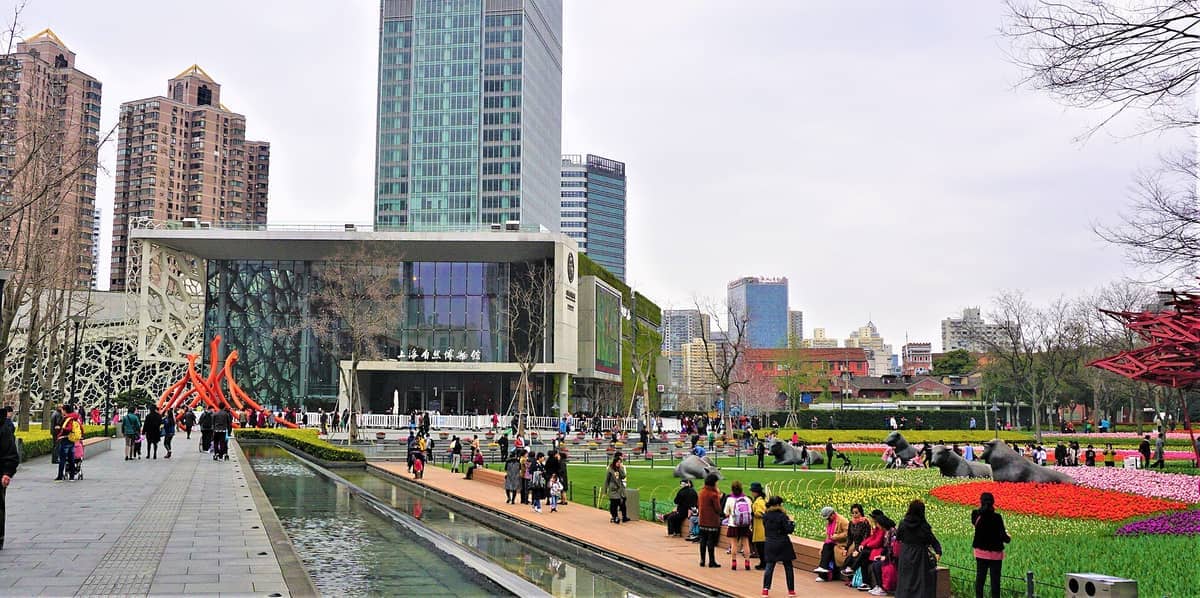
What the Shanghai Natural History Museum Actually Is
The Shanghai Natural History Museum (上海自然博物馆) is one of the largest natural science museums in Asia and operates as a branch of the Shanghai Science and Technology Museum. It opened at its current Jing'an location in April 2015, replacing a much older institution that had occupied a building in the former French Concession since 1956. The new facility represents a significant leap in ambition: roughly 33,000 square meters of exhibition space, nearly 290,000 specimens, and a building that has become a minor landmark in its own right.
Unlike the more generalist science museums in the city, this one focuses specifically on the natural world: paleontology, evolutionary biology, ecology, and the human relationship with nature. The scope runs from prehistoric oceans to present-day biodiversity. For a city as relentlessly urban as Shanghai, the museum functions as an unusual portal to the deep timeline of the planet.
ℹ️ Good to know
Tickets should be booked online in advance. Walk-up ticketing may be limited or unavailable at busy times, and this applies to both paid admissions and free-entry visitors (children, seniors 70+). Booking via the official WeChat mini-program or the museum website before you arrive is strongly recommended.
The Building: Architecture Worth Pausing For
Before you step inside, take a moment outside. The building was designed by Perkins+Will, an American architecture firm, and draws its form from the spiral of a nautilus shell. The curved green roof is planted with native grasses and slopes down toward a central elliptical pond, creating the impression that the structure is half-emerged from the park rather than imposed on it. On overcast days, the pale concrete and muted greens give the complex an almost geological quality, as if the museum itself is a stratum waiting to be read.
The relationship between the museum and Jing'an Sculpture Park is deliberate. The park surrounds the building on multiple sides, and the roofline transitions into parkland seamlessly. Arriving via Metro Line 13 and walking through the park to the entrance is considerably more pleasant than approaching from Beijing West Road directly. Morning light hits the pond facade well for photographs, and the park is quieter before 10:00 on weekdays.
The museum sits adjacent to the Jing'an Sculpture Park, which is free to enter and worth a short walk before or after your visit, particularly if you have children who need open space after hours indoors.
Tickets & tours
Hand-picked options from our booking partner. Prices are indicative; availability and final rates are confirmed when you complete your booking.
Shanghai city and Zhujiajiao water town private tour with lunch
From 371 €Instant confirmationFree cancellationShanghai private tour with iconic landmarks of the old and new city
From 284 €Instant confirmationFree cancellationShangai Yuyuan Garden entrance tickets
From 9 €Instant confirmationFree cancellation
Inside the Museum: What You Will Actually See
The permanent collection is organized across multiple floors and thematic zones. The paleontology galleries are the most dramatic: full skeletal mounts of dinosaurs, including a Mamenchisaurus that stretches an improbable length across the ceiling of the main atrium, dominate the lower levels. The fossil collection extends to marine reptiles, early mammals, and Cambrian-era specimens from Yunnan Province, several of which are genuinely rare. The quality and labeling of these displays is comparable to major natural history institutions internationally, though English translation is inconsistent across zones.
The ecology halls shift the tone. Diorama-style environments recreate African savannahs, polar regions, and subtropical forests with taxidermy specimens positioned in naturalistic groupings. The lighting in these zones is calibrated to reinforce the habitat mood, which works well in the rainforest section where the canopy ceiling filters green-tinted illumination downward. Children respond strongly to these rooms, and the sound design, low ambient calls and insect noise, adds texture that pure specimen cases cannot.
On the upper floors, exhibits address human evolution and the relationship between civilization and the natural environment. These sections are more text-heavy and the English translations become patchier here, so visitors who cannot read Chinese may find the upper levels less engaging. The interactive science zones, aimed at younger visitors, include touchable specimens and digital identification stations that work without language.
💡 Local tip
The main atrium dinosaur skeleton is best viewed from the upper-floor balcony overlooking the hall. Walk up to the second or third level before spending time on the ground floor to get spatial orientation and the best overhead perspective on the large mounts.
Timing Your Visit: Crowds and Quiet Hours
Weekend mornings from roughly 10:00 to 12:00 bring the heaviest foot traffic, particularly school groups and families with young children. The dinosaur halls become genuinely congested by mid-morning on Saturday, and the noise level in the atrium rises considerably. If you are visiting with adults only and want to move through exhibits at your own pace, a Tuesday-to-Thursday morning slot is the most comfortable option.
Midweek afternoons, arriving around 13:30, offer a useful window. School groups typically depart before 14:00, and the later afternoon light enters through the atrium glazing at an angle that illuminates the fossil mounts differently than the overhead artificial lighting of the morning. The museum closes around 17:15 with last admission at 16:00, so a 13:30 arrival gives you a full three hours without rushing.
The museum makes an excellent wet-weather option. Shanghai summers are hot and humid, and the building is fully climate-controlled. Rainy days drive more visitors indoors, but the museum is large enough to absorb the overflow without the experience being ruined. Winter visits are underrated: the park is bare but peaceful, and the indoor galleries are warm.
For context on Shanghai's seasonal weather and which months suit outdoor versus indoor itineraries, the best time to visit Shanghai guide breaks down temperature, rainfall, and crowd patterns across the year.
Getting There and Practical Logistics
Metro Line 13 stops directly at Natural History Museum Station (自然博物馆站). Exit 1 brings you into the Jing'an Sculpture Park, and the museum entrance is a three-to-five minute walk through the park from the exit. The station name itself confirms the destination, which makes navigation straightforward even without Chinese language skills. Line 13 connects to Lines 1, 2, and 4 at Jing'an Temple Station, one stop east, giving direct access from most parts of central Shanghai.
The museum is open Tuesday through Sunday, 09:00 to 17:15, with last admission at 16:00. It is closed on Mondays, except when Monday falls on a Chinese public holiday. Ticket prices are ¥30 for adults and ¥12 for students with valid student ID. Children under 6 years of age or under 1.3 meters in height enter free. Seniors aged 70 and above also enter free. Seniors aged 60 to 69 may receive a discounted rate according to current policy. All visitors, including those entitled to free admission, are strongly advised to reserve a timed entry slot online before arrival, especially on weekends and holidays.
⚠️ What to skip
Verify current ticket prices and opening hours on the official museum website or WeChat mini-program before your visit. Prices, hours, and reservation procedures are subject to change, and the museum occasionally closes for special events or maintenance.
If you are combining this with other Jing'an District attractions, the Jing'an Temple is a short walk east via the metro, and the district itself has a compact walkable core worth exploring before or after your museum visit.
Photography and What to Bring
Photography without flash is permitted throughout the permanent galleries. The dinosaur atrium is the most photographed space and benefits from a wide-angle lens if you have one. Smartphone cameras struggle with the contrast between the bright skylight above and the darker floor level, so try photographing from the upper balcony looking down, where the light is more even. The ecology dioramas are lit with spot lighting that creates dramatic shadows; slower shutter speeds or night-mode settings produce better results than auto.
Bring water. The museum has a cafe and a small food area, but they are typically crowded during peak hours and the options are limited. A reusable water bottle and a snack for children will reduce the need to queue. The museum shop near the main exit sells reasonably priced natural history books in Chinese, plus dinosaur models and science kits that are popular with younger visitors. The selection changes seasonally.
Comfortable shoes matter more than you might expect. The building is large and much of the floor is polished concrete, which becomes tiring over a long visit. If you plan to walk through Jing'an Sculpture Park afterward, factor that into your footwear choice.
Honest Assessment: Who Will Love This, and Who Might Not
The Shanghai Natural History Museum delivers genuinely at its core mission. The fossil and paleontology collections are exceptional by any standard, and the building itself elevates the experience beyond what the content alone would provide. Families with children aged roughly 5 to 14 will likely find it one of the best half-days in Shanghai. Adults with a serious interest in natural science, geology, or evolutionary biology will find enough depth to reward careful attention.
The museum is less suited to visitors with limited time who are trying to cover Shanghai's historical and architectural highlights in a short trip. It sits somewhat outside the primary tourist circuit centered on the Bund and the French Concession, and it requires a deliberate journey rather than fitting naturally into a walking itinerary. Visitors who are indifferent to natural history and are mainly looking for a scenic or culturally atmospheric space may find the experience more functional than evocative.
If your Shanghai itinerary is focused on urban history and architecture, the Shanghai History Museum at the base of the Oriental Pearl Tower covers the city's own past with a different kind of depth, and may be a better fit for that particular interest.
For travelers building a broader museum itinerary, the best museums in Shanghai guide covers the full range of options across the city, from natural science to contemporary art to urban planning.
Insider Tips
- Book your timed-entry slot as early as possible for weekend visits, especially during school holidays and national holiday weeks. Slots for popular morning windows fill up days in advance.
- The green roof of the museum is not publicly accessible, but walking to the far western end of Jing'an Sculpture Park gives you a ground-level view of the planted roofline that most visitors miss entirely.
- The Cambrian fossils from Yunnan on the lower floor deserve more attention than they typically receive. They are among the most scientifically significant specimens in the building, but most visitors walk past them quickly on the way to the dinosaurs.
- If you visit with young children, download the museum app or check for any active audio guide before arriving. The official multilingual audio content covers key exhibits in English and can bridge the gap where English panel text is sparse.
- Exiting through Jing'an Sculpture Park rather than back to Beijing West Road lets you decompress in green space and extend the visit naturally. The park connects northward toward Jing'an Temple Station if you want to continue by metro.
Who Is Shanghai Natural History Museum For?
- Families with children aged 5 to 14 who want an engaging, educational full morning or afternoon
- Architecture and design enthusiasts interested in contemporary Chinese institutional buildings
- Science and natural history readers who want to see significant fossil collections in an East Asian context
- Travelers visiting Shanghai during hot, humid summer months or rainy days who need a high-quality indoor attraction
- Visitors combining a Jing'an District day that includes the temple and sculpture park
Nearby Attractions
Other things to see while in Jing'an:
- Jing'an Sculpture Park
Jing'an Sculpture Park is a free, open urban park in central Shanghai where large-scale outdoor sculptures share space with seasonal flower displays and the architecturally striking Shanghai Natural History Museum. It rewards a slow morning stroll and offers one of the more relaxed green escapes in a district defined by commerce.
- Jing'an Temple
Founded in 247 AD and rebuilt to striking effect on the corner of one of Shanghai's most commercial corridors, Jing'an Temple is a working Buddhist monastery encased in gilded roofs and deep-red walls. Here is everything you need to know before you visit.