Sanctuary of Santa Rosalia: Palermo's Cave Shrine on Monte Pellegrino
Carved into the limestone of Monte Pellegrino, 445 metres above Palermo, the Sanctuary of Santa Rosalia is one of Sicily's most atmospheric religious sites. Free to enter and open daily, it combines a working cave church, dramatic coastal views, and centuries of pilgrimage tradition into a single, genuinely moving visit.
Quick Facts
- Location
- Via Pietro Bonanno s.n., Monte Pellegrino, 90142 Palermo, Italy
- Getting There
- Bus from Piazza Sturzo, Palermo (no metro stop); or on foot via the signed pilgrimage trail
- Time Needed
- 1.5–3 hours including the scenic drive or walk up
- Cost
- Free entry; donations welcome
- Best for
- Religious history, photography, escaping city heat, understanding Palermo's identity
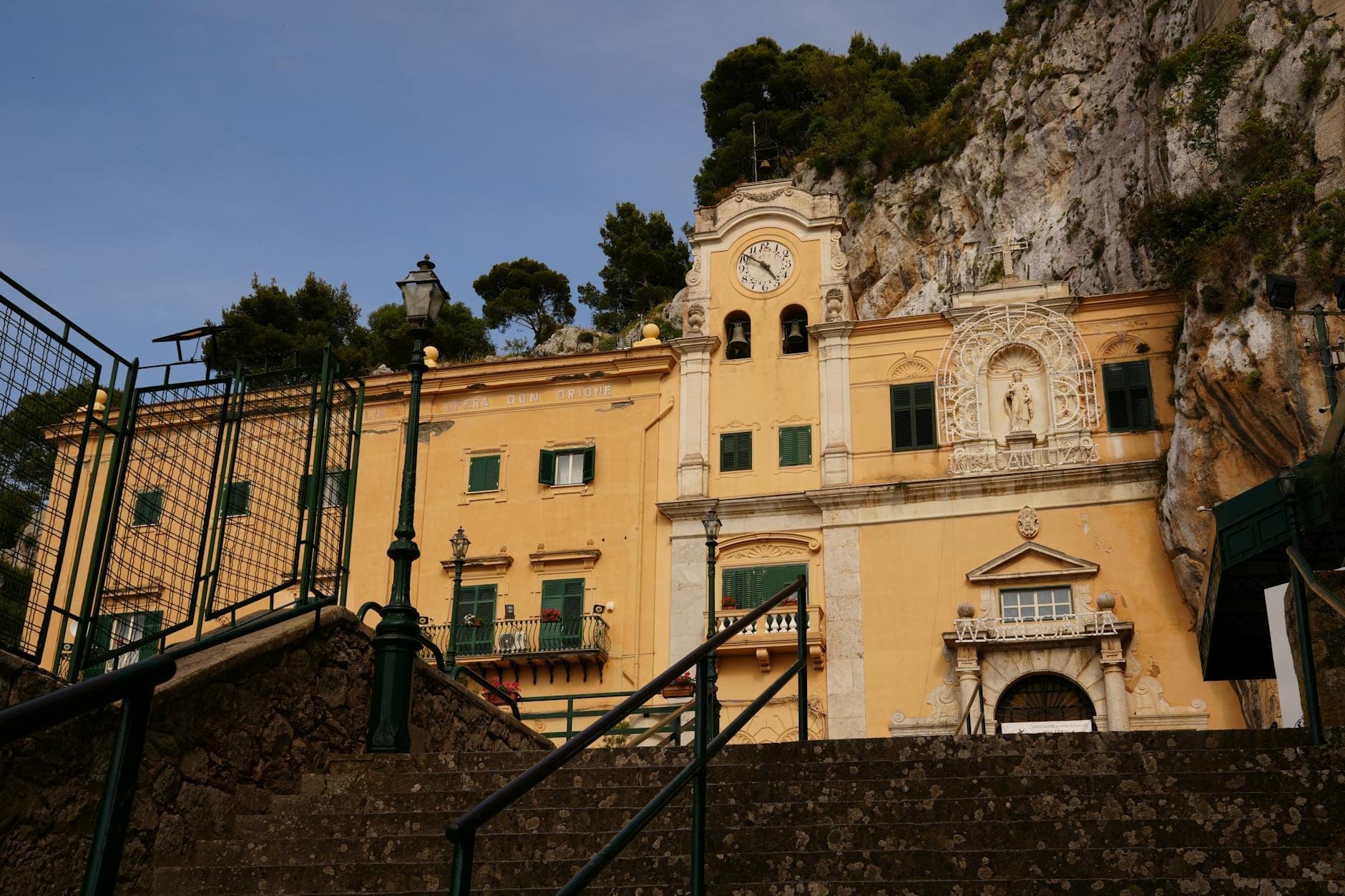
What Is the Sanctuary of Santa Rosalia?
The Sanctuary of Santa Rosalia (Santuario di Santa Rosalia sul Monte Pellegrino) is a cave church built directly inside the limestone grotto on Monte Pellegrino where Saint Rosalia, the patron saint of Palermo, reportedly lived as a hermit and died around 1160 to 1170. Construction began in 1625, the year after her bones were discovered in the cave on 15 July 1624, and the church was completed by 1629. The cave itself extends roughly 25 metres into the rock face, and the small church built at its entrance frames the raw geology with gilded altars, candlelight, and near-constant trickle of spring water dripping from the cave ceiling.
This is not a museum or a tourist monument in the conventional sense. It is an active place of worship visited daily by Palermitani who treat Rosalia less as a historical figure and more as a living protector. You will share the space with elderly women reciting prayers under their breath, families lighting votive candles, and the occasional pilgrim who has walked the footpath barefoot from the city below. The atmosphere is particular: cool, dim, faintly damp, heavy with incense and the sound of dripping water.
ℹ️ Good to know
The sanctuary is open daily approximately 09:00–19:00, with no admission charge. Donations are customary. Verify current hours locally before visiting, as schedules can change around major feast days.
The History Behind the Pilgrimage
Rosalia was a noblewoman of Norman descent who, according to tradition, renounced her aristocratic life in the 12th century to live in isolation on Monte Pellegrino, one of the limestone promontories that rise dramatically from the coast north of Palermo. She is said to have spent her final years in this cave, scratching her name into the rock wall before she died. For centuries after her death, she was venerated locally but had no officially confirmed relics.
The transformation of her cult into city-wide devotion came in 1624, when Palermo was in the grip of a devastating plague epidemic. A sick man reportedly experienced a vision directing searchers to the cave, where bones were soon identified as Rosalia's. The relics were processed through the city, and the plague reportedly subsided within a year. This event sealed her status as Palermo's intercessor and patron. The sanctuary was built almost immediately after, and the annual feast on 4 September draws pilgrims who hike the trail from the city, some completing it barefoot, as an act of devotion.
The story of Santa Rosalia is inseparable from the history of Palermo itself. If you plan to understand the city's layered identity, visiting the sanctuary alongside the Palatine Chapel and Palermo Cathedral gives a far richer picture of how faith, politics, and civic life have overlapped here across centuries.
Tickets & tours
Hand-picked options from our booking partner. Prices are indicative; availability and final rates are confirmed when you complete your booking.
Home Restaurant at Sant'Angelo Muxaro in Agrigento Province
From 60 €Instant confirmationFree cancellationEtna South Upper Craters Guided Excursion from Taormina
From 42 €Instant confirmationFree cancellationTaormina private tour with an expert guide
From 42 €Instant confirmationFree cancellationIsola Bella boat tour and snorkeling
From 55 €Instant confirmationFree cancellation
Inside the Cave: What You Actually See
Entering the sanctuary feels unlike walking into any conventional church. You pass through a modest baroque facade built into the cliff face, then the air shifts immediately: cooler by several degrees even in July, with a mineral dampness that clings to your clothes. The cave ceiling rises unevenly above the nave, raw limestone dripping with moisture that has been channelled into lead pipes and collected in basins below the altar. Locals attribute curative properties to this water, and you will often see people filling small containers to take home.
The interior is small. The church extends only about 25 metres into the rock, and the nave can feel crowded with as few as 30 people. The main altar is positioned against the back wall of the cave, with a gilded statue of Santa Rosalia reclining in a glass-sided reliquary case. Side chapels and niches cut into the cave walls hold ex-votos, silver body parts representing healed ailments, painted panels depicting miraculous interventions, and handwritten notes. These offerings accumulate over generations and give the space a texture that no amount of restoration could produce artificially.
Near the entrance, you can see the groove scratched into the cave wall that is traditionally identified as Rosalia's own inscription. Whether or not the attribution is historically accurate, the worn letters in the stone carry a weight that the baroque ornament alone cannot.
💡 Local tip
Arrive before 09:30 or after 17:00 to find the cave church quieter. The midday window, roughly 11:00–15:00, sees the heaviest visitor numbers, particularly in summer when tour groups arrive from the city.
Getting Up Monte Pellegrino: Your Options
The mountain sits about 445 metres above sea level and roughly 7–8 kilometres from Palermo's historic centre. The easiest route is the bus from Piazza Sturzo, which follows a winding road through pine and macchia scrub to drop passengers near the sanctuary. The road itself offers repeated views of the Conca d'Oro (the fertile plain in which Palermo sits) and the bay beyond, and the bus journey is worth taking slowly if you have a window seat.
Walking is possible via a signed trail used for centuries. The path takes roughly 60 to 90 minutes uphill depending on your pace and the heat. It is rocky in sections and entirely unshaded, which makes it genuinely demanding from June to September when afternoon temperatures regularly exceed 30°C. Serious walkers should start before 08:00 in summer and carry water. The path is not wheelchair accessible, and parts of it require sure footing on loose stone.
If you are combining the visit with a broader exploration of Palermo's hills and coastal scenery, Monte Pellegrino itself is worth treating as a destination rather than just an approach route, with panoramic outlooks over the whole northern coast.
How the Experience Changes by Time of Day
Morning visits carry a particular quality. The light on the coastal drive up is soft, and the cave is cold and almost empty until around 09:30 when the first tour buses arrive. Candles burn from the night before, and the resident priests are often conducting a low Mass. The sound of chanting against dripping water and limestone walls is genuinely striking.
By late morning the sanctuary can feel congested. Tour groups from cruise ships docked at Palermo rotate through in tight sequences, guides speaking over each other in three or four languages while the faithful try to pray at the side altars. The narrow cave acoustics amplify every voice. If this is your only option, patience and a willingness to wait out the groups will eventually reward you with quiet moments.
Late afternoon, roughly 16:30 to 18:30, is arguably the best time. The tour buses are gone, the western light on the bay below is golden, and the cave settles back into something close to its devotional purpose. Many Palermitani who work in the city come up in the early evening, particularly on Saturdays and religious feast days, and their presence gives you a sense of how the sanctuary actually functions in daily life rather than as a tourist destination.
⚠️ What to skip
The sanctuary is inside an active religious site. Photography is generally tolerated but should be done discreetly and not during Mass or moments of private prayer. Modest dress is required: shoulders and knees must be covered. Scarves and wraps are available at the entrance for those who need them.
Photography and Practical Considerations
The cave interior is dark and the available light is almost entirely candlelight and dim artificial spots. A phone camera will struggle without the night mode engaged. If you shoot with a proper camera, a wide lens in the 24–35mm equivalent range works well for capturing the full height of the cave interior; anything longer will feel cramped. The exterior facade against the cliff face, particularly in morning light, photographs clearly and gives a better sense of scale.
The views from the road just below the sanctuary, and from the small terrace above the church, are among the finest in the Palermo area: the full sweep of the bay, the grid of the historic city, and on clear days the coastline stretching toward Mondello. These shots are better in the first hour after sunrise and in the last hour before sunset.
If you want a beach visit after descending from the mountain, Mondello Beach is the closest option, roughly 20 minutes by road from Monte Pellegrino.
Is It Worth Visiting? An Honest Assessment
The Sanctuary of Santa Rosalia is not a showpiece building in the architectural sense. There is no grand nave, no famous ceiling fresco, no collection of world-class paintings. What it offers instead is immediacy: a real cave that a real person is said to have inhabited, with centuries of accumulated devotion pressed into every wax-streaked surface. For travellers interested in how religion actually lives and breathes in a Mediterranean city, rather than how it is displayed in museums, this is one of the most direct examples in southern Italy.
That said, visitors who are primarily interested in art history or baroque architecture will find more to study at the Palatine Chapel or Monreale Cathedral. Visitors with limited mobility should know clearly that the site is not wheelchair accessible, the cave floor is uneven, and the access road on foot involves significant gradient. If neither religious atmosphere nor panoramic views hold much appeal, the detour up Monte Pellegrino may not justify the time.
Those building a full Palermo itinerary might also consider the Catacombs of the Capuchins, which offer a very different but equally intense encounter with the city's relationship to mortality and faith.
Insider Tips
- The water that seeps from the cave ceiling is collected in a basin near the altar. Locals fill small bottles to take home, and asking for some is perfectly accepted. Whether or not you share the belief in its properties, the gesture marks you as someone paying attention.
- The 4 September feast day draws enormous crowds for a nocturnal procession up the mountain. Experiencing it is memorable, but the sanctuary itself is very crowded on that day and the day before.
- The switchback road up Monte Pellegrino passes a small belvedere point about halfway up with a pull-off area. It offers a better unobstructed view of the bay than the terrace at the sanctuary itself, and almost no one stops there.
- On weekday mornings, the cave is sometimes used for private Masses and the main altar may be screened off. Timing around these (roughly 09:00–10:00) means you see the daily rhythms of the church rather than competing with tourism.
- The carved inscription attributed to Saint Rosalia is easy to miss. It is on the left-hand cave wall near the entrance, at roughly shoulder height, partially worn and not heavily signposted. Take a moment to look for it before the altar draws all attention.
Who Is Sanctuary of Santa Rosalia For?
- Travellers interested in active Catholic devotion rather than sanitised religious tourism
- Photographers looking for atmospheric cave interiors and panoramic coastal light
- Visitors who want to understand Palermo's emotional and civic identity beyond its markets and palaces
- Those seeking cool, quiet respite from the city heat in summer
- History-minded travellers tracing Norman-era Sicily and the roots of its saint veneration
Nearby Attractions
Other things to see while in Palermo:
- Ballarò Market
Stretching through the Albergheria district from Piazza Ballarò to Corso Tukory, the Mercato di Ballarò is Palermo's oldest continuously operating street market, with roots tracing back over a thousand years to Arab rule. It is free to enter, open daily, and unlike anything else in Sicily for raw atmosphere, local produce, and street food.
- Catacombs of the Capuchins
Below a quiet convent on the western edge of Palermo's historic centre, the Catacombs of the Capuchins hold one of the most extraordinary collections of preserved human remains anywhere in the world. Around 2,000 mummified bodies and skeletons line stone corridors carved from tuff rock, dressed in period clothing and arranged by profession, gender, and social status. It is an intimate, unsettling, and genuinely thought-provoking encounter with how a Mediterranean culture once confronted death.
- Church of the Martorana
Built in 1143 by a Norman admiral and decorated by craftsmen from Constantinople, the Church of the Martorana contains some of the most important Byzantine mosaics in the western Mediterranean. It sits on Piazza Bellini in Palermo's historic center, part of a UNESCO World Heritage site, and rewards visitors who arrive early and look up.
- La Kalsa
La Kalsa is Palermo's oldest neighborhood, founded by Arab rulers in the 9th century as the city's administrative heart. Today it is a layered district of crumbling palazzi, Baroque churches, art-filled piazzas, and some of Palermo's most atmospheric street life. Free to explore and walkable in half a day, it rewards those who slow down.