Santuario di Nostra Signora di Bonaria: Cagliari's Hilltop Sanctuary
Rising above Cagliari's southern harbour on the Colle di Bonaria, the Santuario di Nostra Signora di Bonaria is the island's most venerated religious site. A Gothic-Catalan church dating to the first half of the 14th century sits alongside a Baroque basilica begun in the early 18th century, together forming a complex that draws pilgrims, architecture enthusiasts, and curious travellers in roughly equal measure. Entry is free.
Quick Facts
- Location
- Piazza Bonaria 2, Cagliari, Sardinia — on the Colle di Bonaria, southeast of the city centre
- Getting There
- Accessible via Viale Bonaria; CTM city buses, including lines such as M and PF, serve the area. The hill overlooks the harbour near su Siccu.
- Time Needed
- 45–90 minutes for the church, basilica, and a walk around the terrace
- Cost
- Free admission
- Best for
- History, religious heritage, architecture, and views over Cagliari's harbour
- Official website
- www.cagliariturismo.it
What Is the Santuario di Bonaria?
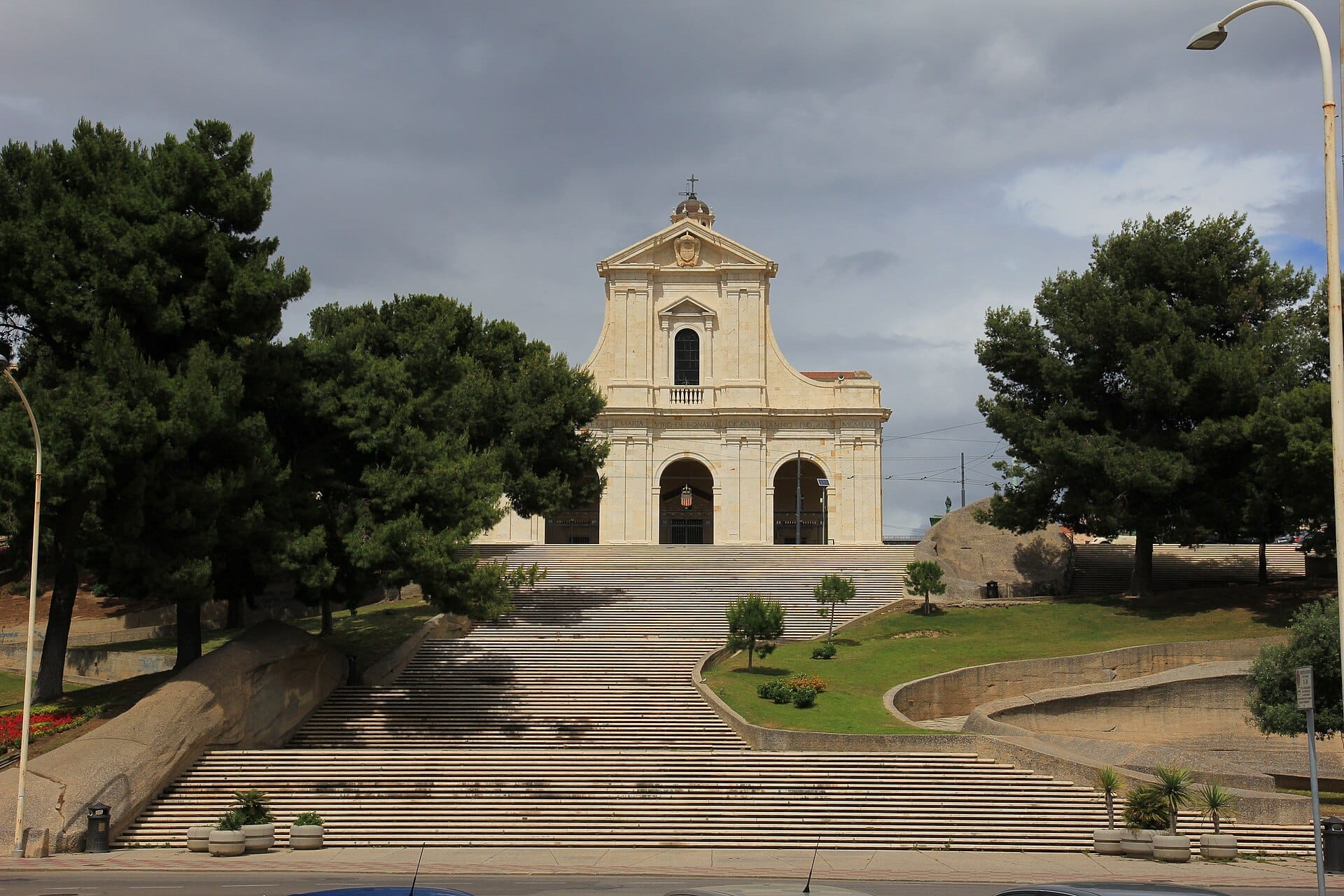
The Santuario di Nostra Signora di Bonaria is a dual-church complex perched on a low but commanding hill at the southeastern edge of Cagliari's urban fabric. The older of the two structures is a 14th-century Gothic-Catalan church, one of the finest surviving examples of that architectural style in Sardinia. Attached to it is a larger Baroque basilica, construction of which began in the early 18th century and which was elevated to the status of minor basilica by the Vatican in 1926. Together they form a pilgrimage destination of national significance.
The site is also, quietly, a place of considerable maritime history. Cagliari was long a port city under various Mediterranean powers, and the sanctuary's hilltop position, directly above the working harbour, gave it a role as both a spiritual landmark and a navigational reference point for sailors approaching from the sea.
ℹ️ Good to know
Opening hours as reported: daily 6:30–11:45 and 16:30–19:30 on weekdays, and 6:30–12:30 and 16:30–20:00 on Sundays and feast days. Hours may vary on religious feast days — check locally before visiting. Admission is free.
Historical Context: From Aragonese Conquest to Minor Basilica
The origins of the sanctuary are tied directly to the Aragonese conquest of Sardinia. In 1323–1325, the Aragonese forces under the Infante Alfonso established a fortified camp on the Colle di Bonaria, and the Gothic-Catalan church dates to the first half of the 14th century, during this early period of their control over the island. The architectural vocabulary is immediately legible: pointed arches, restrained stone carving, and a compact single-nave interior that reflects the austere mendicant style common to the Iberian Gothic tradition of the era.
Tradition holds that in 1370, a ship in distress off the Sardinian coast jettisoned its cargo to survive a storm. A wooden crate washed ashore and was found to contain a statue of the Madonna with a candle burning beside it — the flame still lit despite its time at sea. This statue, known as the Madonna di Bonaria, became the object of intense local veneration and remains in the sanctuary today. The story is almost certainly legendary in its details, but it established the site's identity as a protector of sailors, a reputation it holds to this day.
The connection to Christopher Columbus is sometimes mentioned in guides: Columbus visited Cagliari before his 1492 voyage and is said to have prayed at the sanctuary. Whether or not that tradition is historically documented, it explains why the island in the Americas named La Española — later Hispaniola — and, separately, the name "Buenos Aires" in Argentina are sometimes linked etymologically to Bonaria in devotional traditions. The Argentine capital's name is thought to derive from the sailors' devotion to the Madonna di Bonaria.
The broader context of Cagliari's layered history is worth understanding before you visit. The Castello district, the medieval fortified quarter above the city, is also heavily shaped by Aragonese and Catalan influence, and the two sites make natural companions on the same day.
Tickets & tours
Hand-picked options from our booking partner. Prices are indicative; availability and final rates are confirmed when you complete your booking.
Vineyard Guided Tour and 7 Wine Tasting in Palau
From 84 €Instant confirmationFree cancellationFull-Day Sailboat Tour in La Maddalena Archipelago from Cannigione
From 112 €Instant confirmationFree cancellationHiking excursion to the Devil's Saddle
From 35 €Instant confirmationFree cancellationExcursion to the Archaeological site of Nora
From 70 €Instant confirmationFree cancellation
What You Actually See: The Two Churches
Entering the complex from Piazza Bonaria, you encounter the two buildings side by side, and the contrast is instructive. The original 14th-century Gothic-Catalan church is relatively modest in scale — a single-nave structure with a simple stone facade and a rose window above the entrance portal. The interior is dim and cool, the walls lined with votive offerings: model ships, photographs, crutches, and small plaques left by sailors and their families over centuries. This accumulation of objects is one of the more affecting things about the space. It is not a museum; it is a room still actively in use.
The Madonna di Bonaria statue is housed here, set in a place of honour at the altar. The statue itself is wooden and relatively small, the kind of medieval carved figure that rewards close attention rather than dramatic presentation. The light inside the old church is subdued even on a bright day, and the smell of candle wax and old stone is present throughout.
The adjacent Baroque basilica, begun in 1704, is considerably larger and unfinished in its facade — a characteristic it shares with several Sardinian churches that ran out of funds or political momentum before completion. The interior is tall and airy, with side chapels and a painted ceiling, representing a different moment in the island's religious and architectural history. The visual shift between the two buildings, walking from one to the other, is one of the more interesting small experiences the complex offers.
💡 Local tip
Dress code applies in both buildings: shoulders and knees must be covered. Scarves and wraps are sometimes available at the entrance, but bringing your own is more reliable.
The Terrace and the View
The Colle di Bonaria is not especially high, but it rises sharply enough above the harbour to give unobstructed views across the Gulf of Cagliari. From the terrace outside the basilica, you look directly over the ferry terminal and the working port, with the water stretching south toward the horizon. On clear days, the Sella del Diavolo headland to the west closes the gulf in a sharp promontory of limestone.
This is a good viewpoint, and it is far less crowded than the more tourist-visited elevated areas of the city. The Bastione di Saint Remy in the Castello district draws larger crowds for its panoramic terrace; the Bonaria terrace is quieter and faces a different compass direction, making it a complementary rather than competing viewpoint.
Early morning is a particularly rewarding time to be here. The light comes from the east and falls directly onto the harbour, the water catches it in a way that it does not at midday, and the piazza in front of the churches is largely empty. By mid-morning, tour groups and pilgrims begin to arrive, and by midday in summer the heat on the open terrace can be punishing.
Practical Walkthrough: How to Visit
Access to the complex is via Piazza Bonaria, reached from Viale Bonaria, one of Cagliari's main arterial roads. CTM city buses serve this corridor. The hill is not steep enough to make walking from the harbour area difficult, but there is a long staircase descending from the sanctuary toward the marina and su Siccu, which connects the site visually and physically to the working waterfront below. Note that this staircase may not be suitable for travellers with mobility limitations.
The complex is free to enter. Both churches can be visited in under an hour if you are moving at a moderate pace; allow longer if you want to spend time with the votive offerings, the statue, or the Baroque interior's side chapels. There is a small museum associated with the sanctuary that holds additional votive objects and historical material — worth checking for current opening status on arrival.
If you are combining this with a broader day in Cagliari, the sanctuary pairs naturally with a walk through the city's lower harbour area and the salt lagoon at Parco Molentargius, which sits just east of the city and is visible from the hill on a clear day.
⚠️ What to skip
The sanctuary is an active place of worship. Religious services take place regularly, and the complex can be closed to general visitors during Mass. Check current times before planning a tight itinerary around the visit.
Photography Notes
Photography is generally permitted in the outdoor areas and from the terrace. Inside the churches, exercise discretion — photography during services is inappropriate, and flash photography is best avoided entirely in the old Gothic-Catalan church, both out of respect and because the artificial light does little for the medieval interior anyway.
The most interesting photographic subjects are the votive offerings in the old church (atmospheric in low natural light), the architectural contrast between the two facades viewed from directly in front of the complex, and the harbour panorama from the terrace. Late afternoon light is better for the facade; early morning is better for the harbour view.
Who Should Skip This
Travellers with no interest in religious architecture or history and who are pressed for time in Cagliari will find more immediately spectacular return from the Castello district or the archaeological museum. The sanctuary's appeal is relatively quiet and cumulative — it rewards attention rather than delivering a single dramatic spectacle.
Visitors specifically interested in Sardinia's ancient pre-Roman past will find more relevant material at the Museo Archeologico Nazionale di Cagliari, which holds the island's most significant collection of Nuragic and Phoenician artefacts. The sanctuary's historical significance begins in the 14th century and has little overlap with that older layer of Sardinian history.
Insider Tips
- Visit on a weekday morning, ideally Tuesday to Thursday, when the complex is at its quietest. Weekend mornings bring organised pilgrimage groups and the ambience inside the old church changes considerably.
- The staircase descending from the hill toward the marina is one of the better-kept secrets of the complex. Walk down it after your visit for an unusual perspective on the harbour and the city's relationship with the sea.
- The unfinished Baroque facade is often overlooked in favour of the older Gothic church. Stand back and look at both buildings together from the far side of Piazza Bonaria — the architectural discontinuity between them tells the story of the site's history more clearly than any caption.
- If you visit during the Festa di Nostra Signora di Bonaria on 24 April, you will encounter one of Cagliari's most significant religious processions. The city's relationship with the Madonna di Bonaria is deep, and the atmosphere is entirely different from a regular visit.
- The terrace view is best in the hour after sunrise. The ferry traffic in the harbour below starts early, and watching the large ferries manoeuvre out of port with the early light on the water is a reminder that this is still a working maritime city.
Who Is Santuario di Nostra Signora di Bonaria For?
- Travellers interested in medieval Gothic-Catalan architecture in its Sardinian context
- Pilgrims and those with an interest in active places of Catholic devotion
- History-focused visitors exploring Cagliari's Aragonese and maritime past
- Photographers looking for a quiet elevated viewpoint over the harbour away from the main tourist areas
- Visitors who want to understand Cagliari as a layered city rather than just a gateway to beaches
Nearby Attractions
Other things to see while in Cagliari:
- Anfiteatro Romano di Cagliari
The Roman Amphitheatre of Cagliari is the most significant Roman monument in Sardinia, partially carved into the limestone hillside of Colle di Buoncammino. With a capacity estimated at 10,000 spectators, it dates to the late 1st or early 2nd century AD. Ongoing restoration limits what you can explore, but the scale of the structure and its setting repay the modest entrance fee.
- Bastione di Saint Remy
Standing at the southern edge of the Castello district, the Bastione di Saint Remy is a monumental Belle Époque terrace that offers some of the most commanding views in Cagliari. Free to enter and, as a public terrace, generally accessible at all hours, it rewards visitors who time their ascent right — especially at dusk, when the city lights begin to compete with the last colour in the sky.
- Castello District
Perched about 100 metres above sea level on a fortified limestone hill, the Quartiere Castello is the oldest and most historically layered part of Sardinia's capital. Enclosed by 13th-century Pisan walls, it holds the city's cathedral, major museums, and some of the best rooftop views in the Mediterranean. Entry is free, and the streets can be walked at any hour.
- Cattedrale di Santa Maria (Cagliari)
Rising above the Castello quarter on Piazza Palazzo, the Cattedrale di Santa Maria e Santa Cecilia is Cagliari's most important religious monument. First documented in the mid‑13th century and remodelled across several centuries, it layers Pisan Romanesque, Gothic, Baroque, and Neo-Romanesque styles into a single compelling structure. Entry is free, and the interior rewards anyone willing to look closely.