Basilica di Santa Maria in Trastevere: Rome's Golden Mosaic Church
Standing at the heart of Rome's most characterful neighborhood, the Basilica di Santa Maria in Trastevere is widely considered the oldest church in Rome dedicated to the Virgin Mary. Its 12th-century apse mosaics rank among the finest medieval art in the city, and the piazza in front is one of the few public squares in Rome that genuinely rewards sitting still.
Quick Facts
- Location
- Piazza di Santa Maria in Trastevere, Trastevere, Rome
- Getting There
- Bus 23 or 280 to Lungotevere; walk via Piazza Belli and Via della Lungaretta (~10 min)
- Time Needed
- 45–90 minutes inside; longer if you linger in the piazza
- Cost
- Free entry
- Best for
- Medieval art lovers, history seekers, evening atmosphere
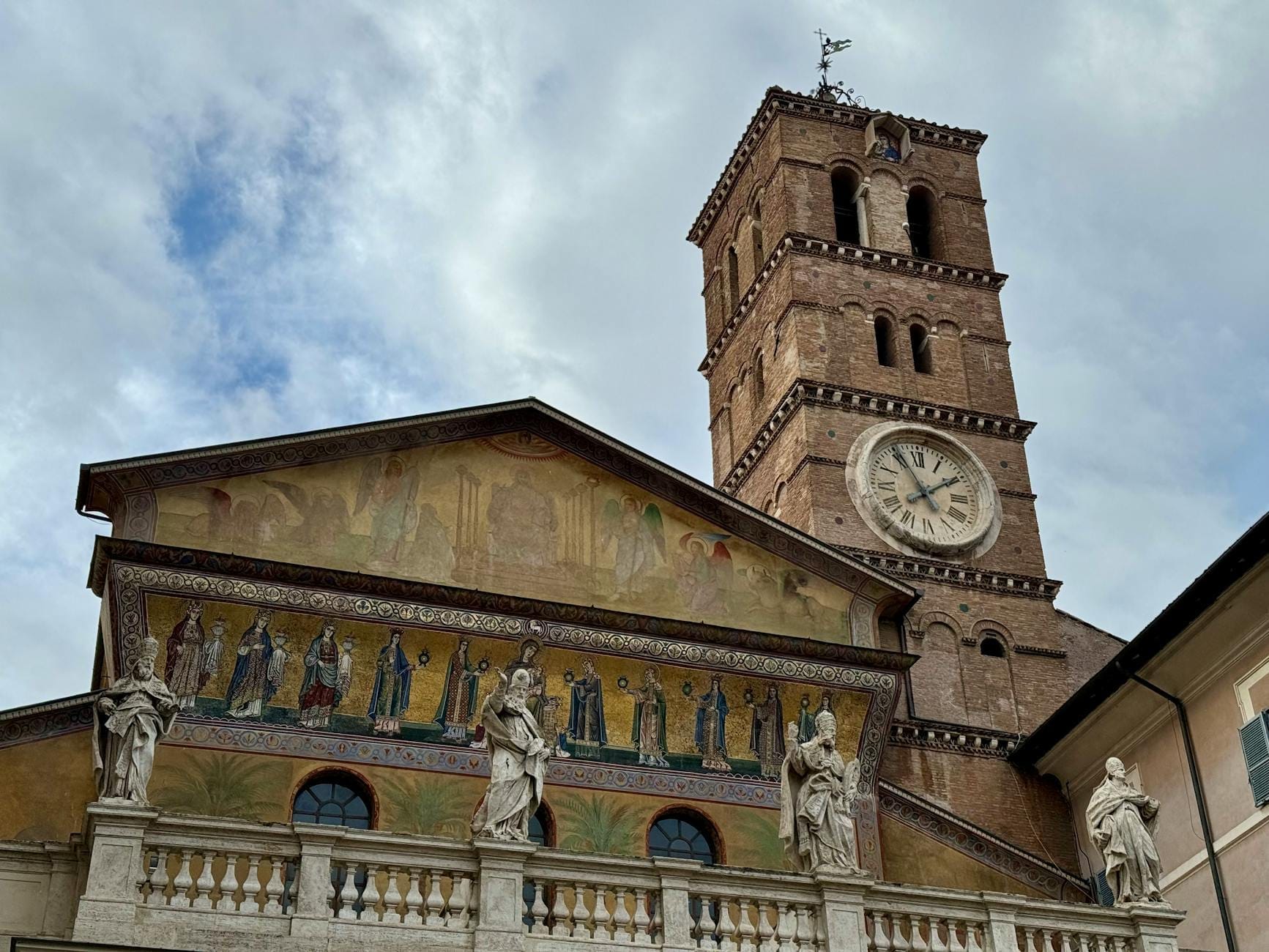
What the Basilica di Santa Maria in Trastevere Actually Is
The Basilica di Santa Maria in Trastevere is not a minor parish church dressed up for tourists. It is, by most historical accounts, the first church in Rome where Christians were permitted to worship openly, and possibly the first in the city formally dedicated to the Virgin Mary. That gives it a weight that older-looking but actually younger churches elsewhere in Rome cannot match.
According to tradition, Pope Callistus I established a place of worship on this site in the early 3rd century. The first proper church building followed under Pope Julius I around 340 AD. What you see today, however, is primarily the result of a major reconstruction between 1139 and 1148 commissioned by Pope Innocent II, himself a native of Trastevere. The columns lining the nave, 21 of them in granite and marble, were salvaged directly from the Baths of Caracalla, giving the interior a sense of Roman history folded inside Christian history.
The facade mosaic, depicting the Virgin flanked by ten figures (traditionally interpreted as the Wise and Foolish Virgins), prepares you for what's inside. For deeper context on how this church fits into Rome's broader sacred landscape, the best churches in Rome guide covers the city's most significant religious buildings in one place.
The Mosaics: What to Look at and Why They Matter
The apse mosaics are the reason most people make the effort to come here, and they justify the trip completely. The upper register, dating from around 1148, shows Christ and the Virgin enthroned together, surrounded by saints and Pope Innocent II himself. The gold ground catches even weak morning light and intensifies dramatically when the interior lamps are on in the afternoon and early evening.
Directly below that, a cycle of six scenes depicting the Life of the Virgin was added by Pietro Cavallini around 1291. Cavallini's work is significant in art history: his figures show a naturalism and emotional weight that prefigures the revolution Giotto would complete in the following decade. The robes have actual folds. The faces show grief and tenderness rather than symbolic blankness. For anyone with even a passing interest in how Western painting evolved, standing in front of these panels is a specific and worthwhile experience.
💡 Local tip
Bring a small pair of binoculars or use your phone's zoom function. The Cavallini mosaic panels are high up and the details — particularly the facial expressions — reward magnification that the naked eye at floor level cannot easily achieve.
The interior also contains a Cosmati pavement, the geometric inlaid marble floor popular in medieval Roman churches. This one is well-preserved and worth a few minutes of attention at floor level before you lift your eyes to the apse. The gilded ceiling, added by Domenichino in the early 17th century, features a central panel depicting the Assumption and introduces a later Baroque register that sits somewhat awkwardly against the medieval mosaics — though not unpleasantly so.
Tickets & tours
Live prices and dates from our booking partner. If you book, we may earn a commission at no extra cost to you.
Santa Maria Maggiore Dome entrance ticket with downloadable audioguide
From 26 €Instant confirmationFree cancellationBasilica of Santa Maria Maggiore audio tour and skip-the-line ticket
From 15 €Instant confirmationFree cancellationSanta Maria Maggiore Basilica audio guide and Underground entry ticket
From 30 €Instant confirmationFree cancellationSanta Maria Maggiore and panoramic dome entry ticket
From 22 €Instant confirmationFree cancellation
The Piazza: Morning Quiet Versus Evening Life
Piazza di Santa Maria in Trastevere, the square directly in front of the church, is one of the more honest piazzas in Rome. It has a functioning octagonal fountain at its center, attributed in its current form to Carlo Fontana and Gian Lorenzo Bernini in the 17th century, and the space around it belongs to the neighborhood at all hours rather than only to tourists.
Early morning, around 8 to 9am, the piazza belongs almost entirely to locals: elderly residents crossing it on the way to the market, delivery workers unloading at the cafes, cats occupying the fountain steps. The church itself is quiet at this hour, and the light coming through the west-facing windows of the facade is soft. This is the best time to spend inside without crowds, though you should check locally that the church is open before visiting at this hour, as times may vary.
By early evening, roughly from 6pm onward, the piazza transforms. The fountain steps fill with younger visitors and groups of friends who have come to Trastevere for dinner. Street musicians sometimes appear. The restaurants around the square push their tables outward. The church facade, lit from below, turns the gold of the mosaic figures into something genuinely theatrical. Coming back to look at the facade after dark, from across the square with a glass of something, is one of the more memorable small pleasures this neighborhood offers.
Trastevere as a whole repays extended exploration beyond the church itself. The Trastevere neighborhood guide covers the surrounding streets, dining options, and what else to see in the area.
Practical Walkthrough: Getting In and Moving Around
There is no ticket desk and no queue. Entry is free. You walk in through the main portal on the piazza, and the scale of the nave hits you immediately. The columns from the Baths of Caracalla create a procession that draws the eye directly toward the apse, which is exactly what they were intended to do.
The church is used for regular worship, so visiting during a Mass means observing quietly from the sides rather than moving freely to photograph the apse. Check the current Mass schedule by contacting the church directly at 06 5814802. Outside of services, movement inside is unrestricted.
⚠️ What to skip
Dress code applies. Shoulders and knees must be covered to enter, as with all functioning churches in Rome. The rule is enforced at the door. Bring a scarf or light layer if you're visiting in summer.
The most direct public transport route is Bus 23 or 280 from the area near Piazza della Rovere, alighting on the Lungotevere. From there, follow the river south to Piazza Belli, then turn right onto Viale di Trastevere and right again on Via della Lungaretta, which leads directly to the piazza. The walk from the bus stop takes about ten minutes. Trastevere is not served by Metro, so buses are the standard option.
If you're planning a full day in the area, the Baths of Caracalla — the source of many of the columns inside this basilica — are reachable from Trastevere on foot or by a short bus ride, and make for a logical complement to the visit.
Photography and Sensory Details
The interior is darker than most visitors expect. The apse mosaics glitter because they catch available light and lamplight, not because the room is bright. Wide-angle lenses or a phone with good low-light performance will give better results than a standard camera flash, which the space will not allow anyway. The best angle for capturing the full apse is from the central nave, roughly two-thirds of the way back from the altar, where the proportions align clearly.
The smell of the interior is characteristic of old stone churches: cold marble, candlewax, and a faint trace of incense that has settled into the walls over centuries. The acoustics are strong, and any sound carries. On quieter mornings you can hear footsteps from quite a distance. In the evening with a few dozen visitors present, there is a low collective murmur that the medieval builders clearly didn't plan for, but which the space absorbs with some dignity.
Who Should Temper Their Expectations
The Basilica di Santa Maria in Trastevere is not a comprehensive museum experience. There are no audio guides available at the door, no extensive labeling, and no gift shop. Visitors who need interpretive scaffolding to appreciate historical art may find the visit frustrating without preparation. Reading about Pietro Cavallini before you go makes a measurable difference to what you take away.
Those visiting solely for the Trastevere neighborhood atmosphere should know that the church and the piazza are genuinely different experiences. The piazza is accessible and enjoyable at any hour without entering the church at all. The church itself asks for some patience and a willingness to stand quietly and look upward. It rewards that patience considerably, but it won't announce itself to visitors who pass through quickly.
If your priority is Rome's most significant religious architecture across the city, it's worth reading about the Basilica of San Giovanni in Laterano and Santa Maria Maggiore alongside this visit. All three are ancient basilicas with distinct characters and together represent the breadth of Rome's early Christian heritage.
Insider Tips
- Visit on a weekday morning between 9 and 11am for the fewest other visitors inside. Weekend evenings can make quiet contemplation of the mosaics nearly impossible.
- The fountain steps in the piazza are a legitimate place to sit and have a coffee from the surrounding cafes, though technically the fountain is not a picnic area. The atmosphere is relaxed and enforcement is minimal.
- The side entrance on Via della Paglia (postal address of the church) is less trafficked and can be useful if the main piazza entrance has a brief bottleneck during busy periods.
- The Cavallini mosaic cycle is chronologically later than the upper apse mosaics, but visually subordinate because of its position. Spend time specifically on it rather than letting your eye be dominated by the gold ground above.
- In summer, the interior is noticeably cooler than the street outside. The thermal contrast when you step in from a hot afternoon is immediate and welcome. Plan a midday visit in July or August accordingly.
Who Is Basilica di Santa Maria in Trastevere For?
- Art history enthusiasts interested in the transition from Byzantine to proto-Renaissance mosaic work
- Travelers making a full Trastevere half-day who want cultural depth alongside the neighborhood's food and cafe scene
- Visitors looking for significant free attractions in Rome without queues or booking requirements
- Photographers drawn to interior sacred spaces with dramatic gold-ground mosaics
- Anyone who wants to experience a genuinely neighborhood-embedded Roman piazza at different times of day
Nearby Attractions
Other things to see while in Trastevere:
- Gianicolo Hill
Rising above Trastevere on the city's western edge, Gianicolo Hill (Colle del Gianicolo) delivers what many argue is the finest 180-degree view of Rome's skyline, entirely free. Beyond the panorama, the hill holds Risorgimento monuments, a 17th-century fountain, and Bramante's celebrated Tempietto, all connected by a shaded promenade that rewards those willing to leave the crowds below.
- Porta Portese Flea Market
Every Sunday morning, over a thousand stalls spread across nearly two kilometers of Trastevere streets, selling everything from vintage clothing to old coins, tools, and curiosities. Mercato di Porta Portese is Rome's largest and most storied flea market, and it rewards early risers willing to dig.
- Villa Farnesina
Villa Farnesina is a 16th-century Renaissance villa in Trastevere housing some of the finest frescoes in Rome, including Raphael's celebrated Galatea and the luminous Loggia of Psyche. Smaller and quieter than the Vatican Museums, it offers a rare chance to stand inside rooms that have barely changed since a Sienese banker commissioned the greatest artists of the High Renaissance to decorate them.
Planning a trip? Discover personalized activities with the Nomado app.