Villa Farnesina: Rome's Most Intimate Renaissance Masterpiece
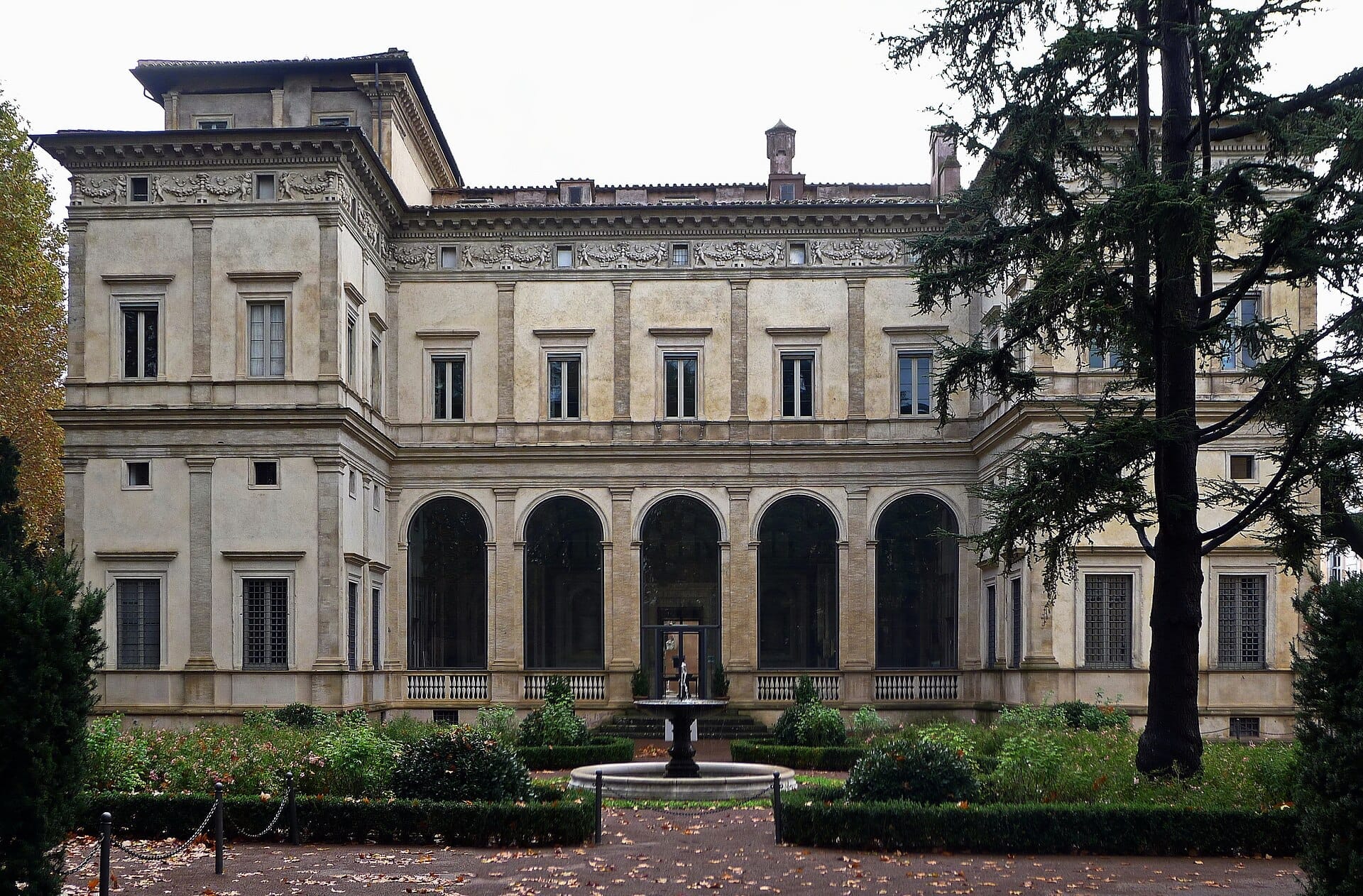
Villa Farnesina is a 16th-century Renaissance villa in Trastevere housing some of the finest frescoes in Rome, including Raphael's celebrated Galatea and the luminous Loggia of Psyche. Smaller and quieter than the Vatican Museums, it offers a rare chance to stand inside rooms that have barely changed since a Sienese banker commissioned the greatest artists of the High Renaissance to decorate them.
Quick Facts
- Location
- Via della Lungara 230, Trastevere, Rome
- Getting There
- No direct metro. Take tram 8 to Trastevere or walk across Ponte Sisto from Centro Storico (10-15 min on foot).
- Time Needed
- 1 to 1.5 hours for the villa; add 30 minutes for the gardens
- Cost
- Paid entry — verify current prices at villafarnesina.it before visiting
- Best for
- Art history lovers, Renaissance architecture, anyone seeking a crowd-free alternative to the Vatican Museums
- Official website
- www.villafarnesina.it/en
What Villa Farnesina Actually Is
Villa Farnesina is not a palazzo in the Roman sense — it was designed specifically as a suburban pleasure villa, built between 1506 and 1510 by the Sienese architect Baldassare Peruzzi for Agostino Chigi, the wealthiest private banker in Renaissance Europe. Chigi financed popes and princes, and he spent accordingly. He hired Raphael, Sebastiano del Piombo, Sodoma, and Peruzzi himself to cover the interior rooms with frescoes that read like a confident declaration: this is what money and taste look like when they arrive at the same moment.
The villa passed to the Farnese family in 1579 — hence the name — and eventually became state property in 1927. Since 1944 it has housed the Accademia dei Lincei, one of Italy's oldest scientific institutions. That institutional use has kept it off the standard tourist circuit, which works entirely in your favor. On most mornings, you can move through Raphael's frescoes with only a handful of other visitors present.
💡 Local tip
Check the official website for current opening hours and admission prices before you visit. Hours have varied seasonally and the villa occasionally closes for institutional events.
The Loggia of Psyche: Raphael's Open-Air Illusion
You enter through the ground-floor loggia that faces the garden, and the ceiling stops you immediately. Raphael designed the Loggia of Psyche to look like a garden pergola open to the sky, with painted swags of fruit and vegetables hanging between the narrative scenes above. The fiction is almost convincing. Figures from the myth of Psyche and Cupid stretch across the vault in scenes of extraordinary physical confidence — Raphael's workshop, working from his designs, filled the space in 1517.
The colors are warmer than you might expect after seeing reproductions. The blues have faded toward a soft gray-green, which gives the room an aged warmth that photographs never capture. Mornings with diffuse light through the original arched openings are the best condition for reading the individual scenes. By midday, when tour groups from nearby hotels occasionally pass through, the loggia can feel briefly crowded — but it empties quickly.
Tickets & tours
Live prices and dates from our booking partner. If you book, we may earn a commission at no extra cost to you.
The Sala di Galatea: One of the Greatest Frescoes in Rome
The adjacent Sala di Galatea contains the fresco Raphael considered among his finest achievements. The Triumph of Galatea, painted around 1512, shows the sea-nymph racing across the water on a shell chariot pulled by dolphins, surrounded by sea creatures and wind gods. The composition is circular and self-contained, drawing the eye continuously inward. Raphael described his artistic goal in a letter as depicting an ideal figure beyond what he saw in nature — and this painting is the clearest evidence of what he meant.
The same room contains a large head of Polyphemus by Sebastiano del Piombo, painted in direct competition with Raphael's panel. Comparing the two within a single glance is an art history seminar compressed into a moment. For context on how Rome's Renaissance painting scene fits into the city's broader cultural landscape, the best museums in Rome guide covers where the Farnesina sits relative to other major collections.
Look also at the lunettes above the main fresco: Peruzzi painted landscape panels that read as windows onto the Roman countryside, a trompe-l'oeil device he would develop further on the upper floor. The technique is easy to miss if you are focused on the Galatea, but it rewards a second look.
The Upper Floor: Peruzzi's Perspective Room and Sodoma's Bedchamber
The staircase to the upper floor leads to the Sala delle Prospettive, Peruzzi's masterwork in painted illusion. The entire room is designed to look like an open colonnade overlooking Rome: columns painted with such precision that the floor appears to extend beyond the walls, and between the columns you see views of 16th-century Rome — the Tiber, the Janiculum, the city's rooftops. It is one of the most sophisticated exercises in architectural illusionism in European painting, and it exists in a room that sees a fraction of the visitors who queue for the Sistine Chapel.
Off this room is the Camera delle Nozze di Alessandro e Rossane, frescoed by Sodoma around 1519. The subject is Alexander the Great and his bride Roxane, and Sodoma's figures have a fluid, almost melancholic elegance quite different from Raphael's physical confidence. The bedroom setting was deliberate: Chigi himself married in this villa, and the choice of Alexander as the wedding theme was a characteristically Renaissance piece of flattery toward a wealthy patron.
ℹ️ Good to know
Photography is generally permitted inside the villa without flash, but confirm the current policy at the entrance, as rules are subject to change.
The Gardens and the Aurelian Wall
The gardens behind the villa are a genuine addition to the visit, not an afterthought. The grounds include sections of the Aurelian Walls, the 3rd-century defensive circuit built under Emperor Aurelian from 271 AD, which rise up to 6.5 meters in places along the property boundary. Walking along them from the garden side gives a perspective on Roman infrastructure that most visitors only see from the road. The garden itself contains botanical specimens and archaeological fragments arranged without much drama — it is a quiet, slightly overgrown space that suits the villa's character. Trastevere's residential streets just outside the walls make the whole setting feel a long way from the tourist center, even though you are five minutes' walk from the river.
When to Visit and How to Get There
The villa is on Via della Lungara, the long straight road running along the Tiber's west bank through Trastevere. The easiest approach from the historic center is to walk across Ponte Sisto, the 15th-century pedestrian bridge just south of Campo de' Fiori, then follow the river north for about five minutes. The walk through the neighborhood on the way adds context: the streets around the Farnesina are quieter and more residential than the tourist-heavy southern end of Trastevere.
If you prefer public transit, tram 8 connects Trastevere with Largo di Torre Argentina in the center. From the tram stop it is a 10-minute walk north along Via della Lungara. There is no metro station within easy walking distance. For a broader plan of how to move around the city, getting around Rome by public transit covers routes and ticketing clearly.
Mornings are consistently better than afternoons. The light in the loggia comes from the garden side and is most useful in the first hours the villa is open. Afternoons can feel slightly flat. April through June and September through October offer the most comfortable temperatures for walking between Trastevere and the surrounding sights, and crowds inside the villa remain manageable compared to peak summer months.
⚠️ What to skip
The villa occasionally closes for academic events hosted by the Accademia dei Lincei. Check the official website in advance, especially if you are visiting on a weekday.
Practical Notes: What to Know Before You Go
The interior rooms are not large, and the frescoes are at ceiling height in several rooms, so craning upward is unavoidable. Comfortable shoes matter less here than at outdoor sites, but the garden ground is uneven. The villa is not designed for rapid visits — rushing through in 20 minutes is possible but defeats the purpose. Budget an hour at minimum, longer if you want to read the iconography of the Loggia of Psyche carefully.
Visitors with serious mobility limitations should check accessibility conditions directly with the villa, as the upper floor is reached by a staircase. If you are building a full day in this part of Rome, the Farnesina pairs naturally with Santa Maria in Trastevere, the neighborhood's ancient basilica, and with a walk along the Janiculum ridge above. For anyone planning a wider art itinerary, the Galleria Borghese in the Villa Borghese area represents the other great concentration of Renaissance and Baroque art in a non-museum setting — a useful comparison point.
There is no cafe inside the villa. The area around Via della Lungara has a small number of bars and trattorias, but nothing immediately adjacent. Plan to eat before or after in the southern part of Trastevere, where the options multiply considerably.
Who Will Not Enjoy This Visit
Travelers primarily drawn to scale and spectacle may feel underwhelmed. Villa Farnesina is intimate by design — there is no grand sequence of halls, no enormous sculpture collection, no gift shop packed with reproductions. If your Rome itinerary is already dense with major sites, it can feel like a detour that requires justification. Those on a single-day visit who haven't yet seen the Colosseum, the Roman Forum, or the Vatican Museums should probably prioritize those first. The Rome in 3 days itinerary can help you decide where this fits relative to your other plans.
Families with young children may find the visit challenging to sustain unless the children have a specific interest in paintings. The rooms are not interactive, there are no audiovisual displays, and the iconography of the frescoes requires explanation to hold attention. That said, the garden gives children space to move, and the painted columns of the Sala delle Prospettive tend to produce genuine surprise even in visitors who are not expecting to be impressed.
Insider Tips
- Arrive within the first 30 minutes of opening. The loggia light is best then and the rooms are quietest. By mid-morning, even small groups of visitors make the space feel tight.
- Bring a small pair of binoculars if you own them. The ceiling details in the Loggia of Psyche — especially the individual fruits in the hanging swags — are worth examining closely and are too high for comfortable naked-eye inspection.
- The Sala delle Prospettive on the upper floor is the room most visitors spend the least time in. Spend the most. Stand in the center and rotate slowly: the painted colonnade holds its illusion at almost every angle.
- After the villa, walk north on Via della Lungara for two minutes to see the exterior of Palazzo Corsini, which houses part of the National Gallery of Ancient Art — a separate visit, but worth noting the building.
- If you are visiting in late morning, the walk south through Trastevere toward Piazza Santa Maria in Trastevere takes about 10 minutes and gives you one of Rome's most photogenic medieval piazzas as a natural endpoint before lunch.
Who Is Villa Farnesina For?
- Art history enthusiasts who want to see Raphael's frescoes without the crowds of the Vatican
- Architects and design professionals interested in Renaissance spatial illusionism
- Slow travelers who prefer depth over volume and are happy to spend an hour in a single building
- Repeat visitors to Rome who have already covered the major sites and want something less obvious
- Photographers looking for Renaissance interiors with genuine natural light
Nearby Attractions
Other things to see while in Trastevere:
- Gianicolo Hill
Rising above Trastevere on the city's western edge, Gianicolo Hill (Colle del Gianicolo) delivers what many argue is the finest 180-degree view of Rome's skyline, entirely free. Beyond the panorama, the hill holds Risorgimento monuments, a 17th-century fountain, and Bramante's celebrated Tempietto, all connected by a shaded promenade that rewards those willing to leave the crowds below.
- Porta Portese Flea Market
Every Sunday morning, over a thousand stalls spread across nearly two kilometers of Trastevere streets, selling everything from vintage clothing to old coins, tools, and curiosities. Mercato di Porta Portese is Rome's largest and most storied flea market, and it rewards early risers willing to dig.
- Basilica di Santa Maria in Trastevere
Standing at the heart of Rome's most characterful neighborhood, the Basilica di Santa Maria in Trastevere is widely considered the oldest church in Rome dedicated to the Virgin Mary. Its 12th-century apse mosaics rank among the finest medieval art in the city, and the piazza in front is one of the few public squares in Rome that genuinely rewards sitting still.
Planning a trip? Discover personalized activities with the Nomado app.