Porta Portese Flea Market: Rome's Sunday Ritual
Every Sunday morning, over a thousand stalls spread across nearly two kilometers of Trastevere streets, selling everything from vintage clothing to old coins, tools, and curiosities. Mercato di Porta Portese is Rome's largest and most storied flea market, and it rewards early risers willing to dig.
Quick Facts
- Location
- Piazza Porta Portese, Trastevere, Rome
- Getting There
- Tram 8 to Porta Portese stop; buses along Viale di Trastevere
- Time Needed
- 1.5 to 3 hours depending on how seriously you browse
- Cost
- Free entry; bring cash for purchases
- Best for
- Bargain hunters, vintage shoppers, curious wanderers, Sunday morning culture seekers
What Porta Portese Actually Is
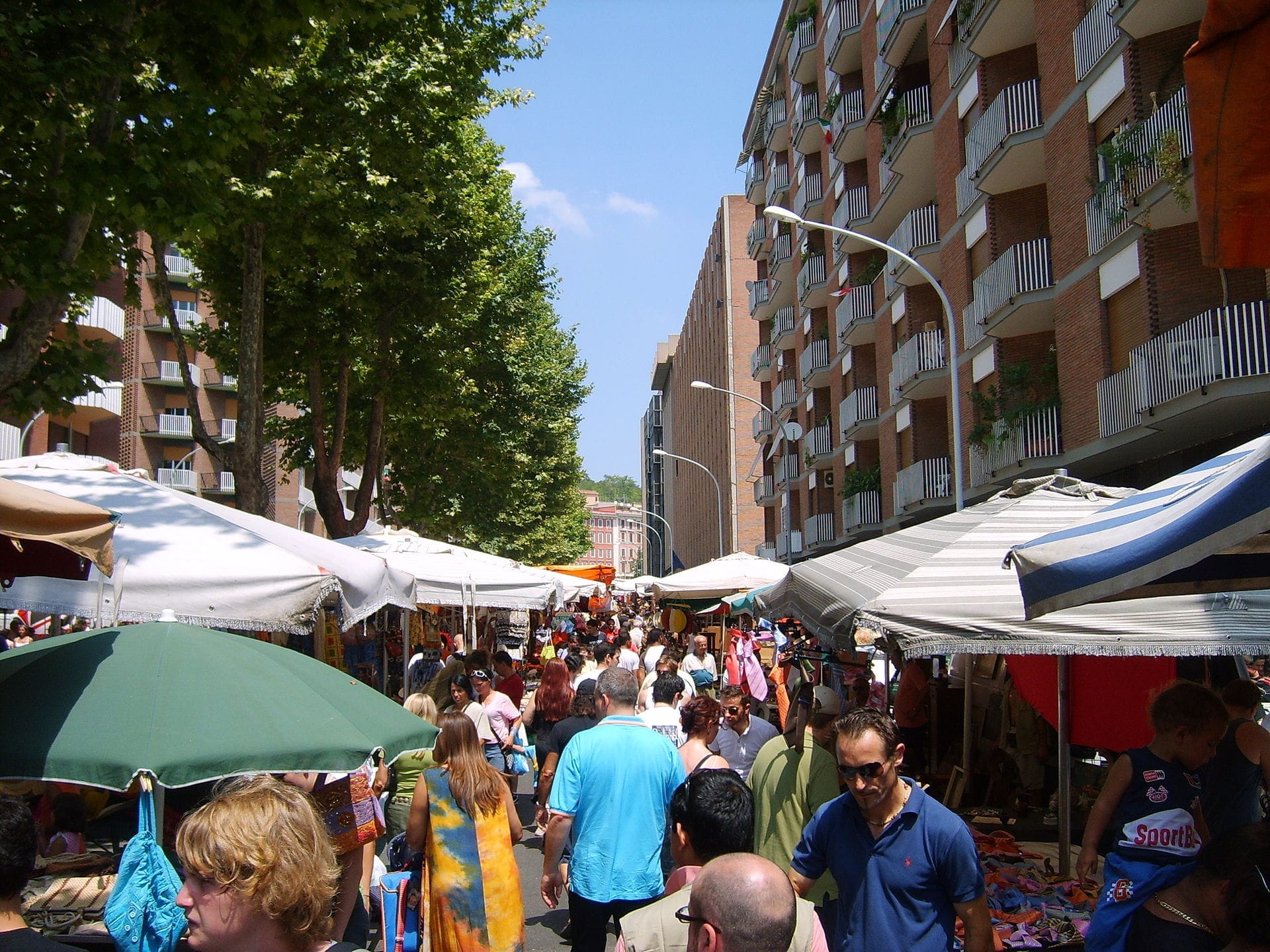
Mercato di Porta Portese is Rome's largest flea market, operating every Sunday from 7:00 to 14:00, with some vendors staying until 17:00. It stretches approximately two kilometers from Piazza Porta Portese through Via Portuense, Via Ippolito Nievo, and Via Ettore Rolli, with entry points off Via Ergisto Bezzi and Via Angelo Bargoni. More than a thousand stalls line these streets, and no two Sundays look exactly alike.
The range of goods is genuinely staggering: vinyl records stacked in milk crates, military surplus gear, 1970s Italian kitchenware, loose coins and stamps, religious icons, leather belts, bootleg DVDs that no one actually buys, secondhand jeans, art prints, old tools, and the occasional piece of furniture someone has dragged out of an apartment. It is not a curated antique market. Some of it is junk. But the junk is part of the experience, and the finds, when they happen, feel like discoveries.
💡 Local tip
Bring only cash. Most vendors do not accept cards, and ATMs near the market can run dry or have long queues by mid-morning. Small bills are helpful when bargaining.
A Market Born from Post-War Rome
The market takes its name from the Porta Portese gate, built in 1644 under Pope Innocent X to replace the ancient Porta Portuensis. The gate itself still stands at the southern edge of Trastevere, a broad Baroque arch that marks where the market begins each week.
Porta Portese as a market dates to the mid-19th century, emerging in the chaos that followed World War II. Romans who had lost nearly everything traded salvaged goods, black-market supplies, and whatever could be exchanged for a few lire. That survival-economy origin never fully left. The market still operates with a certain unregulated energy, and the mix of goods reflects decades of accumulated Roman life rather than any deliberate curation.
For context on how Trastevere developed as a district around this kind of working-class commerce, the neighborhood's history rewards some background reading before you visit.
Trastevere today is better known for its restaurants and nightlife, but Porta Portese is a reminder of its older, grittier character. If you want to understand the neighborhood beyond its tourist-facing side, explore the Trastevere neighborhood guide before or after your visit.
Tickets & tours
Live prices and dates from our booking partner. If you book, we may earn a commission at no extra cost to you.
Villa d'Este and Hadrian's Villa Guided Tour with Transport to Tivoli
From 119 €Instant confirmationFree cancellationFiumicino airport to Vatican City direct bus transfer
From 6 €Instant confirmationPortuguese guided tour of Ancient Rome highlights
From 105 €Instant confirmationFree cancellationRoundtrip Transfer Ticket From Rome Fiumicino Airport To Vatican
From 7 €Instant confirmationFree cancellation
Arriving Early vs. Arriving Late: Two Different Markets
The gap between arriving at 7:00 and arriving at 10:30 is significant enough to merit its own section. Early morning, around dawn, the market smells of strong espresso from mobile carts and the cool damp of Trastevere's narrow side streets. Vendors are still setting out their goods, sometimes still negotiating placement with neighbors. The light is low and golden, the crowd is thin, and this is when serious buyers, dealers, and pickers work. If you are looking for something specific, especially anything with real value, come before 8:00.
By 10:00, the dynamic has shifted. The market is loud, pressing, and full of tourists alongside Roman families treating it as their Sunday ritual. The smell changes too: fried food appears, vendors are more confident in their prices, and the best smaller items have often already moved. This is still a good time to visit for the atmosphere alone, but your chances of an unexpected find decrease with every hour.
After noon, the market begins to wind down. Some vendors start packing up, paths widen, and the energy drops. On hot summer Sundays, this process can start even earlier. If you arrive at 13:00 hoping to browse leisurely, you will find gaps in the stalls and a reduced selection. Plan accordingly.
⚠️ What to skip
Sunday mornings in summer can be hot by 10:00. Wear comfortable shoes, bring water, and apply sunscreen before you arrive. There is no shade for most of the route.
Navigating the Stalls: What You Will Find Where
The market is not zoned in any official way, but patterns emerge. Stalls near the Piazza Porta Portese entrance and along the first stretch of Via Portuense tend to carry clothing: new and used, with a mix of streetwear, vintage pieces, and factory surplus. Deeper into the market, especially along Via Ippolito Nievo and the side streets, you find more interesting territory: books, records, tools, ceramics, small antiques, and the miscellaneous personal effects of Roman households.
Haggling is expected but not aggressive. A reasonable opening offer is around 20 to 30 percent below the asking price. Vendors who are clearly professionals will hold firmer; individuals selling household items are often more flexible. Politeness matters. Starting with a few words of Italian, even just "quanto costa?" (how much?), shifts the tone of any negotiation.
Be aware that some goods, particularly electronics and brand-name items at suspiciously low prices, are unlikely to be what they appear. The market has always had an informal underbelly, and while overt illegal sales are less common than in past decades, basic skepticism protects you.
Getting There and Getting Around
Tram lines 3 and 8 both stop at Porta Portese, making this one of the easier Rome destinations to reach by public transit on a Sunday. The tram stops directly at the market entrance, which matters because Sunday bus and tram frequencies are lower than weekday schedules. Check the ATAC schedule before you go and plan your return accordingly.
Walking is the only way to navigate inside the market. The route is mostly flat, on paved streets and some uneven cobblestone sections. The crowds can make movement slow in the middle sections, and vendors set up on both sides of relatively narrow roads, which means the central path narrows considerably. Strollers and wheelchairs face real challenges: the pavement is uneven, the crowd is dense, and there are no accommodations made for accessibility. Anyone with mobility limitations should be aware that conditions are difficult, particularly between 9:00 and 11:30.
If you are planning a broader Sunday in Trastevere, consider pairing the market with a visit to Santa Maria in Trastevere, one of Rome's oldest churches, which is a short walk away and typically quiet on Sunday mornings while the market absorbs the foot traffic.
Honest Assessment: Who This Is For, and Who It Is Not
Porta Portese is not a polished experience. The ground can be muddy after rain. Some sections smell of diesel from vendor vehicles. The clothing section nearest the entrance is largely unremarkable, and the proportion of genuinely interesting goods to filler has shifted over the decades as the market has grown more tourist-aware. First-time visitors sometimes find it overwhelming, chaotic, or simply larger than expected without much payoff if they do not know what they are looking for.
The market suits people with patience, curiosity, and a tolerance for unpredictability. If you enjoy the process of looking rather than the certainty of finding, you will have a good time regardless of whether you buy anything. If you are hoping to quickly locate a specific category of vintage item and leave, you may find the disorganization frustrating.
Travelers looking for artisan crafts, local food products, or aesthetically curated goods will be disappointed. This is not that kind of market. For a different Sunday market experience with local produce and food, Rome has other options worth considering.
If your primary interest is finding unique, locally made goods rather than secondhand finds, the Mercato di Testaccio offers a tighter, more food-focused experience in a covered market setting just across the river.
ℹ️ Good to know
Porta Portese is free to enter and free to browse. You are under no obligation to buy. Many locals come simply to walk it, drink a coffee from one of the mobile carts, and return home. That is a perfectly valid use of a Sunday morning.
Photography and Practical Details
The market is a strong photographic subject, particularly in the first two hours when the light is best and the crowd is thinner. Vendors vary in their comfort with being photographed: ask before pointing a camera at anyone, and expect some to decline. Objects, stalls, and street scenes are generally fine. The golden-hour light along Via Ippolito Nievo, with the stalls still half-assembled and vendors drinking espresso, is the most photogenic moment the market offers.
Keep your bag in front of you and secure zippers. Pickpocketing in crowded markets is a documented problem across Rome, and Porta Portese is no exception given the density of the crowd. Do not carry more cash than you intend to spend, and leave valuables at your accommodation.
For more context on navigating Rome's public transit to get here and to other parts of the city on a Sunday, the guide to getting around Rome covers tram, bus, and metro options in detail.
Insider Tips
- Enter from Via Ergisto Bezzi rather than the main Piazza Porta Portese entrance. This puts you deeper into the market from the start and bypasses the least interesting clothing stalls near the gate.
- The vendors selling from the backs of vans and temporary tables set up in the side streets off Via Ippolito Nievo often have more unusual goods and lower prices than those in the main lanes, because foot traffic reaches them later.
- If you are buying anything fragile or bulky, negotiate delivery to the market entrance rather than carrying it the length of the route. Some vendors will hold items for you while you finish browsing.
- Coffee from the mobile espresso carts is cheap, reasonably good, and gives you a natural excuse to pause and observe a section of the market before committing to a direction. The carts near the middle of the route tend to be less crowded than those at the entrance.
- Rain does not cancel the market, but it significantly reduces vendor turnout. A wet Sunday means fewer stalls, less competition among buyers, and sometimes better deals from vendors who want to move goods and go home.
Who Is Porta Portese Flea Market For?
- Vintage clothing browsers with flexible taste and patience for unsorted racks
- Collectors of records, books, coins, or small antiques willing to dig through quantity for quality
- Travelers who want to observe Roman street life rather than consume a packaged attraction
- Budget travelers who enjoy the hunt regardless of outcome
- Early risers who can arrive before 8:00 when the market is at its most atmospheric and least crowded
Nearby Attractions
Other things to see while in Trastevere:
- Gianicolo Hill
Rising above Trastevere on the city's western edge, Gianicolo Hill (Colle del Gianicolo) delivers what many argue is the finest 180-degree view of Rome's skyline, entirely free. Beyond the panorama, the hill holds Risorgimento monuments, a 17th-century fountain, and Bramante's celebrated Tempietto, all connected by a shaded promenade that rewards those willing to leave the crowds below.
- Basilica di Santa Maria in Trastevere
Standing at the heart of Rome's most characterful neighborhood, the Basilica di Santa Maria in Trastevere is widely considered the oldest church in Rome dedicated to the Virgin Mary. Its 12th-century apse mosaics rank among the finest medieval art in the city, and the piazza in front is one of the few public squares in Rome that genuinely rewards sitting still.
- Villa Farnesina
Villa Farnesina is a 16th-century Renaissance villa in Trastevere housing some of the finest frescoes in Rome, including Raphael's celebrated Galatea and the luminous Loggia of Psyche. Smaller and quieter than the Vatican Museums, it offers a rare chance to stand inside rooms that have barely changed since a Sienese banker commissioned the greatest artists of the High Renaissance to decorate them.
Planning a trip? Discover personalized activities with the Nomado app.