San Michele Island: Venice's Serene Cemetery Island
Isola di San Michele is Venice's principal cemetery island, reachable in minutes from Fondamente Nove by vaporetto. A place of quiet contemplation rather than spectacle, it holds the graves of Igor Stravinsky, Sergei Diaghilev, and Ezra Pound, and features one of the finest Renaissance churches on the lagoon.
Quick Facts
- Location
- Isola di San Michele, Venice Lagoon — between the historic centre and Murano
- Getting There
- Vaporetto Line 4.1 or 4.2 from Fondamente Nove; San Michele is the first stop (approx. 7 minutes)
- Time Needed
- 45 minutes to 1.5 hours
- Cost
- Free entry to the cemetery; standard vaporetto fare applies for the boat crossing
- Best for
- History lovers, architecture enthusiasts, quiet reflection away from crowds
What Is San Michele Island?
Isola di San Michele sits just a few hundred metres north of the historic city, separated from Cannaregio by a narrow stretch of the lagoon. It is Venice's municipal cemetery, and has been the city's principal burial ground since the early 19th century, when Napoleonic decrees prohibited burials within the city itself for public health reasons. Before that, the island housed a Camaldolese monastery, founded in the 13th century.
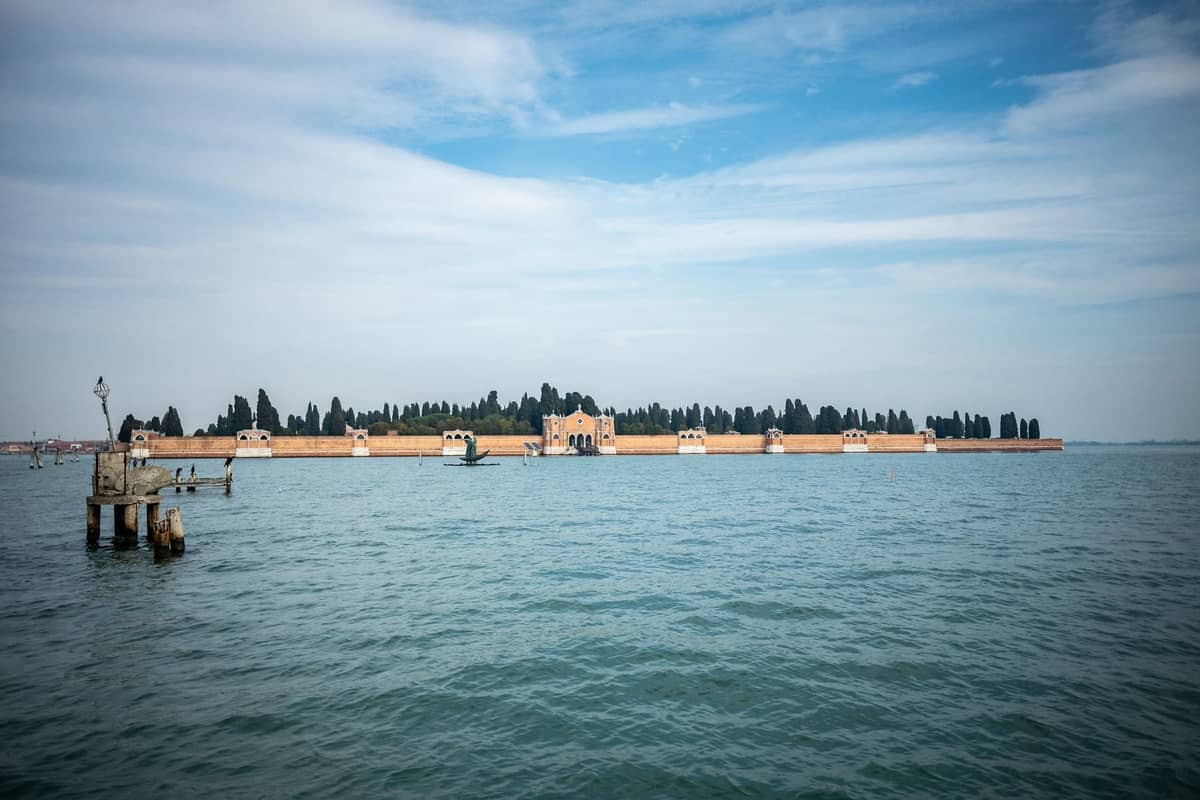
The island you see today was actually formed from two originally separate islands, San Michele and San Cristoforo della Pace, which were joined together during the 19th century to create enough space for the expanding cemetery. The perimeter wall of white Istrian stone, broken only by the water gate and the church facade, gives the island a striking, self-contained appearance from the vaporetto.
💡 Local tip
The vaporetto stop is directly at the island's landing stage. Boats on Line 4.1 and 4.2 call here briefly, so be ready to disembark quickly. The return journey is equally simple — boats run frequently throughout the day.
The Church of San Michele in Isola
Before you enter the cemetery proper, the church of San Michele in Isola commands attention. Completed in 1469 and designed by Mauro Codussi, it is widely considered the first Renaissance church built in Venice. The white Istrian limestone facade is restrained and precise, a deliberate contrast to the ornate Gothic language that had dominated Venetian sacred architecture for centuries. Standing in front of it on a clear morning, with the light reflecting off the lagoon behind you, the geometry of the facade reads almost like a mathematical argument.
The adjacent Cappella Emiliana, added in the 16th century, introduces an octagonal dome and a more elaborate decorative vocabulary. Together, the church and chapel form a compact but architecturally significant ensemble that would justify the short boat crossing on its own.
Tickets & tours
Hand-picked options from our booking partner. Prices are indicative; availability and final rates are confirmed when you complete your booking.
Doge's Palace skip-the-line tour
From 67 €Instant confirmationFree cancellationVenice Legends, Anecdotes and Ghost Stories Tour
From 35 €Instant confirmationFree cancellationGhosts and legends tour of Venice
From 29 €Instant confirmationFree cancellationSkip-the-line guided tour of Doge's Palace and Saint Mark's Basilica
From 106 €Instant confirmationFree cancellation
Navigating the Cemetery
The cemetery is divided into clearly marked sections. Most visitors make directly for the Evangelica (Protestant) and Greco-Ortodossa (Greek Orthodox) sections on the far side of the island, where the most internationally famous graves are located. Igor Stravinsky is buried in the Evangelica section alongside his wife Vera; a few steps away, Sergei Diaghilev's grave in the Orthodox section is almost always decorated with ballet shoes left by admirers. The poet Ezra Pound is buried nearby.
Beyond these famous names, the cemetery rewards unhurried walking. The older Catholic sections contain elaborate 19th-century funerary monuments, some of them reaching genuine sculptural quality, with weeping angels, portrait medallions, and carved drapery that speaks to the prosperity of Venetian merchant and noble families. Narrow paths between the graves are lined with cypress trees, which cut the sound of the city entirely.
Note that space on the island is finite, and Venice operates a system where remains are eventually exhumed and transferred to an ossuary or cremated to free plots for new burials. This means the cemetery is a living, active space rather than a frozen historical site.
ℹ️ Good to know
Signage within the cemetery is clear, and a map is typically available at the entrance. The Evangelica and Orthodox sections are well signposted, but the island is small enough that you are unlikely to get disoriented.
How It Changes Through the Day
Early morning visits, particularly on weekdays, offer the most atmosphere. The mist that often sits over the northern lagoon in autumn and winter months reduces visibility of the Murano skyline and creates an unusual sense of isolation. The only sounds are pigeons, the distant chug of a vaporetto, and occasionally the footsteps of locals who have come to tend a family grave.
By late morning the island can receive a modest stream of visitors, but it never approaches the density of the main tourist sites. The cemetery is a working burial ground visited daily by Venetian families, which sets a natural tone of quietness that most visitors respect without being asked. On All Souls' Day in early November, the island receives large numbers of locals paying respects, and additional vaporetto services are typically laid on.
Afternoon light in summer can be harsh in the open sections of the cemetery, and there is limited shade outside the cypress-lined paths. A hat and water are worth bringing in July and August. In winter, the island is noticeably cold in the open sections; the wind off the lagoon is sharper here than in the sheltered calli of the city.
Photography on the Island
San Michele is visually rich for photographers, but requires sensitivity. The white perimeter wall reflected in the lagoon, the cypress silhouettes against the sky, and the layered textures of old grave monuments all make strong subjects. Wide-angle shots from the vaporetto on approach capture the island's characteristic profile well.
Inside the cemetery, discretion matters. Photographing individual graves, particularly those of famous figures, is generally acceptable, but avoid photographing families at recent burials or areas where funeral services are taking place. The Cappella Emiliana interior may have restricted photography; check the posted notices on arrival.
⚠️ What to skip
San Michele is an active municipal cemetery. Visitors are expected to behave accordingly: keep voices low, avoid eating or drinking within the cemetery grounds, and stay on the marked paths.
Getting There and Practical Details
From Cannaregio, the Fondamente Nove waterfront is a short walk north. Vaporetto Lines 4.1 and 4.2 both stop at San Michele, and the crossing takes around seven minutes. The same lines continue to Murano, making it straightforward to combine both islands in a single outing. For context on planning a broader lagoon itinerary, the Venice lagoon islands guide covers the full range of options.
The cemetery is reported to be open daily, generally from early morning until late afternoon or early evening depending on the season, though the specific schedule should be verified before visiting, as cemetery opening times can vary by season and on public holidays. There is no admission fee for general visitors. The island is small and flat, which helps with mobility, though some sections have gravel paths that may be less comfortable for wheelchair users. Verify current accessibility arrangements with the Comune di Venezia before visiting if this is a concern.
If you are building a day around northern Venice, Chiesa della Madonna dell'Orto in Cannaregio is a 10-minute walk from Fondamente Nove and pairs well with a San Michele visit. For the full picture of what to do in Venice beyond the main sights, the hidden gems guide points to several overlooked spots across the city.
Is San Michele Worth Your Time?
For some visitors, the idea of spending time in a cemetery will not appeal, and that is a reasonable position. San Michele does not offer the kinetic energy of the Rialto or the visual saturation of the Piazza. What it offers instead is a genuine pause: a place that has nothing to prove, that exists for Venetians rather than for tourists, and that rewards the kind of slow attention that the main sights often make difficult.
Visitors who have already covered the major churches and museums and want something genuinely different will find it here. If you are exploring which sites merit your limited time in the city, the full Venice things-to-do guide gives a ranked and practical overview. For those interested in the broader context of Venetian sacred architecture, the best churches in Venice guide covers the key buildings worth seeking out.
Travellers who get frustrated by slow, contemplative sites, or those with very limited time in Venice, will find their hours better spent elsewhere. The crossing is quick, but time on the island passes slowly by design.
Insider Tips
- Go on a weekday morning rather than a weekend afternoon. Locals visiting family graves give the island a completely different feeling from a tourist attraction, and the quietness is more pronounced early in the day.
- The graves of Stravinsky, Diaghilev, and Pound are all in the non-Catholic sections on the far side of the island from the entrance. Head left after passing through the main gate and follow the signs to Evangelica and Greco-Ortodossa.
- If you visit in November around All Souls' Day (2 November), the island is full of Venetians with flowers. It is one of the few occasions where you see the city in a genuinely local, non-touristic context.
- The view back toward the Fondamente Nove and Cannaregio from the island's landing stage is one of the cleaner northern lagoon panoramas in Venice. Worth a photograph before you step onto the island.
- Combine the crossing with a visit to Murano: Lines 4.1 and 4.2 continue directly from San Michele to Murano without returning to the city. This makes a logical half-day itinerary that avoids backtracking.
Who Is San Michele Island (Isola di San Michele) For?
- Architecture lovers interested in early Venetian Renaissance buildings, particularly the Codussi church facade
- Visitors who want a complete break from the main tourist circuit without leaving Venice proper
- Fans of 20th-century music and literature, drawn by the Stravinsky, Diaghilev, and Pound graves
- Photographers looking for atmospheric lagoon light, cypress silhouettes, and monumental funerary sculpture
- Travellers combining a northern lagoon loop with a visit to Murano on the same vaporetto line
Nearby Attractions
Combine your visit with:
- Burano Island
Eight to nine kilometers north of Venice, Burano Island is a compact, flat island of roughly 21 hectares where fishermen's houses are painted in saturated reds, yellows, and blues. It has a legitimate history in lace-making stretching back to the 16th century, and the 40-minute vaporetto ride across the lagoon is part of the experience.
- Chiesa del Redentore
Built in 1577 as a vow to God after a devastating plague, the Chiesa del Santissimo Redentore is Andrea Palladio's finest church in Venice. Standing on the island of Giudecca across the canal from Dorsoduro, it rewards visitors with serene interiors, important Renaissance paintings, and one of the most dramatic facades in Italian architecture.
- Chioggia
Chioggia is an ancient fishing town at the southern entrance of the Venetian Lagoon, built on a cluster of small islands linked by bridges and crossed by canals. Unlike Venice, it functions as a living, working community, and that distinction shapes everything about a visit.
- Giudecca Island
Giudecca Island sits just minutes from the heart of Venice yet feels like a different city entirely. Flat, walkable, and free to explore, it rewards visitors with Palladian architecture, waterfront promenades, and a glimpse of how Venetians actually live.