San Francisco Maritime National Historical Park: Ships, History, and the Working Waterfront
San Francisco Maritime National Historical Park preserves a rare collection of historic vessels and waterfront history at the edge of Fisherman's Wharf. With no park entrance fee and a walkable waterfront setting, it rewards curious visitors with a tangible connection to the city's seafaring past.
Quick Facts
- Location
- Fisherman's Wharf, San Francisco, CA (Visitor Center: 499 Jefferson St; Maritime Research Center: 2 Marina Blvd, Building E)
- Getting There
- F-line historic streetcar to Jones & Beach St; Muni bus lines 8, 28, 30, and 49 stop within walking distance
- Time Needed
- 1.5 to 3 hours depending on whether you board the ships
- Cost
- Free park entry; verify current per-person fees for historic ship boarding at nps.gov/safr
- Best for
- History enthusiasts, families with school-age kids, maritime photography, and anyone who wants a quieter alternative to Pier 39
- Official website
- www.nps.gov/safr
What San Francisco Maritime National Historical Park Actually Is
San Francisco Maritime National Historical Park is a unit of the US National Park Service, established by Congress on June 27, 1988 to preserve and interpret the maritime heritage of the Pacific Coast. It is not a single building or a museum in the conventional sense. It is a corridor: a stretch of San Francisco's northern waterfront that includes a fleet of historic vessels moored at Hyde Street Pier, a maritime museum housed in a bathhouse-era building, an extensive research library and archive, and a sandy beach within earshot of the city.
The park sits just west of the commercial center of Fisherman's Wharf, which makes it easy to combine with a broader waterfront afternoon. But unlike the souvenir shops and seafood stalls that define most visitor activity in that neighborhood, the Maritime Park has a different register: quieter, more considered, and genuinely educational in ways that hold up for adults as well as children.
ℹ️ Good to know
The park grounds and waterfront promenade are free to enter at all times. The visitor center, staffed daily from 10:00 AM to 5:00 PM, is also free. Verify current per-person boarding fees for the historic ships directly with the park before your visit, as these may vary.
The Historic Fleet at Hyde Street Pier
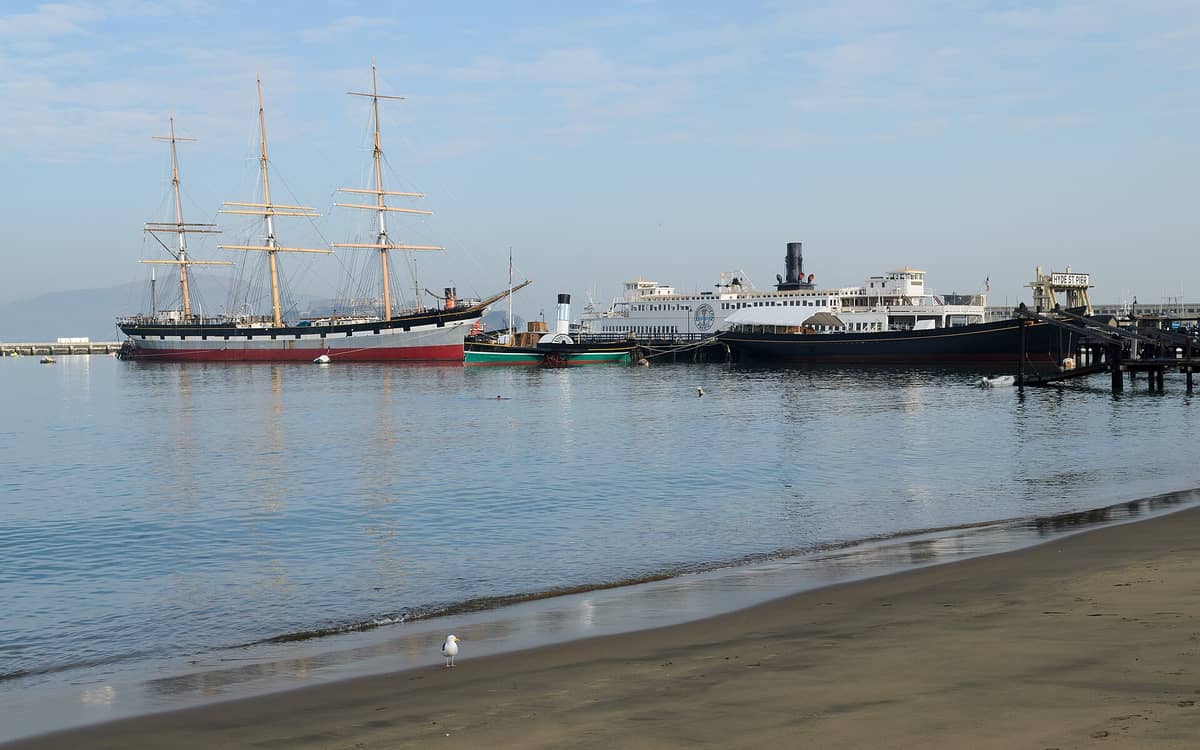
The centerpiece of the park is Hyde Street Pier, where a collection of historic vessels sits moored in San Francisco Bay. These are not replica ships or dry-land exhibits. They are real working and preserved vessels that visitors can board, walk through, and in some cases, examine below the waterline. The collection includes the Balclutha, a three-masted square-rigger built in Glasgow in 1886 that sailed the Cape Horn route carrying grain and general cargo. Its steel hull, now over 130 years old, still carries the faint smell of bilge water and salt-soaked timber when you step below deck.
Also moored at the pier is the Eureka, a double-ended paddle-wheel ferryboat that carried commuters across San Francisco Bay until 1957. Its car deck still holds a collection of vintage automobiles and trucks that bring the 1950s back in an unexpectedly vivid way. The C.A. Thayer is a three-masted lumber schooner, and the Hercules is an ocean-going steam tugboat built in 1907. Each vessel tells a different chapter of Pacific Coast commercial history, and the NPS interpretation panels on deck are clear and well-researched.
Plan at least 45 minutes just for the pier if you intend to board more than one ship. Wooden decks can be uneven and some below-deck areas require ducking through low hatches, so the experience is better suited to visitors who are reasonably mobile. Go on a weekday morning for the most peaceful experience: weekend afternoons bring families with strollers and school groups, which makes the narrow gangways congested.
💡 Local tip
Arrive at Hyde Street Pier before noon. Morning fog often softens the light on the ships' rigging in a way that makes for exceptional photographs, and the pier is measurably less crowded before lunch.
Tickets & tours
Hand-picked options from our booking partner. Prices are indicative; availability and final rates are confirmed when you complete your booking.
Sonoma and Napa Valley wine tour from San Francisco
From 127 €Instant confirmationFree cancellationGo City | San Francisco Explorer Pass
From 76 €Instant confirmationFree cancellationSan Francisco CityPASS
From 77 €Instant confirmationFree cancellationThe Flyer San Francisco - “Flying Theater experience”
From 12 €Instant confirmationFree cancellation
The Maritime Museum Building
The San Francisco Maritime Museum occupies the Aquatic Park Bathhouse, a streamlined Moderne building completed in 1939 as part of the Works Progress Administration. The building's exterior resembles the prow of an ocean liner, an architectural choice that feels deliberately theatrical and has aged well. Inside, the museum's galleries cover the social and commercial history of West Coast maritime life, from the Gold Rush era through the twentieth century. Exhibits include navigational instruments, ship models, photographs, and salvaged artifacts.
The building sits at the edge of Aquatic Park Cove, a small sheltered bay where open-water swimmers brave the mid‑50s degree Fahrenheit bay water year-round. The Dolphin Club and South End Rowing Club, two of San Francisco's oldest athletic organizations, have boathouses here and have operated continuously since the nineteenth century. The presence of these swimmers gives the cove a lively, slightly eccentric quality that is very San Francisco.
The Waterfront Promenade and Aquatic Park
Aquatic Park itself is a largely overlooked pocket of calm within one of the city's most tourist-dense neighborhoods. The curving municipal pier extends well over a thousand feet into the bay, offering unobstructed views of the Marin Headlands, Alcatraz, and Angel Island. Fishermen line the railings in the early morning, and the wind off the bay in the afternoon can be significant, so a layer is advisable regardless of the season. San Francisco's maritime climate means that summer mornings are often cold and gray before the fog burns off, while September and October bring the clearest and warmest conditions. For a deeper understanding of the broader waterfront, the Fisherman's Wharf neighborhood provides useful context on what else is within walking distance.
The beach at the western end of Aquatic Park is a calm place to sit and watch the bay traffic: container ships, tugboats, ferry commuters, and recreational sailboats all pass through the same narrow channel. It is a genuinely good spot to understand why San Francisco's location made it the dominant port of the western United States for over a century. If you want to extend your waterfront walk eastward, Crissy Field is accessible from the western edge of the park and offers one of the city's finest bay-to-bridge walking routes.
Historical Context: Why This Port Mattered
San Francisco Bay was the entry point for the Gold Rush of 1849, when ships from around the world arrived carrying prospectors, merchants, and speculators. At its peak, dozens of ships were abandoned in the bay as their crews deserted for the goldfields. The waterfront that the park now preserves was built on top of some of those hulks, which were used as landfill. The neighborhood around Fisherman's Wharf grew from the Italian fishing community that settled here in the late nineteenth century, primarily from Genoa and Sicily, and the maritime culture they built persisted well into the twentieth century.
The park also connects to the broader story of San Francisco as a labor city. The 1934 West Coast Waterfront Strike, one of the defining labor actions in American history, began here on these docks and transformed the relationship between longshoremen and shipping companies nationwide. The park's research library holds primary source materials on this period for those interested in digging deeper. For a broader look at San Francisco's architectural and cultural history, the San Francisco architecture guide provides useful framing.
Practical Walkthrough: How to Structure Your Visit
The park's main components are spread across roughly a quarter mile of waterfront, so it is easy to navigate on foot. A sensible sequence is to start at the visitor center at 499 Jefferson Street, which provides orientation materials and ranger staff who can answer questions about current programming. From there, walk to Hyde Street Pier for the historic vessels, then continue west along the promenade to the Aquatic Park Bathhouse and the Maritime Museum. Finish with a walk out along the Aquatic Park municipal pier.
The visitor center is open daily from 10:00 AM to 5:00 PM. The park, visitor center, Hyde Street Pier, and museum are closed on Thanksgiving, December 25, and January 1. If you are arriving by public transit, the F-line historic streetcar is the most atmospheric option and stops at Jones and Beach Street, a two-minute walk from Hyde Street Pier. The F-line itself uses restored vintage streetcars from cities around the world and is part of the city's working Muni system.
⚠️ What to skip
San Francisco's waterfront is windy and often significantly colder than the rest of the city, even on sunny days. Bring a layer even in summer. The fog that rolls in off the Pacific can drop temperatures by 10 to 15 degrees Fahrenheit within an hour.
If this visit is part of a first trip to San Francisco, it pairs naturally with a morning at the Ferry Building or an afternoon at Ghirardelli Square, which is a short walk to the west. For a well-structured approach to the wider waterfront and neighborhood, the first-time visitor guide to San Francisco covers how to connect these areas efficiently.
Who Should Consider Skipping This
If your primary interest is hands-on interactive exhibits or cutting-edge museum presentation, this park may feel dated in places. The ship boarding experience requires some physical agility and tolerance for tight below-deck spaces. Visitors with significant mobility limitations may find the pier and vessel access challenging, and the park's official materials do not provide detailed accessibility specifications for the vessels themselves. It is worth contacting the park directly before visiting if this is a concern.
The park is also unlikely to hold the attention of young children under six for more than thirty to forty minutes unless they have a specific interest in boats. For families with younger children, the nearby Aquatic Park beach and the cove provide open space that works better as a supplement to other activities.
Insider Tips
- The Aquatic Park municipal pier is free to walk and almost always less crowded than any other waterfront viewpoint in the Fisherman's Wharf area. The sightlines to Alcatraz and the Marin Headlands from the pier's end are better than many paid viewpoints nearby.
- Ranger-led programs and occasional living history events are offered periodically, including sail-training demonstrations on the historic vessels. Check the NPS events calendar at nps.gov/safr before your visit to see if anything is scheduled.
- The park's research library at Building E holds one of the most significant collections of Pacific Coast maritime photographs, oral histories, and logbooks in the United States. Researchers and serious maritime history enthusiasts can access the collection by appointment.
- The open-water swimmers at Aquatic Park Cove typically enter the water in the early morning, year-round. Watching them from the beach adds an unexpected and very local dimension to a waterfront walk, and the Dolphin Club occasionally welcomes curious visitors to learn about their history.
- Parking near Fisherman's Wharf is expensive and often congested. The F-line streetcar from Market Street is the most practical option and takes about 25 to 30 minutes from the Financial District. It also passes through the Embarcadero, giving you a ground-level tour of the northern waterfront en route.
Who Is San Francisco Maritime National Historical Park For?
- History travelers who want depth over spectacle and are interested in the economic and labor history of the American West Coast
- Families with school-age children (roughly 7 and up) who can handle shipboard exploration and appreciate hands-on learning
- Photographers looking for moody morning light on tall-ship rigging with the bay as a backdrop
- Visitors who want a genuine National Park Service experience within the city, free of charge
- Anyone spending a full day in Fisherman's Wharf who wants something substantive to anchor the waterfront hours
Nearby Attractions
Other things to see while in Fisherman's Wharf:
- Alcatraz Island
Alcatraz Island sits 1.5 miles offshore in San Francisco Bay, and the ferry ride alone sets the mood. Once a military fortification, then a federal penitentiary from 1934 to 1963, the island is now a National Park Service site offering one of the most atmospheric historical experiences on the West Coast. Allow at least three hours, and book tickets well in advance.
- Aquarium of the Bay
Aquarium of the Bay sits at the entrance to Pier 39 on Fisherman's Wharf, putting 24,000 marine animals and over 200 Bay-native species within arm's reach. From walk-through acrylic tunnels to touch pools filled with bat rays, it offers a focused, educational look at the waters just outside its walls.
- Ghirardelli Square
Once the city's working chocolate factory, Ghirardelli Square is now listed on the National Register of Historic Places, located at the western end of Fisherman's Wharf. The 1890s brick buildings house restaurants, shops, and the original Ghirardelli Chocolate Experience, all set around a fountain plaza with views toward San Francisco Bay. Entry is free.
- Musée Mécanique
Housed in a cavernous shed on Pier 45 at Fisherman's Wharf, Musée Mécanique is a free-admission museum of over 300 antique coin-operated machines spanning more than a century of American amusement culture. From hand-cranked peep shows to full-sized mechanical orchestras, this is a place where history runs on quarters.