Musée Mécanique: San Francisco's Living Penny Arcade Museum
Housed in a cavernous shed on Pier 45 at Fisherman's Wharf, Musée Mécanique is a free-admission museum of over 300 antique coin-operated machines spanning more than a century of American amusement culture. From hand-cranked peep shows to full-sized mechanical orchestras, this is a place where history runs on quarters.
Quick Facts
- Location
- Pier 45 at the end of Taylor Street, Fisherman's Wharf, San Francisco, CA 94133
- Getting There
- F Market & Wharves historic streetcar (Muni F-line) to Fisherman's Wharf; several Muni bus routes serve the Fisherman's Wharf / Embarcadero area
- Time Needed
- 45 minutes to 2 hours depending on how many machines you play
- Cost
- Free entry; machines cost $0.01–$1.00 per play (bring quarters and small bills — change machines are on-site)
- Best for
- Families with older kids, nostalgia seekers, design and mechanical history enthusiasts, rainy-day visitors
- Official website
- museemecanique.com
What Is Musée Mécanique, Exactly?
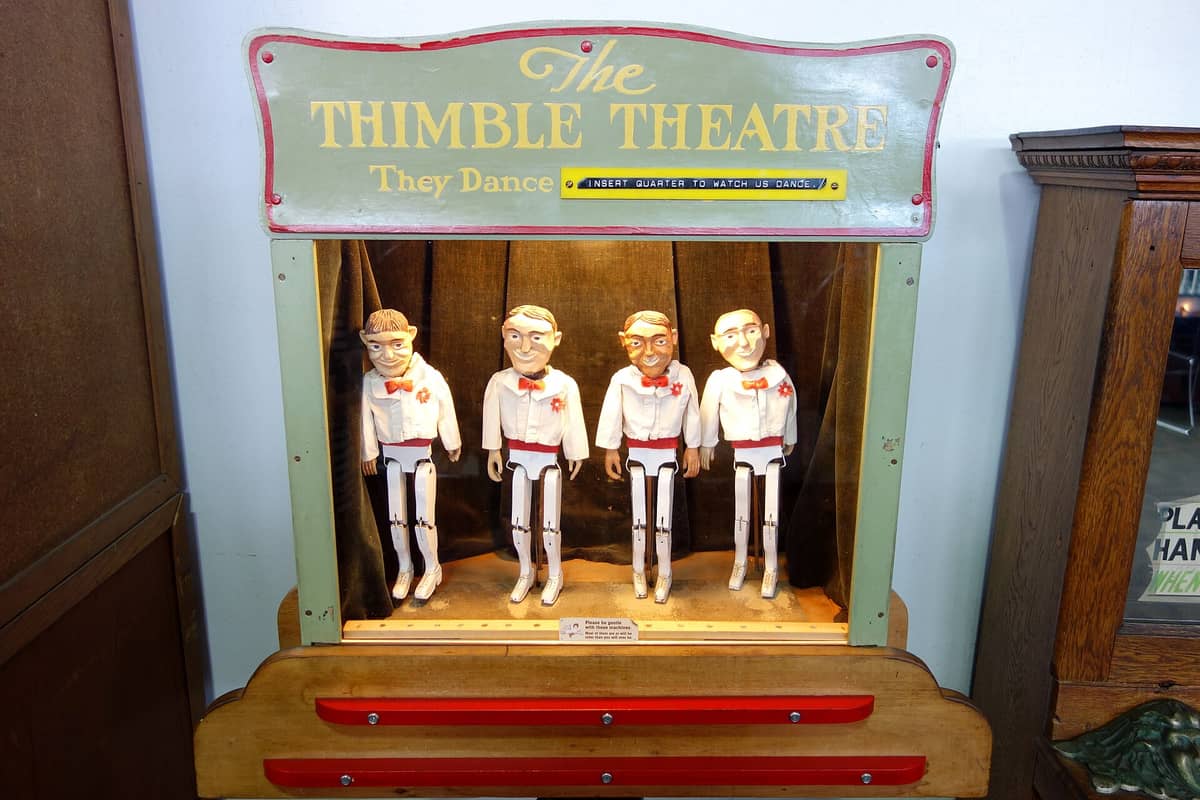
Musée Mécanique is a private interactive museum dedicated to coin-operated mechanical amusements, and it is unlike anything else in San Francisco. More than 300 machines fill a long, industrial shed on Pier 45 at Fisherman's Wharf: fortune tellers sealed in glass boxes, hand-cranked flip-card movies, automated puppet dioramas depicting barroom brawls, mechanical orchestras the size of wardrobes, and rows of pinball tables from the 1940s through the 1980s. The collection spans over a century of American amusement culture, preserved in working condition and available to play for as little as a quarter.
The admission is free. The machines themselves cost between $0.01 and $1.00 per play, with most in the $0.25–$0.50 range. Change machines are available inside, so arriving with a pocketful of quarters is helpful but not strictly necessary. Plan to spend at least $5–10 if you intend to actually play rather than just look.
💡 Local tip
Bring a mix of quarters and dollar bills. The on-site change machines handle both, but they can run out during busy weekend afternoons. The coin-op machines do not accept cards.
The Collection: A Century of American Amusement
The oldest machines in the collection date to the late 19th and early 20th centuries. Mutoscopes, the hand-cranked flip-card viewers that predate cinema projection, are among the most striking. You turn a handle at the side and a cascade of cards flips past a lens — the motion is jerky, hypnotic, and oddly satisfying in a way that scrolling a phone screen will never replicate. Adjacent to these are early fortune-teller automata: wax figures in glass cabinets that dispense printed fortunes after accepting your coin, their glass eyes tracking nothing.
A significant portion of the collection was rescued from Playland at the Beach, San Francisco's oceanside amusement park that operated from 1928 until its demolition in 1972. Laughing Sal, the famous (and unsettling) animatronic figure that once greeted visitors to Playland's Fun House, stands near the entrance of the museum. Her recorded laughter loops continuously. Children find her hilarious. Some adults find her deeply unnerving. She is, by most accounts, the museum's most photographed object.
The mechanical orchestrions, self-playing instruments that combine pipes, drums, and percussion into a single cabinet, represent the high-water mark of pre-electronic entertainment technology. Several examples here are fully functional. When one starts up, the sound cuts through the ambient noise of the shed with surprising clarity. For context on how mechanical music fits into San Francisco's broader cultural history, the Cable Car Museum offers a similar appreciation for 19th-century mechanical ingenuity, just a short distance away in Nob Hill.
Tickets & tours
Hand-picked options from our booking partner. Prices are indicative; availability and final rates are confirmed when you complete your booking.
The Walt Disney Family Museum general admission tickets
From 21 €Instant confirmationSonoma and Napa Valley wine tour from San Francisco
From 127 €Instant confirmationFree cancellationGo City | San Francisco Explorer Pass
From 76 €Instant confirmationFree cancellationMuir Woods and Sausalito guided tour with transportation
From 82 €Instant confirmationFree cancellation
The Space Itself: Pier 45 and the Sensory Experience
The museum occupies Shed A on Pier 45, a working-history pier that also houses the USS Pampanito submarine. The shed is a long, open warehouse structure with exposed steel beams and concrete floors. It is not a polished gallery environment. Lighting is functional rather than atmospheric, the floor is hard, and the space smells faintly of aged machinery, metal, and the bay. This is entirely appropriate.
The noise level is the most distinctive sensory quality. With dozens of machines running simultaneously, the shed fills with a layered cacophony: mechanical clicking, tinny recorded music, the thwack of pinball flippers, the rattling of a wooden ball through a Skee-Ball lane, and every few minutes the eruption of Laughing Sal. It is loud in a way that feels purposeful rather than chaotic. The noise is the experience.
On weekday mornings, the shed is quiet enough that you can hear individual machines clearly and read the interpretive cards without competing for space. On weekend afternoons, particularly in summer, the room fills with families and school groups, and the energy shifts to something closer to a funfair. Both versions of the experience are valid, but they are different.
ℹ️ Good to know
The museum is open daily 10:00 am to 8:00 pm, 365 days a year including major holidays. Summer evenings (after 5:00 pm on weekdays) tend to be quieter than Saturday afternoons while still offering reasonable crowd density.
History and Preservation Context
The collection was assembled over decades by Edward Zelinsky, who began collecting antique amusement machines as a child. For many years the museum operated in the lower level of the Cliff House at Sutro Baths, before relocating to its current Pier 45 location. The move preserved the collection when the Cliff House site became part of the Golden Gate National Recreation Area.
The museum's role as a repository for Playland at the Beach artifacts gives it an archival weight beyond mere novelty. San Francisco's amusement and waterfront history intersects at several points along the northern shore, and the San Francisco Maritime National Historical Park nearby on Hyde Street Pier offers complementary depth on the industrial and maritime history of this same waterfront.
Many of the machines have been maintained and restored by the museum's staff, who repair mechanical failures using original or period-appropriate parts where possible. Small handwritten or typed cards beside each machine explain its origins and operational history. These notes are worth reading: they reveal sourcing stories, prior owners, and the occasional fact about the machine's original location or manufacturer.
Getting There and Practical Walkthrough
The F-line historic streetcar (Muni F Market & Wharves line) is the most atmospheric way to arrive, running from Market Street and the Embarcadero all the way to Jones and Beach Street at Fisherman's Wharf. From that stop it is a short walk west along Jefferson Street to the pier entrance. The line uses restored vintage streetcars from cities around the world, which fits the museum's own preservation ethos.
Pier 45 is accessed from Jefferson Street near its intersection with Taylor Street. Walk through the pier gates toward the shed marked Shed A. The USS Pampanito is moored at the same pier and visible as you approach. The museum entrance is clearly marked. Parking in the Fisherman's Wharf area is available but expensive and often congested on weekends; public transit or ride-hail drop-off is more practical.
The space is ground-level and flat, which makes it accessible for strollers and most mobility aids in terms of physical terrain. However, the museum has not published a formal accessibility statement regarding wheelchair access to all machines or accessible restroom facilities. Visitors with specific needs should call ahead at +1 415-346-2000 to confirm current conditions.
Photography and What to Bring
The machines are visually rich and make for strong photographs. The biggest challenge is light: the shed's overhead fluorescents create a flat, slightly cold light that washes out detail on glass-fronted cabinets. A phone in portrait mode or a camera with a wider aperture will handle this better than automatic settings optimized for bright outdoor conditions. The machines themselves are generally reflective, so shooting at a slight angle to the glass reduces glare.
Wear comfortable shoes. The concrete floor is unforgiving after an hour. There is no coat check, but the shed maintains a consistent temperature year-round since it is enclosed but not climate-controlled; San Francisco's moderate temperatures mean it is rarely too hot or cold inside.
If you are building a half-day itinerary around this area, combining Musée Mécanique with the USS Pampanito on the same pier and then walking east toward Ferry Building Marketplace along The Embarcadero makes for a coherent route without requiring any transit.
Is It Worth Your Time?
Musée Mécanique is not a museum in the conventional sense. There are no curated thematic galleries, no audio guide, and the interpretive signage is minimal. If your primary interest is deep historical context or scholarly presentation, this will feel thin. What it offers instead is direct, tactile engagement with objects that are over 100 years old and still function as intended. That is rare.
The free admission removes the usual calculation of whether admission price justifies the experience. At no cost to enter and a few dollars to play, the risk is low and the reward for the right visitor is disproportionately high. The museum works best for people who are willing to slow down, read the cards, and feed quarters into machines they have never seen before.
⚠️ What to skip
This attraction is less suited to visitors who dislike sensory noise or crowds. On busy summer Saturdays between noon and 4:00 pm, the space fills quickly and the machine noise competes with general crowd volume. Weekday mornings are significantly calmer.
Insider Tips
- The Laughing Sal figure near the entrance is the most photographed object in the museum, but the mechanical orchestrions further back in the shed are the most impressive demonstrations of the technology. Put a coin in one and listen to it cycle through its full program — the sound is remarkable for a purely mechanical device.
- Change machines are available on-site but can run low on weekends. Stop at a nearby convenience store or ask at the pier entrance kiosk to convert bills to quarters before you arrive.
- The museum's printed interpretive cards beside each machine contain sourcing information and history that is not available anywhere online. They are worth reading, especially for machines from Playland at the Beach.
- Visit on a weekday morning if you want to have quiet conversations beside the machines and hear them clearly. The 10:00 am opening hour often draws fewer than a dozen visitors for the first hour.
- The museum is open on Thanksgiving with standard hours, and is generally open 365 days a year including most major holidays. It makes an unusual and low-cost option on days when many other attractions are closed or running reduced schedules.
Who Is Musée Mécanique For?
- Families with children aged 6 and up who can appreciate hands-on mechanical interaction
- Design, engineering, or industrial history enthusiasts interested in pre-electronic technology
- Rainy-day visitors looking for a covered, free-entry indoor option near the waterfront
- Photographers seeking visually textured, non-standard subject matter in San Francisco
- Travelers who want a low-cost, low-commitment stop that can be combined with a Pier 45 and Embarcadero walk
Nearby Attractions
Other things to see while in Fisherman's Wharf:
- Alcatraz Island
Alcatraz Island sits 1.5 miles offshore in San Francisco Bay, and the ferry ride alone sets the mood. Once a military fortification, then a federal penitentiary from 1934 to 1963, the island is now a National Park Service site offering one of the most atmospheric historical experiences on the West Coast. Allow at least three hours, and book tickets well in advance.
- Aquarium of the Bay
Aquarium of the Bay sits at the entrance to Pier 39 on Fisherman's Wharf, putting 24,000 marine animals and over 200 Bay-native species within arm's reach. From walk-through acrylic tunnels to touch pools filled with bat rays, it offers a focused, educational look at the waters just outside its walls.
- Ghirardelli Square
Once the city's working chocolate factory, Ghirardelli Square is now listed on the National Register of Historic Places, located at the western end of Fisherman's Wharf. The 1890s brick buildings house restaurants, shops, and the original Ghirardelli Chocolate Experience, all set around a fountain plaza with views toward San Francisco Bay. Entry is free.
- Pier 39
PIER 39 is a free-to-enter shopping and entertainment complex on San Francisco's northern waterfront. Famous for its resident California sea lions and sweeping bay views, it draws millions of visitors each year. Here's how to make the most of a visit without the rookie mistakes.