USS Pampanito: Step Inside a Real WWII Submarine at Pier 45
Berthed at Pier 45 in Fisherman's Wharf, the USS Pampanito is a preserved Balao-class submarine that saw six war patrols in the Pacific during World War II. Visitors can walk through the actual vessel, exploring torpedo rooms, the conning tower, and crew quarters. It is one of the most tangible and sobering military history experiences in San Francisco.
Quick Facts
- Location
- Pier 45, Fisherman's Wharf, San Francisco, CA
- Getting There
- F-line historic streetcar to Jefferson & Taylor; Muni bus lines 8, 28, 30, 39, and 49 also serve the Wharf
- Time Needed
- 1 to 2 hours
- Cost
- Admission fee charged; verify current pricing at maritime.org before visiting
- Best for
- History enthusiasts, families with older children, veterans and their families
- Official website
- maritime.org/uss-pampanito
What Is the USS Pampanito?
The USS Pampanito is a Balao-class fleet submarine built in 1943 at Portsmouth Naval Shipyard in New Hampshire. During World War II, she completed six combat patrols in the Pacific Theater, sank six Japanese vessels, and damaged four more. One of her most documented moments came in September 1944, when her crew rescued 73 Allied prisoners of war from the South China Sea after their transport ships were sunk by American submarines, including the Pampanito herself. It is a story of warfare and moral complexity that the exhibit does not shy away from.
After the war, the vessel was decommissioned, opened to the public as a museum ship in 1982 and designated a National Historic Landmark in 1986. Today it is operated by the San Francisco Maritime National Park Association and sits in permanent berth at Pier 45, where it is one of the few surviving examples of its class that visitors can actually enter and walk through.
ℹ️ Good to know
USS Pampanito is open Monday through Thursday, 10:00 am to 6:00 pm, and Friday through Sunday, 10:00 am to 8:00 pm. Verify current hours and admission prices at maritime.org before your visit, as details can change.
The Experience: What You Actually See and Feel
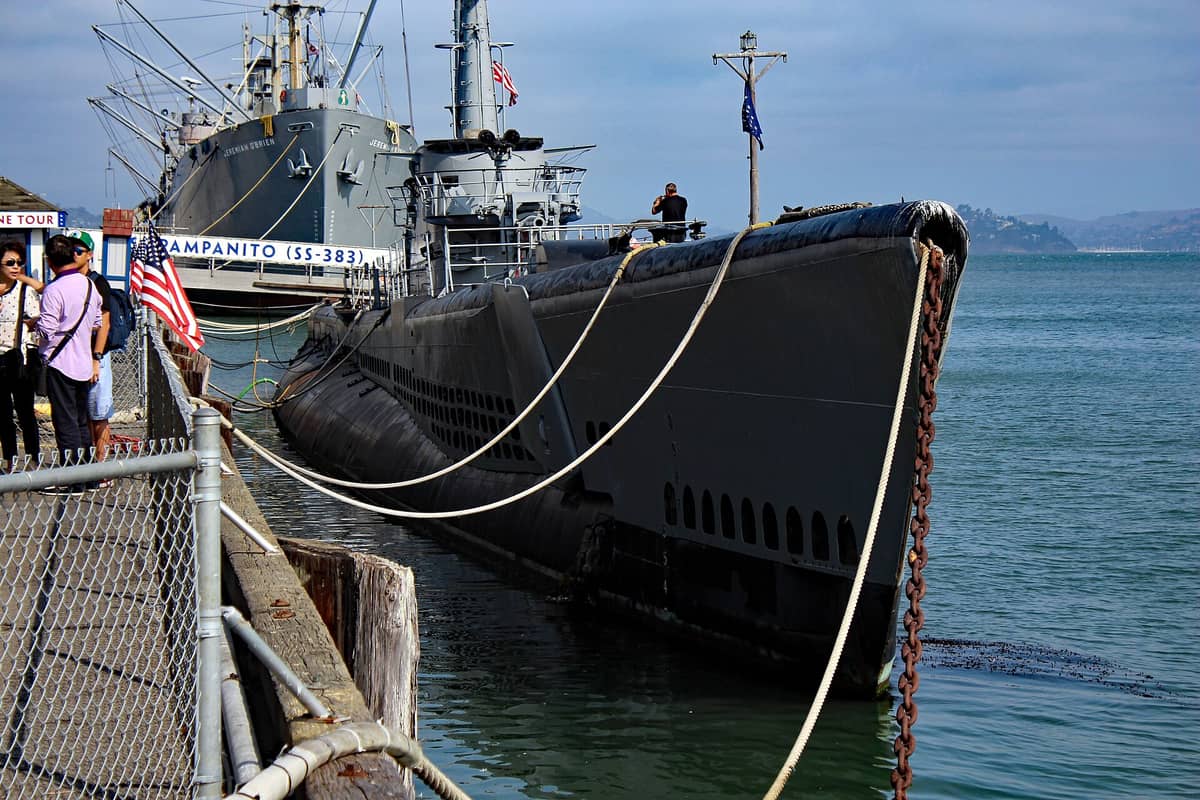
From the outside, the submarine sits low in the water at Pier 45, its black hull streaked with surface rust and salt residue that is part of its authentic character rather than neglect. The conning tower rises maybe 20 feet above the deck. It is compact and industrial in a way that photographs simply do not capture. Standing on the bow before you descend below, the scale of the vessel becomes clear: 311 feet long, yet designed to hold about 70 men for months at a stretch.
Once you climb down through the forward hatch, the air changes immediately. It is cooler, tinged with the faint smell of oil and metal, and the light drops sharply. The passageways are narrow enough that two people cannot pass each other without turning sideways. Overhead pipes, gauges, and electrical conduits run in every direction. The torpedo room is genuinely claustrophobic, with actual torpedoes loaded into their tubes and narrow bunks folded against the hull where crew members slept feet away from live ordnance. This is not a reconstruction. These are the actual spaces.
The audio guide, available for an additional fee, adds considerable depth. Narrated sections include recordings from veterans and historians that explain each compartment's function during a patrol. In the engine room, the diesel generators are enormous relative to the surrounding space, and the audio context makes clear just how deafening and hot that space would have been during a wartime crossing.
Tickets & tours
Hand-picked options from our booking partner. Prices are indicative; availability and final rates are confirmed when you complete your booking.
Sonoma and Napa Valley wine tour from San Francisco
From 127 €Instant confirmationFree cancellationGo City | San Francisco Explorer Pass
From 76 €Instant confirmationFree cancellationMuir Woods and Sausalito guided tour with transportation
From 82 €Instant confirmationFree cancellationSan Francisco CityPASS
From 77 €Instant confirmationFree cancellation
Time of Day and Crowd Patterns
Weekday mornings, particularly Monday through Wednesday before noon, offer the quietest experience. The narrow passages inside the submarine become genuinely uncomfortable when the vessel fills with visitors, and the audio guide loses its effect when you are waiting in a queue to move from one compartment to the next. Arriving at opening time on a Tuesday allows most visitors to move at their own pace and linger in the spaces that deserve it.
Weekend afternoons, especially in summer, can get crowded. Fisherman's Wharf draws large tourist volumes in the peak months of June through August, and the Pampanito is a popular stop. If you visit on a Saturday, aim for the first hour after opening at 10:00 am. The extended Friday and Sunday evening hours are also underused, particularly between 6:00 pm and 8:00 pm, when many day visitors have already left the Wharf.
💡 Local tip
The late afternoon light between roughly 4:00 and 5:00 pm is ideal for exterior photography. The western sun catches the black hull directly and the bay provides a clear backdrop without the midday haze.
Historical and Military Context
The Balao class represented a significant advance over earlier U.S. submarine designs. Launched in the final years of the war, these vessels had a deeper test depth than their predecessors and carried improved radar and fire-control systems. The Pampanito was commissioned in November 1943 and made her first patrol in March 1944, operating primarily in the waters around Japan, the Philippines, and the South China Sea.
The September 1944 rescue operation is central to the vessel's story. After American submarines, including the Pampanito, sank Japanese convoy ships that were unknowingly carrying British and Australian prisoners of war from Singapore, the same submarines returned to pull survivors from the sea. The Pampanito rescued 73 men. The event raises difficult questions about the fog of war, and the exhibit addresses this with appropriate weight rather than sanitizing it into pure heroism.
For travelers interested in exploring broader San Francisco maritime history, the Pampanito is part of a larger concentration of historic vessels and exhibits nearby. The San Francisco Maritime National Historical Park encompasses additional ships, a visitor center, and an extensive collection of nautical artifacts just along the waterfront from Pier 45.
Practical Walkthrough: Getting There and Moving Through It
Pier 45 sits at the northwestern end of Fisherman's Wharf, a short walk from the main visitor cluster around Pier 39. From downtown, the F-line historic streetcar runs directly along the Embarcadero and up Jefferson Street to the Wharf, making it the most straightforward transit option. The ride from the Ferry Building takes roughly 15 minutes.
If you are combining the Pampanito with other Fisherman's Wharf stops, Pier 39 and Ghirardelli Square are both within a 10-minute walk. The Musée Mécanique, a collection of antique coin-operated machines, is located directly at Pier 45 in the same building complex as the Pampanito entrance, so pairing the two visits in a single morning is easy.
The tour is self-guided, with clearly marked arrows directing visitors through the vessel from bow to stern. Most people complete the route in about 45 minutes to an hour; those using the audio guide and reading the posted interpretive panels should budget closer to 90 minutes. There is a small gift shop at the exit.
⚠️ What to skip
The USS Pampanito involves steep metal ladders and very low overhead clearance throughout the interior. People with limited mobility, claustrophobia, or difficulty navigating vertical ladders will find much of the vessel inaccessible. Contact the Maritime National Park Association in advance if you have specific accessibility questions, as no official accessibility details were confirmed in official documentation at the time of writing.
What to Bring and What to Know Before You Go
Wear flat, closed-toe shoes with non-slip soles. The metal deck grating and ladder rungs become slippery when wet, and the Fisherman's Wharf waterfront area is frequently damp from fog and sea spray. Heels or sandals are genuinely inadvisable, not just cautious travel advice.
Dress in layers. San Francisco's waterfront runs cool even in summer, and the marine fog that rolls in from the Pacific can drop temperatures noticeably by mid-morning. Inside the submarine, temperatures are relatively stable but lower than outside, so a light jacket is useful.
Photography inside the vessel is permitted, but the tight quarters and low lighting make it challenging without a phone with strong low-light performance. Wide-angle lenses help capture the torpedo room and engine spaces. If you want to understand Fisherman's Wharf more broadly as a neighborhood rather than just a tourist zone, the Fisherman's Wharf neighborhood guide covers its full history and practical layout.
Who Might Not Enjoy This Visit
Travelers primarily looking for waterfront scenery, dining, or casual people-watching will find the Wharf itself more rewarding than a 90-minute tour through a narrow military vessel. Very young children often find the confined spaces unsettling rather than exciting, and the historical content is not calibrated for audiences under roughly age eight or nine. Anyone with claustrophobia should think carefully before descending through the hatches: the passages are genuinely narrow and there is no open space once you are inside. This is not a simulated museum recreation of a submarine. It is the real thing, and that cuts both ways.
Insider Tips
- Buy your ticket in advance online if visiting on a summer weekend. Walk-up lines at peak hours can add 20 minutes before you even board.
- The conning tower is accessible via a separate ladder and offers the best view of the bay and surrounding pier area. Many visitors skip it or miss the signage. Look for the marked access point before you exit.
- Ask staff about scheduled special events. The Maritime National Park Association periodically hosts overnight lock-in programs and veteran-led tours that offer a significantly different experience than the standard self-guided route.
- The Musée Mécanique at the same pier is free to enter and makes a good 20-minute warm-up before boarding the submarine. It also provides a lighter note to end on after the more sobering Pampanito experience.
- If you are visiting with older teenagers or adults who are serious about the history, read about the September 1944 convoy rescue before your visit. The on-board exhibit covers it, but arriving with background knowledge makes the emotional weight of that section considerably more resonant.
Who Is USS Pampanito For?
- History and military history enthusiasts who want to engage with primary artifacts rather than replicas
- Families with children aged 10 and above who can manage ladders and are ready for substantive historical content
- Veterans and their families, particularly those connected to U.S. Navy submarine service
- Travelers combining a Fisherman's Wharf half-day with nearby maritime and waterfront attractions
- Photographers interested in industrial interiors and historic naval hardware
Nearby Attractions
Other things to see while in Fisherman's Wharf:
- Alcatraz Island
Alcatraz Island sits 1.5 miles offshore in San Francisco Bay, and the ferry ride alone sets the mood. Once a military fortification, then a federal penitentiary from 1934 to 1963, the island is now a National Park Service site offering one of the most atmospheric historical experiences on the West Coast. Allow at least three hours, and book tickets well in advance.
- Aquarium of the Bay
Aquarium of the Bay sits at the entrance to Pier 39 on Fisherman's Wharf, putting 24,000 marine animals and over 200 Bay-native species within arm's reach. From walk-through acrylic tunnels to touch pools filled with bat rays, it offers a focused, educational look at the waters just outside its walls.
- Ghirardelli Square
Once the city's working chocolate factory, Ghirardelli Square is now listed on the National Register of Historic Places, located at the western end of Fisherman's Wharf. The 1890s brick buildings house restaurants, shops, and the original Ghirardelli Chocolate Experience, all set around a fountain plaza with views toward San Francisco Bay. Entry is free.
- Musée Mécanique
Housed in a cavernous shed on Pier 45 at Fisherman's Wharf, Musée Mécanique is a free-admission museum of over 300 antique coin-operated machines spanning more than a century of American amusement culture. From hand-cranked peep shows to full-sized mechanical orchestras, this is a place where history runs on quarters.