San Francisco Cable Car Museum: Inside the Engine Room of a Living City Icon
The San Francisco Cable Car Museum sits inside the actual working powerhouse that drives the city's cable car network. Admission is free, the machinery is loud and hypnotic, and the collection spans back to the 1870s. It is one of the most substantive free attractions in the city.
Quick Facts
- Location
- 1201 Mason Street, Nob Hill, San Francisco, CA 94108
- Getting There
- Muni cable cars (Powell–Hyde and Powell–Mason lines stop nearby); Muni buses 1 and 30
- Time Needed
- 45–90 minutes
- Cost
- Free admission (no ticket required)
- Best for
- History buffs, families, engineering enthusiasts, first-time SF visitors
- Official website
- www.cablecarmuseum.org
What the San Francisco Cable Car Museum Actually Is
Most museums about transport preserve machines that no longer run. The San Francisco Cable Car Museum does something altogether different: it is housed inside the Washington-Mason cable car barn and powerhouse, the actual facility that has powered San Francisco's cable car network for generations. When you step through the front door, the system is running in real time beneath your feet.
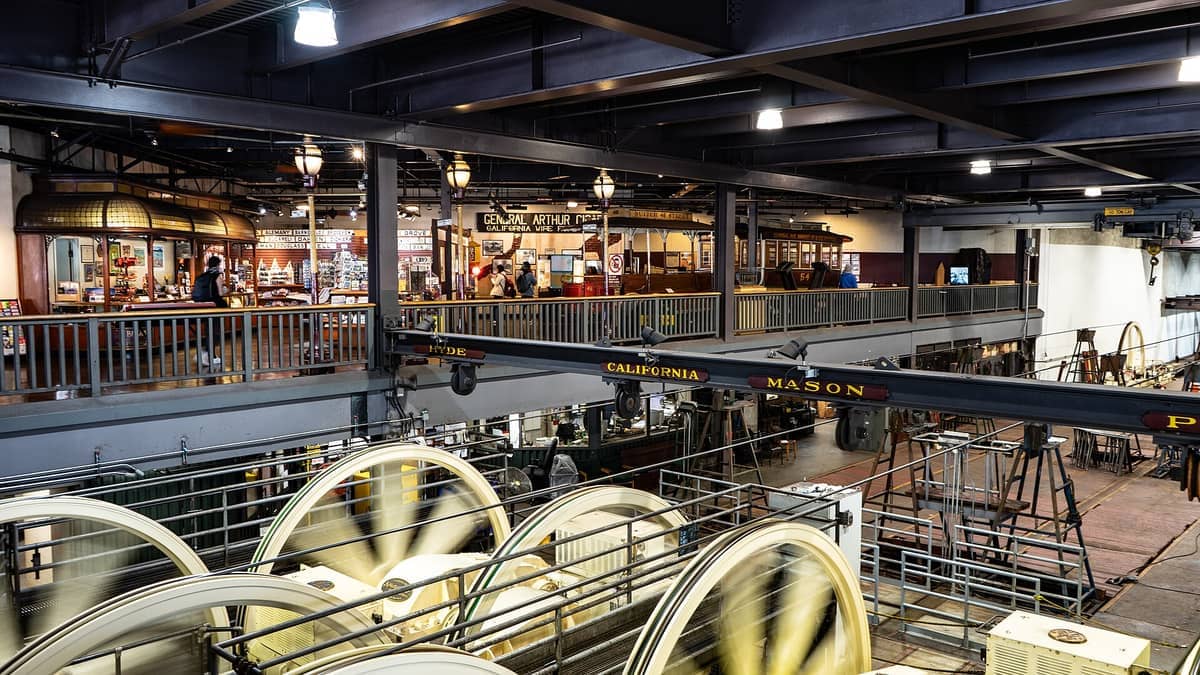
Four massive winding wheels turn continuously in a pit below the main viewing gallery. The cables loop out from this room, under the streets, and all the way to the Powell-Hyde, Powell-Mason, and California Street lines. The low, constant thrum you hear the moment you walk in is not a recording or an exhibit. It is the city working.
💡 Local tip
Admission is completely free. No reservation needed. Plan for at least an hour if you want to read the exhibits properly, longer if you have kids who will inevitably want to watch the winding wheels multiple times.
The Machinery: What You See From the Viewing Gallery
The winding room is the centerpiece, and there is a viewing gallery with railings overlooking the machinery pit. The cables themselves are nearly an inch thick, braided steel, and they move at a constant 9.5 miles per hour regardless of the slope above them. The grip operators on each car clamp onto and release from these cables to start and stop, which is why the ride feels so distinctly different from a bus or tram.
The noise level here is notable. It is not deafening, but there is a persistent mechanical hum and the occasional metallic clunk as cables shift in their channels. Small children sometimes find it exciting, occasionally startling. The smell in the winding room area is faintly industrial, a combination of machine oil and warm metal, which adds to the sense that this is genuinely a working facility rather than a themed exhibit.
Interpretive panels throughout the gallery explain the physics of the grip-and-cable system, the 1873 cable car design by Andrew Hallidie, and the engineering challenges of running cables under the severe gradients of Nob Hill. The explanations are accessible to non-engineers without being dumbed down.
Tickets & tours
Hand-picked options from our booking partner. Prices are indicative; availability and final rates are confirmed when you complete your booking.
Monterey and Carmel full-day tour from San Francisco
From 94 €Instant confirmationFree cancellationGolden Gate Bridge to Lombard Street tour in a little yellow car
From 135 €Instant confirmationFree cancellationMonterey, Carmel and The 17-Mile Drive tour
From 81 €Instant confirmationFree cancellationChoose-Your-Own-Adventure GoCar tour
From 279 €Instant confirmation
Historic Cable Cars and the Collection
Beyond the machinery, the museum holds a collection of historic cable cars dating from the 1870s onward. The most significant piece is the last surviving car from the Clay Street Hill Railroad, which began operation on August 2, 1873. That original car is displayed in a way that lets you get close and examine its construction: the wooden body, the grip mechanism, the worn metal fittings.
Several other cars represent different eras and different companies. San Francisco once had dozens of cable car lines operated by competing private firms. By the time the 1906 earthquake and subsequent electrification of transit had run their course, the network had shrunk dramatically. The museum traces that contraction through maps, photographs, and artifacts.
If you want deeper context on the current cable car routes before or after your visit, the San Francisco cable car guide covers how to ride all three lines, what the experience feels like at different times of day, and how to avoid the longest queues.
How the Experience Changes by Time of Day
Opening time at 10:00 on Tuesdays through Sundays tends to be the quietest window. Tour groups typically arrive mid-morning and peak between 11:00 and 14:00, when the main gallery can feel crowded around the machinery viewing rail. If you arrive within the first 30 minutes of opening, you will often have the winding room gallery nearly to yourself, which makes the machinery easier to appreciate and photograph.
Late afternoon, in the hour before closing, sees visitor numbers drop off again. The museum closes at 16:00 Tuesday through Thursday and at 17:00 Friday through Sunday.
ℹ️ Good to know
Opening hours: Tuesday–Thursday 10:00–16:00, Friday–Sunday 10:00–17:00. Closed Monday, and also closed on New Year's Day, Thanksgiving, and Christmas Day.
Getting There and the Nob Hill Context
The museum sits at the corner of Mason and Washington Streets on Nob Hill, one of San Francisco's steeper central neighborhoods. The address is 1201 Mason Street at Washington Street. If you are already riding a cable car, the Powell-Hyde or Powell-Mason lines pass close by.
Muni bus lines 1 and 30 also serve the area. Driving is possible but parking on Nob Hill is constrained and metered. For most visitors, arriving via cable car or on foot from Union Square is more practical and more fitting given the subject matter.
Accessibility: the official site recommends contacting the museum directly for specific accessibility requirements.
Nob Hill itself rewards a slow walk. The neighborhood contains Grace Cathedral two blocks away, one of the largest Episcopal churches in the United States, with labyrinth walks and notable stained glass. Combining the two in a single morning is straightforward.
Photography Inside the Museum
Photography is permitted throughout. The winding room is the most photogenic space: the scale of the machinery, the texture of the braided cables, and the repetitive geometry of the spinning wheels give wide-angle shots a genuinely industrial quality. A 24mm equivalent or wider works well from the gallery railing. The lighting is mixed, combining industrial fluorescent with natural light from the arched windows, so expose for the highlights on the cable sheaves rather than the darker pit.
The historic cars in the collection are well lit for display. Detail shots of the grip mechanisms and wooden interiors come out cleanly. Flash is rarely necessary in the main hall during daylight hours.
Is It Worth Your Time?
For visitors whose primary interest is the cable cars as a scenic ride rather than as an engineering or historical phenomenon, the museum will feel like a one-room curiosity. The collection is not large. There is a small gift shop, and the museum remains a straightforward, well-maintained space inside an operating industrial building.
For visitors with even a passing interest in urban infrastructure, transit history, or Victorian-era engineering, it is one of the most substantive free attractions in San Francisco. The machinery alone, the sheer physical reality of watching the system that moves cable cars across the city's hills, justifies the stop.
If you are building a full Nob Hill itinerary, this fits naturally alongside a ride on the California Street cable car line and a stop at the Painted Ladies further west, or combined with a walk downhill into Chinatown, which starts just two blocks east of Mason Street.
⚠️ What to skip
The museum is closed on Mondays. It is also closed on New Year's Day, Thanksgiving, and Christmas. Check the official site before visiting if your trip falls near those dates.
Insider Tips
- Stand at the far left end of the viewing gallery railing for the best sightline across all four winding wheels simultaneously. The standard central position crowds out the view of the outer wheels.
- The brick exterior of the building on Mason Street is one of the better backdrops in the neighborhood for a photograph with a cable car in the foreground. Time it so a Powell-Hyde or Powell-Mason car is in motion on Mason Street behind you.
- The museum's gift merchandise includes scale models and historical prints that are more considered than the typical Fisherman's Wharf souvenir. Worth a look if you want something with actual provenance.
- If you want to understand what you are seeing in the winding room, read the interpretive panel on the north wall first before approaching the viewing railing. It explains the cable routing under each line, which makes the machinery layout make far more sense.
- Visiting on a Friday or weekend gives you an extra hour before closing, which matters if you are combining this stop with a morning ride on the Powell-Hyde line and want a leisurely pace through the exhibits.
Who Is Cable Car Museum For?
- First-time San Francisco visitors who want to understand the city's most iconic transit system beyond just riding it
- Families with children aged 7 and up, who tend to find the scale and motion of the winding wheels arresting
- Engineering, architecture, and infrastructure enthusiasts
- Budget travelers, since admission is entirely free
- Anyone who has already ridden the cable cars and wants the context behind what they experienced
Nearby Attractions
Other things to see while in Nob Hill:
- Grace Cathedral
Perched at the summit of Nob Hill, Grace Cathedral is the cathedral church of the Episcopal Diocese of California and one of the most architecturally significant religious buildings on the West Coast. Its French Gothic facade, gilded bronze doors, and twin labyrinths draw visitors well beyond the usual tourist circuit.
- San Francisco Cable Cars
The San Francisco cable car system is the world's last manually operated circulating cable car network, running since 1873 across three lines that climb through Nob Hill and down to Fisherman's Wharf. Part living transit, part rolling landmark, it rewards visitors who understand how to use it.